I beg to differ, random Italian guy

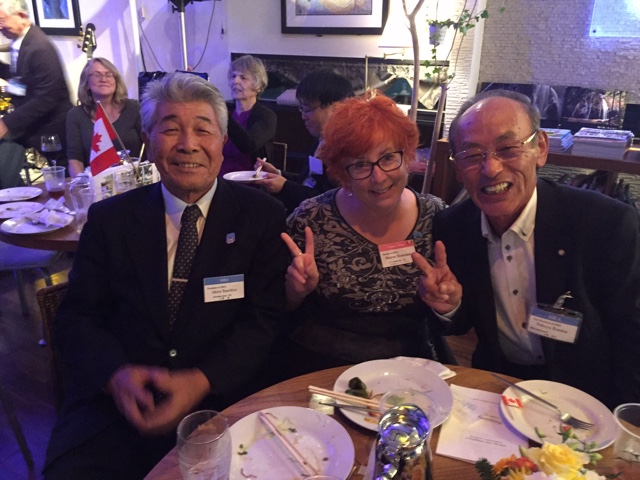
Last we spoke I was telling you about our bike ride across the Kibiji plain. We stopped at one point for a bite to eat and to try to figure out just where we were. While at the picnic area we met a couple riding the trail in the opposite direction. They were both from Italy, the Milan area, but are living and working in North Queensland, Australia. After a bit of chit chat he asked if we found it difficult to meet Japanese people. We agreed that the Japanese do not tend to sit in the town square, drinking grappa and watching football on tv. Nor do they make an evening promenade and chat with their neighbours. But difficult to meet?

Okay, Niimi was a bit unusual in that we were there to meet folks, but the language barrier didn’t slow things down too much with the president of the local chamber of commerce – we managed with the help of Sayuri-san to discuss the implications of the TPP and the possibilities of importing wagyu beef as a luxury item into Canada.
Really, we were talking about serious stuff!
On the train to Takamatsu Wilf and his seat mate, a bank manager, got to chatting. They were talking up a storm, and eventually got to ‘how old are you?’ That led to ‘and your wife?’  Long pause as the age difference was considered, and then, ‘how did you do that?
Once arrived in Takematsu we were looking for a lunch place – we had our map out comparing possibilities when a woman smiled at Wilf then walked over to see if we needed help. Soon we were walking down the mall, next we were having lunch together. Meet Junko


Junko owns a dress shop and once a week she and her friends meet with their English tutor to work on their conversation. As their class was the following day we were invited to join them. Which we did. And it was great fun.
That night we found a great chicken restaurant – grilled chicken on the bone. Before I show you this picture I will say in my own defence that the menu specifically said  ‘use a napkin, pick up the leg and chomp, chomp, chomp’. So I did, because the chopsticks were not cutting it!
At the table next to was a fellow who turned out to be a pilot with ANA, one of the Japanese national airlines. He was curious about where we were from and how we found out about this specific restaurant. (Answer: Tripadvisor).  By the time he left we were up to speed about his family and his career and travel aspirations.
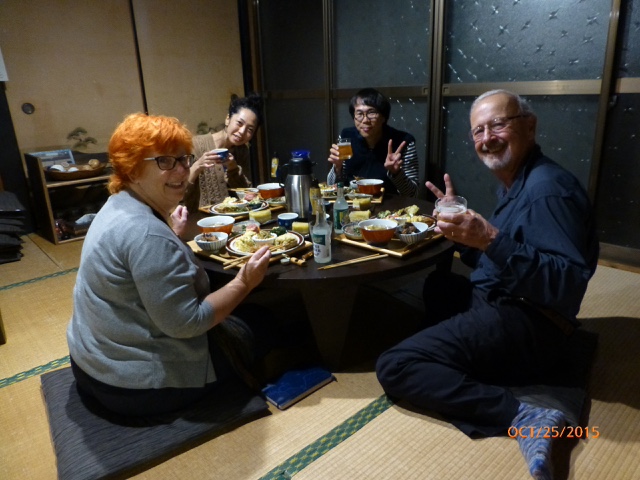
Last night we stayed at a guest house and met Shuhei and Yukiko:
(In case you were wondering our meeting people incidents don’t always involve beer. Just sometimes)
So, back to the Italian guy. No, we haven’t had trouble meeting people. I’m probably too much the polite Canadian to say so, but his issue might have something to do with his big size, shaved head, big beard, many visible tattoos, his female companion’s facial piercings and tattoos. Perhaps they’ll find Tokyo more their style.


Riding across the Kibiji plain

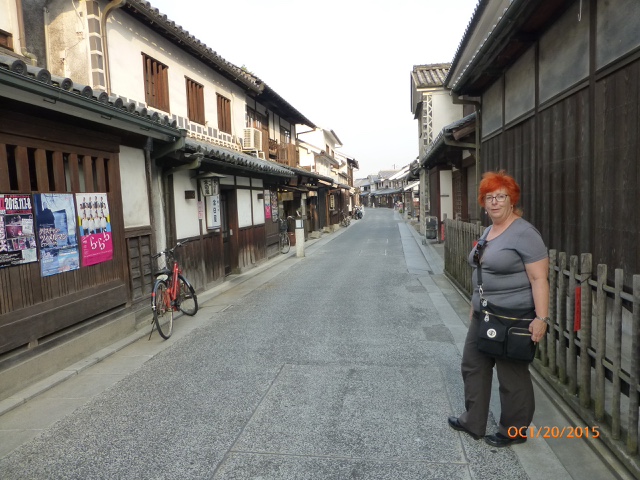
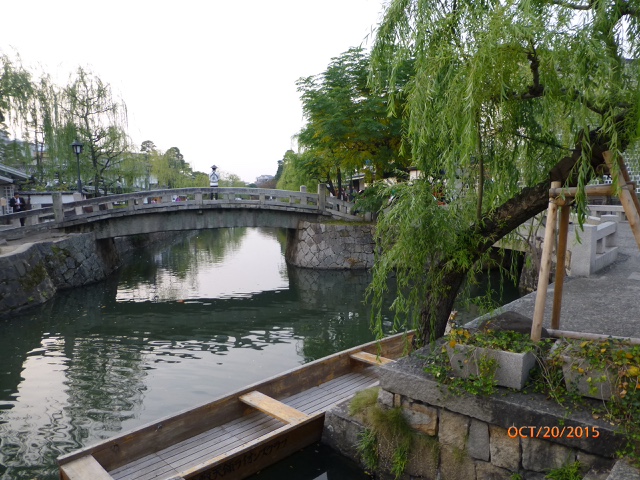
Kurashiki sits to one side of a large agricultural plain. Our guide book notes that Kurashiki has avoided ‘natural and wartime catastrophes’, which has meant that it’s old city has been preserved. It is a major tourist spot with lots of shops, but we managed to do most of our touring late in the day when the crowds had thinned out.

Narrow streets.
A canal.
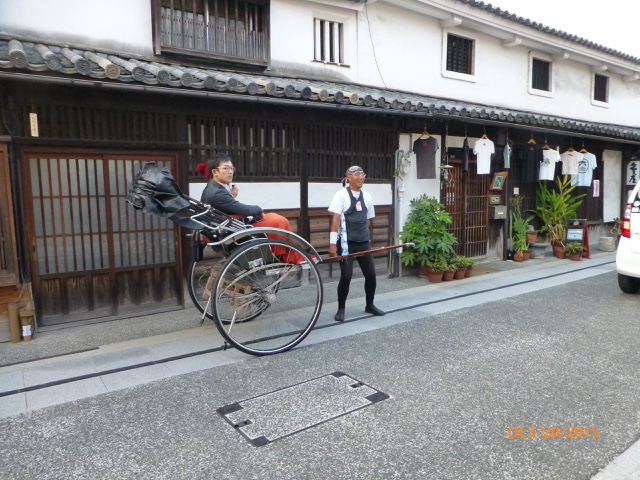
Rickshaw drivers for rent:
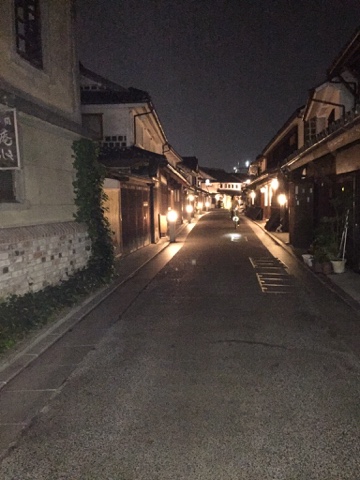
And so pretty at night:
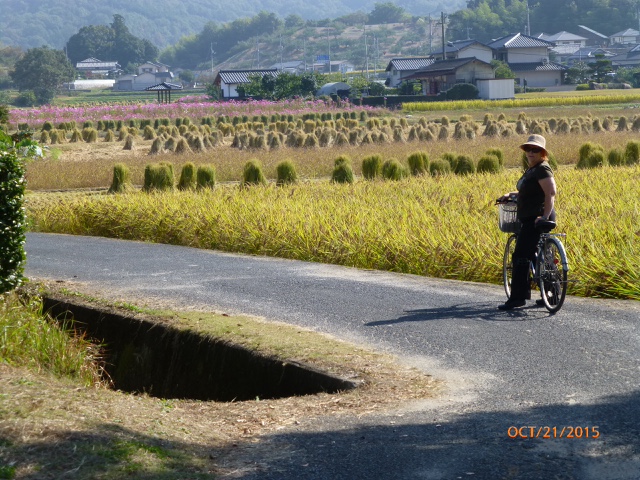
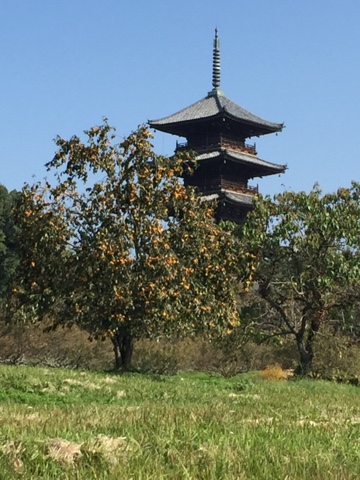
We took a train ride a couple of stops over, where we rented bikes for the day. After a short jaunt through the town of Soja we started onto a bike trail that would take us about 17k through the rice fields. We had what was referred to as a Mom bike – no gears, basket on the front, hard seat. Since pretty much the whole ride was flat it worked out fine. We had a detailed map -in Japanese, of course, and pantomimed instructions from the rental folks, so we felt pretty confident we could manage.
It was a beautiful day for a ride.
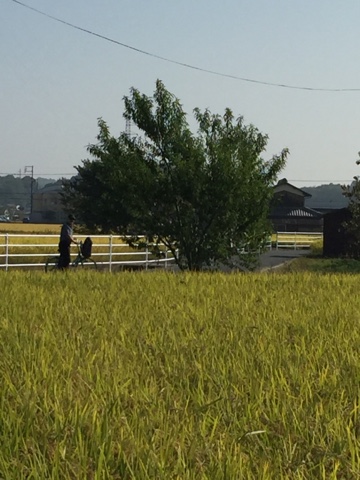
Lots of rice relate activity. Most of the time we were on what we thought was a dedicated bike path, but every so often a vehicle would buzz by – looks like a path, might be a road.
In addition to rice there were small market gardens and the occasional field of cosmos.
They say pride goeth before a fall, and of course just about the time we thought we had this all sort d we veered right not left and got ourselves on the wrong bike path. In spite of great efforts to convince ourselves that the map still made sense we eventually realized that the high speed train tracks we were riding under were not on the map.
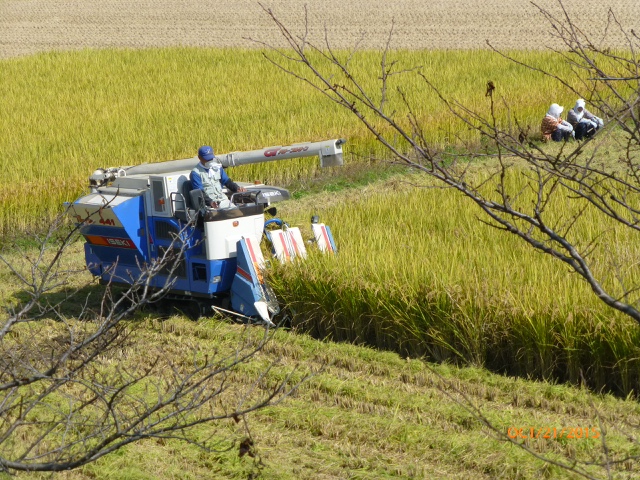
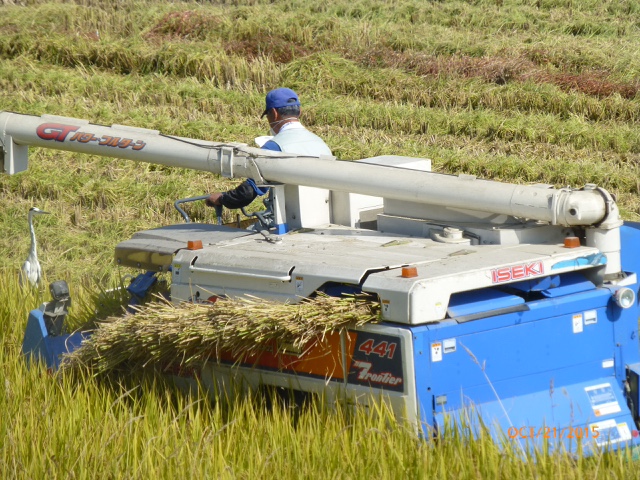
So, some retracing of the route was required. On th one hand- we got lost. On the other – we got to see this guy at work with his little rice combine – smaller than a zamboni.
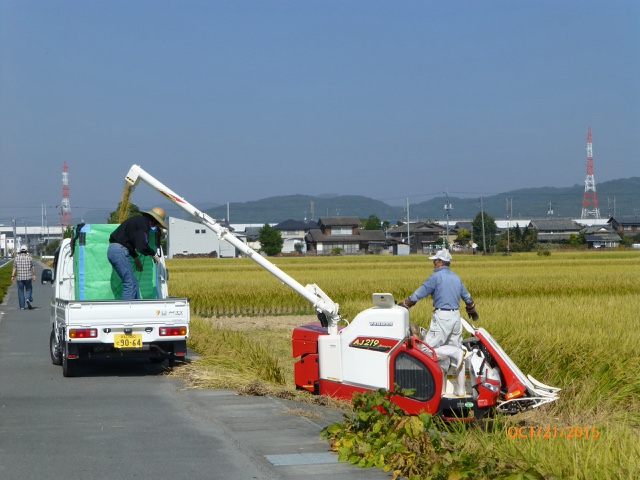
Okay, different guy at the end, but you get the point. Very interesting.
Once back on track we found our way. Had a tough time finding the train station/bike depot, but we persevered. There were no places for food directly on the bike route, but we had brought sandwiches. There were vending machines in strange places, though. Just as I’d be thinking ‘I could use another bottle of water’ we’d round a corner and there would be a vending machine at the side of the path, or the end of someone’s driveway. Very convenient.
So – a big day. The bath on the roof of our hotel seemed extra wonderful after all that pedalling.


The rabbit in the moon

In the west we see a man in the moon, but in some eastern countries there is a rabbit up there. And while we were in Matsue rabbits emerged as a theme. About an hour by train from the city is an important Shinto shrine, the Izumo-taisha.

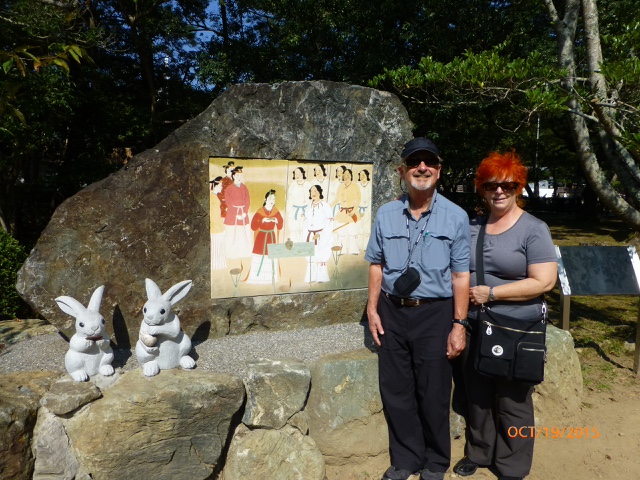
Once upon a time a group of brothers were travelling to woo a princess. They came across an injured rabbit. Rather than help the rabbit the mean brothers caused it more pain. The one kind brother, however, gave the rabbit good advice and healed its injuries. The rabbit revealed itself as a God and blessed the kind brother with the hand of the princess. It also made this brother the deity responsible for marriage.


The kind brother helps the rabbit.
And there are rabbit statues all over the grounds. All carved out of granite!
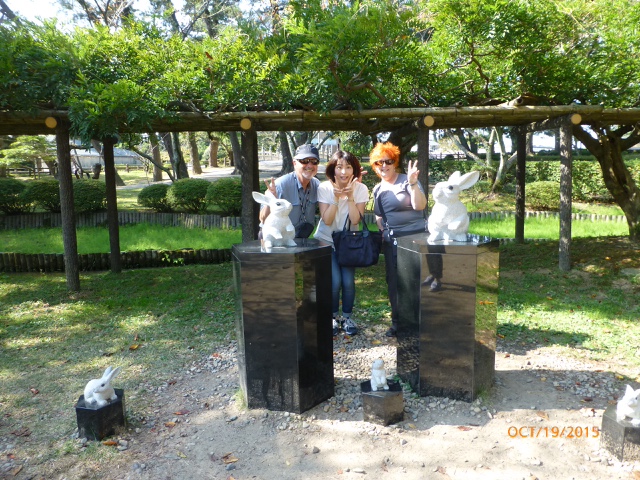
Making friends while checking out the rabbits.
Rabbits sharing sake as done in a Shinto marriage ceremony.


Really, they are everywhere.
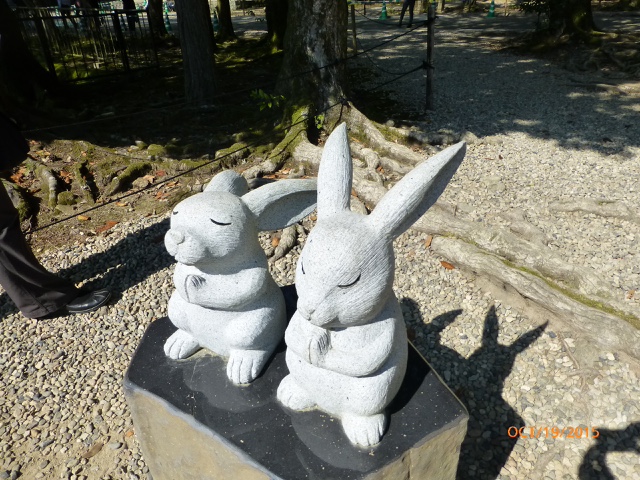
Even rabbits saying their prayers. At most shrines one approaches the appointed spot and throws a coin in a box. We then bow twice, clap twice ( to summon the god) and bow once more before offering a prayer. At this shrine the difference is that we clap four times to summon the god.  This is a busy shrine, with lots of singles wishing for marriage and lots of married couple giving thanks.
The shrine is also famous for having the largest rice straw rope in Japan hanging from the rafters:


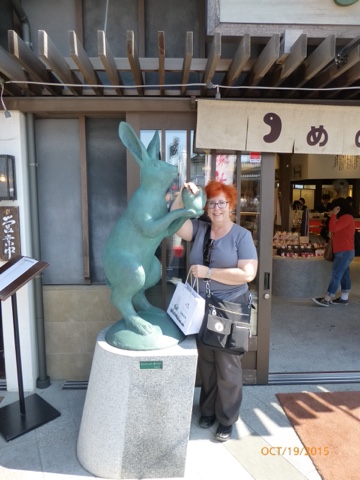
Outside of the shrine was a rabbit themed gift shop that had many of examples of rabbits holding a good luck charm called a magatama.
On the way back to Matsue we stopped at the Vogel gardens, which turned out to be an enormous park setting full of flowers and birds.  They are clearly set up for huge crowds, but late day on an October afternoon we had the place to ourselves.

The official group picture spot was clearly meant for more than two people!

And then there were bird encounters.


Pretty cool!


The magic box has arrived!

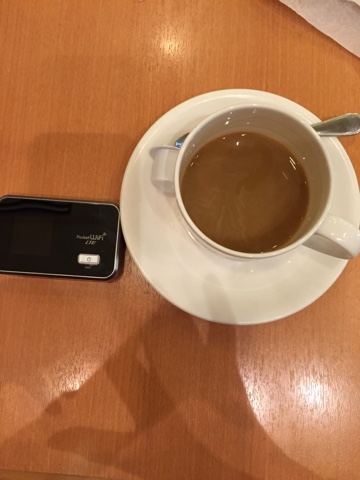
When we arrived at our hotel in Takamatsu yesterday there was a package waiting for us. Inside was this:

Not the cup of coffee! A portable wi-go generator!  We found the company on the internet (their main business is renting cell phones) and put in an order. And it worked. We shall see if we have reception once we leave the city, but it has already helped us find our way to a restaurant.
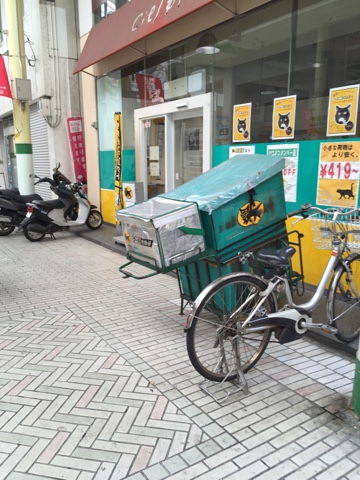
Japan Post handles the mail for the country, and I’m sure FedEx and Purolator and UPS have a presence, but for moving things around Yamamoto Transport are the guys. We see their trucks all over, but there are also fleets of motorbikes in the city.
This is a depot near us. Most convenience stores also take in packages.
See the oval with the black cat carrying a kitten.  That’s the company logo. It was on the envelope with our wi-if doodad and inside is a prepaid return envelope which we can drop at a 7-11 or at the airport. Very convenient. Apparently inexpensive, too. People use the service here when travelling to send their luggage ahead of them when travelling by train. Or if you over shop and don’t want to carry packages, or see something you want to give to someone- zoom! It is on its way.


Sunday in the park. With drums.

Niimi is in the mountains, but our next destination took us down to a wide coastal plain and the city of Mitsue. Even up in the Niimi area we saw a lot of rice being cultivated, mostly in little patches tucked in here and there. Out on the plain the rice was being grown on a much larger scale. I always thought rice was grown in paddies, standing in water. Clearly this is not the only way.  I’ll report back later on that.

Upon arrival in Mitsue we stopped at the tourist information centre for a map. The lady showed us where our hotel was, and the major attractions. She also mentioned that there was a drum festival that afternoon. We got ourselves settled and headed off for some lunch. By the way – we were feeling brave and/or adventurous and picked a random restaurant, went in and sat ourselves down. Wilf pointed at a picture, I pointed randomly at the menu and delicious food arrived. In addition to the usual rice, soup, pickles we each had a sizzling hot mini wok with an egg topped with strips of beef or pork cutlet. Yummy! Don’t know what it was called but we lucked out.
Anyhow. After lunch we continued towards the castle. And we could hear a sound. A big sound, far away. Soon we began to see the police blocking off streets and people gathering along side the roads. We followed the sound, which got bigger and louder until we came to a street full of sound and motion.


Each of these …..carts? had two huge drums in it. Each one was almost five feet across and teams of drummers with small clubs were pounding away. Each team also had a group playing flutes and cymbals with them. A few of the really big groups had a pup trailer attached to their cart with a third drum.
We eventually found out that there were 22 teams. I think they were playing the same song, but not all at the same time so there was this caucophony of sound with an underlay of this incredible, primal beat. It wasn’t painful, but it resonated deep in the body and had a real sense of urgency to it.


Each cart was different in style, size and decoration. Each group had different coats. Eventually there was a signal and they began to move. And they were pulled by children.


Lots of help from the adults, but the kids had ropes and poles and they were getting the job done. Each group had banners, which probably explained in detail who they were, but since we couldn’t read them….  One group came along with 30 or more people in wheelchairs, all in jackets that matched the drummers. They were ahead of the cart, and Boy Scouts in their uniforms were pulling the cart for them.
We found a place to watch right where they had to make a hard right turn followed by a hard left on a short block.
They got them all around the corners without incident.
And the whole time the drummers are pounding away. I don’t know they kept going – the parade was scheduled to be about 90 minutes long and they were some length of time waiting for it all to begin. And it was hot!
And at the end all the kids joined in:


How do you even organize such a thing? Where do you store 22 of these carts. Where do you practise the drumming? Or moving the carts? How do you organize all the clothing? It was an amazing thing to see and hear.


In the end, really, it’s about the people.

I’ve been telling you about some of our Niimi adventures. It has been grand and we have been having fun, seeing and doing things. But the really special part has been meeting people. Even with a big language barrier the desire to connect is strong. Only one of our group can speak some Japanese – the rest of us were trying to learn a few important phrases, and to deploy them correctly. The people we met ranged from no English to great proficiency. And yet – we managed.

On Samurai parade day we wandered into a back garden of the community hall after lunch. The local Women’s Institute type group had a craft booth and hot dog stand. Steve bought a hot dog – and became an instant celebrity.


Soon they treated us to coffees. We gave them flag pins. They gave us little gifts. They were adorable and so excited to meet us and so wanting to talk to us,
At out welcome banquet I sat next to Professor Kiyoshi Yamauchi of Niimi College. Kiyoshi-san is a professor of English at the college, and was our guide when we visited the campus. We had such a great time visiting with him and meeting his students.


That’s Kiyoshi-san in the yellow tie with some of his students.
Both the Niimi City staff and the members of the Niimi International Exchange Association worked hard to show us their city. This lovely lady in the kimono is a member of the Canadian committee of the NIEA and we had the pleasure of her company on several occasions. Although we spoke almost none of each other’s language – we managed!


And could this lady be any more adorable? She taught us how to make paper. When we asked for pictures she said okay, but only if she could stand on her tip toes. Because that made such a difference!


But, of all the people we met my highest praise would be for Sayuri-san, our guide and interpreter. Sayuri-san is an employee of Niimi City and she was responsible for us and our experience. Organized,efficient and knowledgable she made sure that every detail was attended to. She translated for us at all occasions and made sure we understood what we were seeing – and eating!


In addition to managing us Sayuri-san had her own management to be aware of. Her boss was our driver. Her boss’s boss usually arrived at all locations, keeping an eye on things. And for important occasions the head guy would put in an appearance. Not only did she have eight unpredictable foreigners to deal with, at any given time three levels of management would be observing her. I think we behaved well and didn’t cause too much distress. Sayuri-san did a wonderful job for us and I hope we see her in Sidney sometime soon.
We left Niimi with new friends and many happy memories.

Wonders of nature, bounty of the land.

Niimi is located in a beautiful valley on the banks of the Takahashi River. The limestone mountains and rushing water mean the people of this area enjoy a bounty.

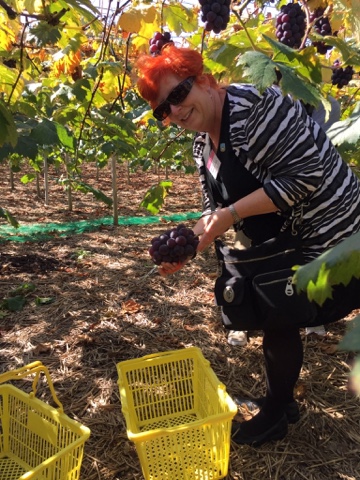
One of the local specialties (besides the beef!) are grapes. Not for wine – for eating! We got to visit one of the vineyards, walk out through the vines and cut huge heavy bunches of purple grapes.
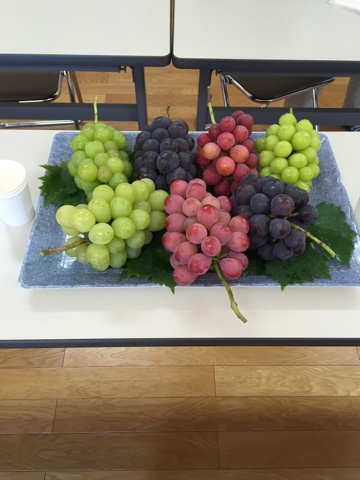
They were so good warm from the vine that we snuck a few.  Once back at the office we had an opportunity for official tasting, with four different types – no seeds, just sweet and delicious. We were all sent on our way with bunches of grapes to enjoy – a very generous gift to us as they are a real luxury item. We have enjoyed them very much.


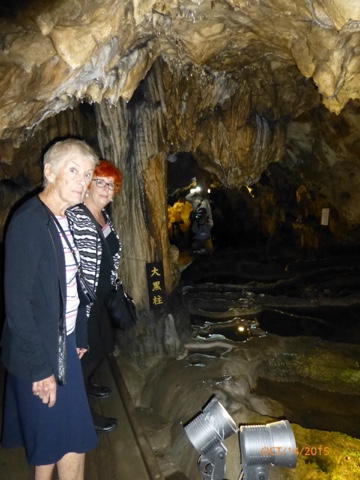
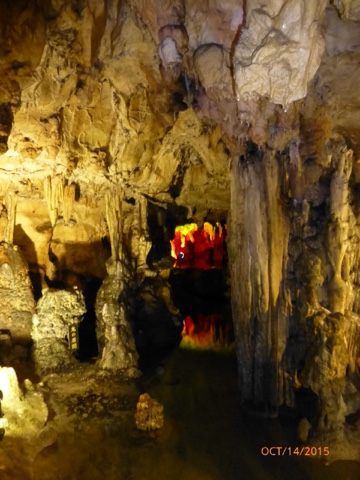
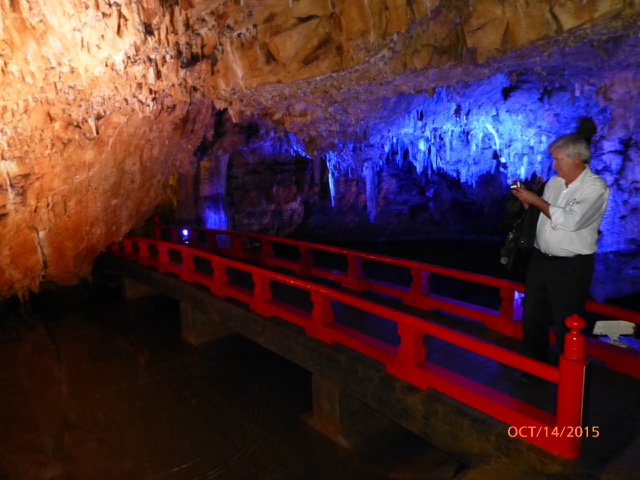
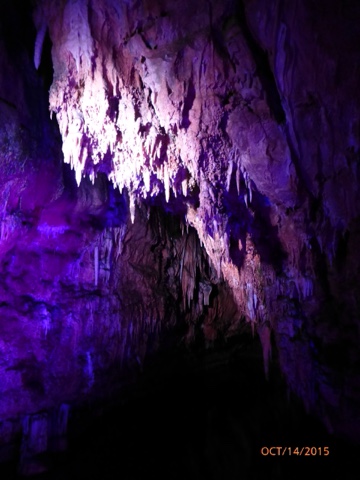
The same limestone that provides such perfect growing material for the grapes also provides another attraction – caves! There are several extensive cave systems in the area. One was recently upgraded with LED lighting, so we went to take a look.
An underground fantasy of stone and water!
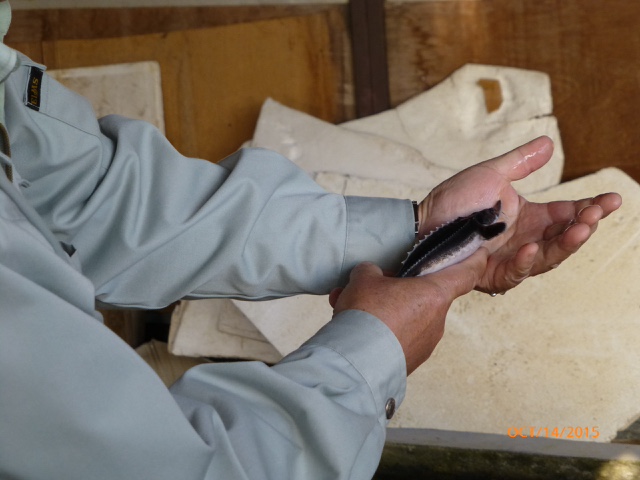
And what else did you see, Sharon? So glad you asked!  A sturgeon farm that produces a very fine caviar.
Baby sturgeon !
We had a tour of an artisanal soy sauce factory – four generations of the family have made soy sauce in that house.
And we had an opportunity to visit the local hot springs for a bath!  Actually there was a delicious lunch involved – and then a lovely soak in a very hot bath – there was even an outside pond with a beautiful garden to enjoy.


Our hosts gave us a chance to enjoy the many wonderful things in their city.


I didn’t know you could train cattle…

Not only did we arrive in Niimi in time for the Samurai festival, on Saturday there was a huge farmers market at the Japan Agricultural office 1 block from our hotel. Needless to say we were all over it!

This is beef country so it was all about the local speciality Chiya wagyu beef – on the hoof and on the grill.
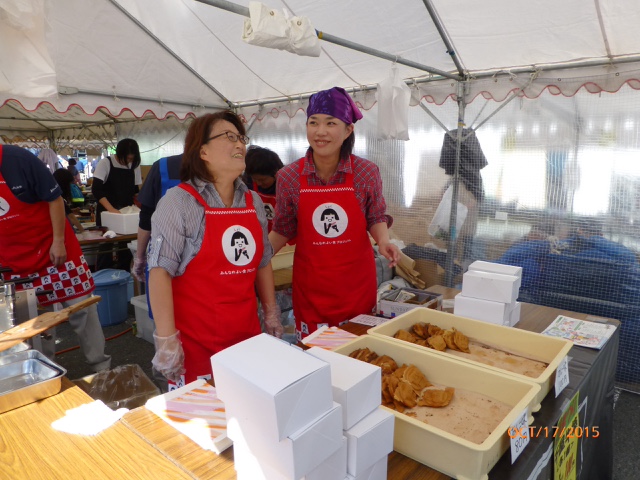
These gals are selling pastries stuffed with curried beef – cooked in a press so they have a cattle shape to them. Yum!
Beef on the spit!


Beef on skewers.


Squid on a stick.

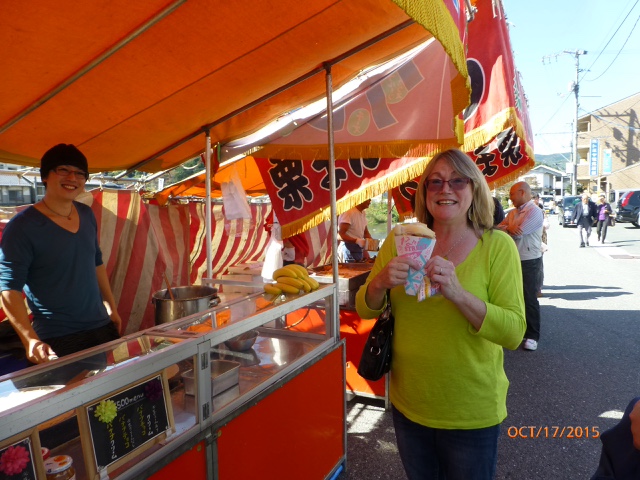
Fiona found the guy making crepes (with bananas and blueberry sauce)
As we wandered about people were giving us all kinds of things to try – usually some variant on beef but what’s wrong with that? Nothing!
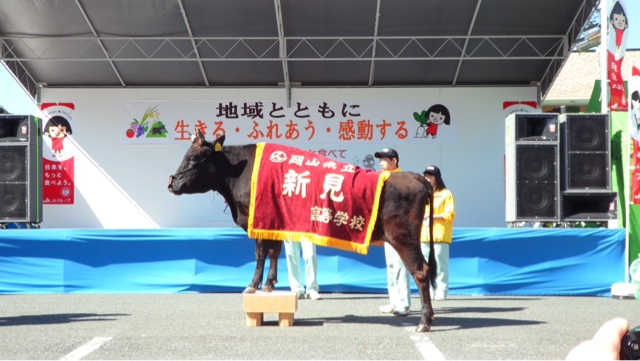
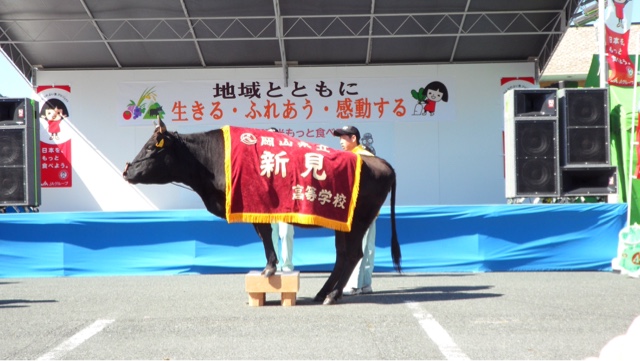
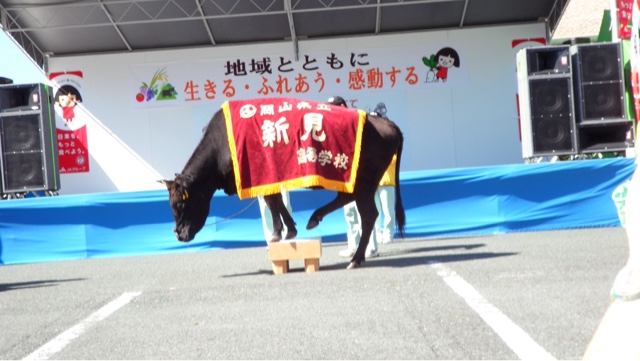
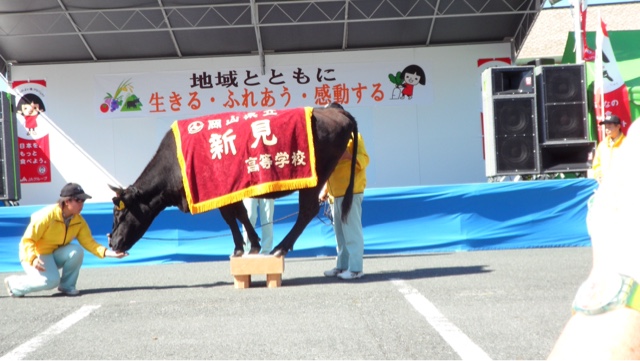
As we have been moving around Niimi we have seen several pictures and statues of cattle standing on a small wooden stool. Seemed kind of strange,  but it turns out to be a thing and at 11:30 we got a demo.
A group of students from the local agricultural school brought out a very lovely steer and proceeded to put it through its paces.
One guy had the rope but all the others crouched down and coaxed the animal.  It looked at them for a long time, but eventually did it. And was rewarded with a treat, just like a dog. Frankly I always thought cattle were to stupid to train, but apparently I was mistaken.


I love a parade!

One of the reasons we are in Niimi this week is to see the Samurai Festival, which held yearly on October 15. The centrepiece of the festival is a parade through the historic part of town which recreates the processions made by samurai lords as they moved between their home lands and the capital in Tokyo.

The day began at the Funakawa shrine. As we began to climb the long flight of steps we saw men in costume making their way up to the temple.


Special sake had been brewed for festival and we stopped for a little bowlful – it was white in colour as it was unfiltered.


Some of the participants were in blue robes, which were pinned up so the wearer’s arms and legs were free. Other participants were dressed very formally. The gentleman with Steve, Fiona and Patricia had been with us at a very lively banquet the night before, but here he is much more solemn.


While we were at the shrine we paid our respects to the resident deity.


Eventually all the participants had assembled, along with the mayor, and a group photo was taken.

Immediately after this picture another one was taken with the eight of us included – didn’t expect that!

Back in town we were given a spot to sit beside the mayor’s reviewing stand. We were instructed in etiquette by the parade marshall – no standing, no cheering, no commotion. So – no Stampede parade behaviour. Misconduct would cause the parade to stop and a marshall would come over to give the trouble makers a tap with a switch as punishment.
Back in the day total respect and obedience was expected when the samurai passed by and it is still taken seriously. 


A long procession of samurai carrying an assortment of weapons and paraphernalia.
Note the guys across the street with the cameras. We thought maybe they were the press gallery, until the press did show up in their green vests.

These guys seem to be with the local camera club. Between them and the press I was afraid to scratch my nose or do anything untoward because a lot of pictures were taken of us.

Once the samurais had passed you could feel the crowd relax as we awaited part two – the procession of portable shrines from the local shrines. This was the the boisterous part of the parade as teams would carry these huge heavy shrines down the street. Every so often they would stop and start shaking the shrine all around. Apparently this is to awaken the god within the shrine and have him bestow blessings. Since we were beside the main viewing stand they all stopped so we were well blessed. All of this is accompanied by lots of whistle blowing and cheering.


These things weigh as much as 500kg so the effort required to be a bearer is pretty substantial.
After the shrines come the children with their kiddie sized shrines, made of paper.
So cute!


There were also Chinese lions.  It is considered good luck to get a ‘lion bite’. Usually this honour is bestowed upon children, but as guests of honour we all got a bite!


As for the kids – most of them were not impressed:


Although I’m not sure I blame them – the lion’s kind of scary!


When in Japan – visit the sewage treatment plant!

When the group from Sidney visited Niimi four years ago they were given a tour of the municipal waste treatment facility. They said it was really interesting. When we were given a sample itinerary for our trip the facility was not on the agenda. We sent a message back to Sayuri-san, our guide, asking if we could please pay a visit.  Being far too polite to refuse a direct request she made the arrangements, probably thinking all the while ‘crazy Canadians!’  Being a most excellent guide she spent some time with Google to make sure she was up on her terminology and away we went.

Of course Sayuri-san has no way of knowing that this is a subject of abiding interest to people in the Victoria area as we continue with the hand wringing and endless discussion involved in solving our local waste treatment issues.
This plant is located in the community, between a business road and a sports park. Most of the facility is underground. This one serves about 4,300 people of the city population of 33,000 and manages about 4,000 m3 of through put a day, producing water that has had 98% of solid material removed. The output is not potable, but is safe to return to the river. The street side of the facility has a fountain, cascade and garden area, complete with a stream with small fish.
Of course we had a tour – here they are proving that what goes in is sewage – lifting the manhole cover in the street provided definite olfactory evidence!


Street side

Sample from the settling tanks. The clear water on top is diverted to the river. Beneficial microbes in the sludge are removed and reused and the remaining sludge is dried, packaged and sold as fertilizer at local garden centres.

So, how ’bout it, Victoria?
We were accompanied all day long by still and video cameramen – Bob got to do an interview at the waste treatment plant.

The field in the background is the underground part of the plant.