A surprising thing.

Japan is full of surprises. Too many to list. But we’ve really noticed one – how many people still smoke. Clearly there are attempts being made – no smoking on planes, trains, ferries, buses. But there are smoking compartments on trains. Designated smoking areas outside train/subway stops and office buildings. Given the Japanese attention to detail and preference for cleanliness those smoking spots are startling because there are actually cigarette butts on the ground!

But the real issue is around restaurants. Some are non smoking. Most have a smoking area – and we know how well that works. And many don’t seem to care. And people smoke hard – between every course, either at the table or they go outside.
We’ve given up on one coffee shop altogether. Caffe Veloce has nice coffee and pastries, but it is clearly a smokers place.
Most surprising to me is the number of very young people smoking. Quite different than Canada where smoking was made a workplace health and safety issue, which got it out of the restaurants. And of course there is the ongoing demonization of smoking in the west.
 
Enough on that – here’s a picture of s little cutie we met on her way to a Hallowe’en party!
 

.

Say my name, say my name.

When we were working on the planning of this trip Bob McLure, one of our fellow travelers, suggested that we have business cards made up – English on one side, Japanese on the other. He even facilitated the translation and production of the cards for the group. Bob was certainly correct about the usefulness of having the cards – we exchanged them with people while in Niimi, but have continued to give them to people as we travel about.

Translating my first name wasn’t a huge challenge, as western names go. Japanese recognizes sha ro and n so three kana are required and we’re done.  (I don’t know how to make the iPad write katakana you’ll have to take my word for it.)
Wilf was a bit more of a challenge. Japanese doesn’t have a wi sound, nor an l, nor a standalone f. That means his name came out as uirifu. And of course his last name comes out as Rambo, which causes great giggles.  We stayed one night at a temple and the head priest was referring to Wilf as Rambo-San.
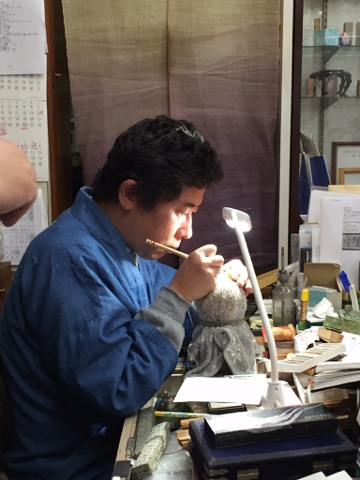
In Japan personal and corporate seals are used in most places where we would use signatures or initials. At the post office, for instance, if you were receiving a package instead to signing to acknowledge receipt you would use your personal stamp. That means that there are businesses that produce these stamps. In the west we hear them referred to as chops, which is the Chinese name. In Japan they are called hanko. Wilf found a little class we could take where we would learn how to carve our own stone hanko, so on Monday morning in Osaka off we went.
Rather than try to cram our whole western names into a little square the plan was to take the first letter of our translated name  – sha in my case, and u in Wilf’s. The shop owner and our guide then came up with several different kanji for that sound and we picked the meaning that we liked best. Then they wrote out several versions of the kanji and we picked the one we liked the look of the best. The master then inked the selected kanji onto the stone, provided us each with a small knife and let us at it.
No pressure.


After we had carefully cut away for awhile and thought we were done the master, his wife, his father, the assistant and our guide all said nice things about our work.  Then the master and the assistant settled in to tidy up what we had done.
The picture below shows our two impressions. The top one on each sheet is our effort, and the bottom one is after a little remedial tidying up. The master also carved our names onto the side, along with a kanji that says ‘made this’ so it says Sharon made this and Wilf made this.


Uirifu on the left, Sharon on the right.

The master and his students!


Name that castle!

We’ve seen a lot of castles on this trip.

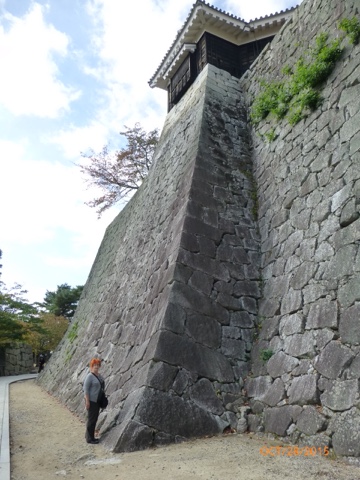
Lots of big stone walls
Kochi castle
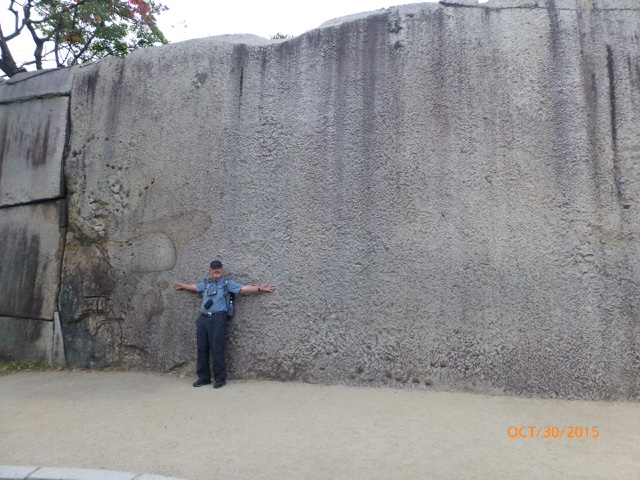
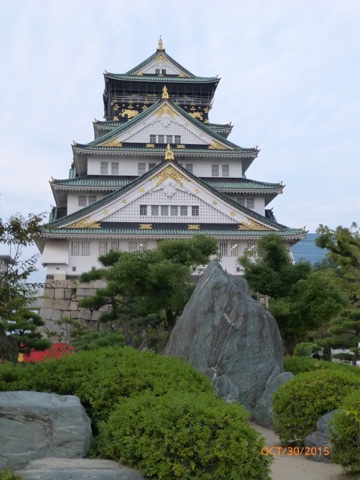
Osaka castle – where not only are the stone walls big, but the stones are massive. The one Wilf is leaning on is called the octopus rock and I couldn’t back up enough to get every bit of it in.
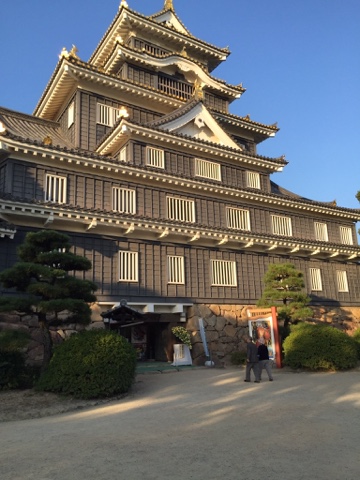
Okayama castle
Osaka castle


Matsuyama castle
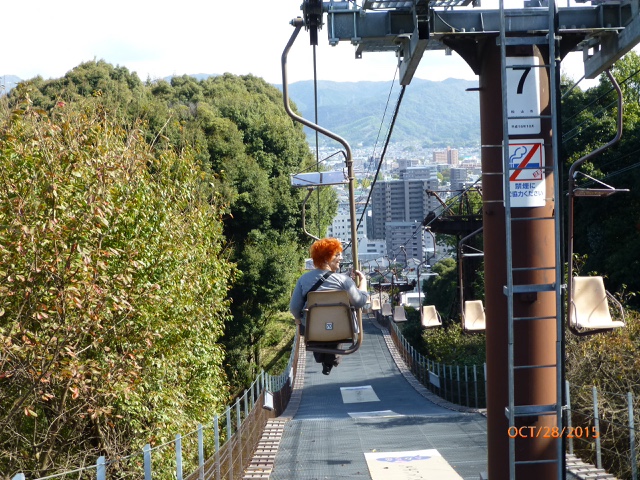
Riding the chairlift down from Matsuyama castle.
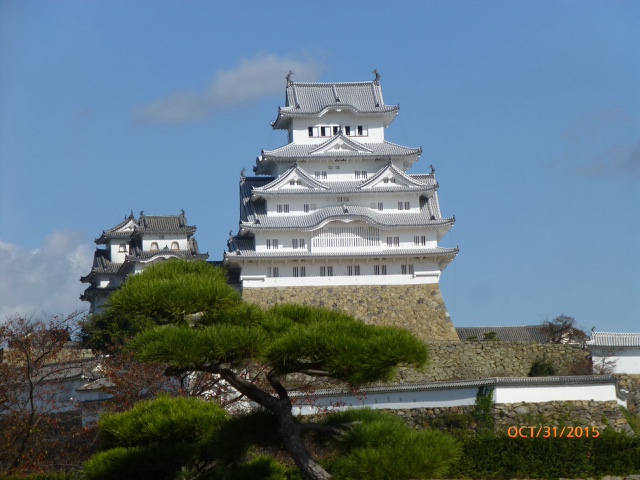
I mean no disrespect to any of the many castles we saw, but I think we will declare Himeji castle the most impressive. For six years the main tower of the castle has been under wraps undergoing a major restoration. In March of this year the wrapping came off and the newly revitalized castle was open for business again. The castle, which only about 30 minutes by high speed train from Osaka, is a huge attraction. They can handle 15,000 people per day. We were going to be there on a Saturday, so we headed out early to try to get ahead of the crowds but it was still crazy.
It is an impressive site, rising a above the city. Nicknamed the white egret, the 5 story tower is the centrepiece of a huge complex. Every design decision about the main part of the castle was made to ensure maximum defensive capabilities. The approach is full of twists and turns, of gates and dead end approaches. There are moats and secret areas to hide soldiers as well and dozens and dozens of places from which to shoot arrows,or guns. As it turns out, the castle was never attacked, but they were ready!
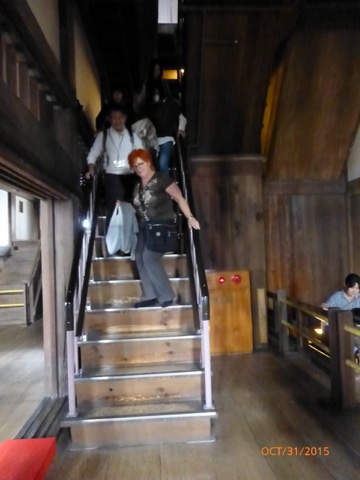
We met a volunteer guide who gave us a three hour tour. He told us all kinds of things we would have missed. In order to manage the number of daily visitors two opposing staircases move people up and down. Sometimes the staircase verged upon being a ladder! And all this in stocking feet.  Though you can see five stories from the outside, there are actually six as there is a basement level.
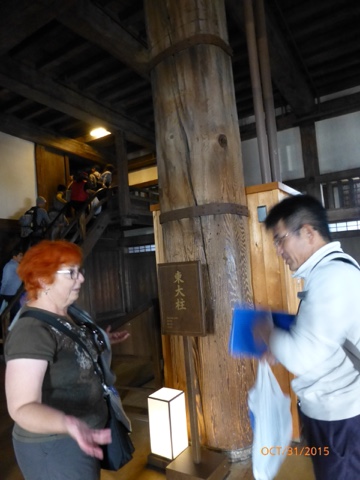
Two huge pillars hold up the interior floors. This one is from the original 1600 construction. The footing in the basement has been replaced, but the remaining portion is original. Its mate on the other side was replaced during the last restoration 50 years ago.


Our guide knows how to take picture.


In which Wilf rampages through the fish market.

It’s Sunday morning in Osaka. The morning after Hallowe’en. We decided to head down to the big shopping area to see the sights and maybe try some of the food. 
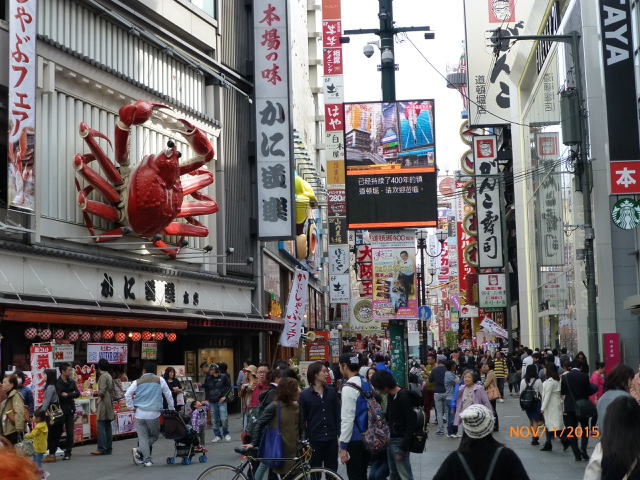
9:30 and the place is already humming. I’ll let you ponder upon the speciality of the shop on the left.
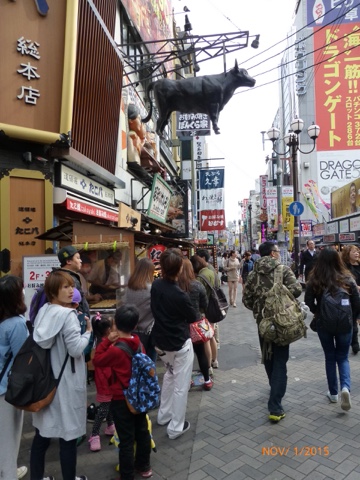
It may be 9:30 in the morning but people are lining up at a one of the many stands selling takoyaki – octopus balls. Chopped octopus in batter cooked in a metal griddle that makes them round. Hometown favourite.
Meanwhile, in the arcaded shopping area there’s a huge lineup waiting for the Disney store to open.


We wandered around for an hour or two and found our way to the fish market. This is not a wholesale market – this is fresh fish and seafood to be eaten right there or taken home. It was noonish and getting busy and food was cooking all around us.
And then Wilf spotted:
Little octopuses on sticks!
One octopus and a skewer of three scallops.
‘Let’s find a table’, says I, turning to find:


Well then, never mind the table.
I went to buy tempura, and by the time I had my bag of goodies we had to sit down right now for tuna sushi.


See the bluefin tuna head on the counter? He was a big fish. He was delicious.
So, tuna and beer taken care of. Bag of tempura dispatched. The crowds have thinned a bit as we’re walking along. And then:
Grilled oysters!


Lots of delicious seafood!
After mowing through an octopus, scallops, oysters, tempura and tuna sushi it was time for someone to have a nap!


What do you say about an icon

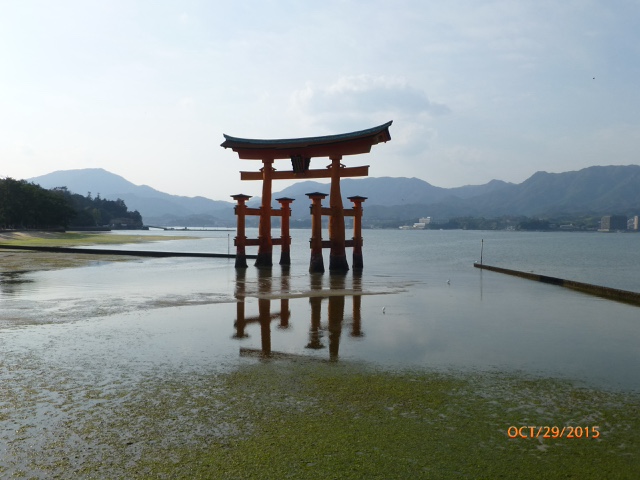
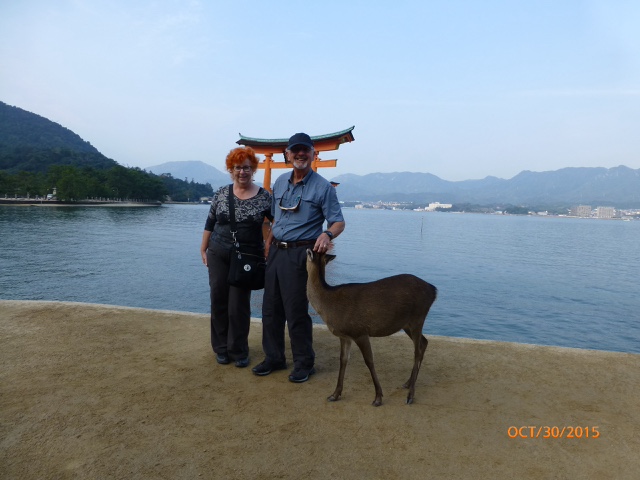
Even if you don’t know it, you probably know Miyajima. The tori gate floating in the sea is probably one of the most recognized representations of Japan – after Mt. Fuji and Hokusai’s ‘The Wave’

We took the ferry over from Hiroshima. Spending the night meant we had the chance to see the tori gate and shrine at several different tide levels.
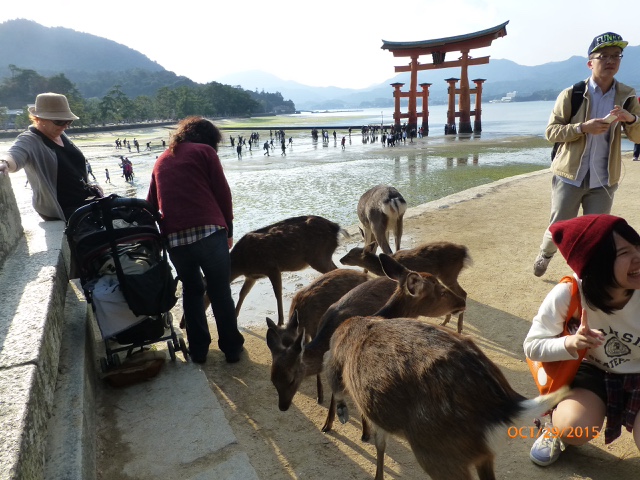
Afternoon, low tide.
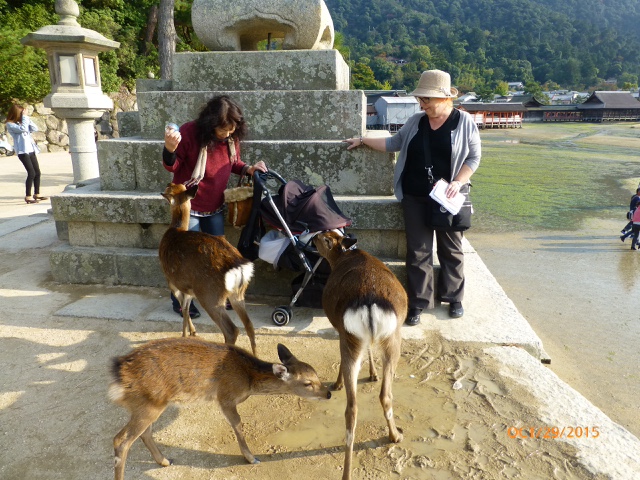
Hey that picture was kind of deceiving – it didn’t show some of the hordes of people out in the bay. There’s also a deer situation at the shrine. Theses guys were in the process of ravaging the baby carriage.
Things got a bit tense when Mom had to defend the carriage from the deer – I was almost expecting someone to go over the edge onto the mudflats.
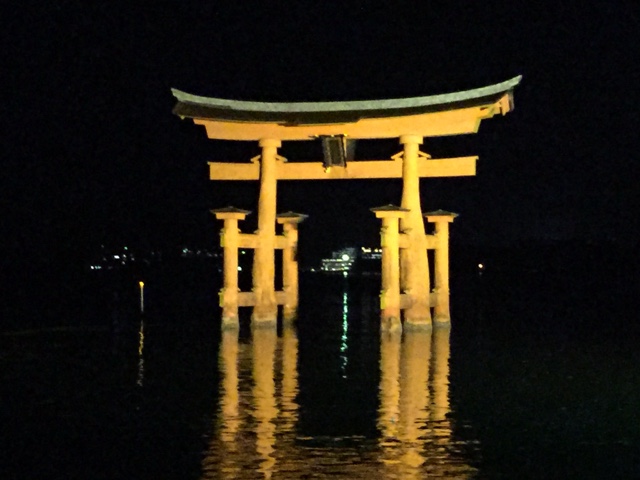
And at night – the incoming tide made for beautiful reflections.
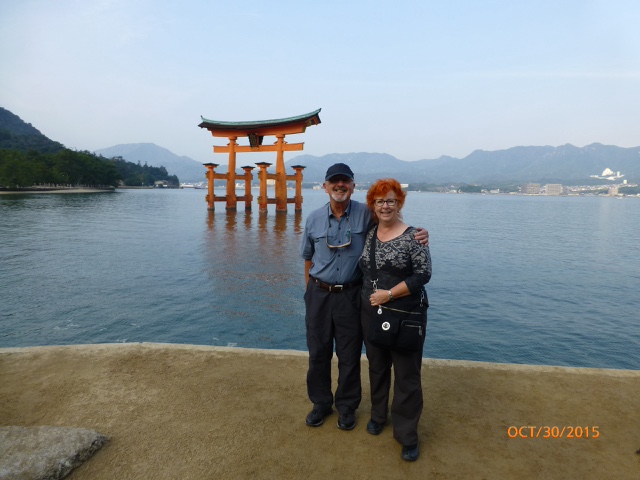
And in the morning, high tide.
No, no, don’t mind me. I’ll just look in your pocket. I’m sure you’ve got something to eat in there. Carry on with your picture.


These people really did have food and it nearly became hand to hand combat.


I said I wouldn’t, but….

You may think, from our stories, that we’ll eat anything. Not so, actually. Well, maybe Wilf will…..

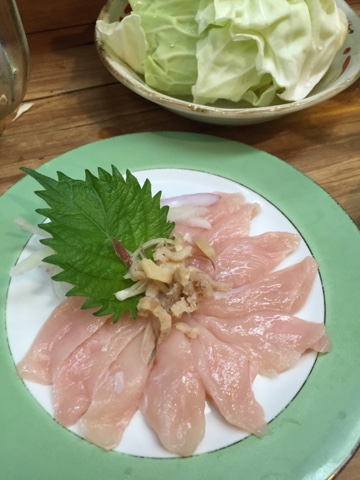
We did have two things, though. We both said we wouldn’t eat whale. And that we couldn’t eat raw chicken. (Even though we both agreed that if we were going to, Japan would be the place with its high standards regarding freshness and cleanliness)
Well.
Never say never!
In Matsuyama we tracked down another chicken restaurant. Not quite a beak to tail establishment, but pretty close. We were looking at a set menu to share and there it was, included in the set.
What the heck. We went for it. It was early in the evening and the proprietor was making sure we were well looked after, which included practically dipping said chicken in the shoyu (soy) sauce when he thought we weren’t using enough. ‘More, more. It will be more delicious.’
Actually, there’s not that much to taste with chicken sashimi. Mostly it’s rather chewy. Certainly not the melting texture of raw fish.
The chicken sashimi was followed by an extravaganza of chicken – grilled, skewered, mysterious crunchy bits on salad, deep fried chicken skin served like potato chips and a stellar chicken broth with a big rice ball.
Man oh man – it was all good.  Oishi!
Making friends with the chicken man!


Now they’re just messing with me.

After our mountain adventures we headed back down to the coastal city of Kochi. Wilf decided to put us in a ryokan. Most often these are country inns, often in particularly scenic locations. Country inn makes them sound rustic, which is not the case. Joseikan is an urban ryokan, 120 years old and in a city that doesn’t see a huge amount of foreign tourism. We were escorted to our room by the front desk clerk and a few moments later this lovely lady arrived.

After serving us tea she confirmed that our yukatas were correctly sized for our height and had us select a time for dinner in our room. And by the way – our room is huge!  And a real bonus is a sitting area with chairs!
We scampered off to the very swanky spa on the top floor for a soak before dinner, returning just as dinner was being delivered.
This style of meal is called kaiseki, which consists of many small dishes. Most of which are fairly mysterious to us. The fish platter looked very good:


And it was – it included bonito tuna that had been seared over a fire made with rice stalks.
Every time we would just about be thinking – okay, that’s the lot our lady would pop back with something else until the fruit and ice cream arrived. That we knew was the end! But with the rest of the meal there is no particular order  – a little of this, some of that as it catches your fancy. The covered pots hold a little wok filled with pieces of beef, chicken and veggies that cook over a small flame. Off to one side is a similar arrangement to cook the rice.
After we ate the dinner lady took the dishes away and a few minutes later housekeeping arrived to switch us to night mode. The table was moved, futons and bedding retrieved from the cupboard and we were good to go.
Here’s what the room looked like with the futons installed.
Through the door at the far end is the entry vestibule with a shoe closet and tea service area. Entry to the toilet and the separate shower/washstand area are from the vestibule. Once the sliding screen is closed we’re in a large tatami mat room.
Looking back to the window and the seating area. I kid you not when I say that the vestibule was close to size of some of the rooms we’ve stayed in.
After a lovely sleep on the thick fluffy futon ( the issue with the futon is getting up and down from the floor, not with the comfort of the bed) I decided to head back up to the spa for another soak – because I could. I trotted upstairs, went down the hall and turned right as I had the night before. I was standing in the entryway about to put my slippers in a cubby hole when a tiny little old lady popped through the curtain and grabbed me. Saying ‘no, no’ she pushed me through the curtain across the hall and disappeared.
Well, WTF, thought I. I looked at the curtain. Red. In my befuddled state (no coffee) I’m trying to remember – red for ladies blue for men, or other way?  As I’m peeking back into the hall a man strolls serenely out the side I had been in.
Oh oh.
So I go into the change room – which is not the one I had been in the night previously. And when I get to the bath area – where the night before the outdoor bath had been a small round jetted tub, now there was a large rectangular pool.
See, this is where it really is annoying to be illiterate. There was a sign in the hall with red writing  pointing at the red curtain and blue writing at the blue curtain. A blizzard of kanji, but not a word of English.
I think I have the red is for ladies, blue is for gentlemen rule burned thoroughly into my brain now. And I owe many thanks to the little lady who saved me from really embarrassing myself.
But really- switching from side to side – what’s up with that!


Lost Japan – the Iya Valley

In 1994 Alex Kerr published his book ‘Lost Japan’. It has many interesting things in it, but mostly it is a lament over the loss of old Japan (by default beautiful and good) and its replacement by the modern(by default ugly and bad). It can be tricky, as a westerner, looking at Japan. We are delighted by the high tech wizardry that we see and impressed by the deep history, by the art and culture.  But we can’t expect a country or a culture to remain frozen in an idealized version of the past.

One of Kerr’s project has been the restoration of a very old house in the Iya Valley on Shikoku island. Like many remote places the valley had suffered as young people moved away looking for work and houses were abandoned and fell into disrepair. While we did not visit his house we did go to the Iya Valley. While it is still pretty far in the back of beyond the train system will get you there!
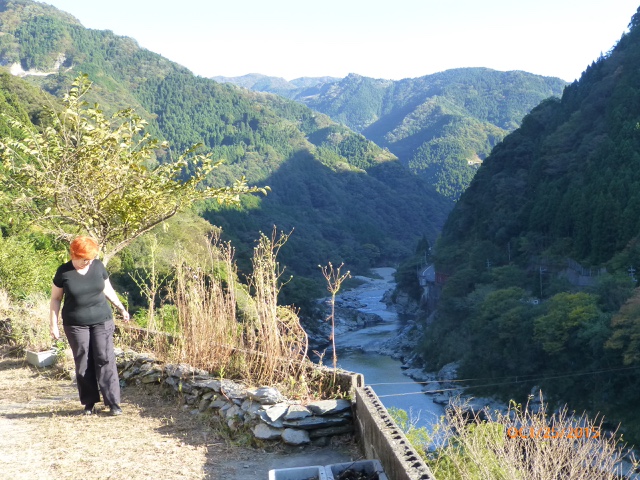
We took the train to the town of Oboke, which meant traveling up into the mountains and through the Oboke gorge. This is a land formed by water, not ice. The valleys are steep and the rivers fast and fierce. We stayed at a guest house that was down a somewhat terrifying road. I’m glad we weren’t driving!
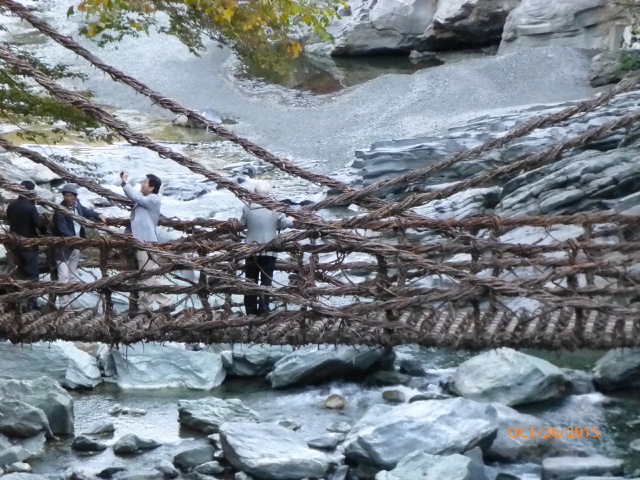
Besides the beauty of the valley one of the big attractions of the area special bridges. They are often described as vine bridges, which doesn’t quite cover it. The story is that a samurai clan were defeated in a battle and withdrew deep into the valleys to rebuild and return another day. They never did, becoming farmers instead. But they built these bridges which could be cut down to foil attackers, if need be. Or so the legend says.
The local bus system had us to the Kazurabashi by about 9:30. Down at the river level it was chilly. And being early we had the bridge to ourselves.
An early group of tourists walk carefully across the bridge.
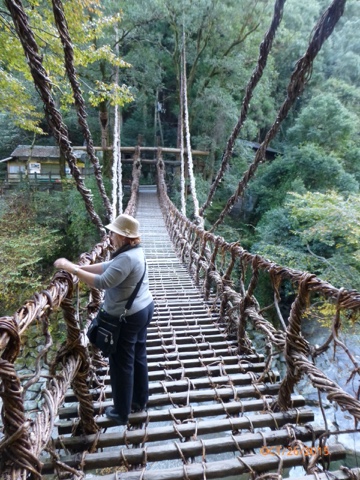
My turn! The modern incarnation of the bridge has steel cables as back up, but vines don’t really describe the material. This is wood that has been woven and twisted- somehow.


The river below looks benign now, but scour marks show how high the water is when the snow melt comes down – a torrent! Because the bridge is moving and the slats are widely spaced we had to look down for each footstep, which meant looking right through the bridge to the river below. Rather unnerving!
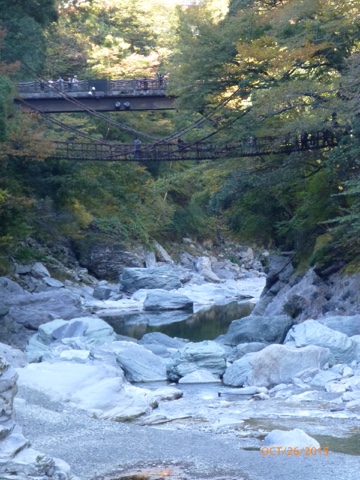
Looking back at the vine bridge and the foot bridge from the river bottom.
Apparently the bridge is rebuilt every three years. I’d like to see that.


Art,art, baby

A short ferry ride from Takamatsu is the island of Naoshima. Once upon a time it had a population of about 8000, now there are about 3300 people living there. Through a partnership with a publishing magnate the island is being turned into a big art experiment/exhibit. We decided to go and see, and decided that touring by bike was the way to go.

We had advice that the way to do the island was to go clockwise, because then the last part was all downhill – a big hill. I don’t know about you, but my experience says that a big downhill is usually proceeded by a big uphill…..
After a short ferry ride over we rented bikes (6 gears, padded seats, woohoo!) The road across the island followed the river valley, which made for easy riding. In the town of Honmura the Art House Project has reclaimed abandoned houses and spaces. We visited three of the houses in this tiny old town of twisting streets.
Our first stop was a purpose built building that houses a work by James Turrell, an American who works with light. Small groups are let into the space and left to sit in a darkness that is so utter that it almost defies description.  Eventually the light returns, so slowly that it takes a long time to register that there is a change in the light level. Eventually we figured out that we weren’t there to see a thing, but to have an experience. All three houses were like that – each completely different, but each about experiencing rather than just seeing. There was also a small museum dedicated to a Japanese architect named Tadeo Ando, who designed many of the structures on the island.
After lunch we headed for the other side of the island, where the big museums are.


Wilf, enjoying the ocean view before it all became about the uphill.
These giant pumpkin sculptures by Yayoi Kasuma are an emblem of the island.


The yellow one lives on a pier at the Benesse House area.


The red one is by the ferry terminal.
Given a combination of huge hills and the blazing sun we decided to concentrate on the Chichu Museum. First we had to push our bikes up a friggin mountain, but once at the top we found a most amazing place. The facility was designed by Ando, and he determined that the building would be under ground, and would use natural light. Seems like a contradiction, but it works. This is a place that takes itself very seriously – the staff are clad In white outfits with lab coats that make it look like they are going to perform some medical procedure. Access to the exhibits is controlled to limit numbers and we were asked to be silent.
One of the galleries contains 5 of Monet’s water lily series. Before entering we took off our shoes and put on slippers. Coming around a corner, through a large ante room the first and largest painting almost explodes into view. It is probably five feet by twelve in two sections, and in the diffused light it glows and fills the room.  It was amazing to see Monet in such a coolly contemporary setting.
There were also three more light sculptures by James Turrell. No sitting in the dark this time. But still surprising. I think I know how to look at a painting. But I’m less certain about experiencing light.
It was a big day. The art alone would have made it a full day. Add in an epic bike ride and I was very ready for the ferry ride back.