Been to Hell, got the postcard.

Okay, not Hell. But “The Hells”. All those lovely hot springs are one way that excess volcanic energy heat gets dealt with. The hot sands of Ibusuki are another. When we arrived in the coastal town of Beppu we thought we were seeing bits of fog or cloud snagged on some of the hills. But, no. We were seeing clouds of steam venting out of the ground here and there.

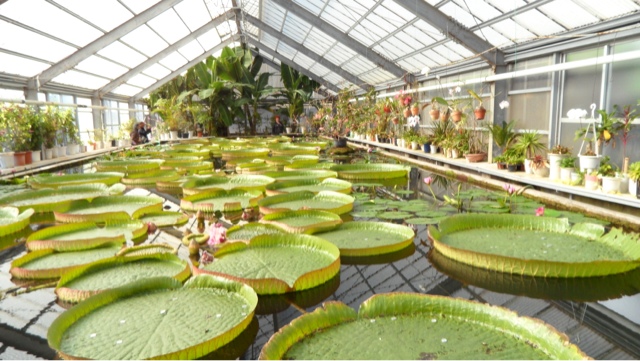
There are 8 ‘Hells’ in the hills above Beppu. We took the city bus up to visit three that are close together. First up was the ‘Sea Hell’, so called because the water the bubbles up is a lovey aquamarine colour. It is also well above 40 degrees C. They hang bamboo baskets of eggs in the water to hard boil them and you can buy them for a snack. They also have a lovely garden with a big lily pond filled with lily pads two and three feet across that a child can stand on. Heat from the hot water also warms a greenhouse full of exotic plants.

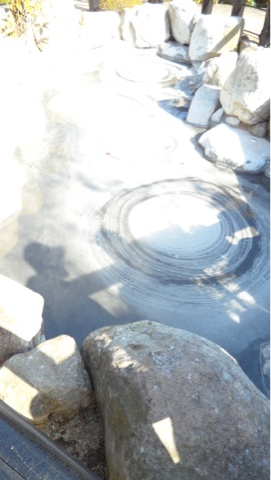
Next door was the ‘Monk’s Head Hell’ Here the hot water comes up through heavy thick grey mud. It comes up in huge bubbles that apparently look like the shaved head of a monk. Can’t attest to that, but they were pretty interesting.

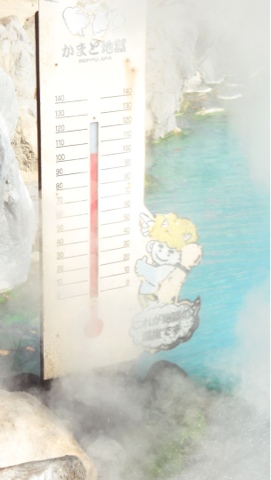
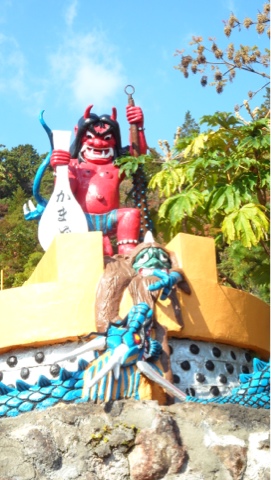
Last up was the ‘Cooking Pot Hell’. Back in the day this was a place where people cooked their food. Now it has some really lurid statuary and some really fierce pools of super hot water. The water here is well past 50 degrees C. In some places is it red, other places is blue. Some of the Hells have onsens attached to them – we were told that the the spa at the monk’s head hell is very good for you, but you’ll smell like sulfur for a week after. Most of the Hells also had footbaths,too.

So, Beppu was the last of the geothermal adventures for us. On then to our last stop on Kyushu island – Fukuoka.

An afternoon with the big boys

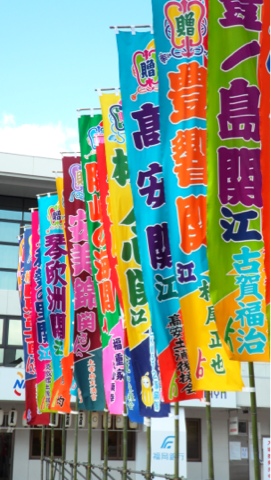
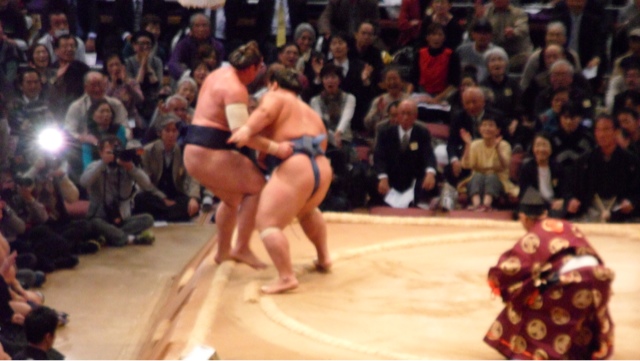
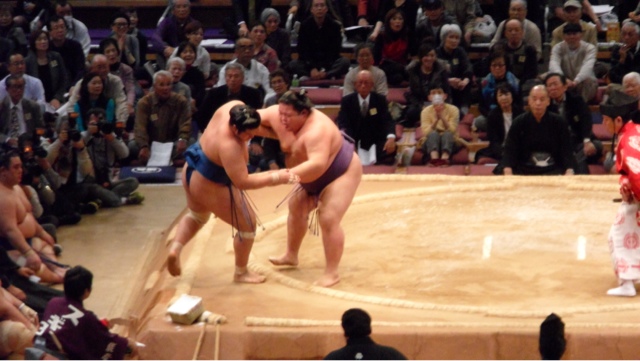
One of the things we wanted to do on this trip to Japan was go to a Sumo wrestling match. A series of championship matches rotates through the country during the year, and the big match in the late Fall is in Fukuoka, on the Southern island of Kyushu. Through the wonders of the Internet were able to order tickets and have them delivered right to us at home.

The tournament began on November 11, but before then we began seeing sumo on tv. Given that Japanese tv is pretty much incomprehensible we figured perhaps it was highlights of previous matches. We watched some and did some research on-line to prepare for the tournament.

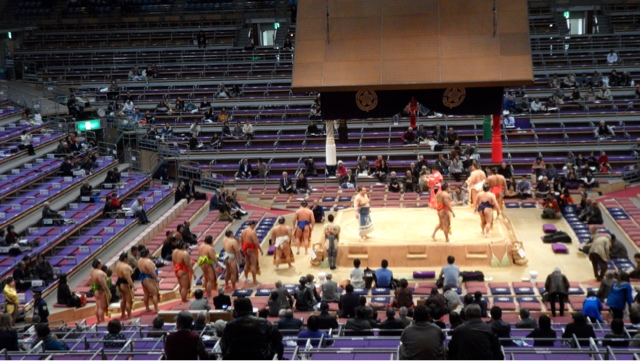
Our ticket gave us access for the whole day, but we figured nine hours of anything, let alone sumo, would be way too much. We decided we would go just after 2:00, when the second tier guys were up, and watch them and the top tier guys. We were very relieved to be given a brochure, in English, about the history, the ceremony and the rules of the sport. We also got an English language version of the bout card so we could figure out who was who.

When we ordered our tickets we asked for seats with backs on them, which put us up fairly high, but there was no way we were going to be able to sit on the floor cushions for several hours. In the end it was sort of like being at the circus – there was so much going on all the time. And the preparation and staring and stomping before the match often took longer than the actual match itself.

It used to be that only the Japanese were sumo wrestlers, but that hasn’t been the case for some time. There are a lot of men from Mongolia, who are on the small side and therefore have to have some pretty fancy technique. There are also a handful of Westerners – mainly from places like Georgia, the Czech Republic and other former Soviet Bloc countries. They’re tall, and more obviously muscled than the Asian competitors.

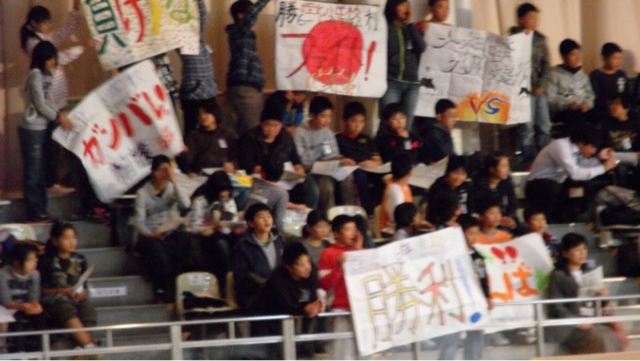
Part of the fun was the audience. When we first got there the crowd was pretty sparse. Up at the top, behind us, there was one woman who was a big fan. She had this high clear voice and we could hear her calling ‘Gambare’ to her favourites. Gambare was the usual cheer in the building – it means ‘Do your best!’. By about 4:30 the place was really filling up – troops of school kids filling in the very top rows. During the early part of the day I could make out what the announcer and referee were saying but eventually there was just too much cheering and calling. At 6:00 the event was over for the day. The lobby was a free for all of shopping, and then everyone trooped outside, where express buses to the major subway/train stations were waiting to take us all away.

Ryokan dining

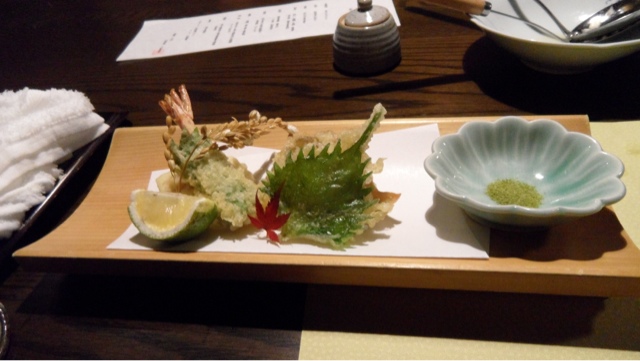
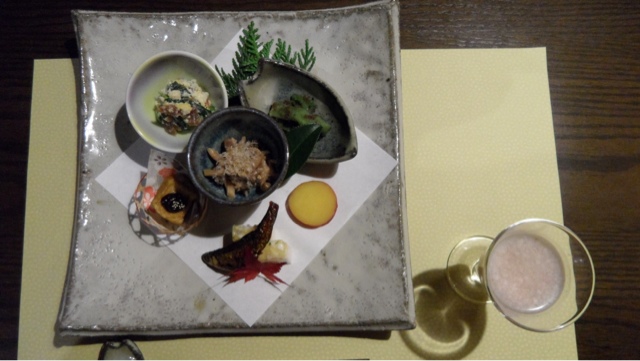
Part of the deal with staying at a Japanese inn (ryokan) is the food. The Sanga Ruyokan in Kurakowa included dinner and breakfast each day. These meals are major productions – it is kind of like going to a huge buffet, but they just bring you one of everything. By the time all is said and done there are usually about 12 different courses. Some are big things, some are just a few bites. The range of tastes and textures is quite amazing.

We had two nights to try this kind of Japanese food. We ate in the dining room, which divided up into little bays and cubbies. Our attendant looked after us and another table that we could see through a screen panel. She spoke a little bit of English and could give us some idea of what we were eating. We couldn’t always tell…. Overall I think I can say that we enjoyed both meals.

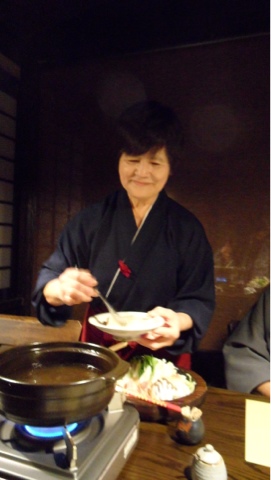
On the first night the centrepiece of the meal was chicken nabe, which is a hotpot dish cooked at the table, where chicken and vegetables are cooked in a light broth. After the chicken and veg are lifted out and eaten, rice and an egg are added to the broth to make a type of soup.

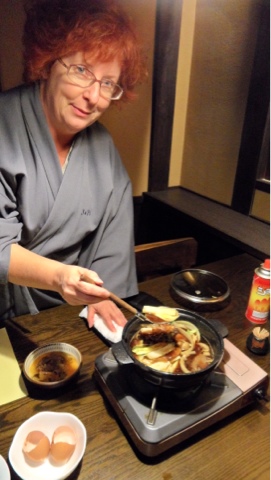
On the second night the centrepiece was beef suikiyaki, which is not a grilled dish. Again a hot pot is used, filled with a very rich broth, to which slices of beef and vegetables are added. We had a smaller bowl, into which a raw egg was broken. As the beef and veg were cooked they were taken out and swirled in the small bowl. Their heat would cook the egg a bit, making a sort of sauce.

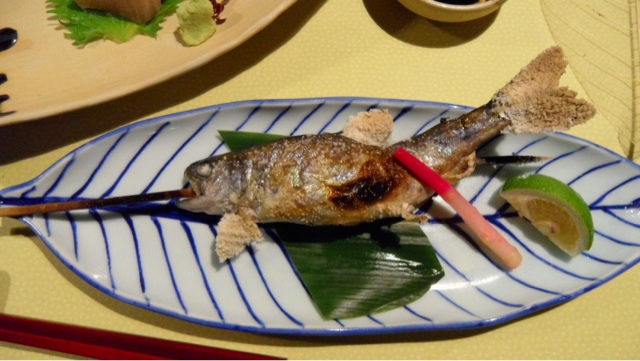
On both nights, before and after the main course there were all kinds of dishes. Sashimi both nights – both fish, seafood and horse meat. There was a tempura course. There was fish – one night it was a whole small fish that had been grilled on a stick, the second night a different kind of fish was steamed and served with a vinegar sauce. There was tofu (very fresh tofu) done many ways. There was a huge variety of pickled things – vegetables, seaweed and fish. There was miso soup. On the second night we had a clear soup with noodles early in the meal and miso soup later.

Each night there was only one thing that each didn’t like. In both cases it was both a texture violation and an unpleasant taste. Might have been able to take the taste, but the texture turned out to be the deal breaker…

There was a dessert each night – something small and light – and a perfect ending.

Here are some pictures from both nights:

The Freshest Fish I Ever Ate

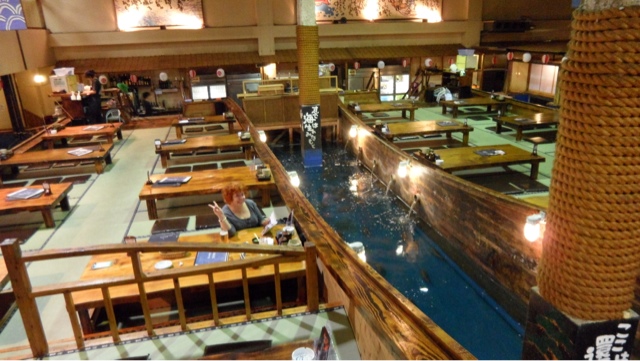
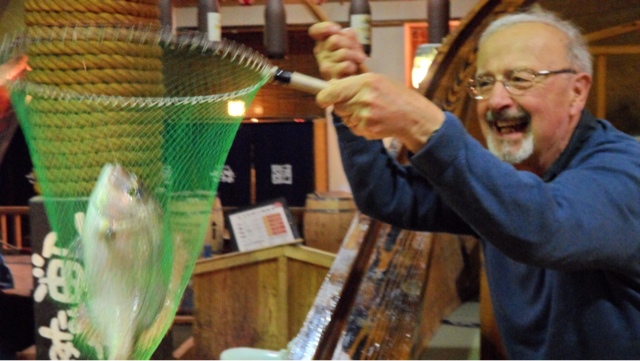
Tonight we had another culinary adventure. Wilf had read about a restaurant where you could catch your own fish and they would prepare it for you. Off we went, first by subway and then on foot. It turns out to be a huge place – like warehouse sized. In the middle are two big boats. And in the water – around the boats – fish! We told the waitress we wanted to fish and she brought a bamboo rod, a net and a shrimp for bait. And before you could say Boo – Wilf had caught our dinner. The waitress suggested half the fish as sashimi and the other half grilled, which is what we did.

It was delicious!

At an Onsen

When a Japanese bath meets a natural hot spring you have an onsen. And on an island with as much geothermal energy as Japan has – you’ve got lots of onsens.

Wilf decided we should really get the onsen experience, so he booked us two nights at the Sanga Ryokan at Kurokawa. This a little town in the back of beyond that has about 24 hot spring spas wedged into a little valley – it is a resort dedicated to bathing. When Wilf was making our bookings he didn’t realize that we would be there on a weekend at the height of leaf viewing season.

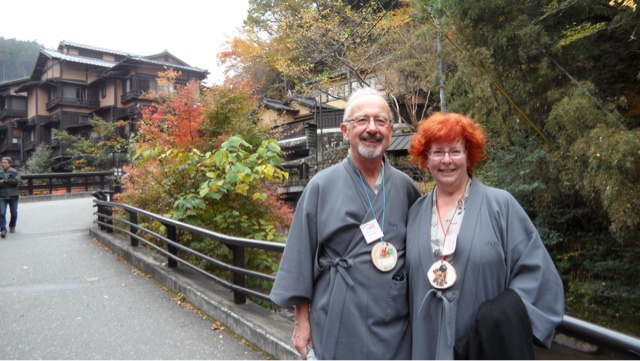
Our ryokan (inn) was beautiful, nestled by the river a few kilometres from town. Our room was huge and welcome tea and a sweet bun were waiting for us. Also waiting were the yukata, hapi coat and tabi socks that are the usual resort wear. We had already left our shoes at the front and picked up indoor slippers. Everyone else was dressed the same, and we wore our yukatas for our meals, as well.

One of the things about Kurakowa is that besides enjoying the baths at your own resort the idea is to trail off and sample some of the other places in town. We were assured that we just sail off in our little outfits – everyone else does. After breakfast on Saturday we got a ride in the shuttle over to another out of town ryokan and started our day. By the time we got to town it was a busy Saturday – lots of day trippers all around. But if there were any fellow ryokan folks they had changed back into their civilian clothes. Because we were the only people in ‘traditional’ Japanese clothing. We were also the only Westerners in town. I mean that quite literally. Now we were never going to pass un-noticed. But we were pretty high on the dork-o-meter that day, I think. Yep. Sharon and Wilf – amusing the locals since 2012.
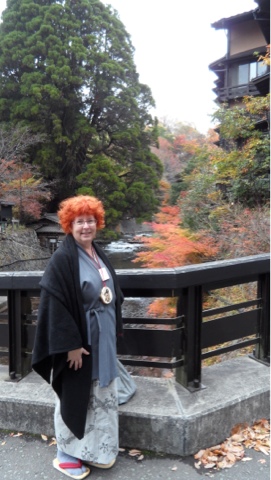
But – let me say. The town was beautiful and the baths were lovely. As day visitors we could use the outside and some of the inside baths at each inn we visited. The outside baths tend to feature stunning views and beautiful foliage while the inside ones concentrated more on interesting architecture.

The etiquette around bathing shifts a bit, too. From the dressing room we would usually go right outside. Instead of a row of taps there would be a stone basin with hot water running into it and small basins or buckets to scoop water with. We’d throw several buckets of hot water over ourselves with a bit of extra attention to private parts and feet. Then, into the pool!! This usually happened pretty quick, what with it being November and all. The pool isn’t crystal clear like an indoor pool – the water is heavily mineralized and leaves fall in. Did I mention that the water temperature was usually between 40 and 45 degrees C?

At the first place we went to I was sorted of adopted by a group of young women who saw me wandering around a bit – unable to read the signs and so a little confused. After a soak in the big outdoor pool they called me to come with them. Off we went down a boardwalk through then woods (each carrying a wee hand towel and that’s it) til we came to a building with two more baths in it. Quick splash and in we went. It was super hot, which led to cries all around of ‘atsui, atsui’ (hot,hot) . In this building the windows slid back, framing a perfect view of a waterfall, surrounded by Japanese maples. Really lovely.

After each bath Wilf and I would meet up, stroll around a bit, look at the shops, have a drink. After we had don town we returned to our ryokan. As guests of the inn we could reserve a private bath. Also called family baths, these baths are not segregated – you can have whoever you wish with you. We went each night around nine. It was really nice, but the 40 degree water temp and the 10 degree air temp ment that there was a lot of Goldilocks going on – too hot, too cold.

So, I’ll leave you with some pictures – Wilf took the camera into a few of the men’s outdoor baths (shhhh don’t tell). And you can decide how dorky we looked!

Bathing Beauties

So – Japanese baths. Everybody’s got questions. Short answers:
• Yes, nakedness is involved
• Communal baths are segregated
• Japanese baths are for relaxing, not for getting clean.

Basic hotels don’t usually have communal baths. In the bathroom, in addition to the sink and toilet there will be a tub. It is shorter, narrower and deeper than a standard North American tub. The bathroom floor is usually raised to accommodate this – you step up into the bathroom and are very careful about not falling out into the room at night!

The idea is to have a good scrub and shower and then, once you are nice and clean you fill the tub and relax. The bath is a place where clean people sit and relax.

Some high rise hotels have communal baths. They are usually on the top floor and/or the roof. They usually open at 3:00 pm and remain open through the night until about 10:00 am, being closed for cleaning during the day.

Every hotel we’ve stayed at in Japan has provided a robe or pyjamas, whether or not they have communal baths. When it is time for a bath you put on your robe or pj’s, gather up your towels, put on your hotel issued slippers and head for the bath. The hotel provides one regular bath towel and a smaller towel. It is about 6 inches wide and 18 inches long and is a more loosely woven terry fabric than a regular towel. It goes with you to the bath.

Fortunately for those of us who are illiterate the Japanese are rigorous about colour coding men’s and women’s facilities – blue curtains always mean men’s, red always means women’s. Same thing for public toilets. We’ve also learned the kanji for Man and Woman to be double certain!

Upon arrival you leave your slippers on a rack by the front. There’s usually a locker to stow valuables. Next up is the dressing room. Racks on the wall hold baskets, into which you put your bath towel and all your clothes. There is a counter here with sinks and hair dryers and hand lotion and hairbrushes for use later.

From the dressing room we pass through a door into the bathing area. To one side will be a row of cleaning stations. Each one has a low stool, a mirror, hand held shower sprayer, taps, a basin, and big bottles of soap, shampoo and conditioner. The stool is very low, it is better than crouching, but after a long day it is a long way down. Anyhow, you settle yourself and begin the washing. Soap and water, using your towel for your back you wash yourself. Wash or at least thoroughly rinse your hair. Take a surreptitious peak around. Everyone else is still washing. Rinse off every speck of soap. Start over and wash all of yourself again. Thoroughly. By the time I have washed myself as thoroughly as I possibly can and those around me are still not done I usually think ‘screw it, I’m going in’. Get up carefully – it’s a long way down and you and everything around you is wet. Rinse your wash station down completely and return your stool and wash basin to its original position.

Some hotels have an outdoor bath. You may be thirteen floors up, but when you step outside the effect is that you have stumbled upon a rock lined pool in the forest. The area is screened, so private. The only downside to the outside pool is that is usually so freakin’ hot that I spend more time getting ready to bath than I actually do in the pool. Your hand towel comes with you, but never actually goes into the bath – wrap it around your hair, fold into a square and put on your head or leave it on a rock by the side.

The water pours constantly into the bath, draining out over one or another low edge as people get in. The water is crystal clear in these baths.

Inside there is another bath, usually not quite so fiercely hot. A fancier place may also have a cold pool and a sauna. A less fancy place may have just the one bath – sometimes quite large, sometimes the size of a pool table. Often I’m the only one in the place, but sometimes I have company. Once I’m done it is back to the dressing room to reverse the process. After a day seeing the sights it is sue nice to have a hot bath before bedtime.

I don’t have any pictures from the communal baths because, as you imagine, cameras are a big no-no. But, I’m not done with the subject. We stayed two nights at a hot-spring spa, which merits a posting all of its own. And for that I have some pictures, so stay tuned!

Visiting the volcano

After several days in the southern part of Kyushu island we headed a little further north. Mt Aso sits in an enormous caldera about 60 minutes from Kumamoto. We took the Trans Kyushu Limited Express to get there, which turned out to be a special train. It is only two cars long, kind of vintage in style and it goes along a fantastically scenic route.

Early this year there were terrific rainstorms in this area with a lot of road and rail damage and we could see evidence of that as we went along. In order to climb up and into the caldera the train took a series of switchbacks, so we’d go forward, then backward, then forward to climb up.

The train dropped us at Aso Station, where we checked our luggage and caught a bus to take us up the mountain. It was a twisty turny trip made all the more so by the number of road washouts from earlier this year that reduced the traffic to alternating one way.

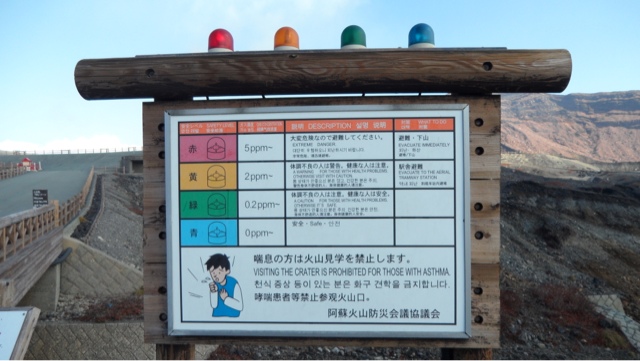
We could see the gas cloud rising from the mountain top and there was a definite smell to the air, even down at the town. Once off the bus we walked through the gift shop only to discovered that the cable car to the top was not operating due to dangerous gas levels. Well. What a disappointment. We were looking around the shop about ten minutes later when we heard a rumble and excited voices – it’s open! Everyone ran upstairs, bought a ticket and crammed onto the cable car for the short ride up.

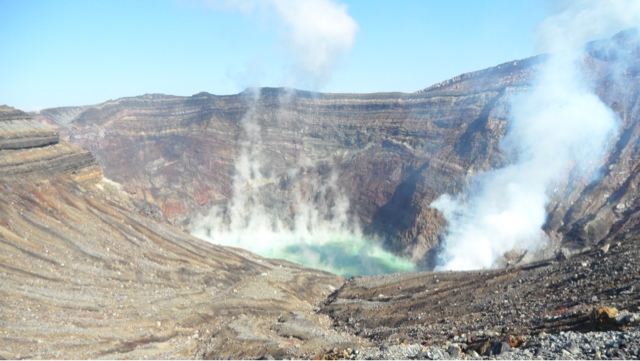
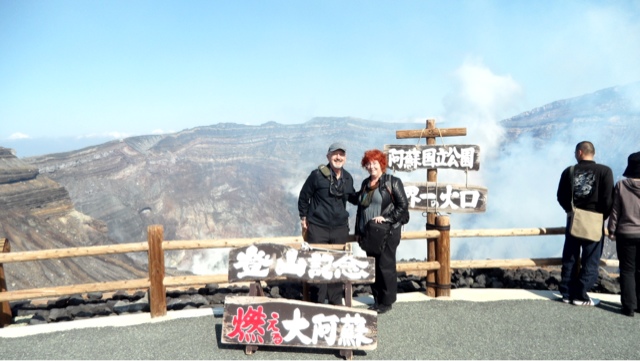
And what a sight! It was fantastic. Below us was a boiling aquamarine lake with plumes of gases rising up. The walls of the caldera are streaked with minerals that have precipitated out from the plume. All the tourists were running around taking pictures as quickly as possible. Souvenir venders were selling big chunks of sulphur and there were technicians in gas masks taking air samples.

After about 15 minutes a voice came on the loudspeaker and everyone started back down toward the cable car building. Even without speaking Japanese it was pretty clear that the message was ‘get out of here now’. The people on bus tours got back on their buses and many people got back on the cable car. But some of us remained and walked to another lookout for views out across the main caldera – it is the biggest caldera in the world, some 28 miles across, with the new active volcano off to one side. Eventually the loudspeaker started up again and the wardens started blowing their whistles – time for everyone to go. We were very happy to have been able to go up and see it all. Sometimes the wind direction closes the peak for days and today when we passed back through Aso it was foggy and rainy and we met people who had been up and seen nothing. It was all my little geologist could have dreamed of.

One more for the list

Do you have a personal list of crazy things you have done? We added to ours today, because today we took the train to Ibusuki to take a sand bath.

Ibusuki is about a 90 minute train ride south of Kagoshima – it is a small town of about 40,000, looking kind of down on its heels. But…. They have hot springs heated by a local volcano, and those springs run out onto the beach. People come from all over to be buried in the sand and have a good steam..

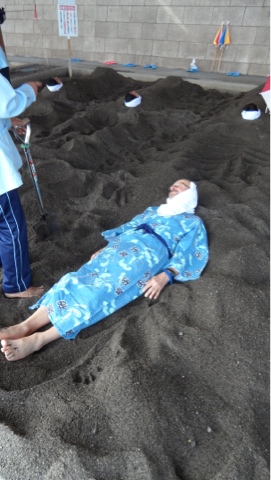
We arrived at the reception desk and were issued yukatas (cotton robes), small towels and told to change into the robes – no underwear! Okay,then. We went off to the change rooms where we changed into our robes and flip flops, then met on the walkway outside. When the tide is out and the weather right they dig little trenches right on the beach, but the tide was in so went into an enclosure where the attendants were waiting with their shovels. They instructed us how to get settled, with our towels around our necks. Once we were settled they proceeded to shovel the hot sand over us. It was surprisingly heavy and quite hot. We were told to stay put for ten minutes.

It was not the thing for people with claustrophobia, that’s for sure. It seemed like a very long ten minutes, but eventually it was time and we sat up and brushed the sand off. At that point we returned to the main building for a big rinse off, and then into the usual Japanese bath process. Since we had a showered this morning, had a bath at noon and another bath tonight before bed we are very squeaky clean. And tomorrow we head off to a town of hot springs, so more hot bath adventures await. We’ll be without Internet for a few days, so we’ll check in again next week.

Till then, here are the pictures from today’s adventure:

Another city, another meal.

We’re in Kagoshima, where they grow their radishes big and their sweet potatoes purple. We made a reservation at a restaurant not far from our hotel, and presented ourselves at 6:00. It was early enough that it wasn’t too busy and the staff had a little more time to explain things to us. We wanted to try local dishes, and they had a set dinner that covered pretty much everything. A mere twelve courses – they didn’t seem to find it unusual that we would order one meal and share it, which was good ’cause it was a pile of food. We ordered shochu to drink, which is a form of firewater distilled from sweet potatoes – it was actually pretty good and went well with the food.

We almost wound up with the dreaded chicken sashimi, but caught that in time and had the tuna instead. There’s always fish and seafood in a Japanese meal, but we’re in pork country here, so we had several variations on the pork theme.

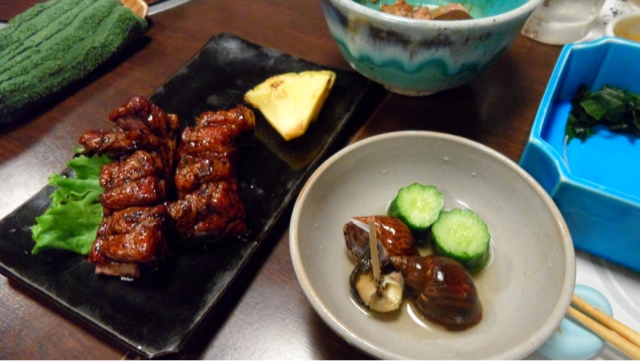
Dinner included:
Salted fish guts (tiny little dish of something salty – if we hadn’t known the name we wouldn’t have blinked at it)
Kibinago sushi – little silver fish fillets serve raw with a yummy sauce
Lettuce with salad dressing
A tray of mysterious pickles
Tonkatsu – breaded pork cutlet with sesame sauce
Bonita sashimi
Tonkotsu – braised pork stew with potatoes and veg, not to be confused with the pork cutlet
Satsuma pork ribs
2 large cooked snails and cucumbers in vinegar
Chicken miso soup
More mysterious pickles
Sakesushi – raw fish and seafood over rice tossed with a lot of sake
Dessert – sweet potato jelly made from bean jam was the menu description – one piece of purple jello, one sort of whitish, neither a big taste sensation.

We had a great time – enjoyed the food, enjoyed the place, and then finished the evening with a visit to the communal bath on the roof of the hotel (communal, but segregated)