Going to an onsen town – but not the onsen?

Kinosaki may be known for its public baths, but that is not all there is to do there. Many people come with the express purpose of visiting all seven public baths. And if we weren’t staying at an inn that provided meals we’d probably be exploring the restaurants. Well – we did check one out before our room was ready – the local brewery, which had great beer and food. And happened to be owned by the hotel we were staying at.

There is a ropeway (cable car) that will take visitors high above the town, with beautiful views. We wandered our way up the street along the river. Since our very large breakfast had lots of tea but no coffee we found a pleasant spot for a cup of coffee, then headed for the cable car.

Our previous trips to Japan have been in October and November as the leaves begin to turn. This time around everything is bright and fresh and green. The azaleas are still blooming and the hydrangeas are just starting to show.

The river flowing to the Sea of Japan.

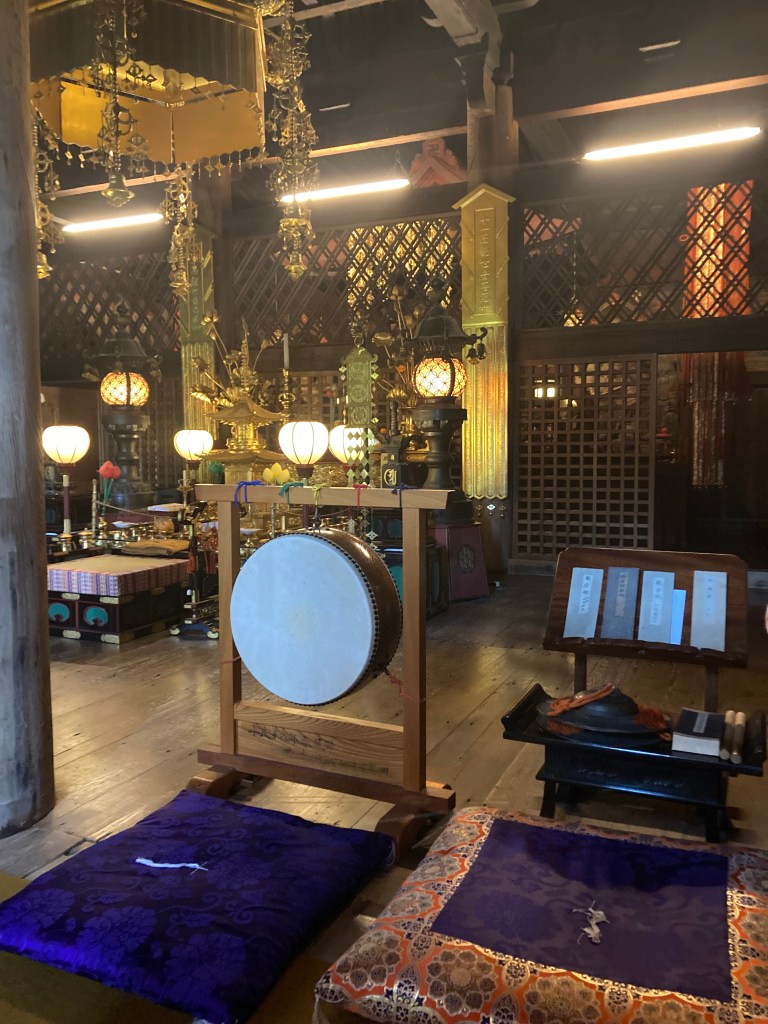
Half way up the mountain there is a Buddhist temple. We stopped to take a look. The monk who was in charge of the temple had a fact sheet in English for us and then he took us through the buildings. Usually when we visit Buddhist temples we can view the rooms from a distance but not go ‘behind the scenes’, as it were. He took around the back of the main alter area and showed us various sub rooms. The most sacred spaces at the back are off limits, but we saw more than the usual and wow – so beautiful!
After our ride up the mountain and back we replenished ourselves with some gelato in a little square where the hot water for the town comes out of the ground. There’s quite a pump station there and from that spring all the water for the town’s onsens is derived. We wandered back along the river through the back streets and made our way toward the train station.

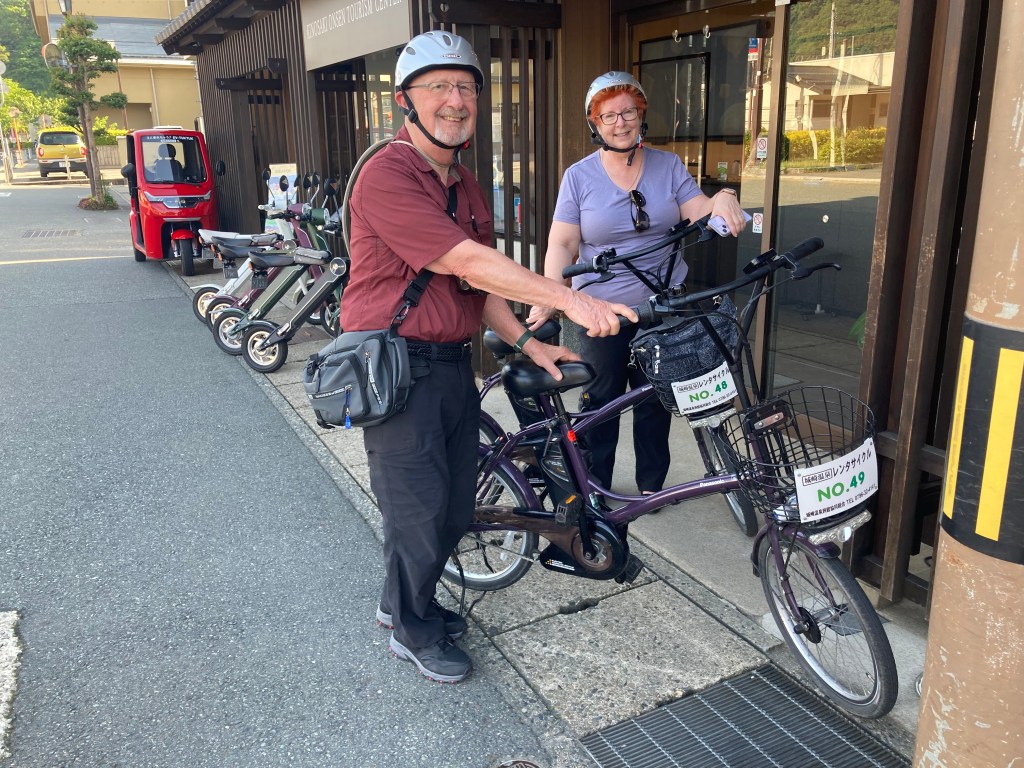
The other attraction in the area is Genbudo Park, a geology museum and outdoor exhibit. No bus service from town, but a taxi was a possibility. We heard that there was a bike rental place, so we headed there. And then we joined the 21st century because – electric bikes!

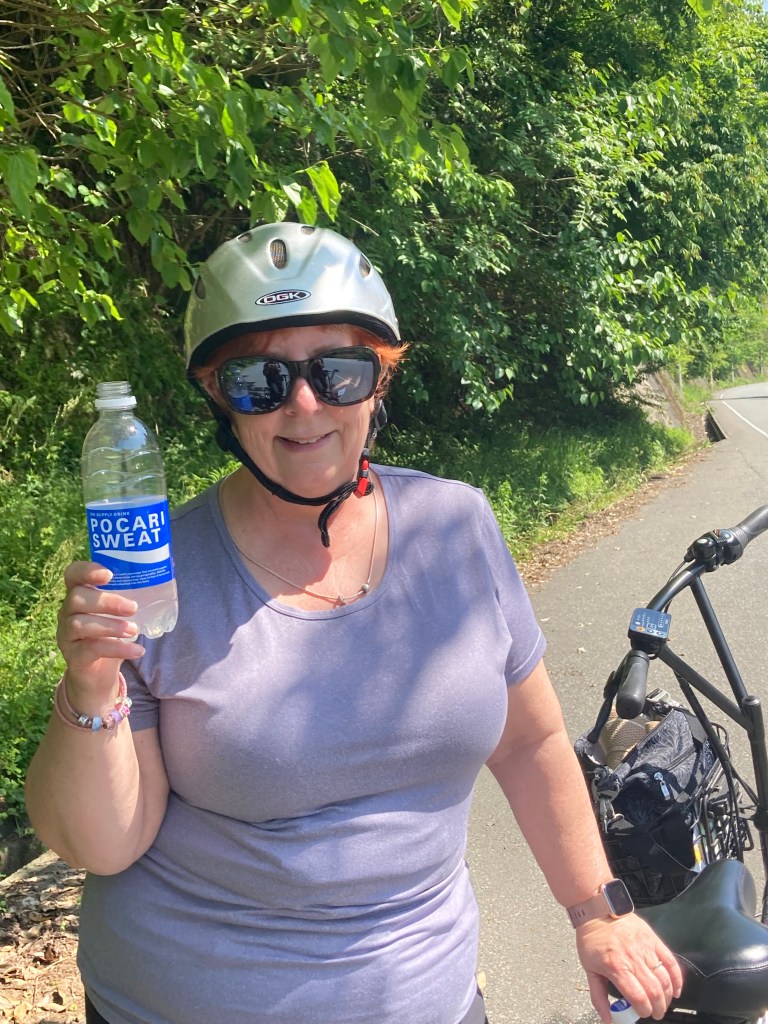
Best $25.00 we could spend. It was still mildly terrifying, as we had to drive on the opposite side of road to what we are used to and drive on the roadway. And did I mention it was hot? 27C. I doubt we could have done it without the ebikes – there was a hill that would have thwarted us. But – off we went and it took us about 25 minutes to get there. Fortunately the secondary road we were on didn’t have much traffic and the cars gave us a wide berth.

Needed this stuff!

The museum was really well done. Full of fossils and beautiful specimens of a wide variety of minerals. I was particularly impressed by the baby T-Rex, and if you’ve ever wondered what T-Rex ate, well just take a look. There’s a rice ball in his mouth. Onigiri for the win!

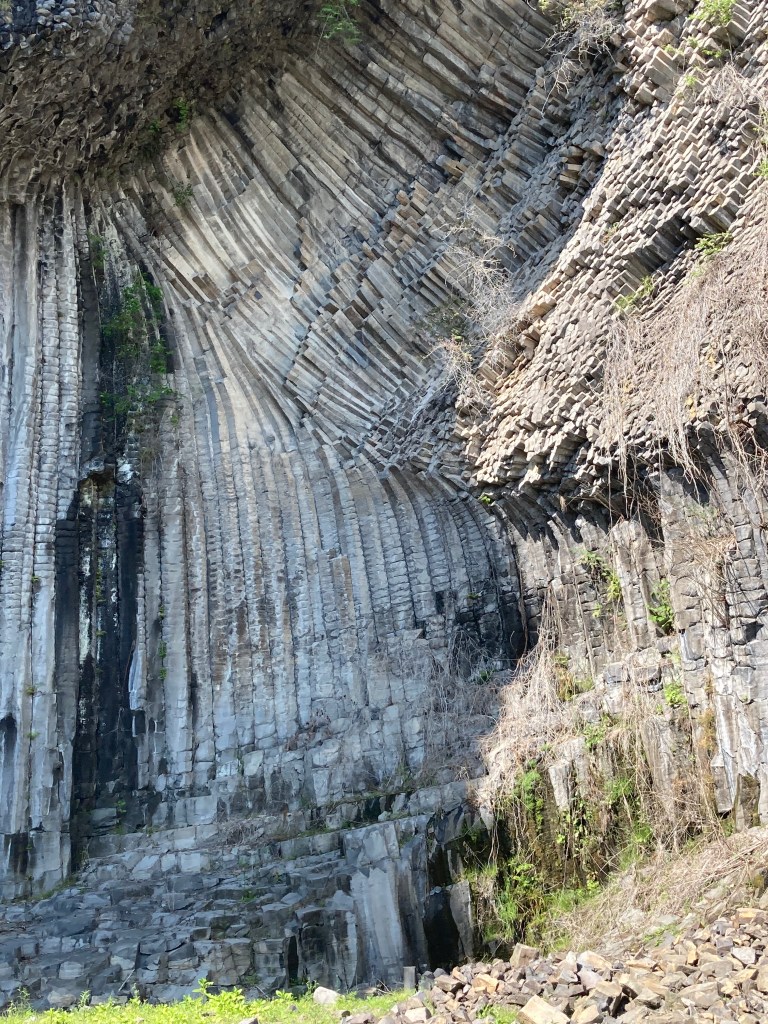
Volcanic activity in the area left behind wonderful examples of columnar basalt. The shape of the museum reflects the hexagonal shape of the basalt columns. As nice as the museum was across the street were the caves….

There were five caves to see. Some had been quarried, others had just been uncovered. They were all very cool.

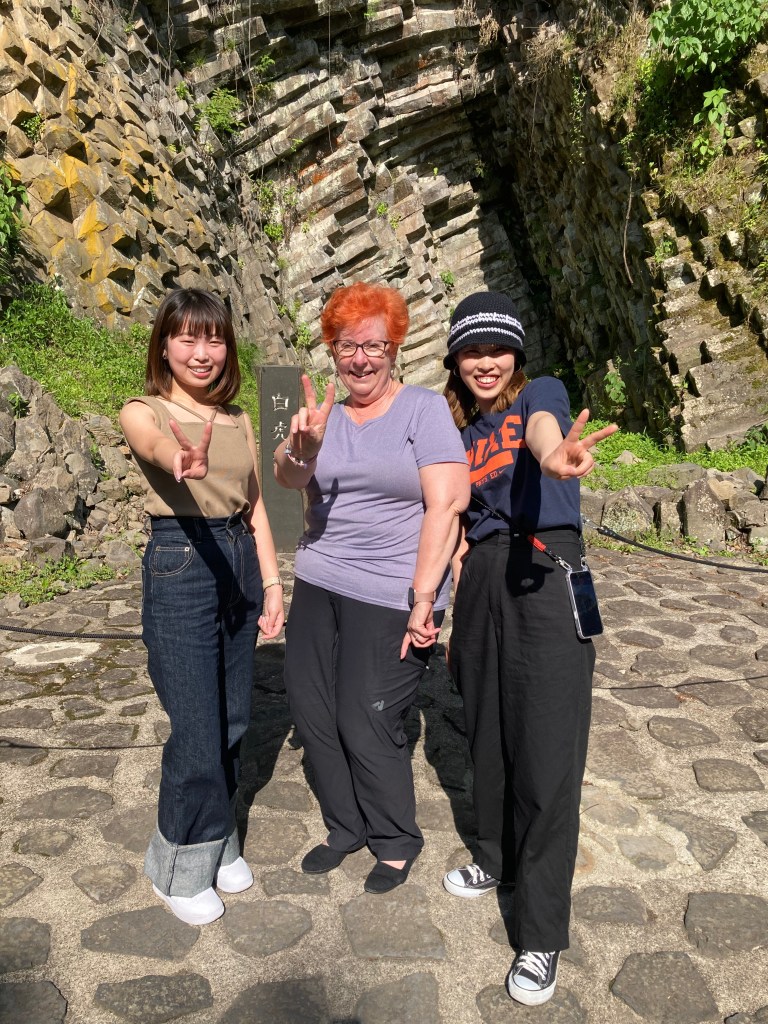
While we were looking at the caves we kept crossing paths with these two young ladies and of course we got talking and taking pictures. One of them had been to Vancouver and loved it. They were so cute!

They had come by car and were astounded that we had come by bike. We said our goodbyes and rode back to town. By that time we were thoroughly grubby, so we put on our yukata and headed to the public bath around the corner. And who did we meet on the street in their yukatas but those two. So, time passes, I’m soaking in the outdoor pool in the bath (which is in a cave) when I hear a little shriek at the door – look over and there they are. And yes, we’re all naked. I managed to say something in Japanese like ‘I don’t have my glasses on and I can’t see you’. They came in for a bit, then said good bye. I waited a bit. Time to go get dried off. And of course they had the locker next to mine. Anyhoo. I think they may have recovered from the trauma of it all by now!

So – in the end we didn’t visit all the onsens but we had a spectacular day!

Another onsen town

Back in 2012 we visited the onsen town of Kurokawa on Shikoku island. It is near to the active volcano Mt Aso, and there are an abundance of hot springs and an abundance of hotels dedicated to the experience. You can read about it here. We had a great time, enjoyed the hot springs and have sought out onsen experiences ever since.

For this trip Wilf scheduled us in for two days at the town of Kinosaki, which is near the Sea of Japan beside the Maruyama River. It has been known as an onsen town for hundreds of years. In 1925 a terrible earthquake devastated the town, and when the townsfolk decided to rebuild they leaned in to the idea of enhancing the town as a resort. A side channel of the river runs through the town. When they rebuilt they created a series of little bridges over the little river and lined it with willow trees. Seven bath houses were built – all different in style. In the years since development has been controlled in the town so it retains a real old fashioned charm.

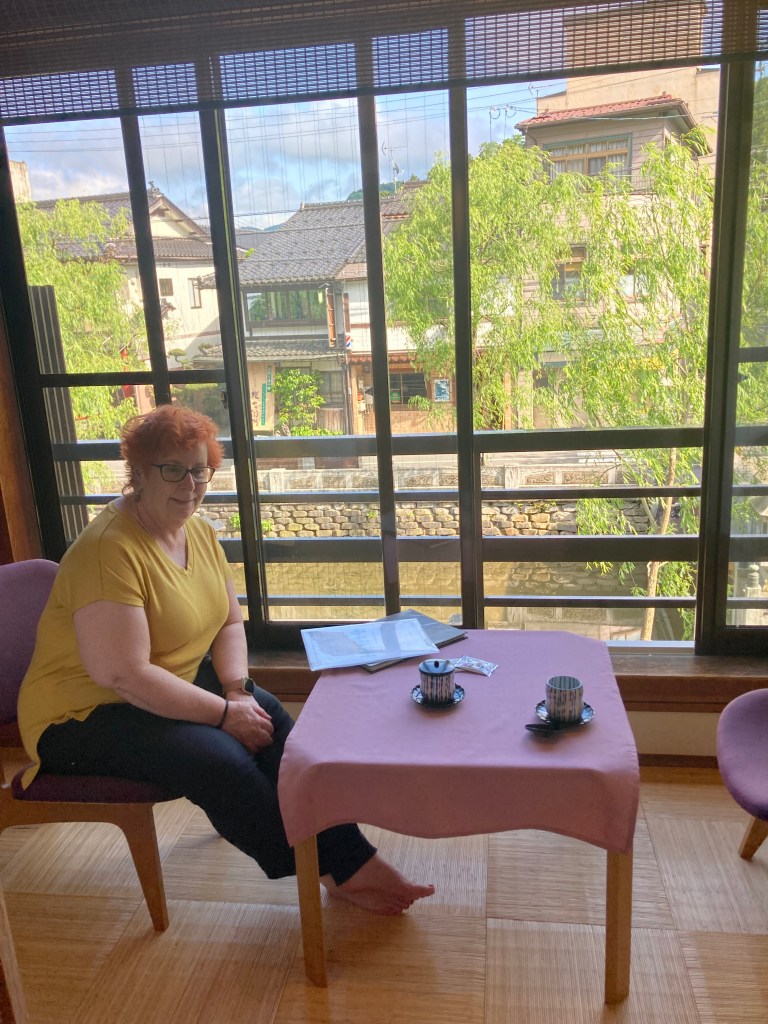
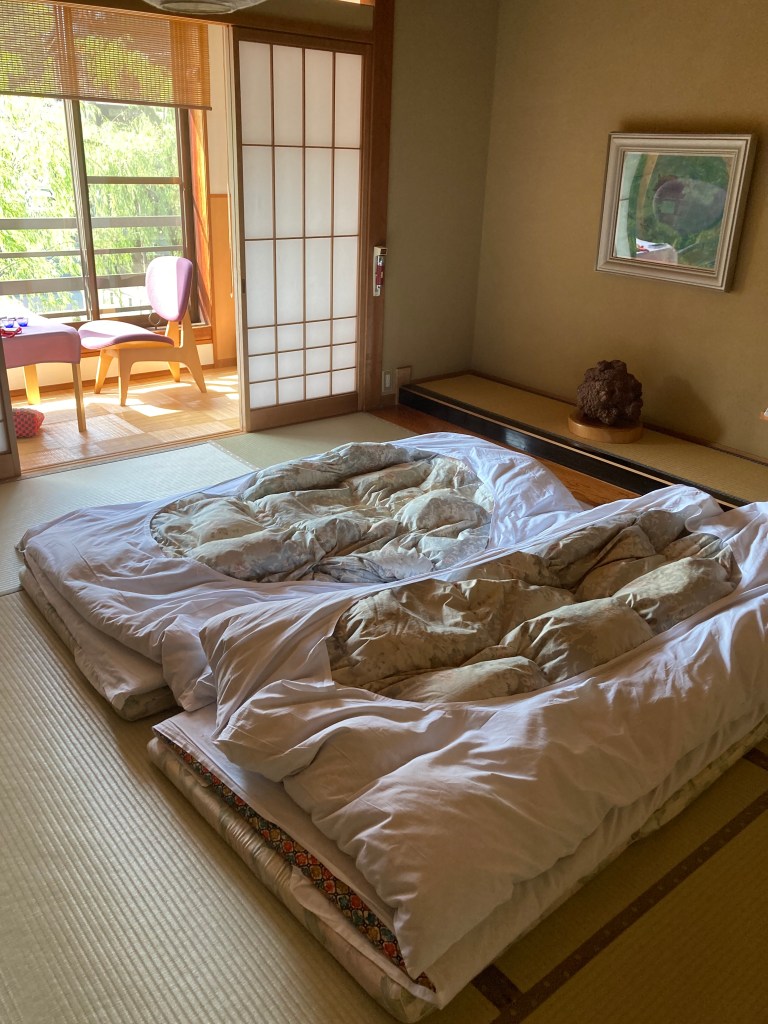
Wilf booked us into a real old school inn. It is a modern three story building, but built in a very traditional style. Once inside the sliding doors we took off our shoes and were issued slippers with our room number on them. No elevators. Our room was on the second floor facing the river. Inside the door is a entry area with wooden floors. A door to the left led to the toilet – a special pair of toilet room only slippers was in there. We took off our slippers and stepped up and into the main room which had tatami mats on the floor. There was a low table there, and the first evening the staff laid out our futons for us. Through another set of sliding doors was a sitting area with a regular height table and chairs. In the corner there was a wash basin. The sitting area had sliding glass panels we could open to lean out and look at the street. No shower in the room – there was a communal bath downstairs we could use. But the expectation was that we’d be trooping off to the big public baths.

Sitting are with a view to the river.

Sleeping on the floor – the getting up and down was rather a challenge!

Also awaiting us was a basket with clothes for us – yukatas (cotton kimonos) with a sash, tabi socks, a jacket and a set of towels. We were also given a lanyard with a pass that would get us into the seven public baths in the town. When we left the inn we wore wooden geta clogs. All day and into the night we could hear the clop clop clop of people walking up and down the street in their clogs. Each inn has its own design for the yukata, so we could spot our fellow residents.

Heading out for a bath.

On the top floor was a spacious restaurant. We had opted for full board, which included dinner and breakfast both days. The kitchen was amazing and the food was delicious. We were never asked about food issues and weren’t told what the menu would be. We sat down and the food began to arrive.

Formal meals in the style we were served are called kaiseki ryori. They are follow a set order, and highlight local foods and the season.

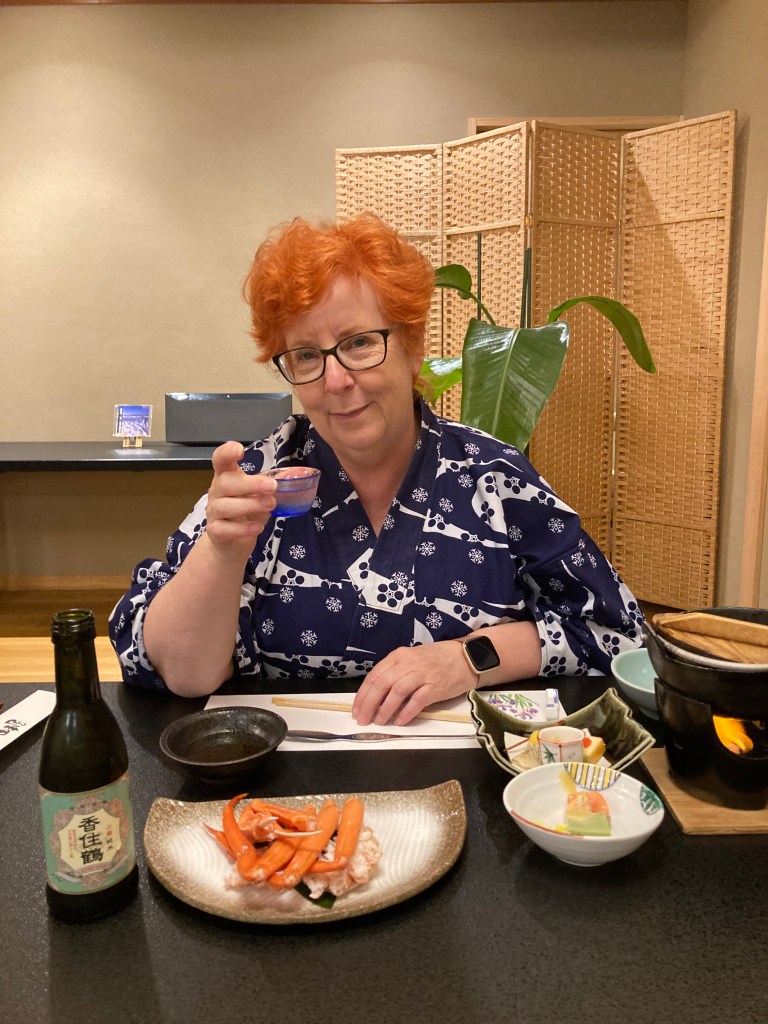
First up – cold appetizer – local crab, and several other small dishes of bites of this and that. There is a hot pot cooking the soup course. Sometimes when we stay at a traditional inn everything is brought all at once. This time things were brought in clusters. And the young lady serving us would tell me what everything was. That doesn’t always happen.

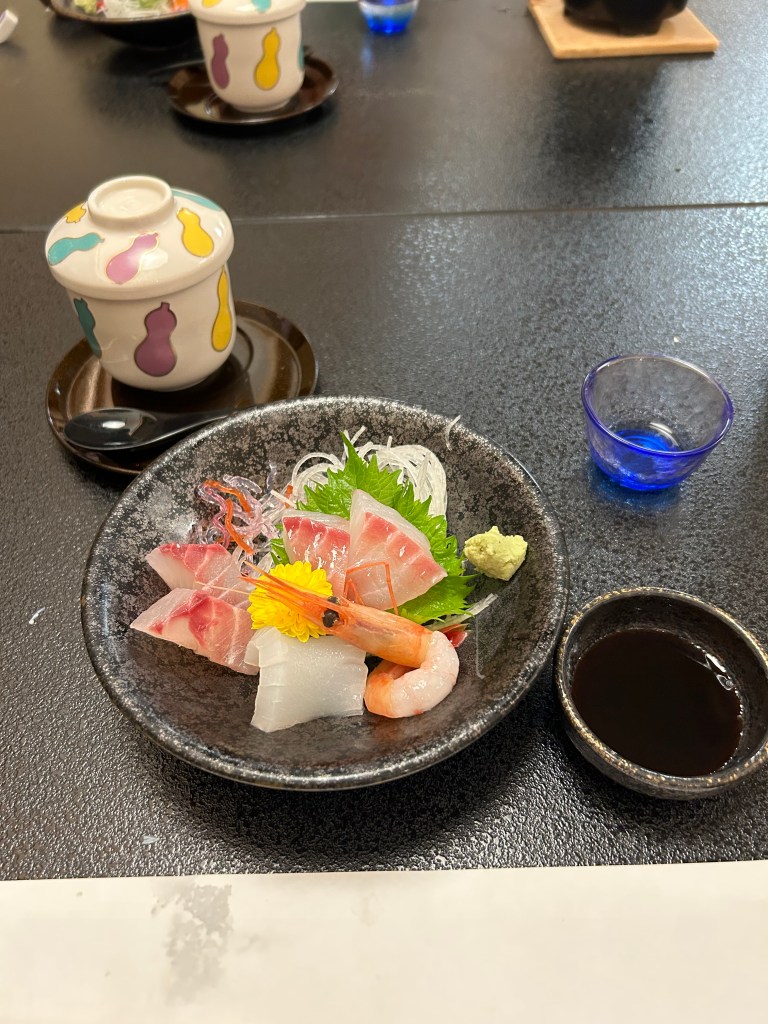
Sashimi course. The little lidded dish contained another course – a savoury custard with fish and mushrooms.

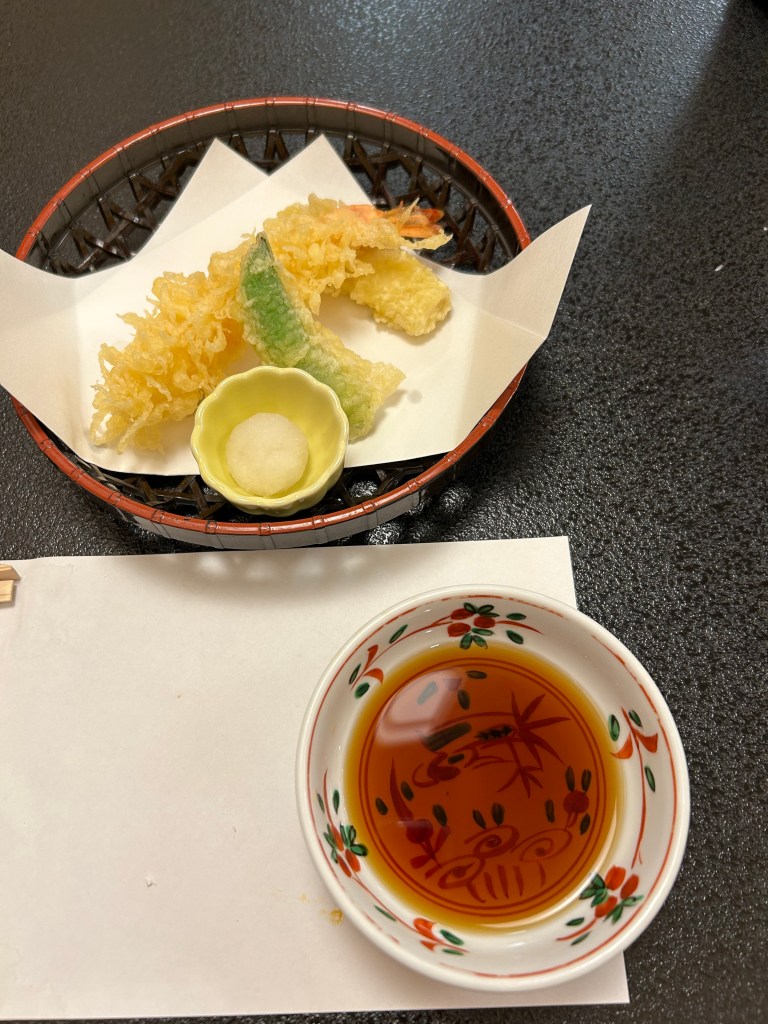
Fried course – tempura and sauce.

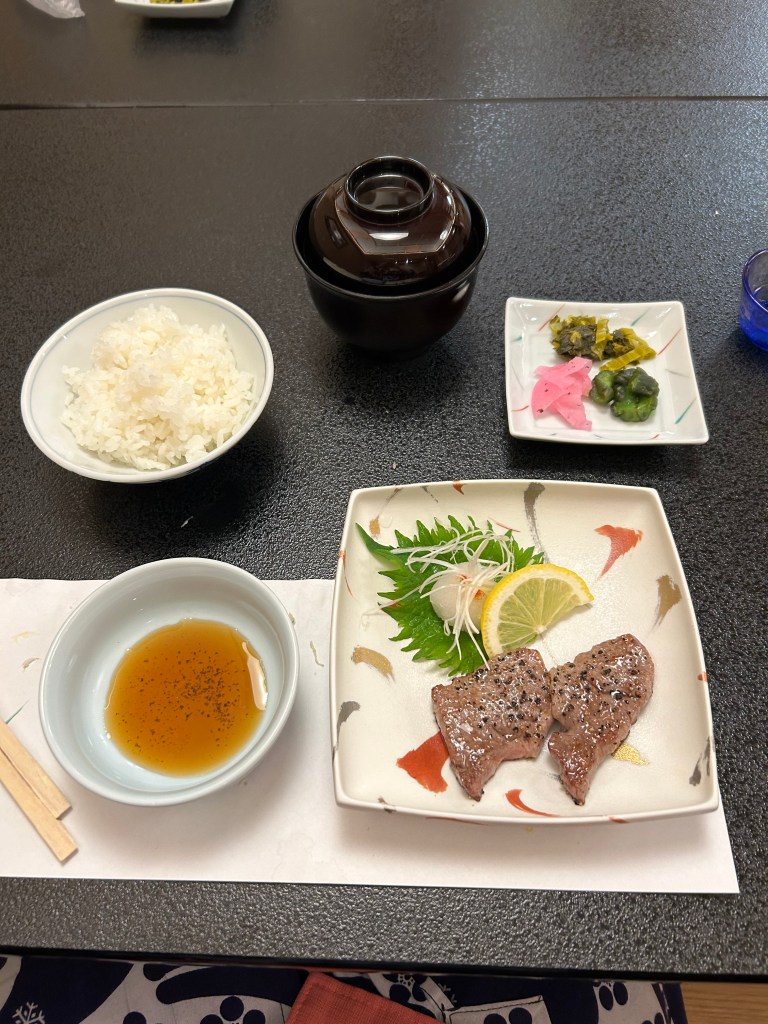
‘Main’ course- local beef, grilled. Last course is the miso soup, rice and pickles.

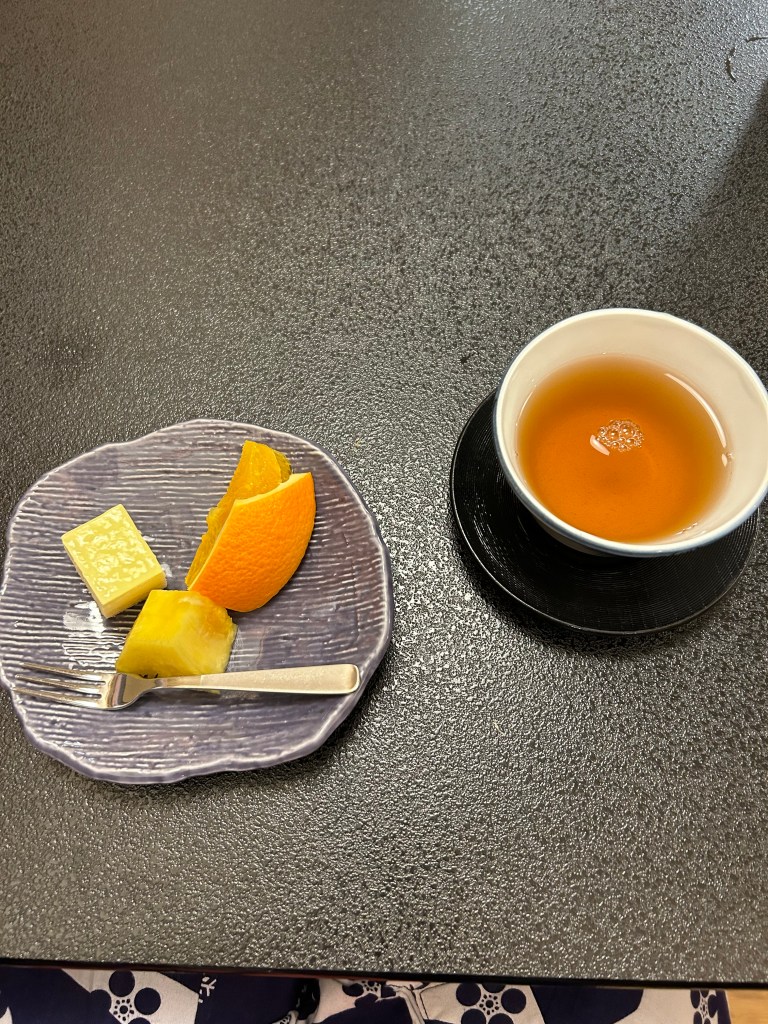
Tea and fruit to finish.

The second night the meal was completely different but followed the same pattern. The ‘main’ was an abalone, which had been steamed in butter at the table.

The thing that I found amazing was that on your first night you had the crab to begin and the steak main. Second night was the abalone. On our second night there were people in the dining room having the crab meal. Which meant that the kitchen was preparing two completely different meals, each of which had nine courses. Yikes! I’d love to see how that was organized.

I’ll talk about breakfast later, but it was the same – different breakfasts for different days, multiple courses for each one.

After our very rigorous day in Hikone we had a long travel day to get to Kinosaki. We enjoyed walking around the town, our first meal and sitting and watching the world go by. Oh – and after all the rain it got hot! We fell onto the floor and our futons and slept big so we could prepare for the adventures ahead!

Number Five kind of broke us

Inuyama Castle was number four of the five national treasures. That left Hikone Castle. We left Inuyama in the rain – too much rain for a stroll along the river back to the station, so a taxi it was. We made it to Hikone on the shore of Lake Biwa by early afternoon. It was Sunday in a smallish city (pop about 120,000) so things were pretty quiet. We decided to tackle the castle right away – just in case!

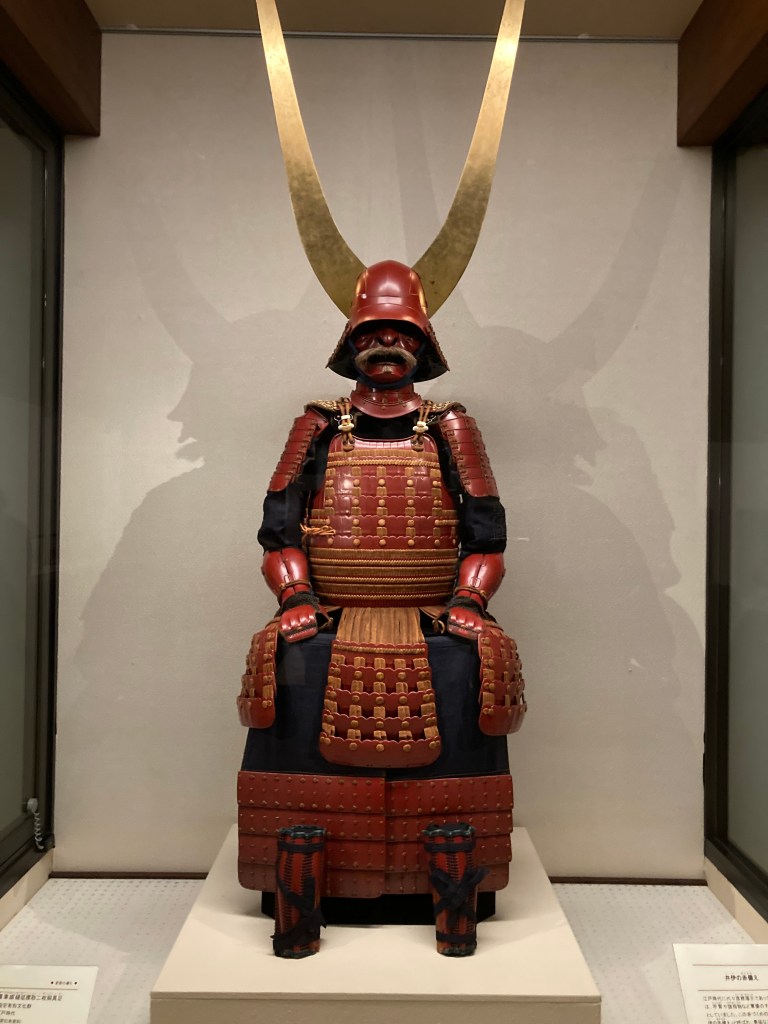
We were feeling a bit droopy after the stair climbing exertions of the day before, but it didn’t look like too far a walk – maybe twenty minutes. The castle grounds are quite spacious and there were several moats and gates to pass through. It turns out that the castle was held by one family pretty much through its entire history. The family name was sometimes translated as Ii, other times as Hi, but for 400 some years this was their place. Mid 20th century they donated the castle and their artifacts, which went to a museum. The museum was very interesting. The artifacts were interesting on their own, but at the back there was a reconstruction of what the living quarters would have been like back in the day. Unlike the luxury of the palace at Nagoya this was fitting for a more minor lord. Seemed more relatable than the gold and glitz of the Nagoya Castle.

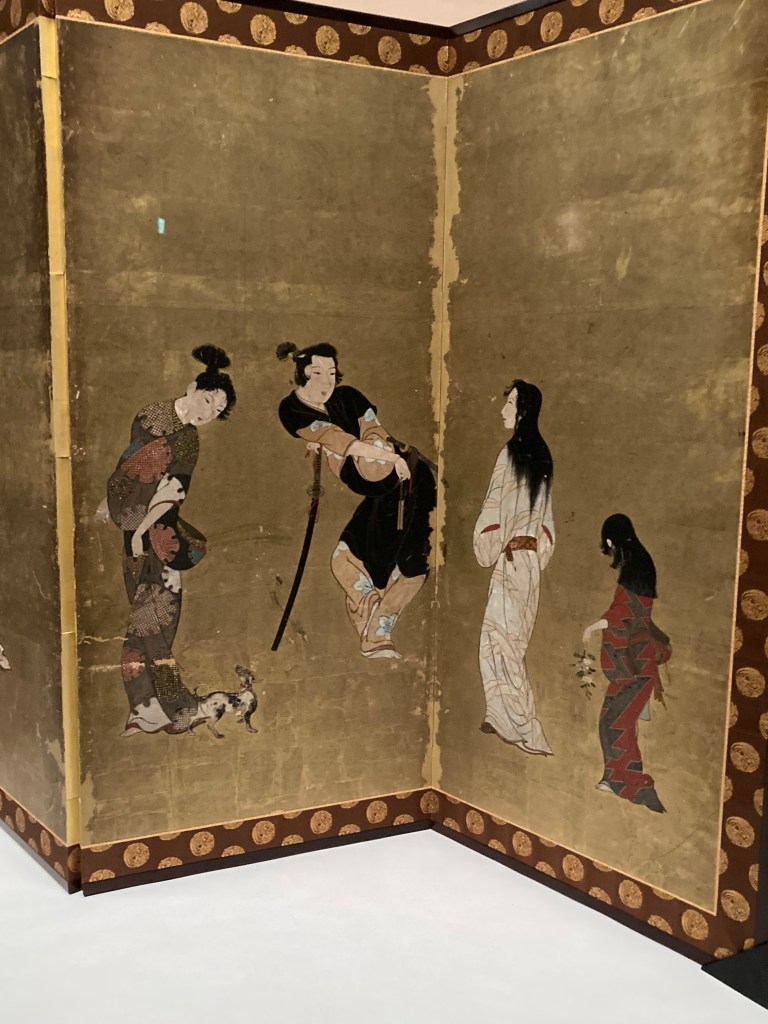
A bit of gold on a lovely screen.

I find it hard to believe that this guy wasn’t forever banging into the door frame and snagging himself on over hanging branches.

However, one inescapable fact of castles had to be dealt with.

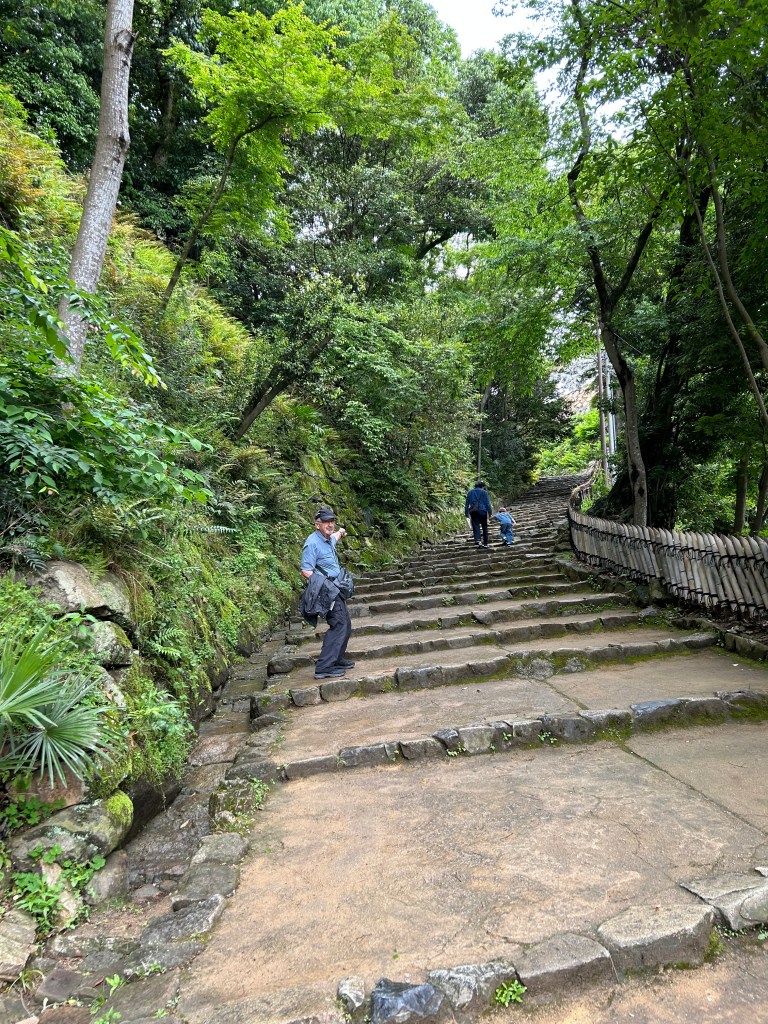
First the long walk up the hill.

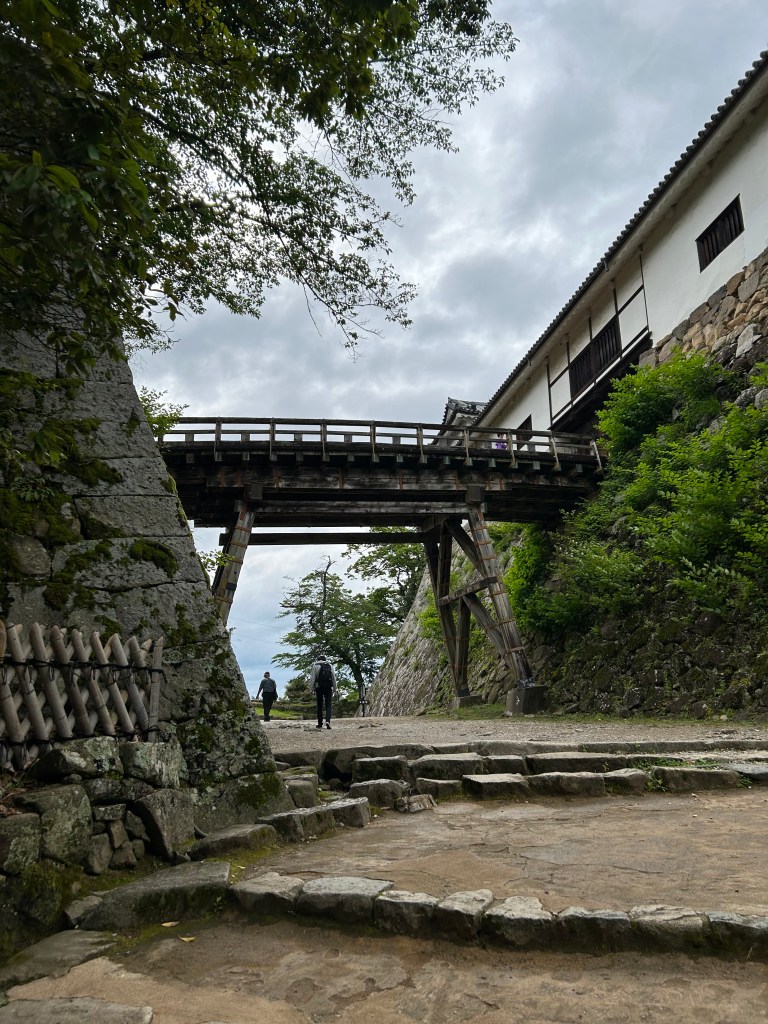
Ugh – that’s the entrance up there. Around the corner to the left and up another hill.

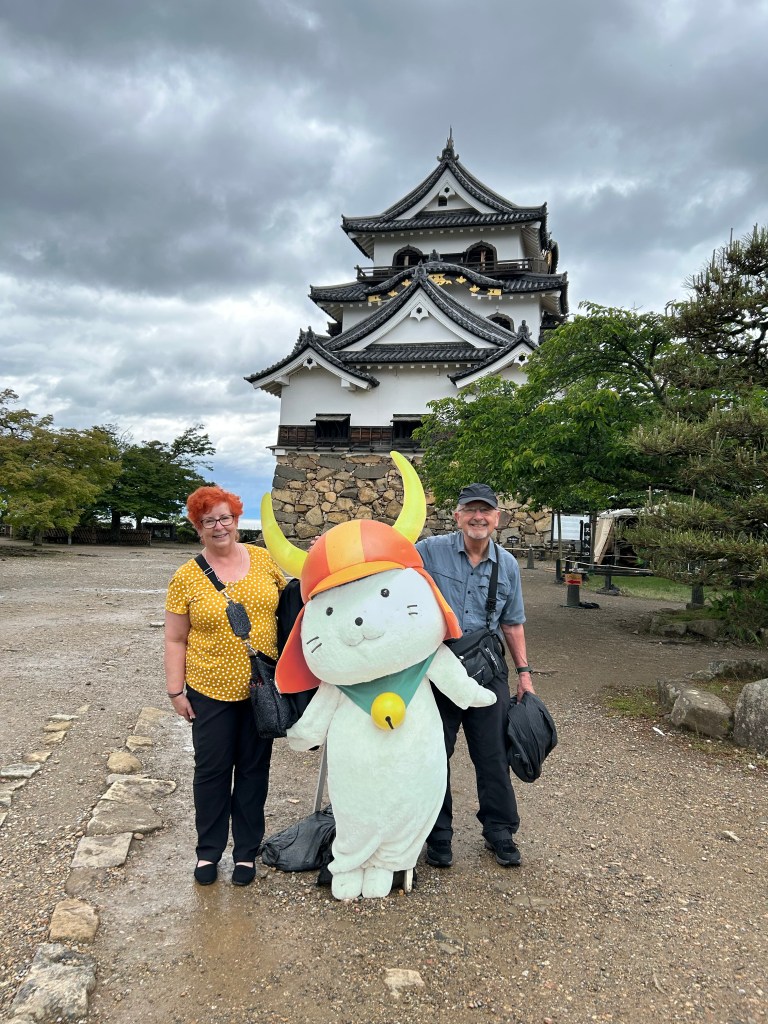
And the all important mascot. Meet Hikonyan, a cat wearing the horned helmet of the Ii family. Cat at least went for the helmet less likely to snag the tree branches….

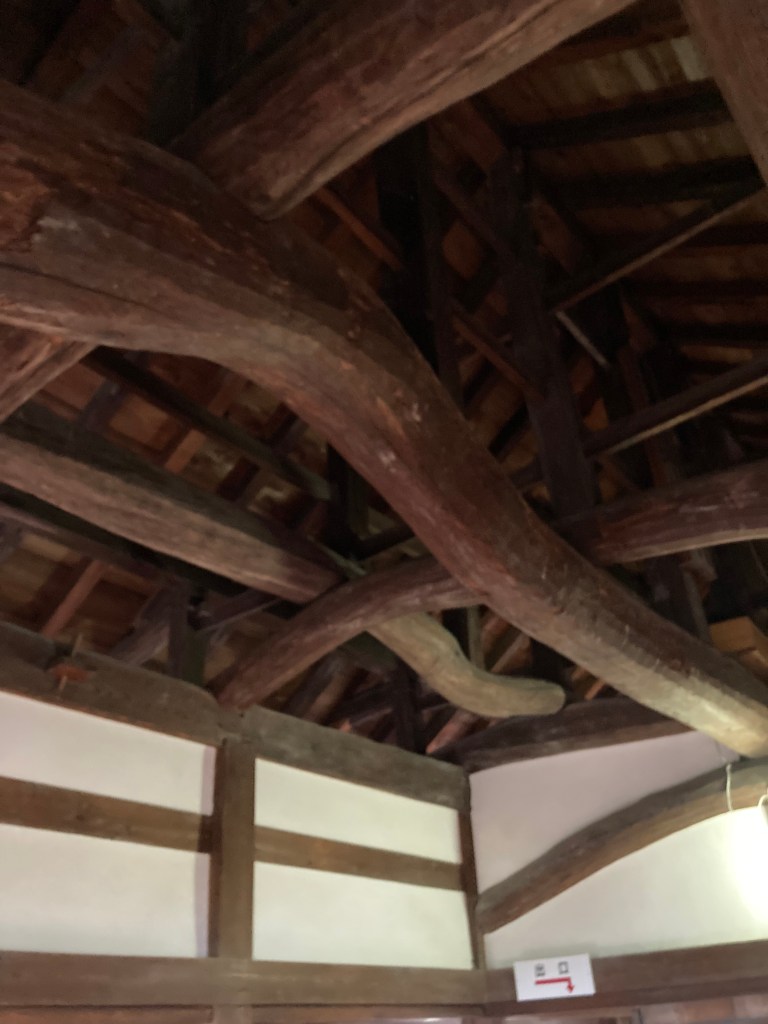
Once again out of our shoes and up the stairs. At least this time they had more modern stairs and hand rails – still steep but not a ladder! Looking at the floor boards and ceiling beams really gives an appreciation of the size of the trees that were used for the construction of the castle.

And at the very top the beams were these huge trunks that were somehow woven together….

After our explorations of the castle it was time to head back down. The weather was threatening but we thought we’d have a chance to visit the garden. But this is where we made a tactical error. Rather than go down the steep slope we had come up we decided to go the back way – what was called the accessible slope. Yeah. Bad Idea. First – laws of physics say if the way up is short and steep and the way back is a gentle slope then its going to be a long way. And they lied about the accessible part – it was both very long and full of steps. By the time we finally got back to the entrance point we had walked a very very long way. We were utterly done. Staggered back to the hotel. It was a night for fried chicken from the convenience store. Number Five did us in – but Wilf has the Five National Treasures ticked off of his bucket list!

A thing about castles….

Probably the most famous castle in Japan is Himeji Castle. It is nearish to Osaka. From our first trip in 2009 I wanted to see it, but it underwent a long period of restoration and it wasn’t until our 2015 trip that we got there. And it is spectacular. We had a volunteer guide on that day and he made sure that we saw every. single. thing. that there was to see. It was nearly the end of us!

But Himeji was not our first castle, nor our last. In fact it has become rather a thing with us. Osaka. Kumamoto. Kagashima. Kochi. Matsue. And on it goes. And eventually one begins to have opinions. Wilf has become interested in finding the oldest and most un-altered castles. Turns out – there’s a list of those.

There are five castles in Japan considered National Treasures because they are intact from the time of their construction in the late 1500’s early 1600’s. The castles are Himeji, Matsue, Matsumoto, Inuyama and Hikone. In 2015 we visited Himeji and Matsue. Last year we went to Matsumoto. And on this trip we are going to see the final two.

There are way more than 5 castles still standing in Japan. Many fell down, were taken down, were bombed and then rebuilt. The big five have never suffered such indignities. The rebuilt castles often used modern techiniques – for instance concrete for the tower rather than stone work. Some – looking at you, Osaka – have escalators inside to manage the huge number of visitors.

The original old castles don’t have the creature comforts. They were military installations, not homes. The staircases are more like ladders. The ceilings are low. Because the floors are original wood visitors go stocking foot. And of course – castles are on hills, right? So it is always an adventure to get up to them.

Leaving Nagoya we headed to Inuyama. Turns out we could hop on the subway, ride it until it popped above ground, make one transfer and there we were. When we were discussing the hotel we were mainly considering location – something not too far from the castle. We were walking along the river when we saw the sign for the hotel and turned in. And found ourselves walking through a beautiful park. Eventually we came around a curve and -‘Dorothy, we’re not in Kansas any more’. A beautiful hotel with the castle perched high above it.

A lovely young lady was standing out front to greet arriving guests. No standing at the counter to check in here. We were escorted to a low table, offered a cool drink and whoosh all the formalities were handled. We were rather distracted by the view from the lobby….

A pond, a park, a castle.

As is so often the case with us – things were not so straightforward. We were too early for the room. We thought we’d walk over to the castle area and scope things out. If the weather co-operated we would see the castle precincts and then go back in the morning to see the the castle proper.

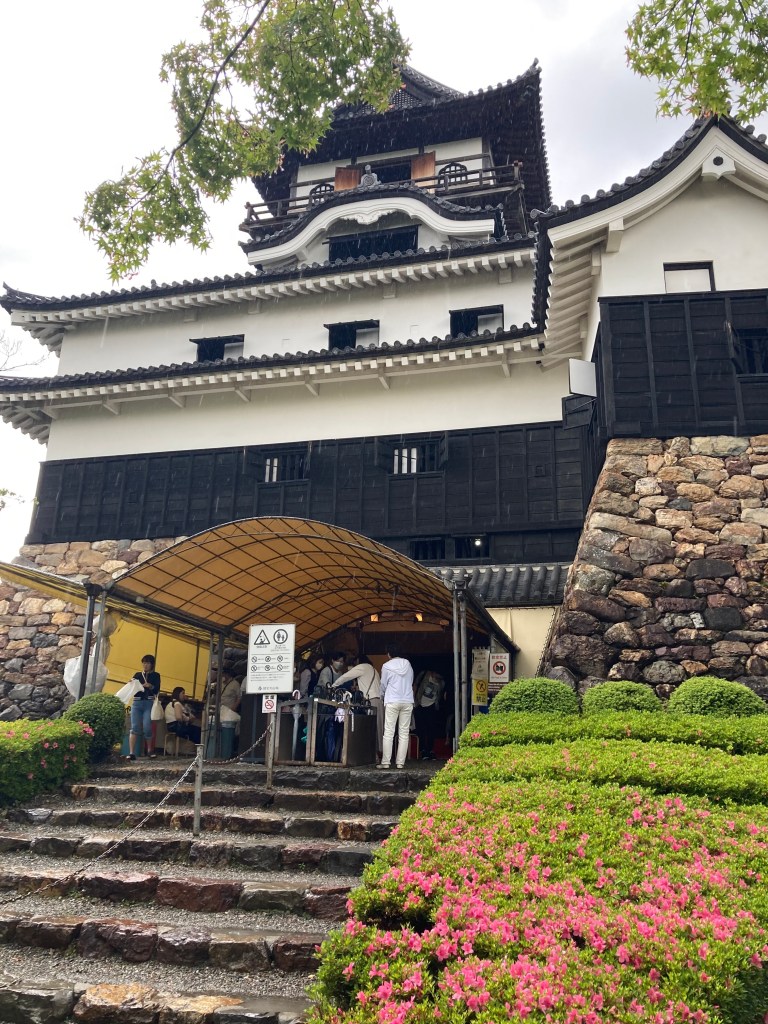
We had hardly got around the corner of the building when the skies opened. Rain like in Singapore. We sort of swam upstream to the area directly below the castle. Inuyama is far enough away from the coast that it didn’t take direct hits during the war and the area directly below the castle has been preserved in a mid-century style. There are many small shops and historical buildings, though the pressure is on to infill with more modern structures.

We walked through part of this shrine, ducking the rain. At the ticket booth for the castle the thunder was booming.

Only a few more stairs before the entrance and shoe removal. (As you can see we didn’t totally miss azalea season!)

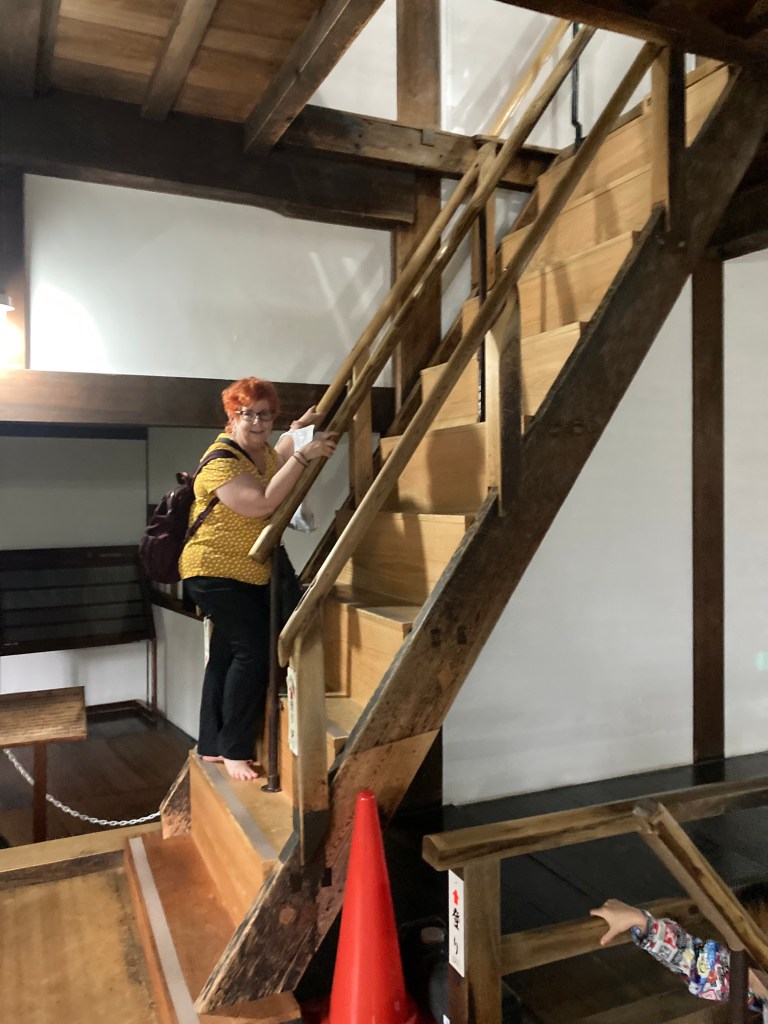
And up we go. Most castles have the entrance a story or two above ground (storage in the lower levels behind the stone walls) and then you go up another 3 or 4 levels from there. At least these stairs are stairs – steep ones, but still stairs and not ladders.

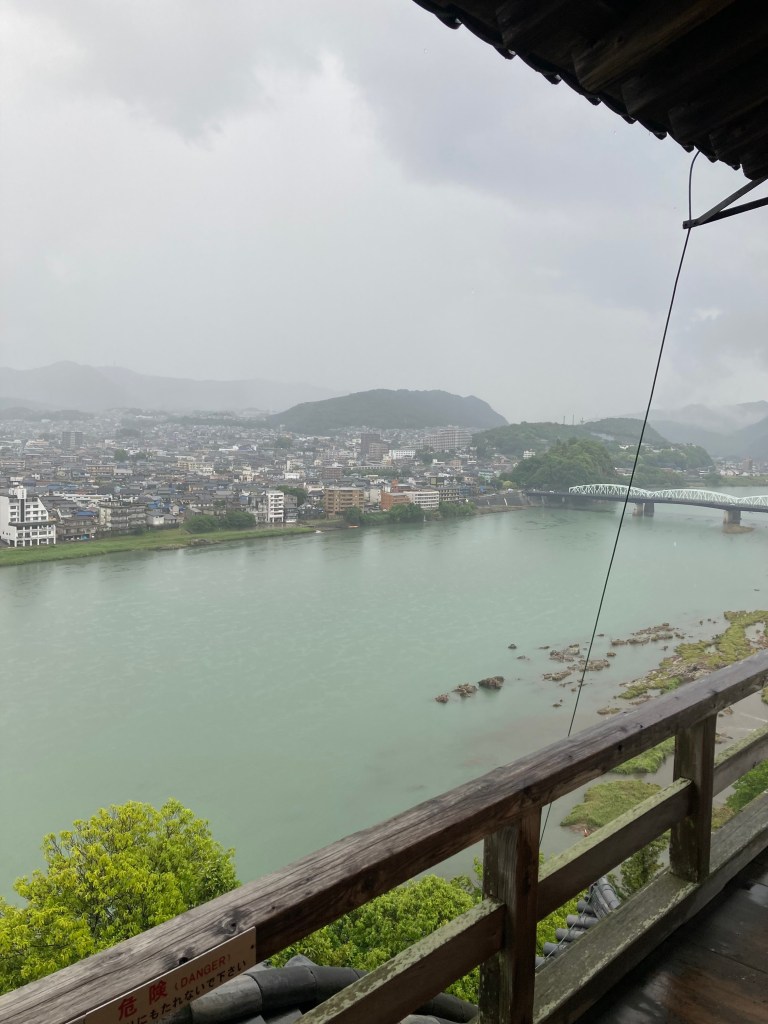
Even on a rainy day with a very low ceilings there is a view….

Across the river

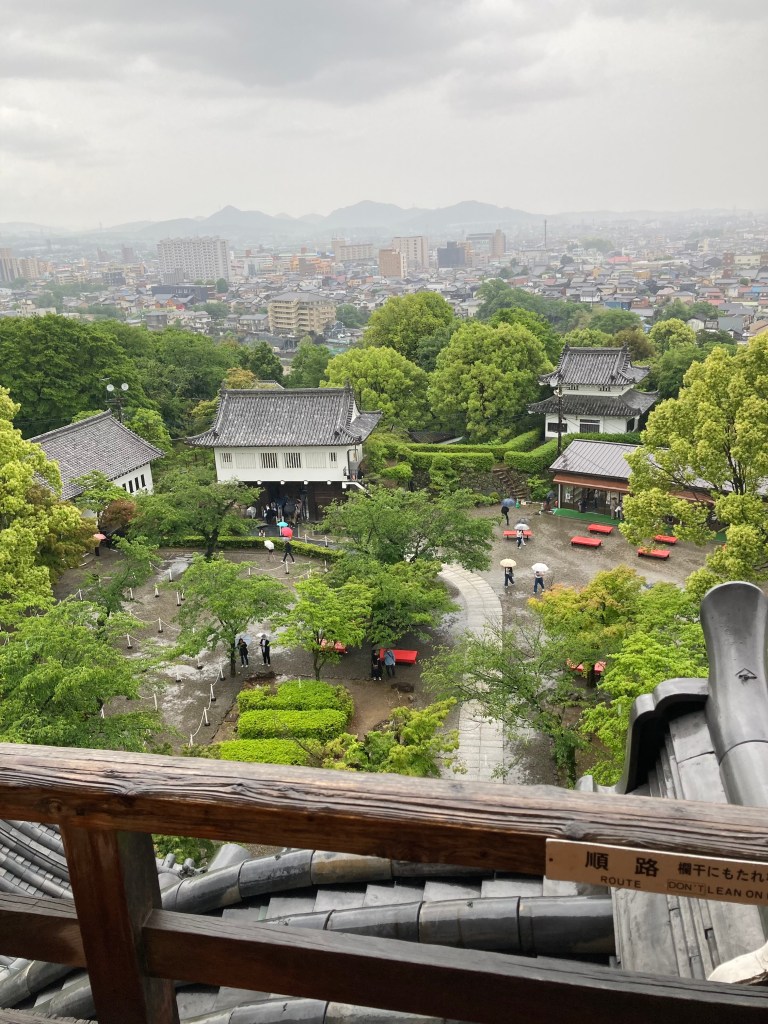
The castle grounds looking to the old town with the city beyond.

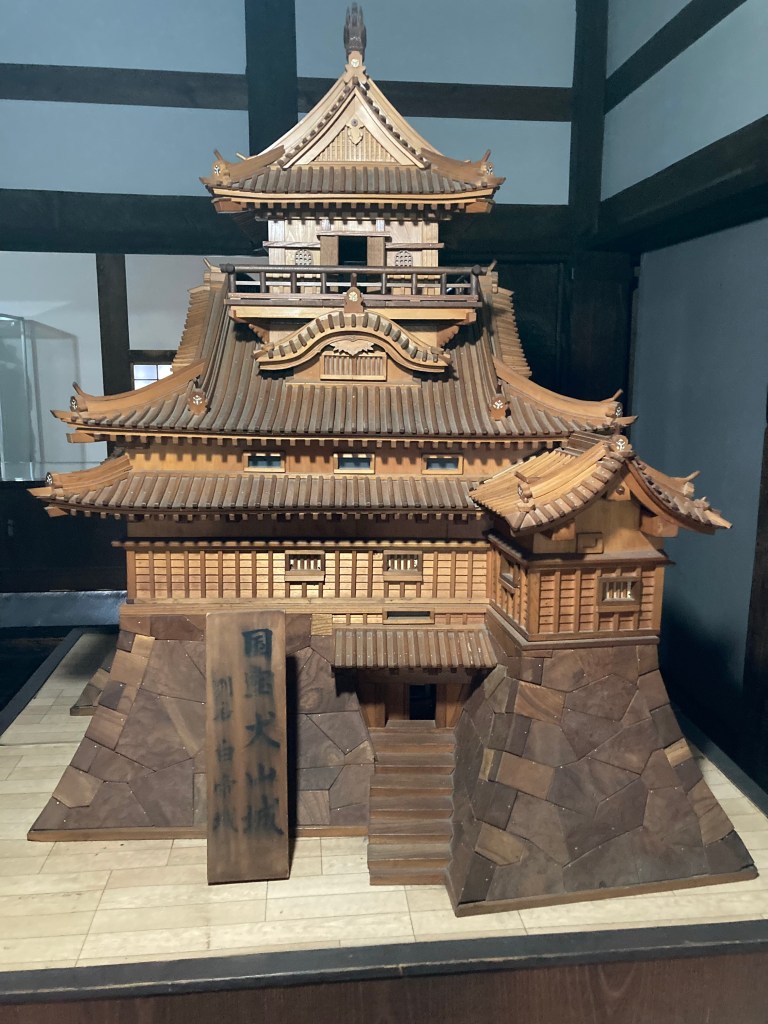
The requisite model of the castle. The upper walkway is usually open, but not in the rain of the day.

The rain did not pound down all afternoon – came in bursts so we could find places to hide.

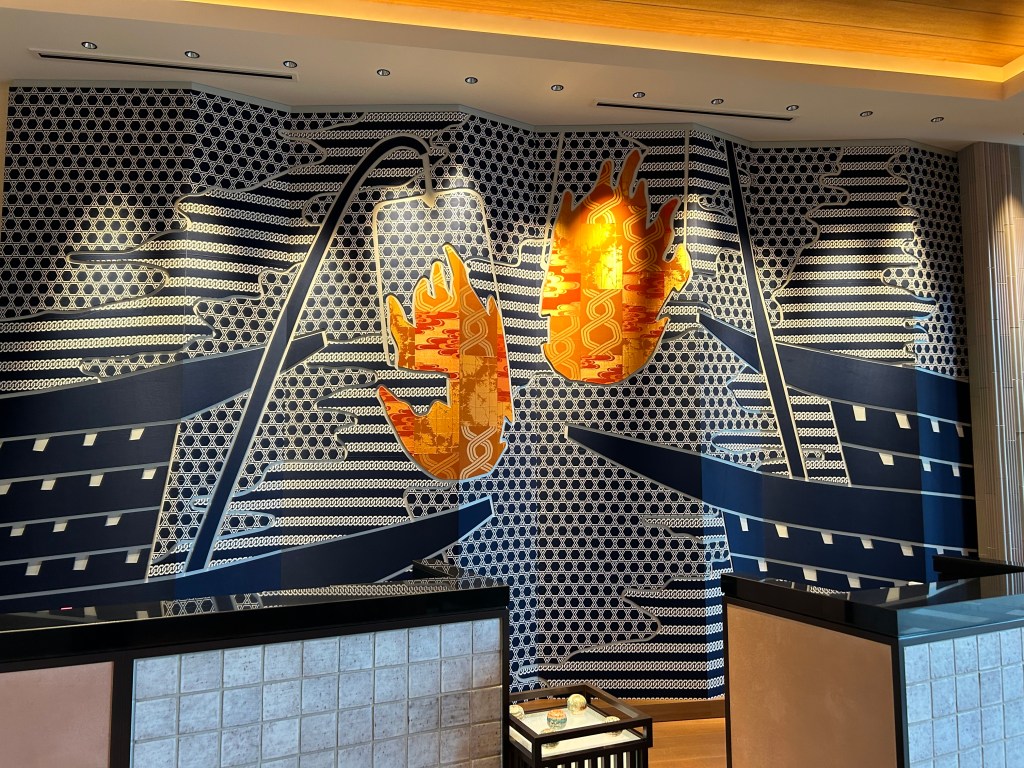
One of the things this area is known for is cormorant fishing. The fishermen use cormorant birds to dive for fish at night. The boats have a lantern hanging off them which attracts the fish. The cormorants dive and catch them and the fisherman take the fish from the birds. I doubt the birds – or the fish – enjoy this. Behind the check in desk at the hotel there was this graphic printed on a huge folding screen. I was so busy looking at the blue and white patterns that I couldn’t really see what I was looking at and could not figure out what the orange blobs were. It wasn’t until I took this picture that I realized it was a very stylized rendering of four boats, two of which had lanterns on curved poles hanging over the water…. The blue patterns that caught my attention depict the currents of the water.

The Hotel Indigo Inuyama Urakuen Garden may be the most beautiful hotel we have ever stayed in. Everything was so lovely and well thought out. There was a nationally famous garden on the property but given the monsoon we were experiencing we didn’t visit. Should you find yourself in Nagoya this would be a nice day trip – but even better to experience the hospitality of this hotel.

Wrapping up Nagoya

Two days is not enough to really get a sense of a city, but we did decide that we quite liked Nagoya. It is not nearly so crazy busy as Tokyo or Osaka, but it has its own style, its own appeal. Just before we came on this trip I read an article online from CNN, which talked about Nagoya trying to shake is reputation as the most boring city in Japan. That seems rather harsh.

I’ve talked about the history – the castle and the palace. And there are some venerable old shopping streets. We were right near a very buzzy area full of clubs and bars – not that we saw them in full swing (early to bed for us after a day of being tourists.)

We did walk out on Friday night, and things were lively. We were headed to see the Oasis 21 site, which is to be seen at night, all lit up.

Pretty cool, eh? The big spaceship thing is just that – a thing! It hovers over an underground complex. There is a big bus terminal, and a connection to the subway and train systems. There is an underground shopping centre, and directly below the spaceship thing there is a huge open area used for events.

Walking about on a Friday night it became apparent that every wannabe musician in Nagoya sets up on the sidewalks and in the park to sing and play their hearts out. One of the (many) subway entrances lets out two floors below street level, into what is basically a big stairwell. There was a stage set up down there and an all male JPop group was giving it their all. I’m guessing that performing at the bottom of a stairwell in front of a subway station is pretty far down the food chain of the pop music industry, but there was crowd hanging over the railings at street level and down below there was a rapturous crowd of sweet young things singing along and dancing to the music.

And so went a Friday night in Nagoya….

Collected my first ‘jōzudesu’

I think I may have finally passed some point in my Japanese studies where things are starting to – sort of – click. Not in any huge way, but I’m starting to hear what is being said around me – and to me. I can read some signage. And I’m speaking to people. Japanese people are very kind when people try to speak their language. And anything beyond the very basics is usually rewarded with 日本語は上手です! ‘Your Japanese is good!’ I got my first one of those yesterday.

But more of that later.

Yesterday was Nagoya Castle day. We took the subway from our hotel and were at the castle grounds in short order. It was a beautiful day – sunny, mid 20’s, light breeze. We haven’t enjoyed weather like this since – last Fall? So nice.

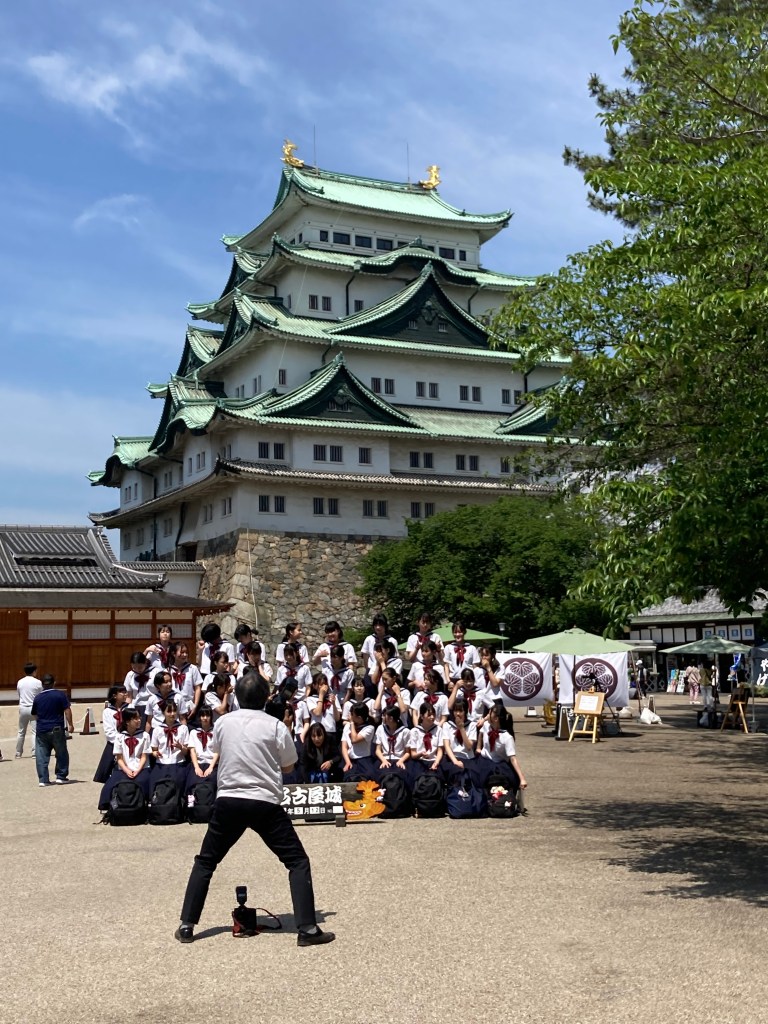
As is often the case the castle area was full of students on a school tour. One very important part of the school tour is the group photo – here’s a group from a girl’s school. They are not quite composed into their usual serious mode for the official photo.

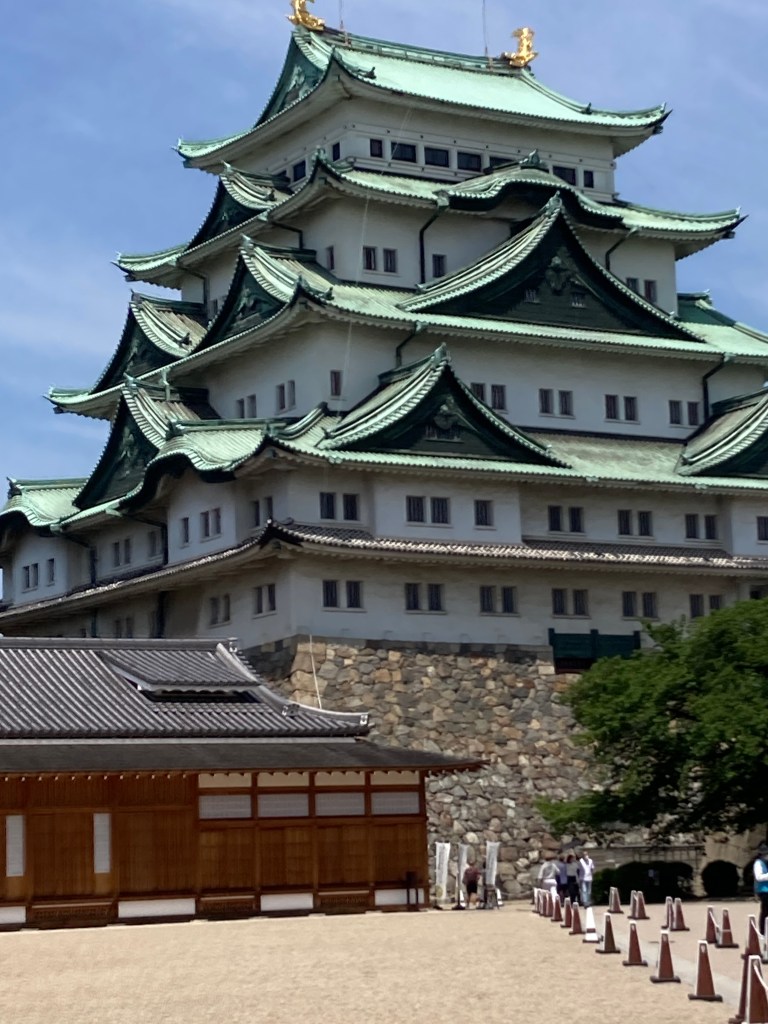
Its a pretty impressive castle, isn’t it? Sadly, the tower is not open to the public. The original castle was destroyed during the bombing of WWII. Because it was such a historically significant castle it was rebuilt and re-opened in 1959. It was built from concrete and steel and made to look like the original castle. Turns out it is not to modern code for earthquake survival. The decision has been taken to rebuild the structure using traditional methods, based on the original specifications from centuries ago. While the funds are raised the castle keep is closed.

The good news is that restoration of the residential Honmaru palace that was also destroyed during the war is complete. And it is exquisite!

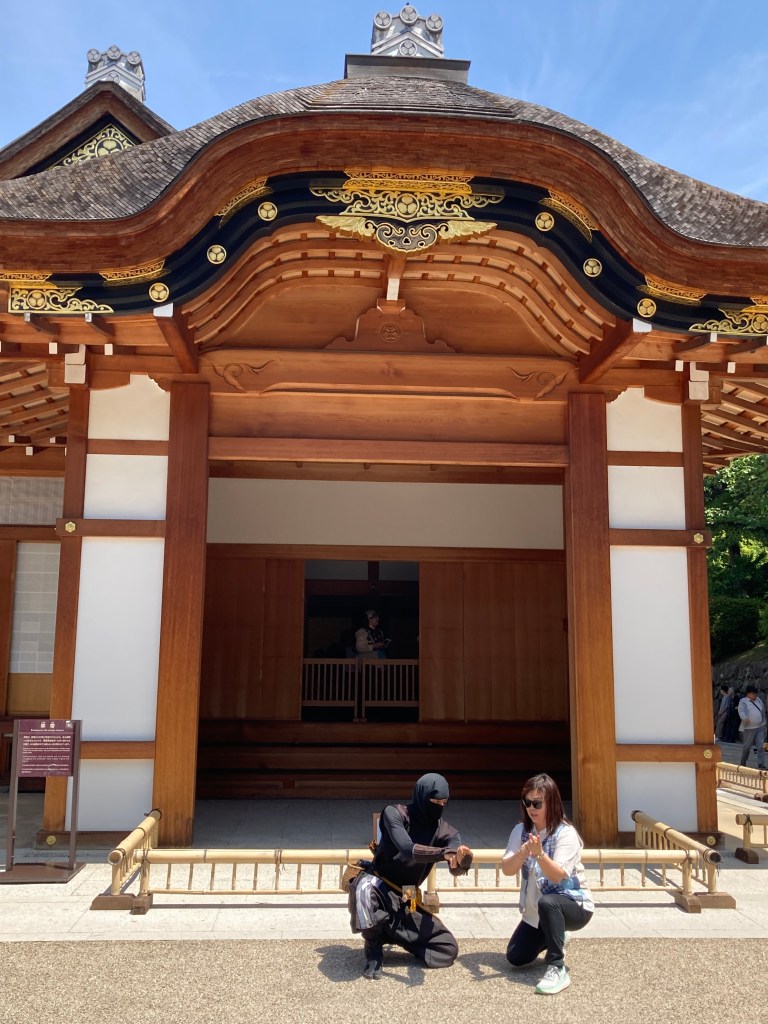
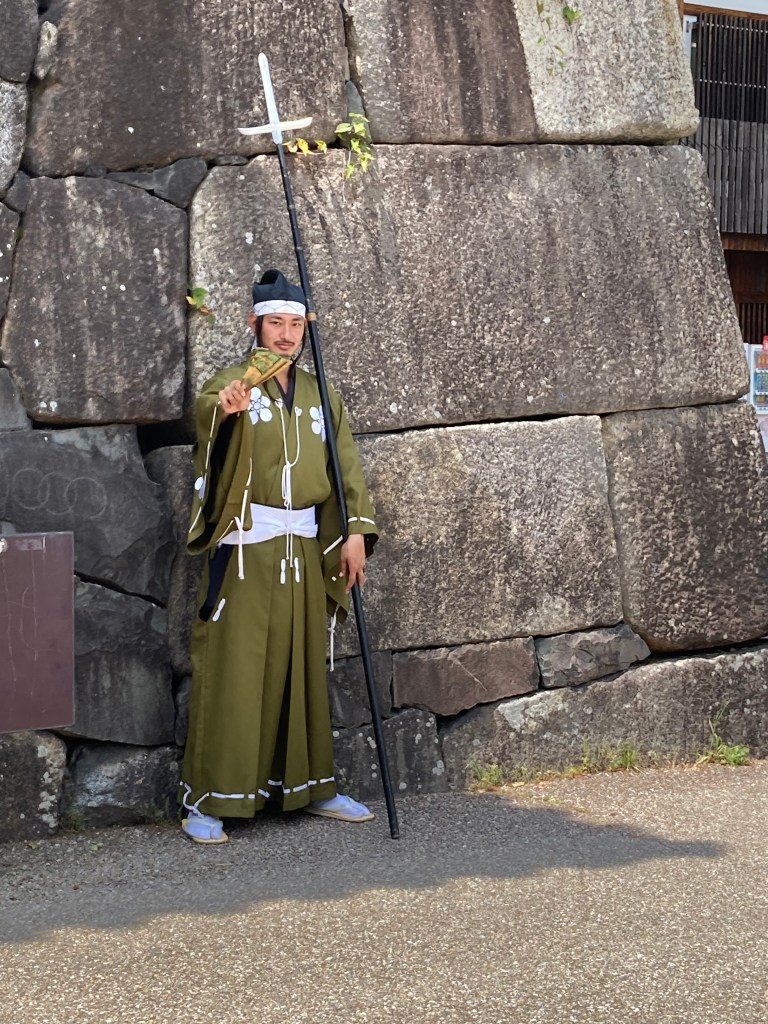
If you were an important guest back in the day you would arrive at this carriage gate for your audience with the daiymo. Currently there are shinobi (ninjas) about teaching the tourists secret hand signals.

Room after room with beautiful screens, painted ceilings, amazing wood work.

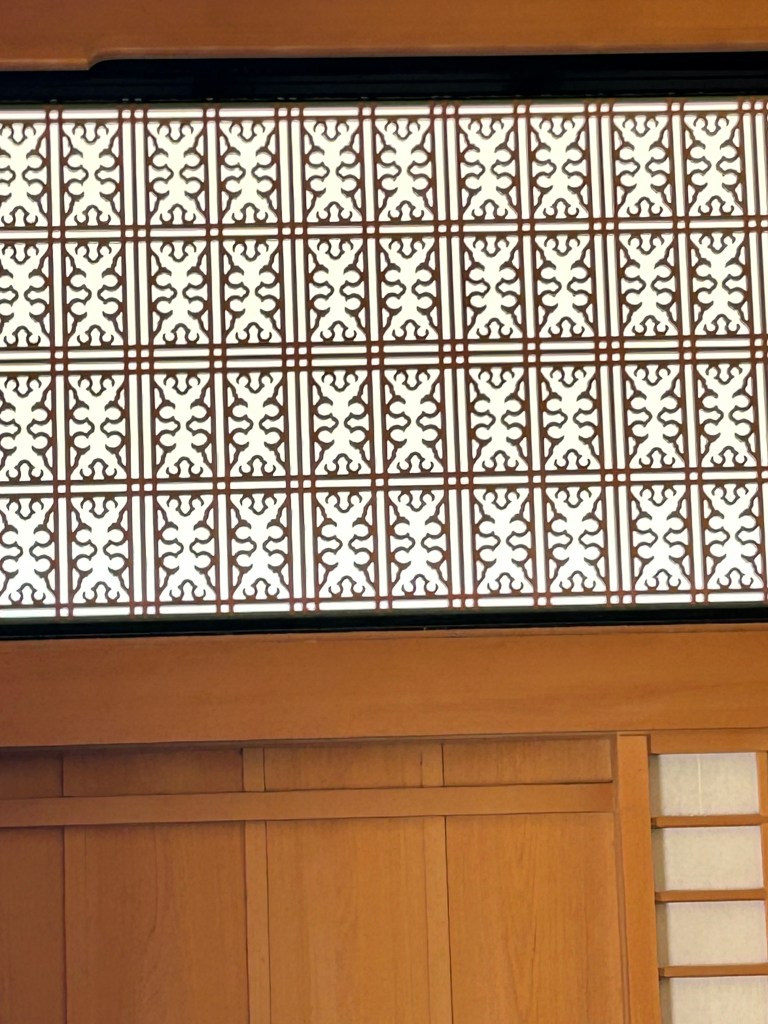
These lattice panels let the light into the corridors, above the sliding doors. It was really impressive to see all the craftsmanship that went into the restoration.

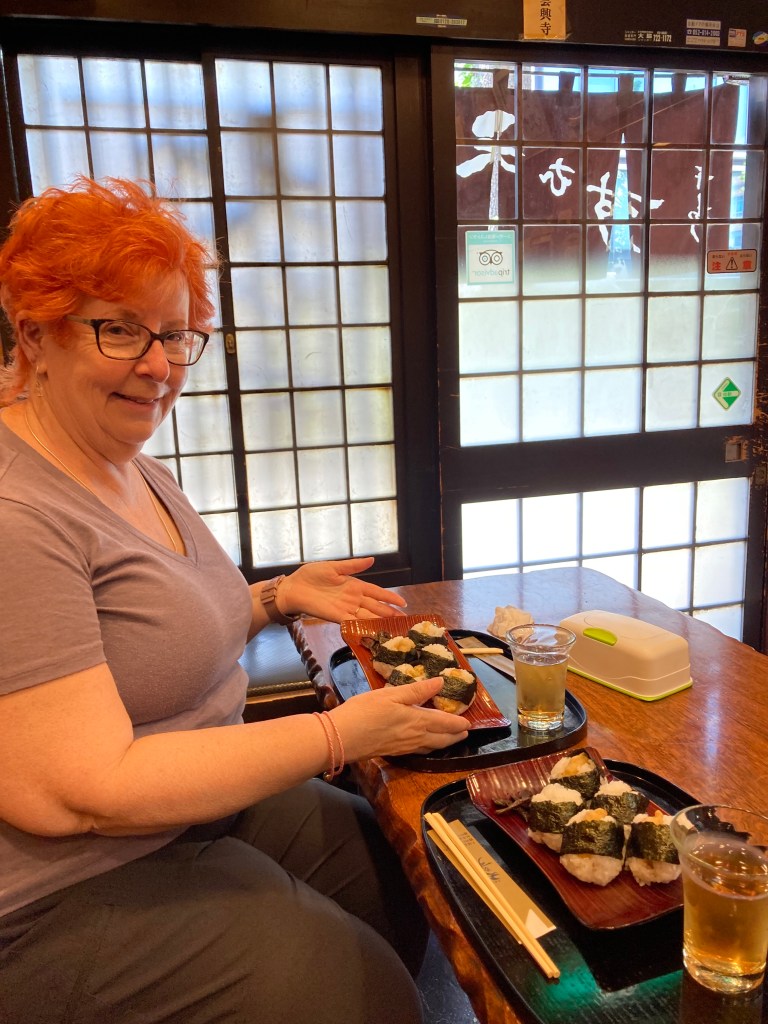
The grounds were surprisingly large and we had a good wander around before getting back onto the subway and heading for a shopping street. One of the local specialties are a version of onigiri (rice balls) called tenmusu. Wilf had found a place that is known for its tenmusu near a big shopping street. We found it on the first try – thank you Mister Google. This was a tiny little place. It had two tables for eating in, but the real business was making packages up to go. Here’s a picture of what they make:

A plate of 5(!) onigiri. They are stuffed with a tempura shrimp and wrapped with a strip of dried seaweed. Pickled something on the side. Glass of cold tea. Usually onigiri are quite large and two is my max. This style is smaller and not the usual triangular shape. I can usually manage two, but we powered through, ate all five and they were so good. Freshly made – still warm. Yum Yum Yum.

While were eating they were pounding out the tenmusu. The front of house lady handled eat in customers and walk in shoppers. She was also wrapping the boxes of tenmusu and labeling them and loading them 10 packages at a time into carrier bags. In the kitchen they were making more more more. Not a word amongst them, just making and wrapping and packing. We did get talking to the one lady and I ventured a few sentences in Japanese and made myself understood – where are you from? Where are you going in Japan? Have you been? And how about those Mariners? There was a clock with a picture of Ichiro in his Seattle Mariners days…..

And at some point in the conversation the lady said 日本語は上手です. Nihongo wa jōzudesu desu. Your Japanese is good. I managed not to laugh and made ‘oh no, no’ sounds and explained that I was studying hard, thank you. I’m just amazed that she understood me!

After our lunch and a stroll through the Osu shopping district returned to our hotel for nap, then set out for ramen for dinner.

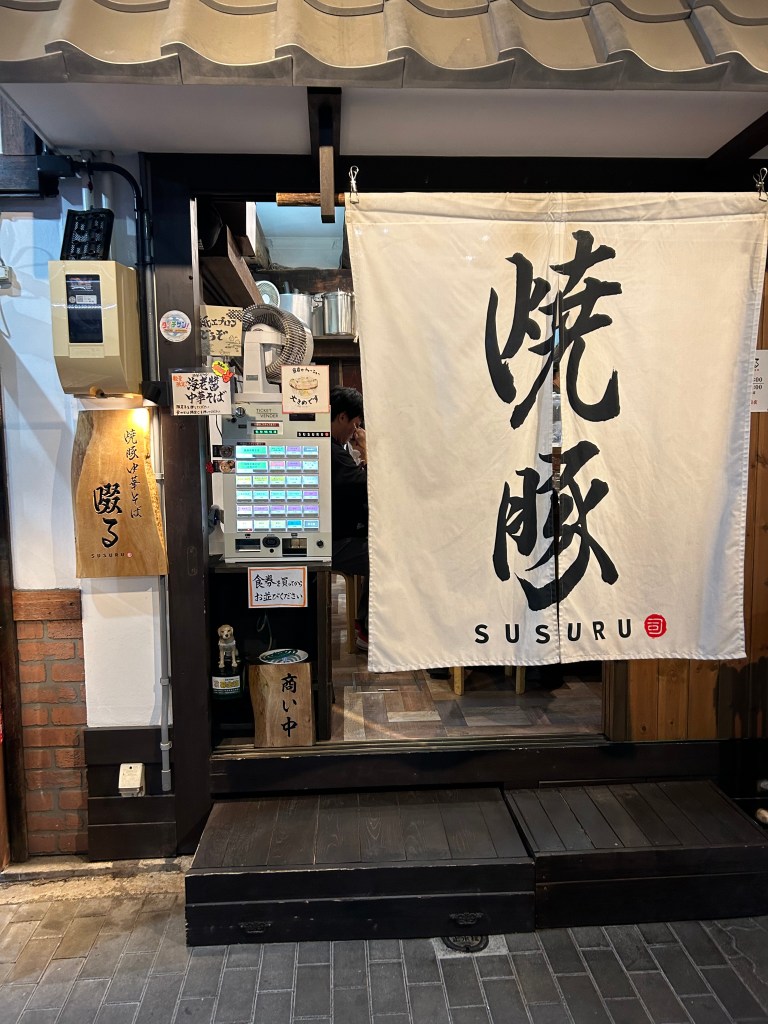
This was our ramen shop of choice. Ticket machine out front- no English but we know that the shop specialty is the upper left corner. There were only 6 spots at the counter, so we had a short wait. One doesn’t linger over ramen and the spots turned over quickly. The ramen master was busy whipping up bowls of soup with big slices of pork – so good!

And after that it was back to the hotel for another visit to the communal bath. Friday night and the place was hopping! I forgot to tell you that most Japanese hotels provide some form of sleeping clothes. Dormy Inn always have what I call ninja outfits. Dark coloured pj bottoms and a tan coloured waffle fabric tunic. And everyone just wears them in the hotel – to the bath, in the lobby, in the restaurant and the lounge area. After 9:30 the restaurant opens up and serves half size bowls of ramen – no charge. Bed snack! Since we had just had ramen we passed. But the place was full up people in their ninja outfits, slurping up noodles. Also available was a freezer full of ice cream bars – those we had!

And one final pic – photo op at the castle….

And here we are again

When last I left you we were in Japan – back in November of 2022. It was a long winter in Sidney with some serious cold, snow and then a long, grey chilly stretch. It was a good time to hibernate. And when Wilf hibernates he plans trips. And this time there was going to be no waiting until the Fall. Instead we decided to pay a visit to Japan in the spring. We waited until all the excitement of cherry blossom season was over, and then waited until all the busyness of the Golden Week was finished. Golden Week is a period at the end of April beginning of May where a series of national holidays in Japan line up and most people have a week off. Very busy time!

And here we are. We did a quick bounce through Tokyo and we are in Nagoya.

We took the bullet train from Tokyo and zoomed south to Nagoya. It is the fourth largest city in Japan, and most tourists blast right through on their way to Kyoto. Granted we are only seeing a small part of the city, but we like what we are seeing. The pace is certainly less frantic than Tokyo…

We are staying at the Dormy Inn hotel – we have stayed at this chain before. One of the benefits of this hotel chain is that they pretty much always have an communal bath, with naturally sourced hot water – not just city water heated up. Usually the bath is on the roof with a view. No roof view on this one, but the spa area is on the second floor and the ladies side has an enclosed outdoor pool. When I say a communal bath I don’t mean co-ed. The men have their side and the ladies there and the two do not mix. On the ladies side there are two pools – a large one inside and a smaller one outside. Everyone gives themselves a very thorough scrub down and rinse then moves to the pools to soak in the lovely hot water. They are lined with smooth marble and have shallow steps that lead into the water. If you sit on the bottom the water is up to your shoulders. You can sit on the steps if it is too hot! After a long day touristing it is lovely to have a soak before bed time.

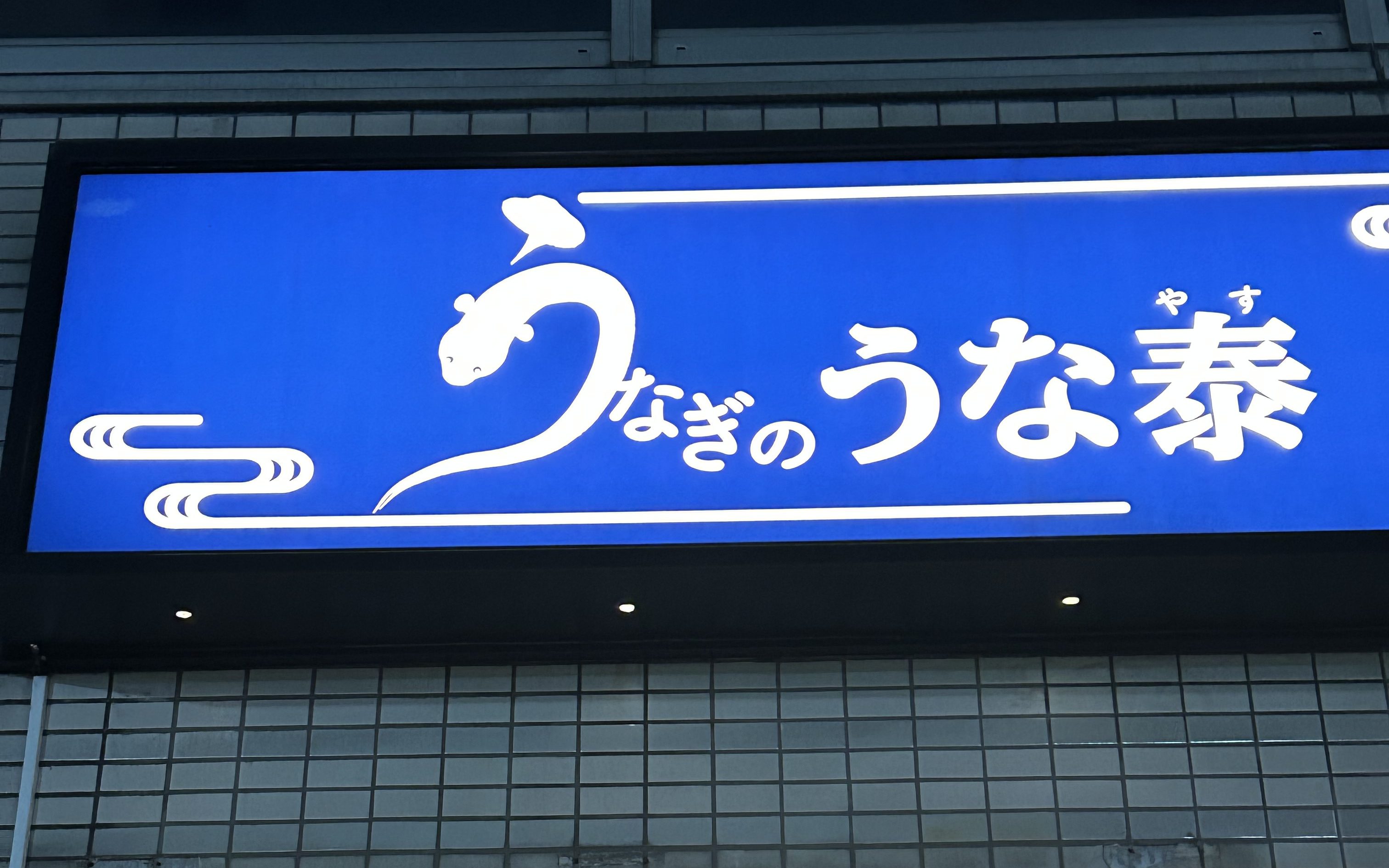
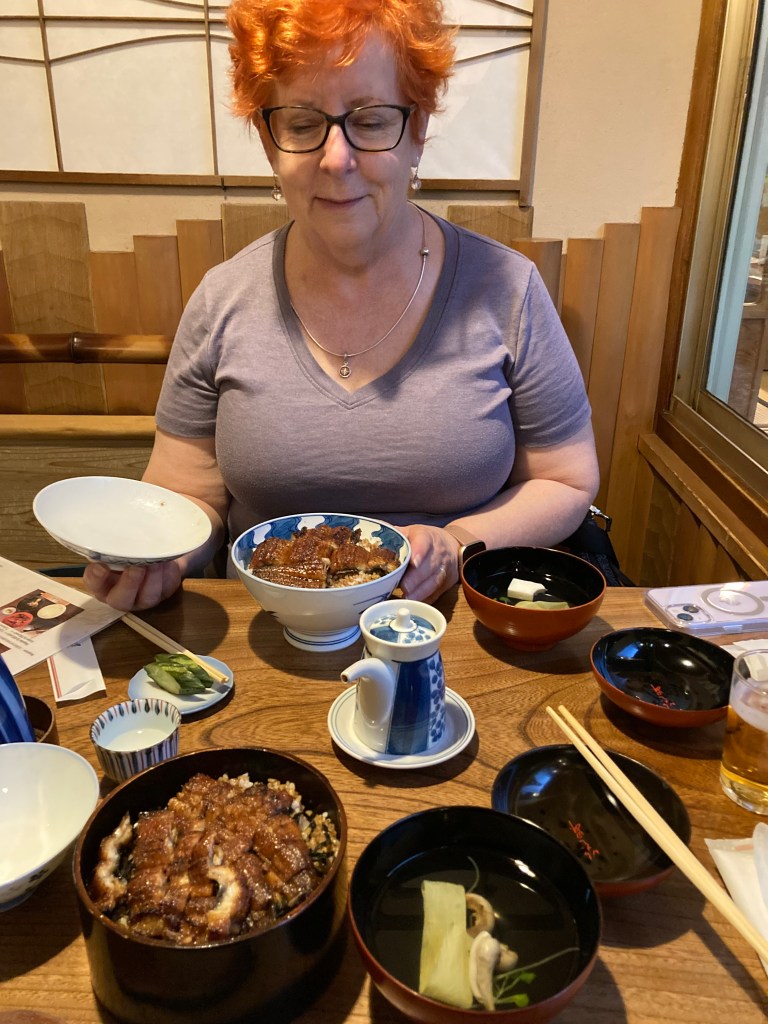
So what have we been doing? A lot of eating, as usual. Nagoya is known for its fresh water eels, and they are called unagi. There are lots of unagi restaurants around. This sign caught my eye – the ‘u’ in unagi is represented by a curvy eel.

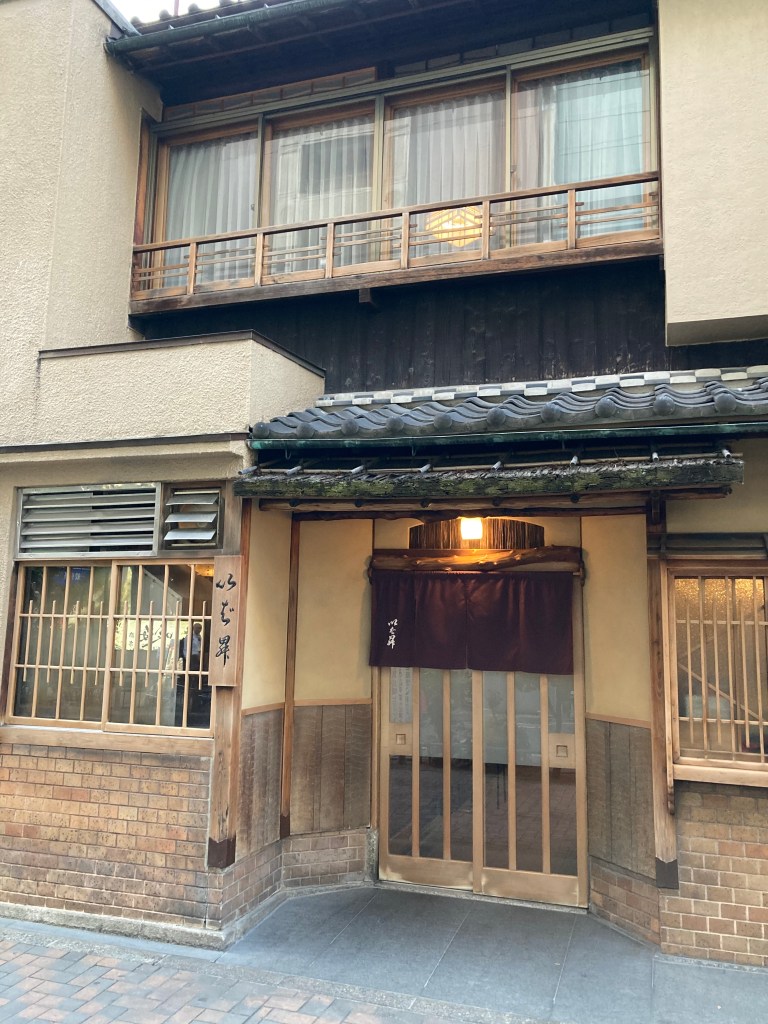
We did go out on our first night for an unagi meal. Its a good thing that Mr Google and his map buddy are on the ball because we would not have recognized the restaurant without their picture.

Rather discreet, no? What the picture doesn’t show is that this on a street just choked with bars and clubs. And then there is this lovely little building that looks like a house. It has a lovely interior garden with a koi pond.

So how do you eat eel? Grilled, over rice. In Nagoya they grill it on a hibachi. I had a serving of larger pieces over rice in a bowl. Wilf had a more elaborate production – a bowl of rice with the unagi chopped over the rice. There was a separate bowl into which he spooned the rice and eel. He could it eat it as it was, or add horseradish (wasabi) and or sliced green onions. There was also a special pot of ‘eel sauce’. And then, if one desired, one could pour from the pot of green tea to make a sort of soup. And there was soup with the meal, as well. Both were a clear soup – mine had minced fish cake in it and Wilf’s had eel liver. I know, it sounds a bit much but it was all good. Oh, and a serving of pickled vegetables came with. Add in a serving of sake and a bottle of beer and you can see why a meal for two people has enough serving pieces to cover the whole table!

Specialty unagi restaurants like this tend to be on the more expensive side – we paid about CAD75.00 for our meal, which is consistent with other such restaurants on other trips to Japan. After all – one can not live on ramen alone!

Visiting the black castle

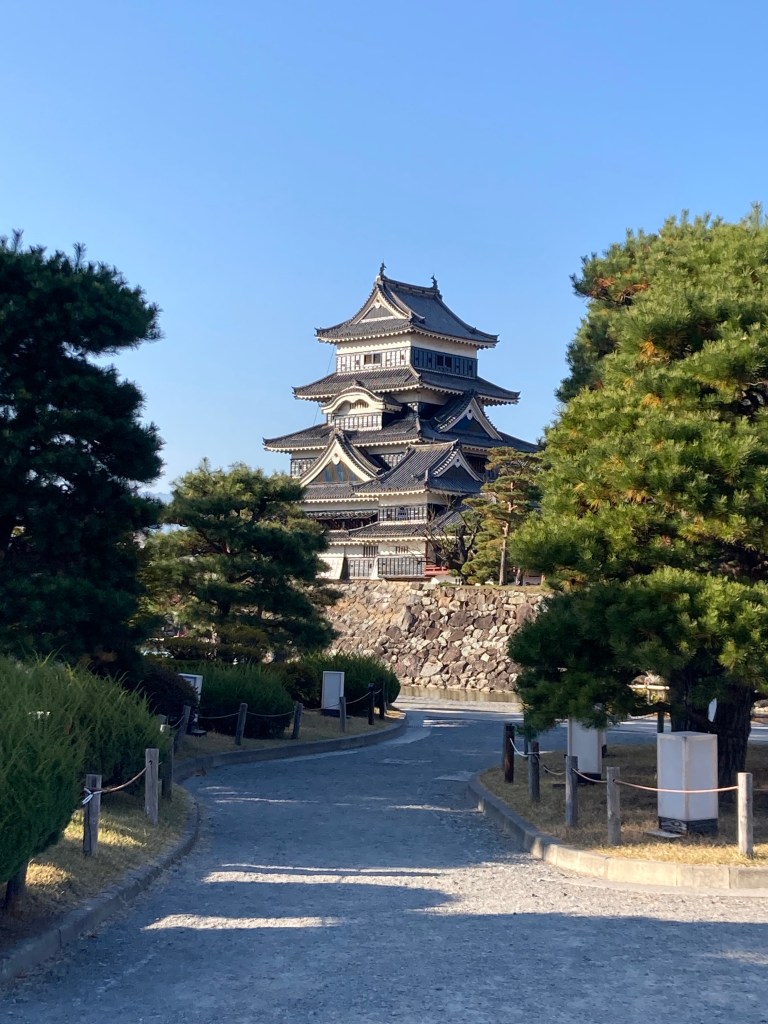
We decided it was time for a short trip out of Tokyo, and since we hadn’t been to see a castle since we arrived in Japan we set off for the city of Matsumoto, in Nagano Prefecture. Its about a 2.5 hour trip from Shinjuku station up into the fringes of the Japanese alps.

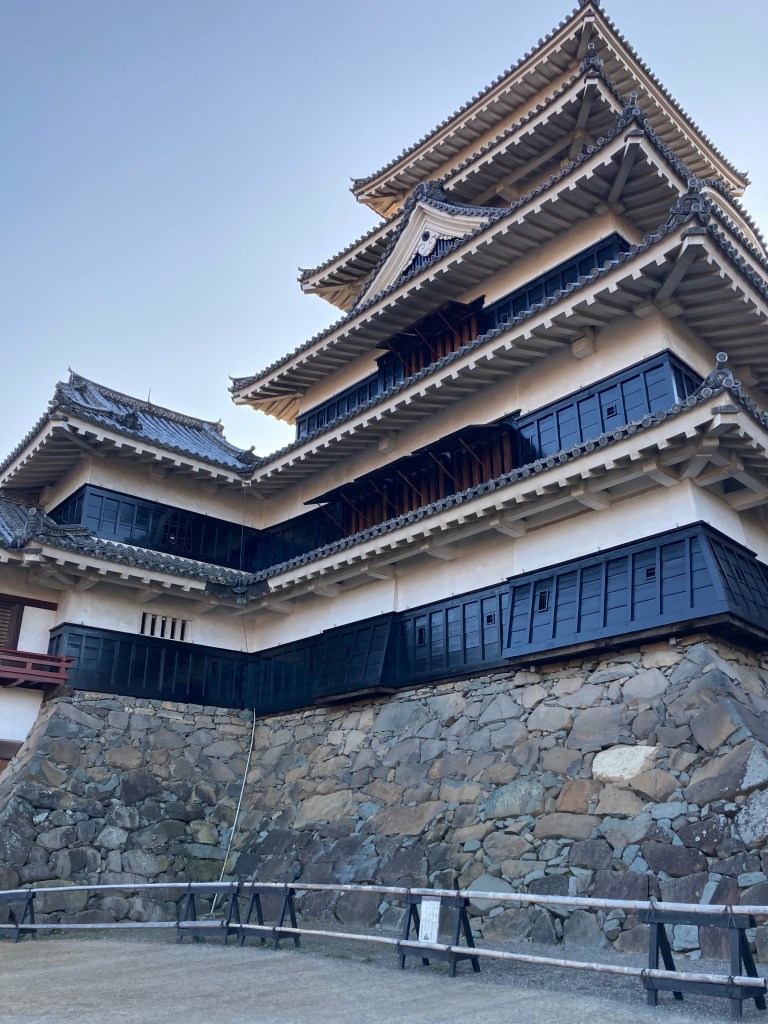
Because Matsumoto is up in the mountains it was not bombed during the Second World War, which means that the castle is the original deal – 400 years old. Okay, its probably not exactly 100% original parts, but its pretty much as it was. Familiar story – it was neglected during the Meiji restoration and was not in good shape. Fortunately local folks decided to buy it and restore is and now it is here for us to enjoy.

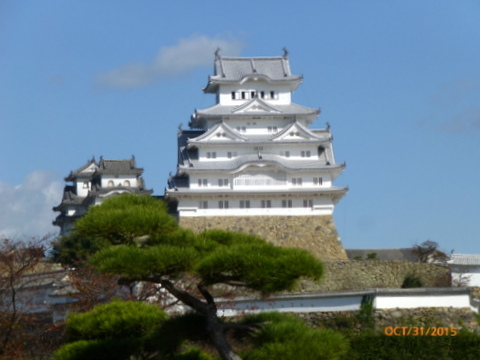
One of the things that is a bit unusual is that the castle is not all white, like most Japanese castles. For contrast, here is Himeji Castle:

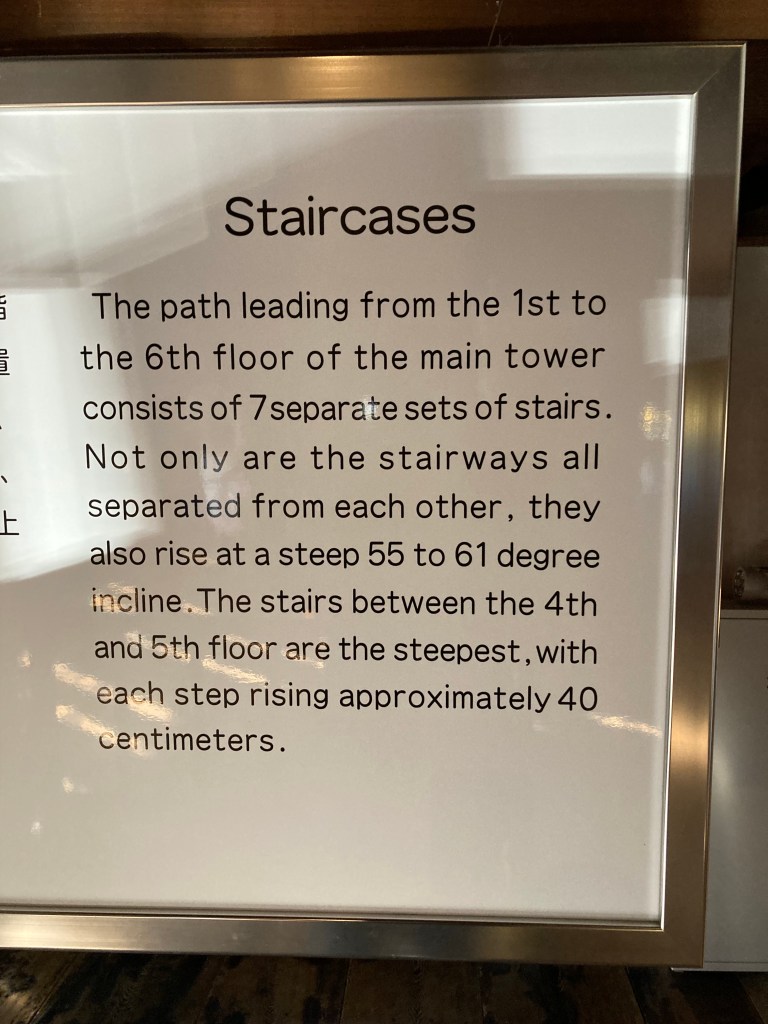
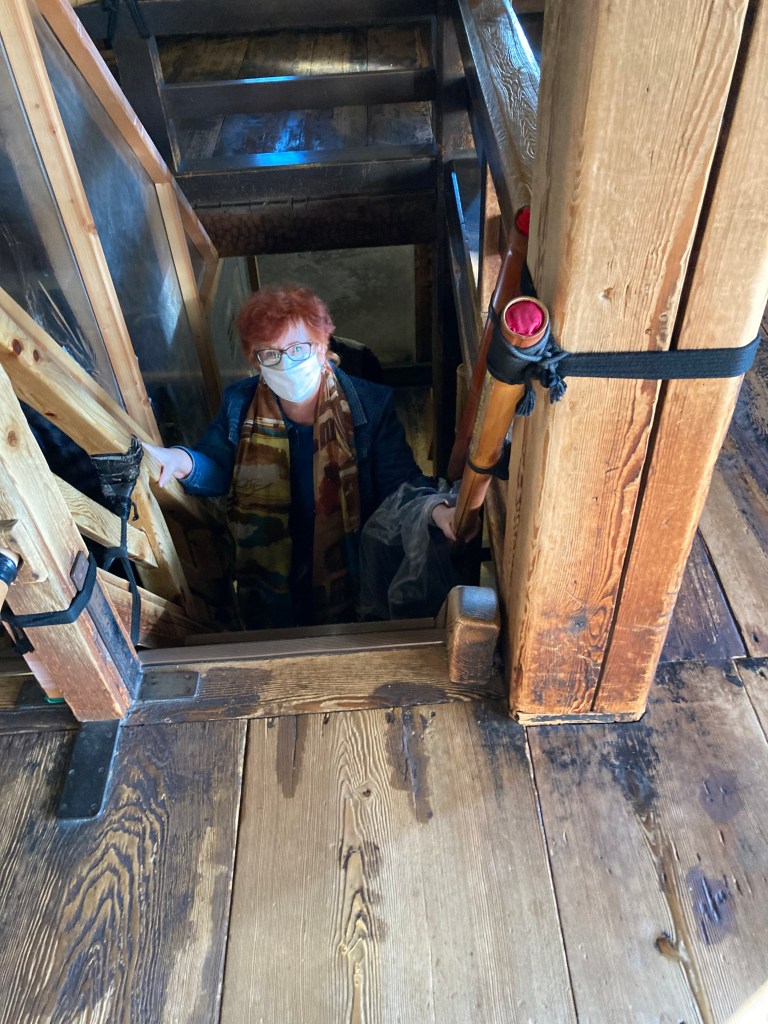
Matsumoto castle pretty neat inside – the spaces are pretty much as they would have been used. And the stairs, oh my gosh, the stairs. This was a defensive structure – people did not live here, so there was no need to make it easy to move about. In some places the risers on the stairs were a foot tall or more. And then the next one would be about six inches. And most of them where more like ladders than stairs.

Did I mention that this is a no shoes facility – we were carrying our shoes in plastic bags while touring the castle. We had to be very careful not to slip in our sock feet….

That was a challenge.

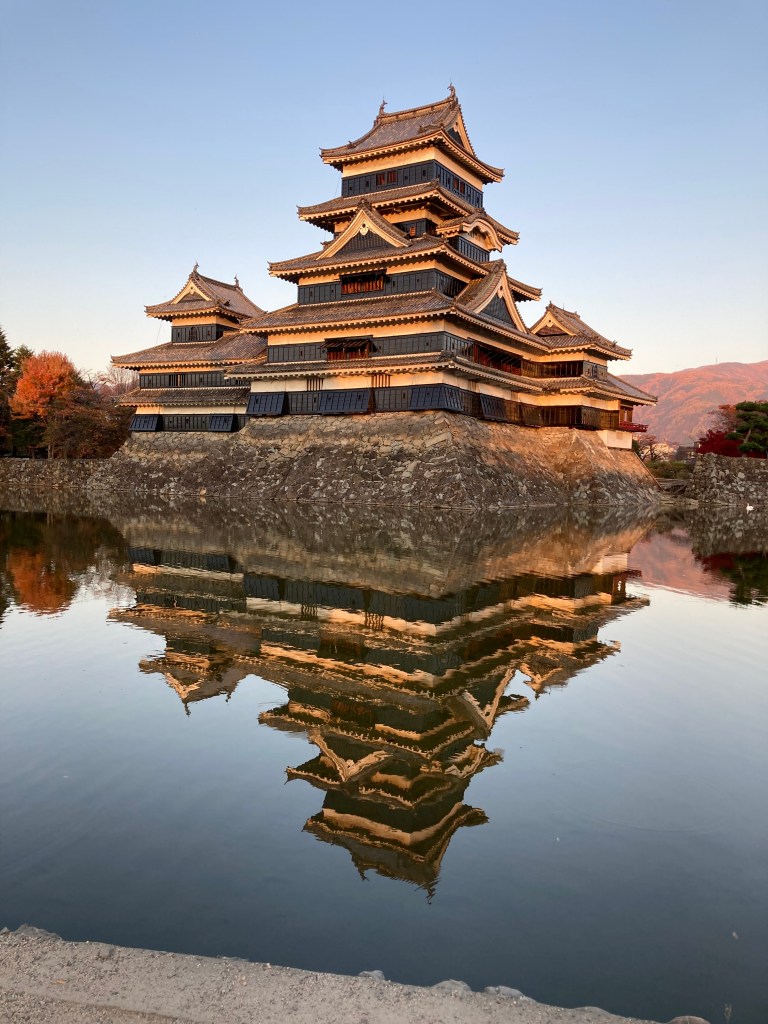
She’s looking pretty good at 400 years of age!

And it was a perfectly lovely fall day – blue skies and not a breath of wind, which led to this lovely shot:

We did it again – without planning to.

Last Saturday we set out to find the Dream Yocasoy Festival in Tokyo – and we did. I told you all about it and your response has been fantastic. Several of you commented that it looked like Bhangra dance or something from a Bollywood movie. It certainly is a joyful thing.

Today’s excursion was a trip to the city of Odawara. Further south than Yokohama, it required a short ride on a Shinkansen (yay!). As we were walking to the Odawara castle we began to see groups of people in bright costumes – in the centre near the rail station and then along the way and even on the grounds of the castle. But we were kind of in denial. Surely not another dance festival? What are the odds of that. We should go see the castle.

So we did.

The modern history of the castle is a familiar refrain – the Meiji government began to disassemble it in a fit of ‘out with the old, in with the new’. The the Great Kanto earthquake of 1923 struck, followed by the Second World War. But, eventually, the citizens of Odawara decided to excavate and rebuild the castle. Unlike Matsumoto Castle which we visited earlier this week, this is a reproduction. Of course, being a Japanese reproduction it is an exacting one, using materials and techniques from the first go ’round. With some improvements- like proper stairs! (But not like the castle in Osaka that has escalators inside to manage the traffic!)

Did I mention that it is unseasonably hot here? It was past 20C today – the 12th of November. And very sunny. And did I mention that one of the unavoidable facts of castles is stairs? Not just inside the castle tower, but just to get there.

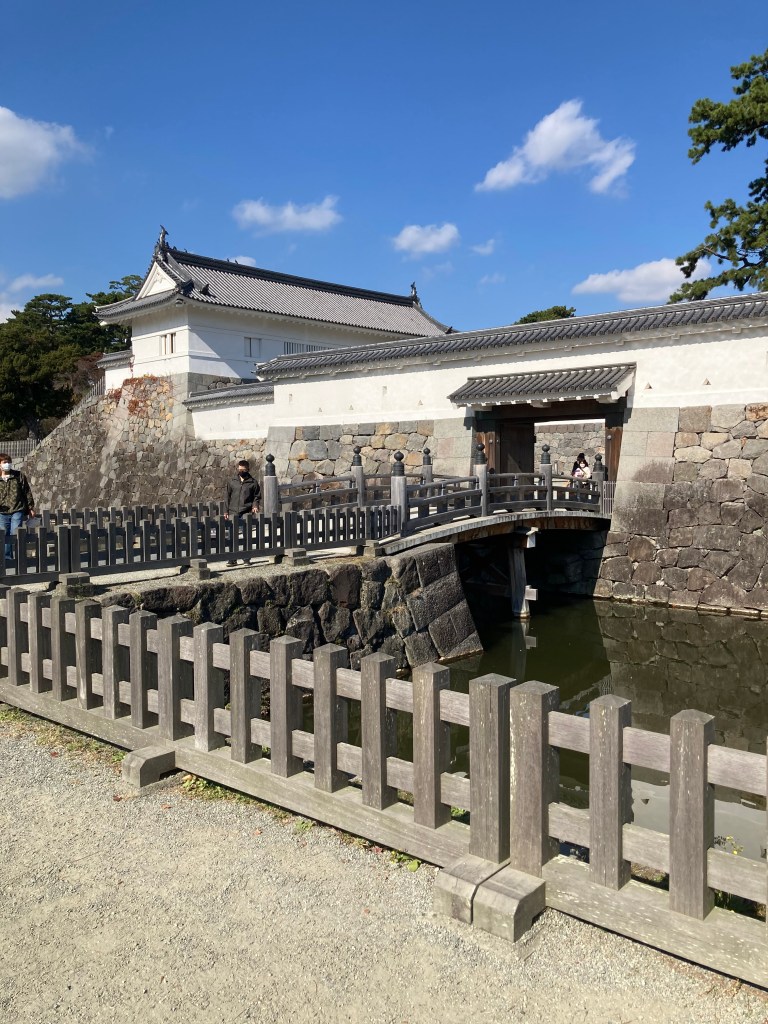
There are moats and bridges and stairs and courtyards before even getting to the main event. And then the castle itself is 5 stories tall. I cannot imagine visiting in the height of summer with heat, humidity and crowds!

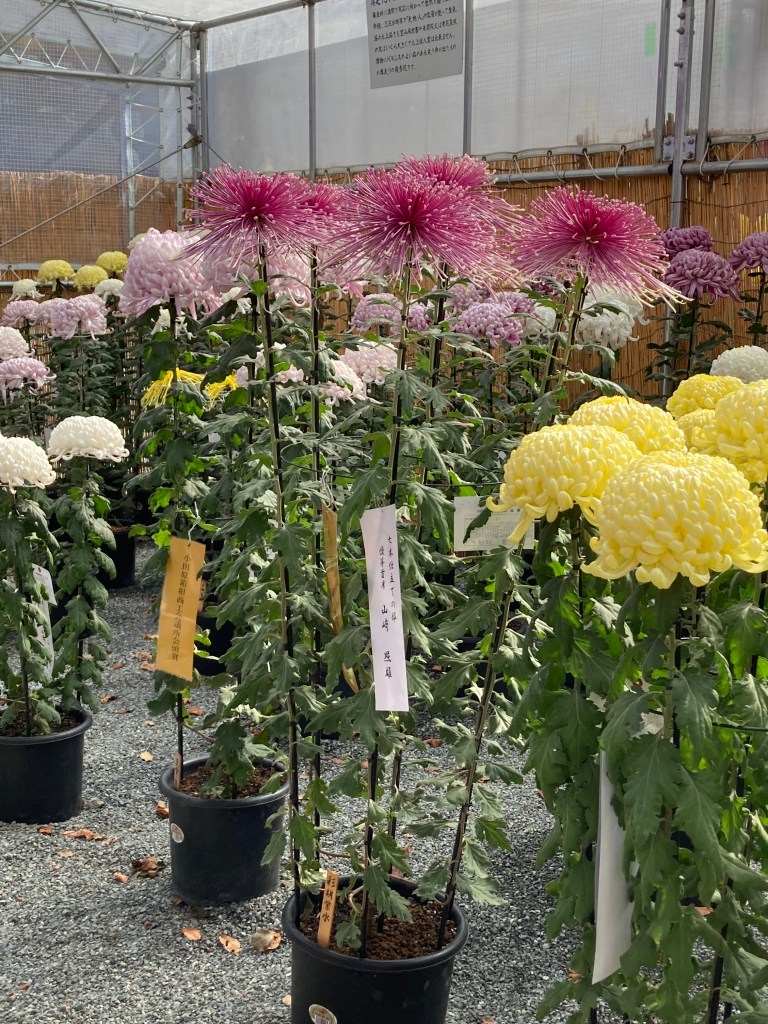
It was a beautiful Saturday and people were out enjoying the day. As is often the case in the fall a big chrysanthemum display was set up in the area around the tower.

There were about ten big tents full of displays of chrysanthemums big and small, simple and fancy.

The inside of the castle is given over to displays about the history of the castle and the Odawara area. Odawara was pivotal in the ending of the battles of the warring states that proceeded the long period of the rule of the Shoguns. The castle surrendered after a siege of three months in 1590 when it was clear that they were outmanned. But no one was going to come in unwanted or uninvited – there was no way to sneak up or sneak in.

For one thing there were a whole series of great big gates to get through…. and oh, look, more stairs!

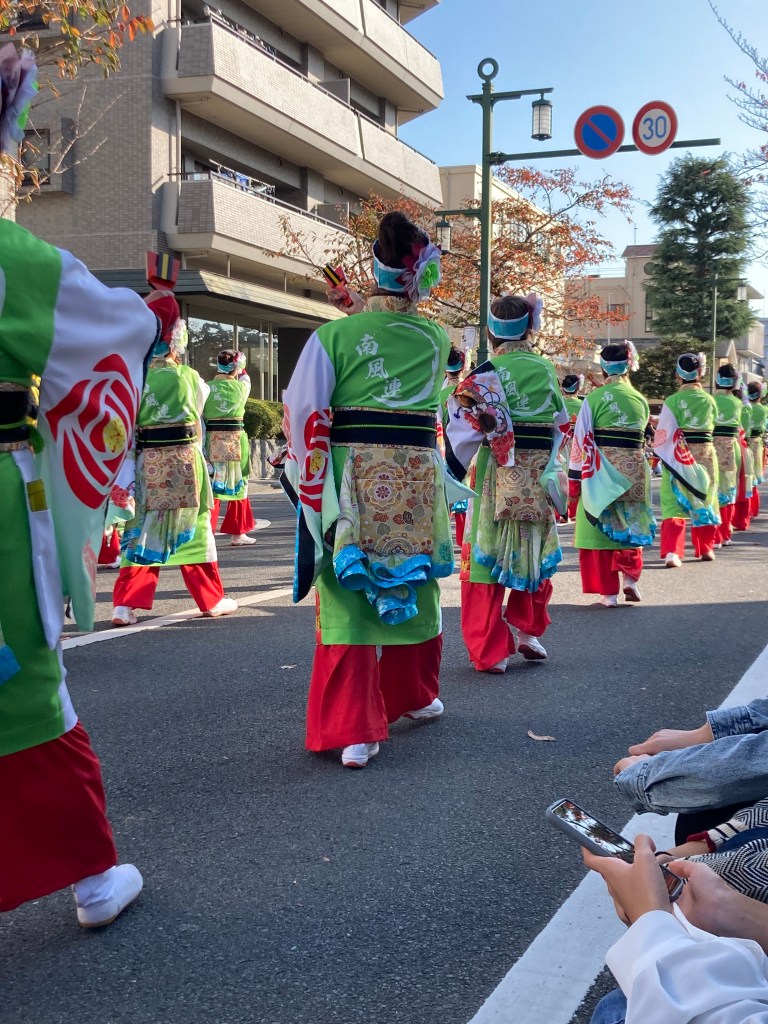
We toured the castle, the grounds and the auxilliary exhibits and decided that maybe we were done. Our enthusiasm for our excursion was not matched, it seemed, by our stamina. Time to consider returning to Tokyo. But as we exited the last exhibit we could hear – music. Familiar rhythms. And sure enough – right across from the main entrance to the castle, in the courtyard of a school there were yokasoi dancers performing. They were in an enclosure and we could only see a little bit, but we could see the bleachers, facing into the blazing sun. Nope – not going to do that. Felt a little badly, but nope. We continued down the street and heard more music – and the street was blocked. And what did we see?

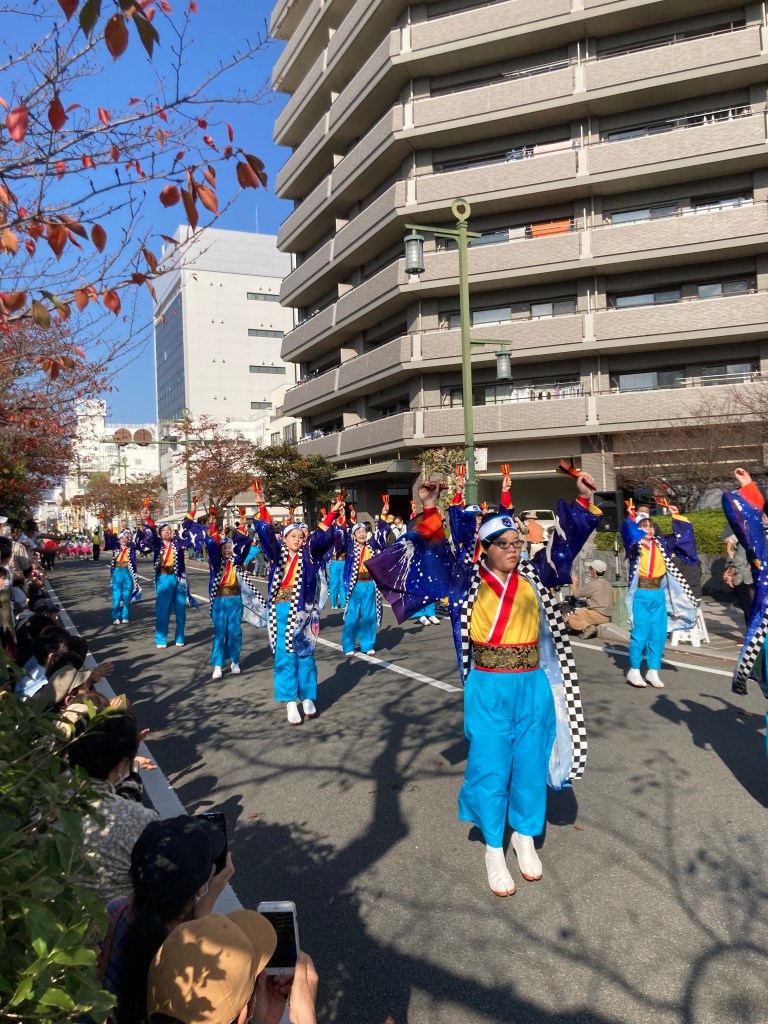
Dancing in the streets, the sequel!

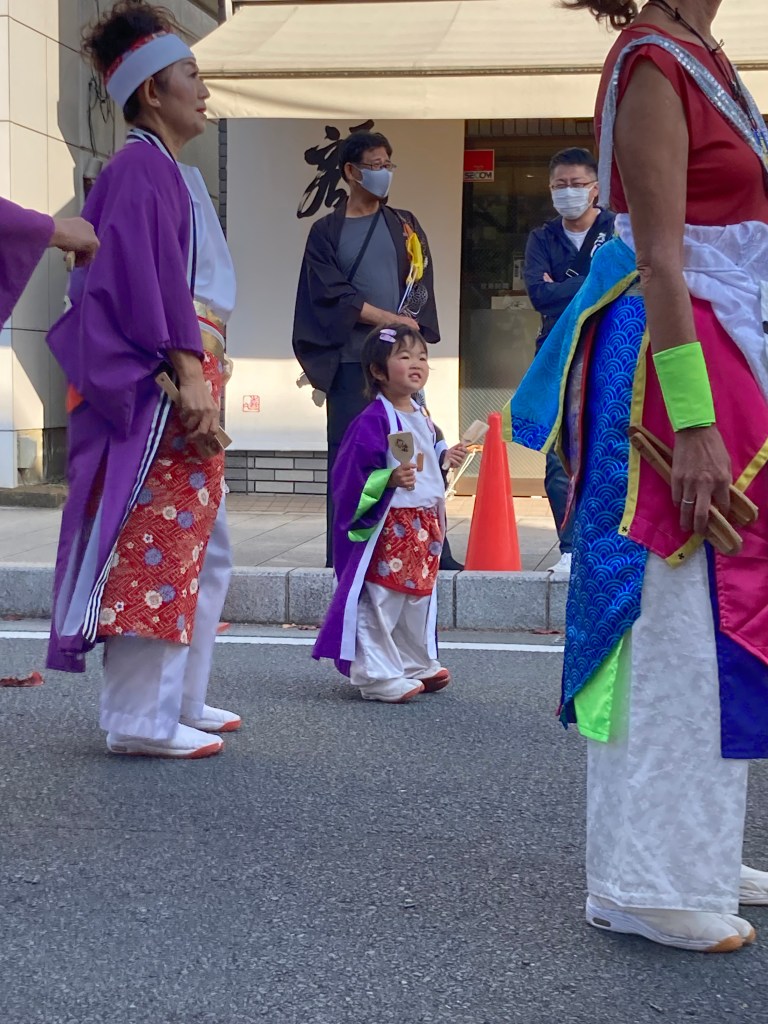
And check out these cuties!

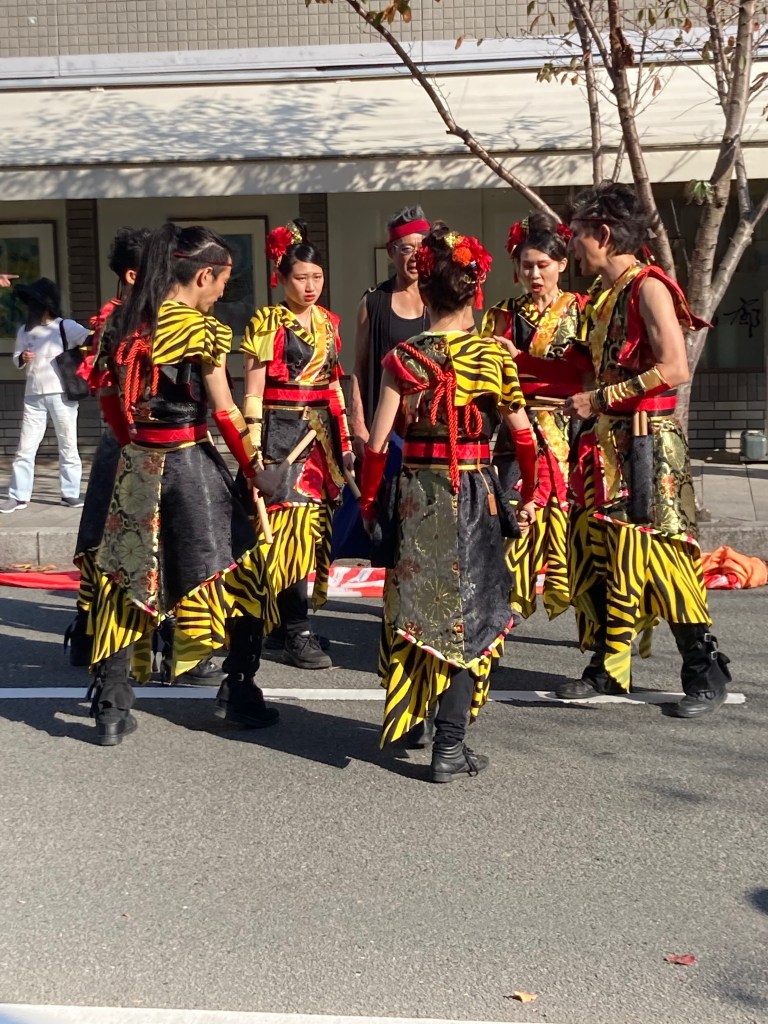
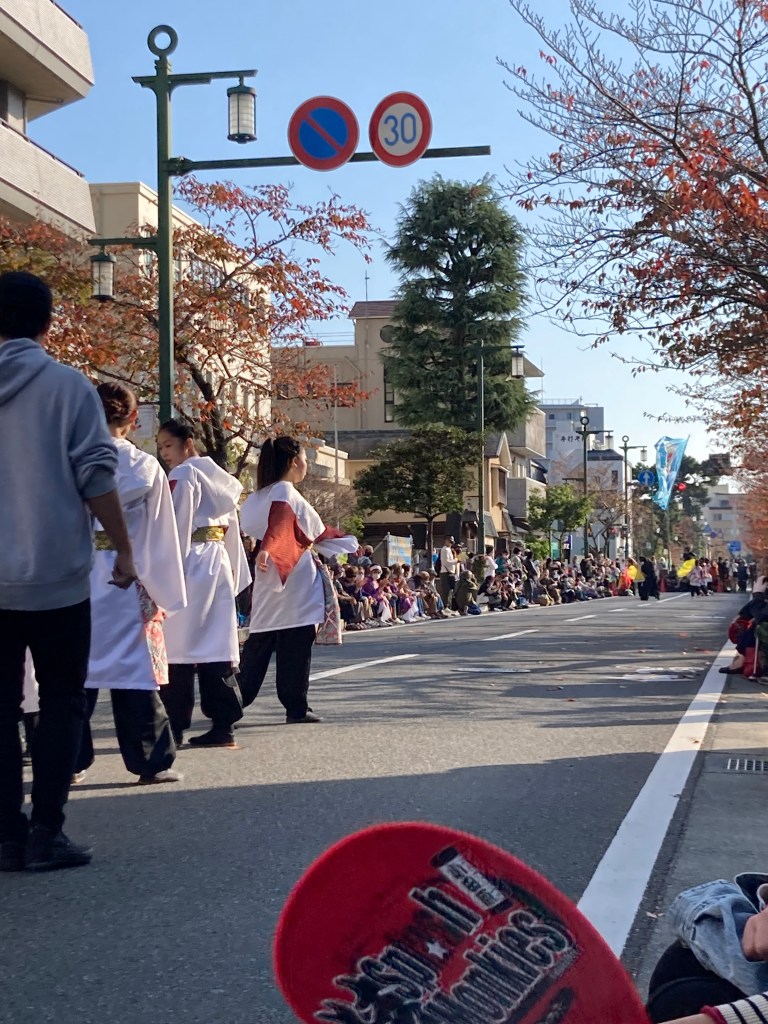
We continued up the block until we could find a curb to sit on. Turns out we were right at the staging area. Got to see close ups of the costumes and the prep and the pre-performence carrying on.

This small group was fierce in their preparation and presentation.

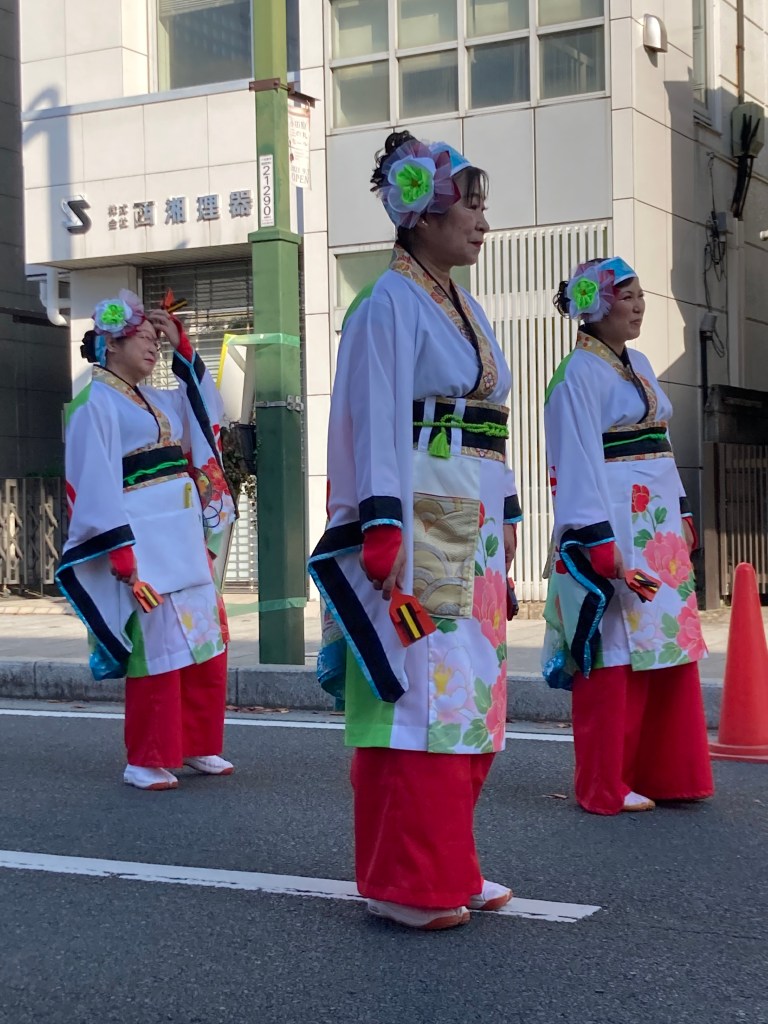
The youngest member of this group was about 65. See the wooden rattle in their hands? It sounds so neat when they all rattle them in unison. One of the happy sounds of the day.

And they’re off!

The group ahead – and their banner man are in full performance mode while the group in the foreground are in the on deck circle. The next group or two are lined up down the street behind them. As they get to this point the official photographer takes the group shot and then everyone moves ahead by one. Very organized.

And then, of course, there are the kids….

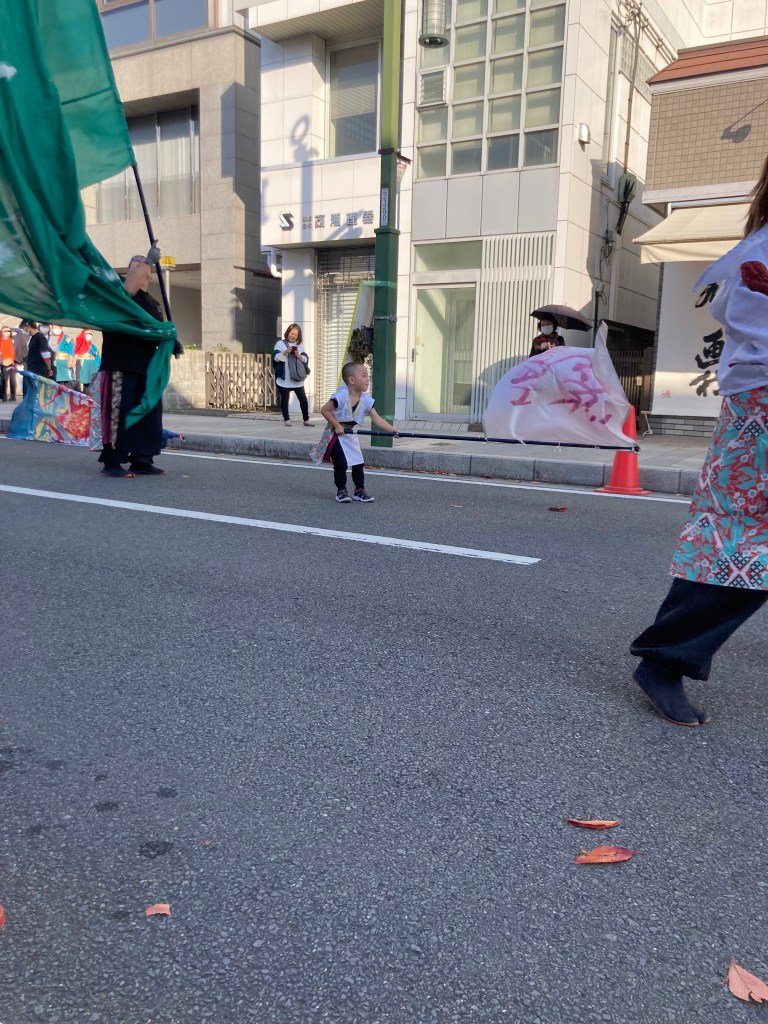
This little guy is a banner man in training. The guys who do the real thing are big guys – they work hard to manage the flag pole and the very large flag – while avoiding the crowd, the signs and their own dancers. This little guy deserved his own video:

He’s a big guy

We decided to take a little road trip to Yokohama. Wilf and I have been there before – its about an hour on the train from Tokyo. It has an important place in the history of modern Japan, as it was one of the first ports to engage with the West after Japan opened itself to foreign trade. Yokohama was transformed from a small fishing port to a major port and industrial centre very quickly in the latter part of the 19th century. Beer making came to the country via Yokohama, for one thing. The city had become a bustling concern with many western style brick buildings when the twin disasters of the great Kanto earthquake of 1923 and the bombings of the Second World War occurred. Yokohama was rebuilt, and more recently parts of the industrial and commercial waterfront have been reclaimed as lively people based places. There is a beautiful European style garden along the waterfront promenade and the old customs warehouses have been re-purposed as event spaces. One of the big events held there every year is a huge Oktoberfest. Wilf was very disappointed to have missed it this year.

There is a huge ferris wheel and a gondola to connect the waterfront to the rest of the city. And amidst all the history there is one very modern thing to see.

This guy:

Meet Gundam. I’ll let Wikipedia introduce him to you:

Gundam is a Japanese military fiction media franchise. The franchise features giant robots, or mecha, with the name “Gundam”.

The franchise began on April 7, 1979. The popularity of the series and its merchandise spawned a franchise that includes 50 TV series, films and OVAs as well as manga, novels and video games, along with a whole industry of plastic model kits known as Gunpla which makes up 90 percent of the Japanese character plastic-model market.

The Gundam franchise had grossed over $5 billion in retail sales by 2000.By 2022, annual revenue of the Gundam franchise reached ¥101.7 billion per year,¥44.2 billion of which was retail sales of toys and hobby items.

Those are some pretty big numbers! Most people I’ve talked to at home assume that Gundam is related to the Transformers franchise, but this is something else completely. It is this huge thing, and if you know, you know. If not – you are oblivious.

Let me back up a bit so you can see the whole thing.

The above photo was taken outside of the facility. You can see him from a long way away. See the people in the glassed in balconys? Those are the truly faithful fans, those who wanted to get up close and personal. We decided we would go into the facility to watch the show.

Here’s a video- its quite long, so don’t feel like you have to watch it all. It was a windy day, so there is wind noise. At about the 4minute 30 seconds point Gundam himself begins to speak. From the music and tone of the speaker I think perhaps he is having an existential crisis of some kind- I can’t make out enough of what the voices are saying to know for sure. In my mind it is a great quasi Shakespearean drama. But then again, maybe not.

After watching him come out of his building, move about, rest, then retreat to his building we headed to the gift shop. If he’s responsible for billions of Yen in sales perhaps there’s something to see? Well. It was really something. Kits to build model Gundams ranging from the $10.00 price point to hundreds of dollars per kit. And limits – there was a limit to how many kits could be bought at one time, and how many times you could enter the facility to buy them each day. Big business indeed.

So- it was an interesting day in an interesting city. A mix of the old and the new. And it was an opportunity to learn about something huge about which we knew nothing at all…..