When we were planning this trip Wilf was asking me what things I wanted to see. There was a museum that I had always wanted to go to, but it never quite fit in. Technically it is a day trip from Tokyo but a long day, so at least overnight seemed like a good idea. After some investigation Wilf found a hotel in the town nearby and got us booked in there.
The next step was figuring out how to get there and this consumed much of our winter. We would by flying back to Tokyo from Fukuoka, landing at Haneda airport. Trains and buses for the lake area leave from Shinjuku station. Only the most complicated train station in the world that handles 1 million people per day…We usually try to avoid it. There were fewer options for the train so we settled on the bus. But we could only make reservations one month in advance, so we were checking checking checking and we did get a reservation for the bus from Shinjuku to Kawaguchiko Station. We figured we would be able to get the Highway bus from from Haneda to Shinjuku on the day of, as it ran several times an hour and we were not sure of our exact timing at the airport.
At this point I’ll step out for minute to discuss the weather in Japan. More particularly the weather forecasting. What the heck, people? We’ll look at our weather app for a few days forward and it will show expected rain 100mm on Saturday. Yikes – that’s not good. Then the next day we’ll look and the forecast for the same place on Saturday – 5mm. The next time we look – 50mm. How does anyone plan anything? Fukuoka, Tokyo and Kawaguchiko were all calling for rain on our travel day, and quite a bit so we figured there was no avoiding it.
No rain in Fukuoka and we didn’t have to go outside to get to the airport. Raining in Tokyo. The Haneda airport has managed to create a bus platform that, while enclosed, somehow tunnels all the wind in the city through that spot, and the rain. We bought our tickets, got a snack and then went to the platform. Which is covered and yet somehow everyone was getting wind blown and wet. By the time we got to the city it was sheeting down and people on the street were losing the battle between the wind and their umbrellas.
The ride to Kawaguchiko was pleasant and the closer we got the better it got – the sun even came out.
Now, perhaps the name Kawaguchiko rings a faint bell for you? It is a lake and town on the north side of Mt Fuji. Very popular destination – lots of parks and hotels. Passed an amusement park with a truly horrifiying looking roller coaster on the way.
Last year someone posted a picture of a Lawson convenience store with Mt Fuji in the background – a perfect picture. Suddenly the whole world wanted to go and take That Picture. That led to chaos and people standing in the middle of the busy street and blocking the sidewalks and general unhappiness in town, Here is the story – Lawson Picture. They even tried putting up a screen but people just poked holes in it. So we were going to that town!
Also – this winter we watched a Japanese series on Netflix called The Hot Spot, which was set in Kawaguchiko and the neighbouring town. It was a charming and offbeat story and set in the area! The Hot Spot
So – back to our journey. Having left our hotel at 8:15 we arrived at Kawaguchiko Station (having passed the famous Lawson) around 4:00. The station is heaving with tourists. But lo! The shuttle to our hotel is there and we hop on board. A quick scoot and we are up a scary little road to our lovely hotel perched above the lake.
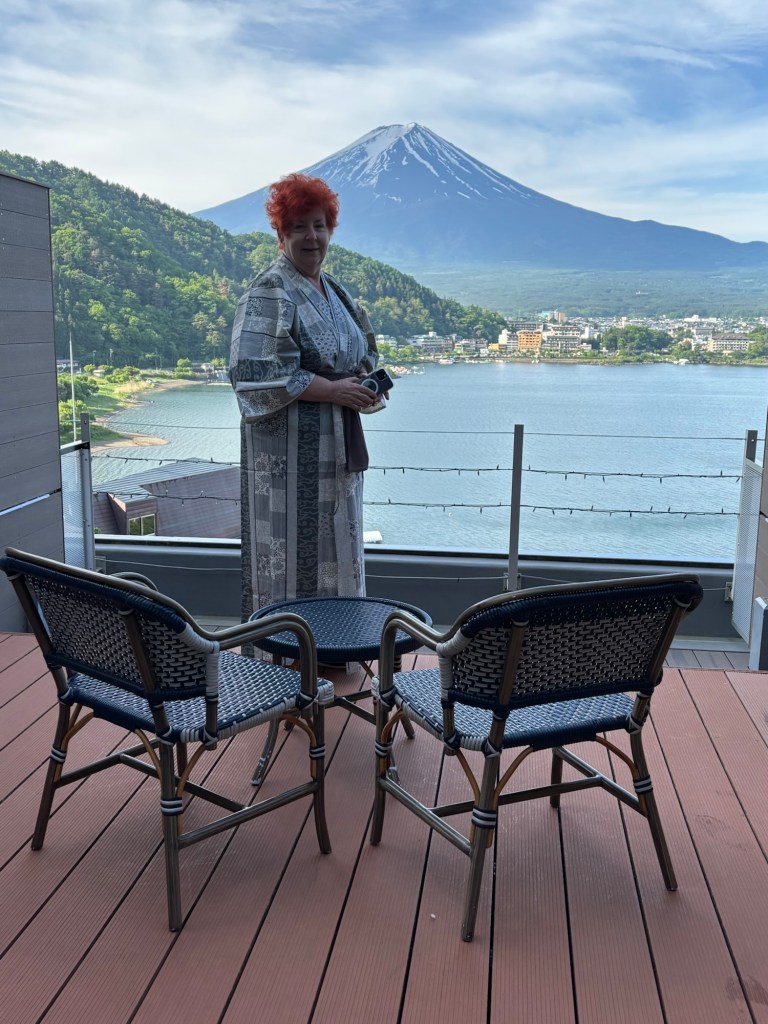
The rain has stopped but the clouds have not lifted, so no mountain to see. But in the morning…..
I opened the drapes at 07:00 and there it was. I threw on my hotel yukata and rushed out onto our deck. Wilf captured me taking photos – so excited I don’t even have my glasses on! But look!!!
We weren’t all about the day trips while in Fukuoka. There were things to see in the city (besides the city itself).
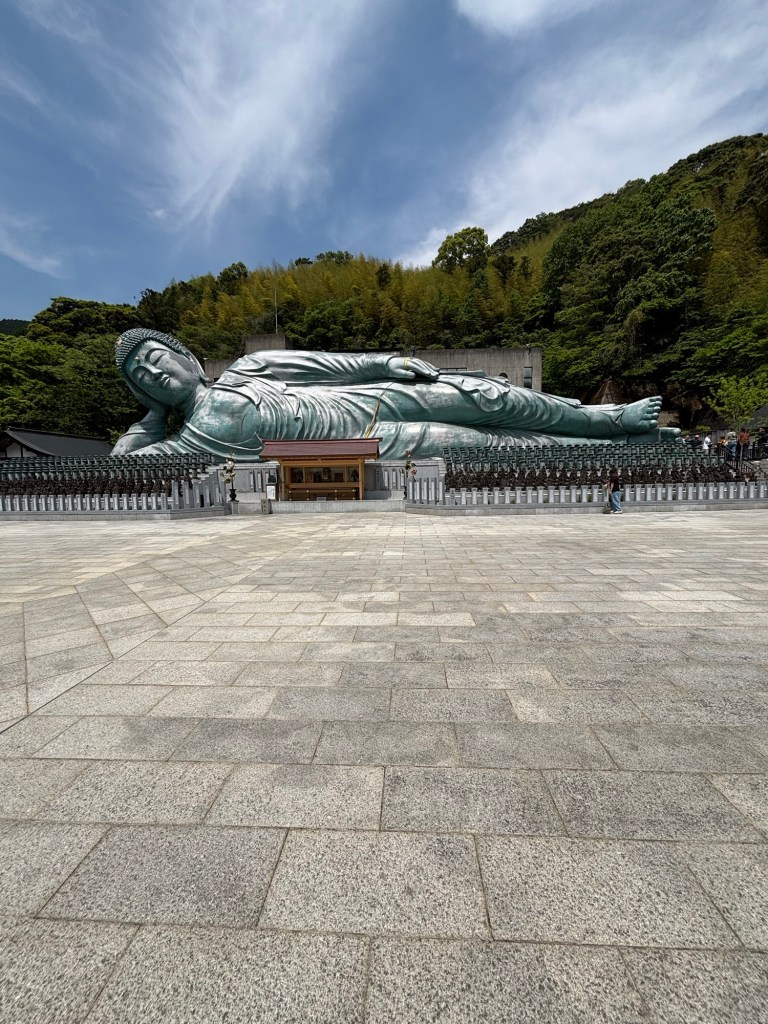
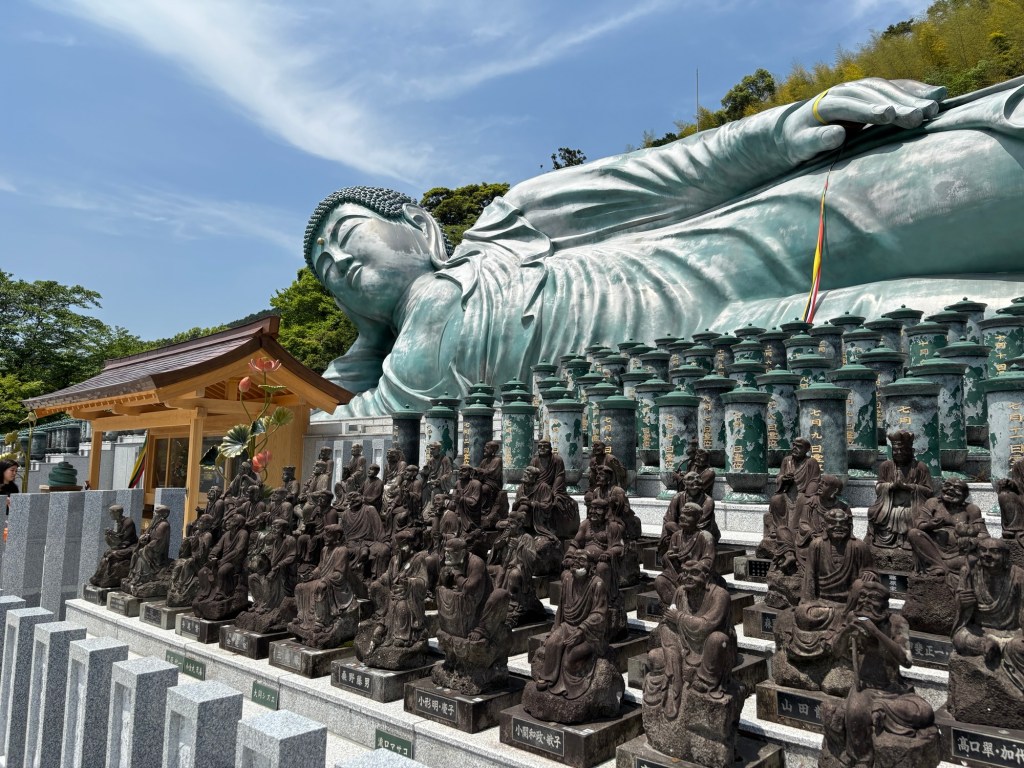
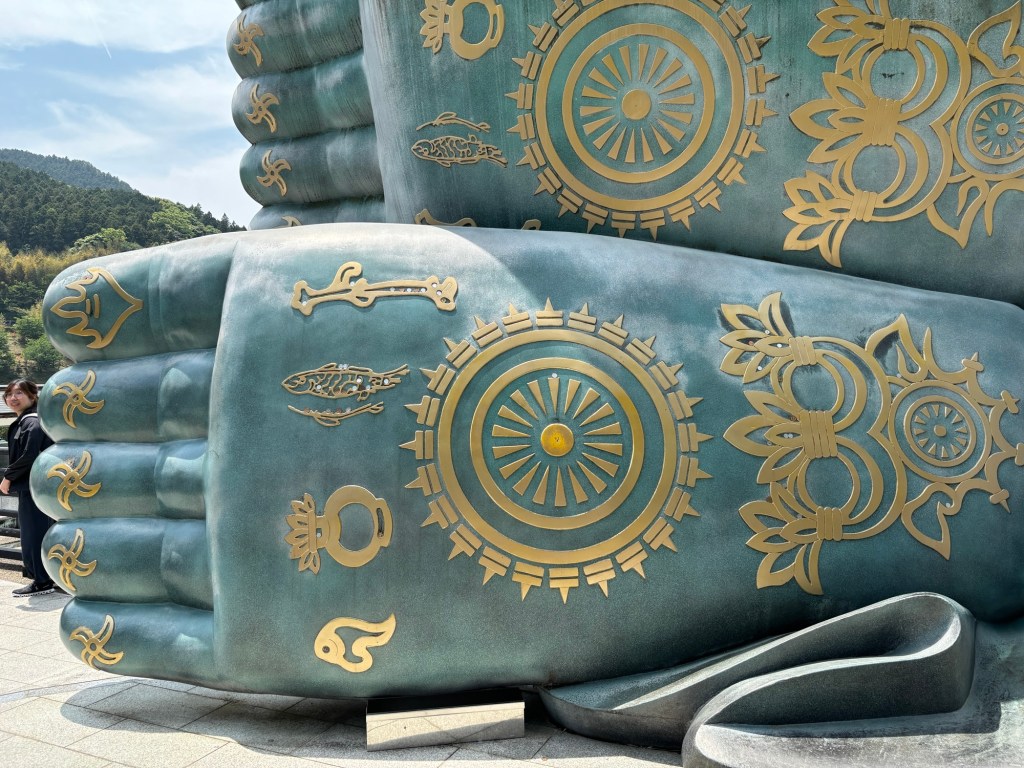
First up there was a big Buddha to see in the suburbs. Said Buddha resides at the Nanzo-in temple. The temple was originally located on Mt Konya and was moved to its present location in the late 19th century where it became a part of a major pilgrimage route. Information about the site says that close to a million people visit it in a year.
The statue of the reclining Buddha is more recent – it was unveiled in 1995. Weighing in at 300 tons, the statue is 135ft long and 36ft high – immense!
It is a bit of a challenge to get the whole statue into one shot.
The scale of the plaza gives you a bit of an idea of the number of people who visit.
The grounds of the temple were lovely and in addition to the usual flights of steps going up up up there was a long and winding ramp with a rubbery surface that took us up above the temple proper to where the Buddha was resting. The long ramp would make it accessible to wheelchair bound pilgrims.
After a visit to the temple and the Buddha we skipped ahead in time and went to see teamLabs Forest. When we were in Tokyo in 2018 we went to see the first teamLabs digital art project and were quite amazed. It was a combination of music and digital projections and interactive experiences that was unlike anything we’d experienced. Originally planned as a temporary exhibit the teamLabs folks now have permanent exhibits in various places on various themes.
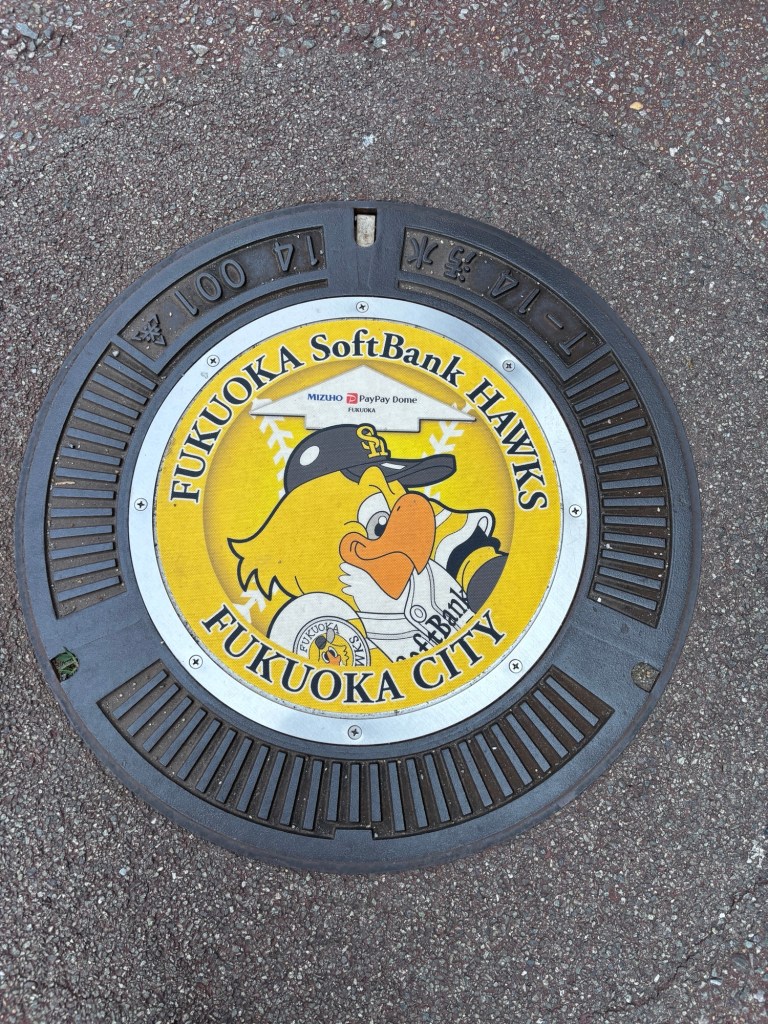
Another subway ride and a walk to the building where the exhibit lives. It turns out to be right beside the baseball statdium, where the Fukuoka SoftBank Hawks play. Hints along the way….
Not much to see from the outside – a big grey building with no windows and an easy to miss entrance. We were pretty much first through the door. The building also has a rollercoaster on the roof which appeared to have single seats suspended below the track – looked very swingy. There was also an unko museum on the upper floor – unko being poop, so a poop museum for children……
Anyhoo. Before we went into the first room we were encouraged to download an app onto our phone so we could interact with the animals. So I did. The idea was that through our camera we would look at the animals as they appear and ‘catch’ them. Information about the animal would then appear on the phone screen to be viewed and then on to the next critter. I felt like I was spending more time fiddling around, trying to make the ‘catch’ work and not really looking at what was going on around me. I decided to experience what was going on around me directly.
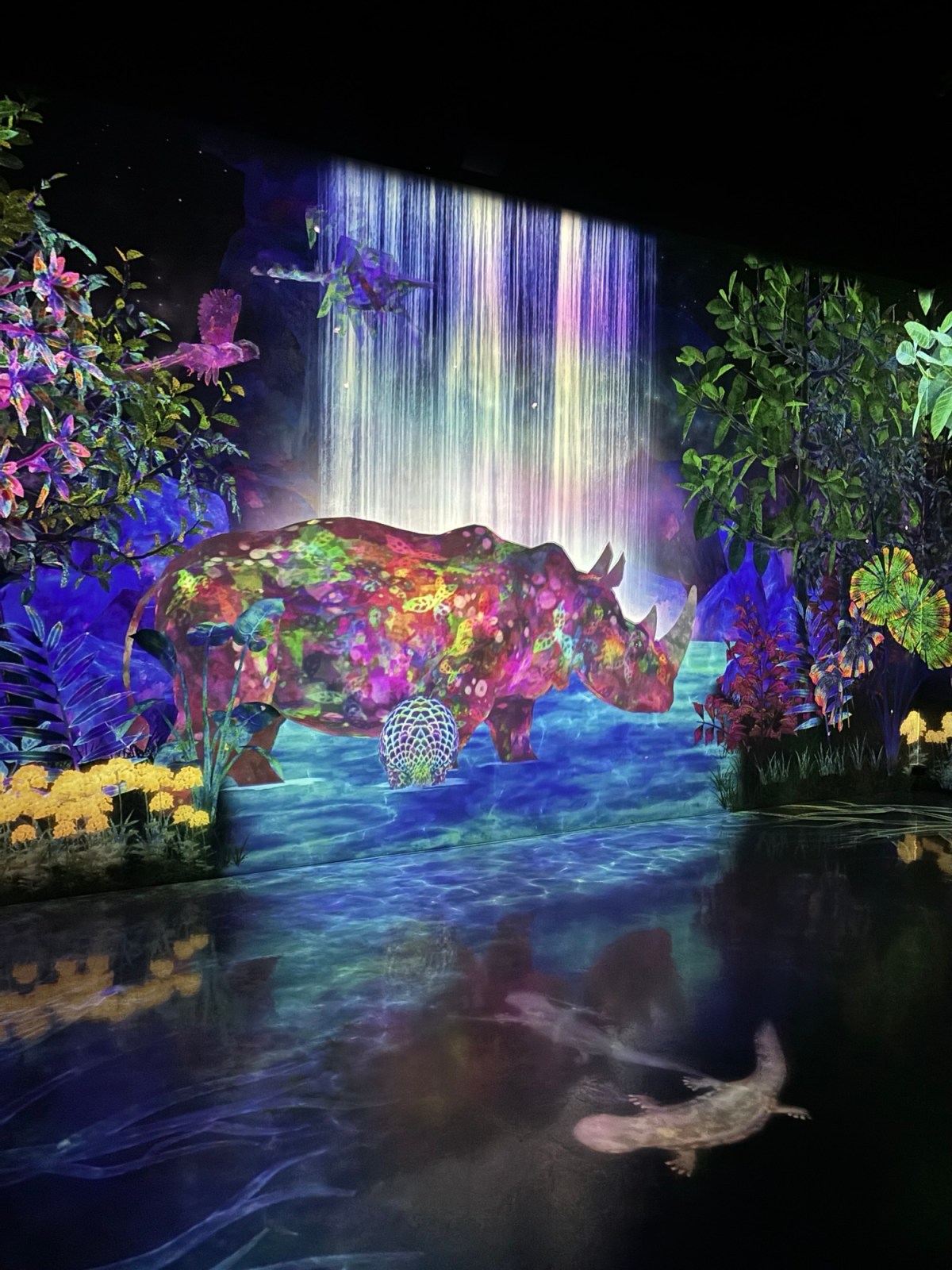
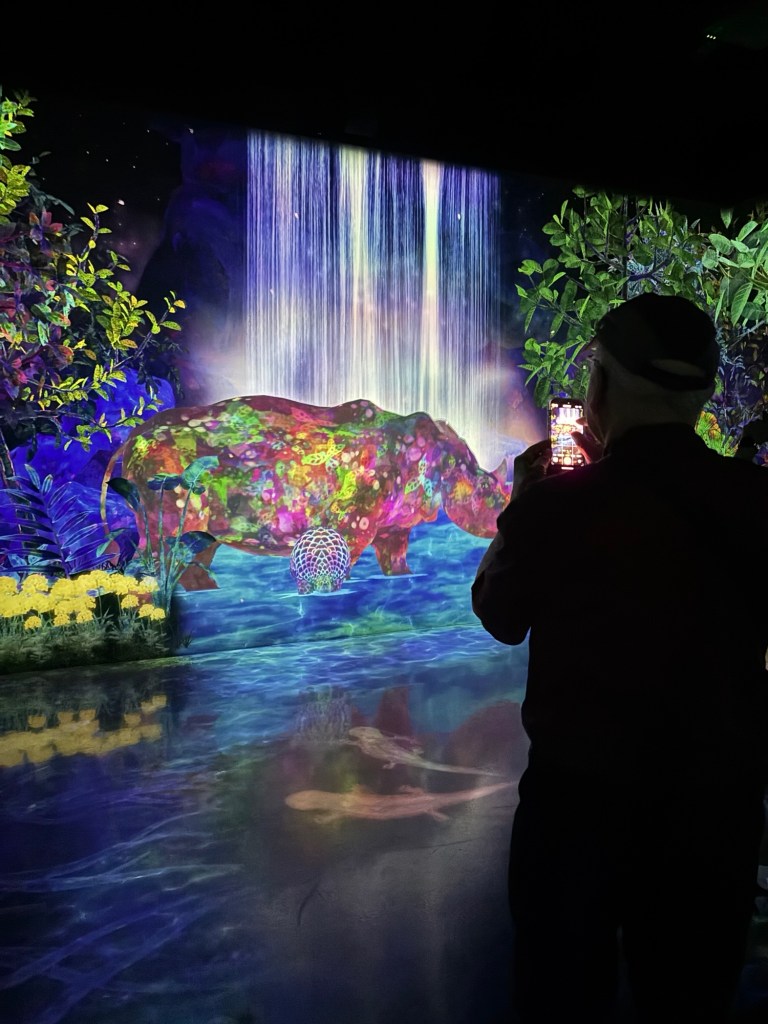
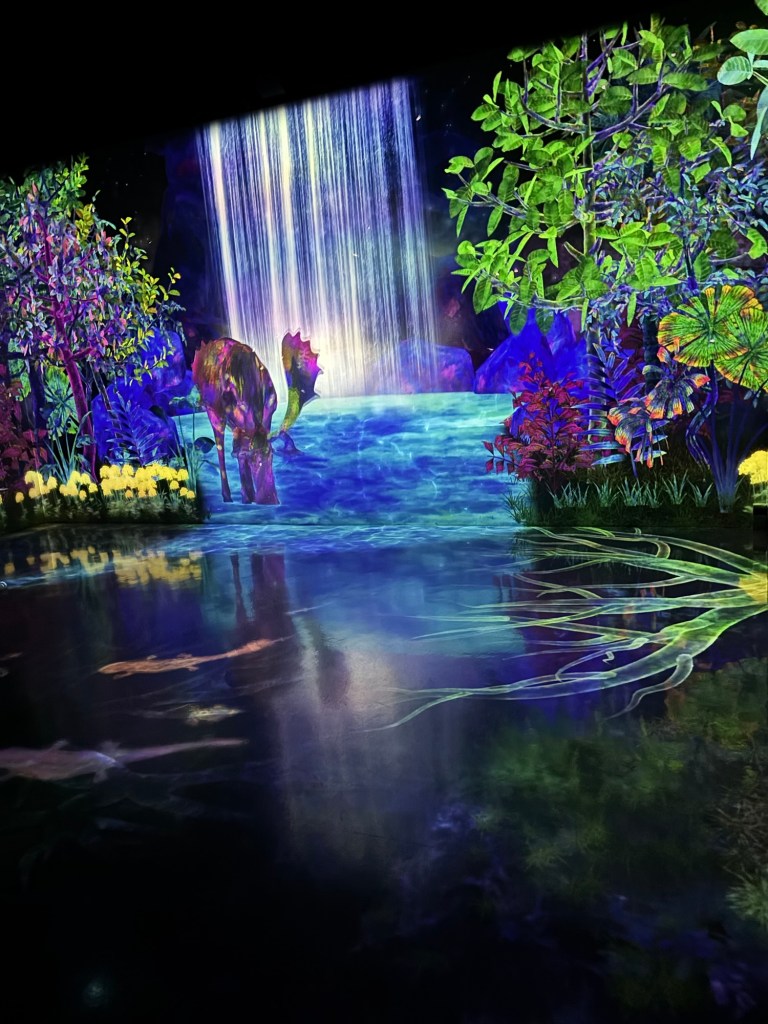
Rhino wandering past WilfMoose below the waterfall.
Not only were there animals wandering through the forest on the walls around us, but the floor was covered with fish swimming by and birds flying overhead. We moved from room to room through the forest as there was movement all round us. Mirrors helped to make the space seem even more huge than it was, and all the time there was music playing. It was very beautiful.
In the forest
From the forest we moved into the more interactive rooms.
The first room was the ‘Oh, hell no room’. We didn’t get a picture there – too busy getting out. When we entered the room we were standing on a narrow solid strip. As soon as we stepped forward we were on a very squishy floor and we had to fight to stay upright. We were clinging to each other trying to figure out how to get back onto solid ground without having the other tip over. Eventually we did it and walked along the edge of the room. Lots of lights and movement and music.
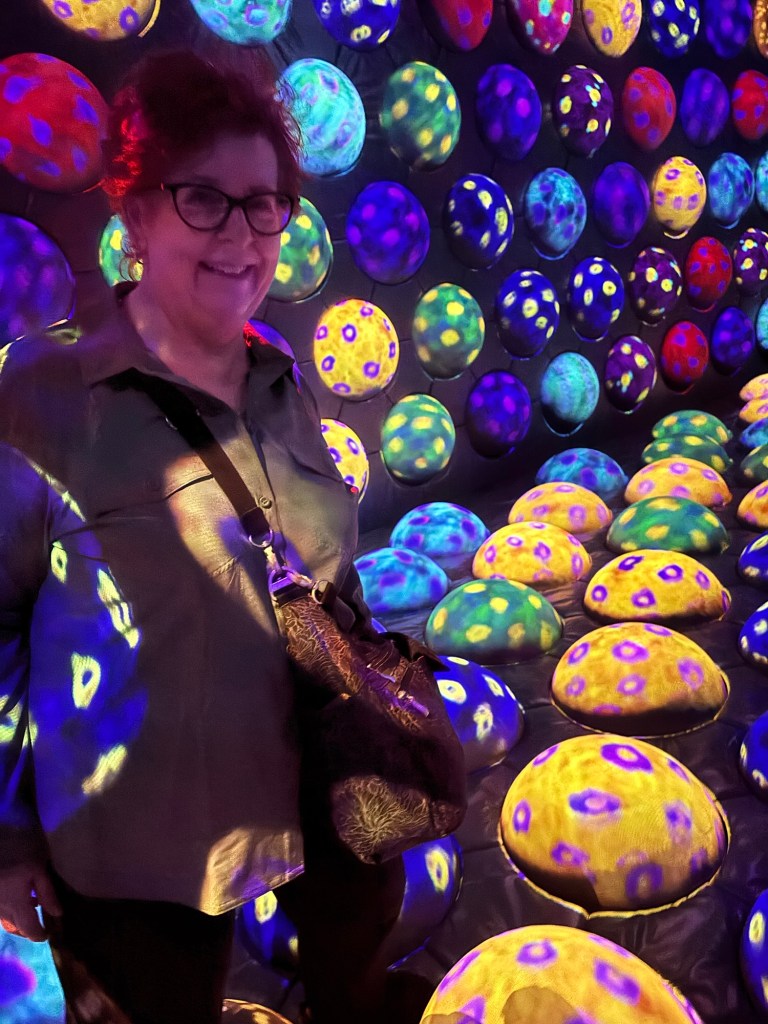
In the next room the walls and floor were covered in pillow like bumps. If you stepped on them they changed pattern or colour and were very squishy.
We decided we’d be better off walking on the black part between the pillows – still soft but stable.
The third room had an undulating but solid floor.
Lots of animals and textures and music. The next room was our favourite ….
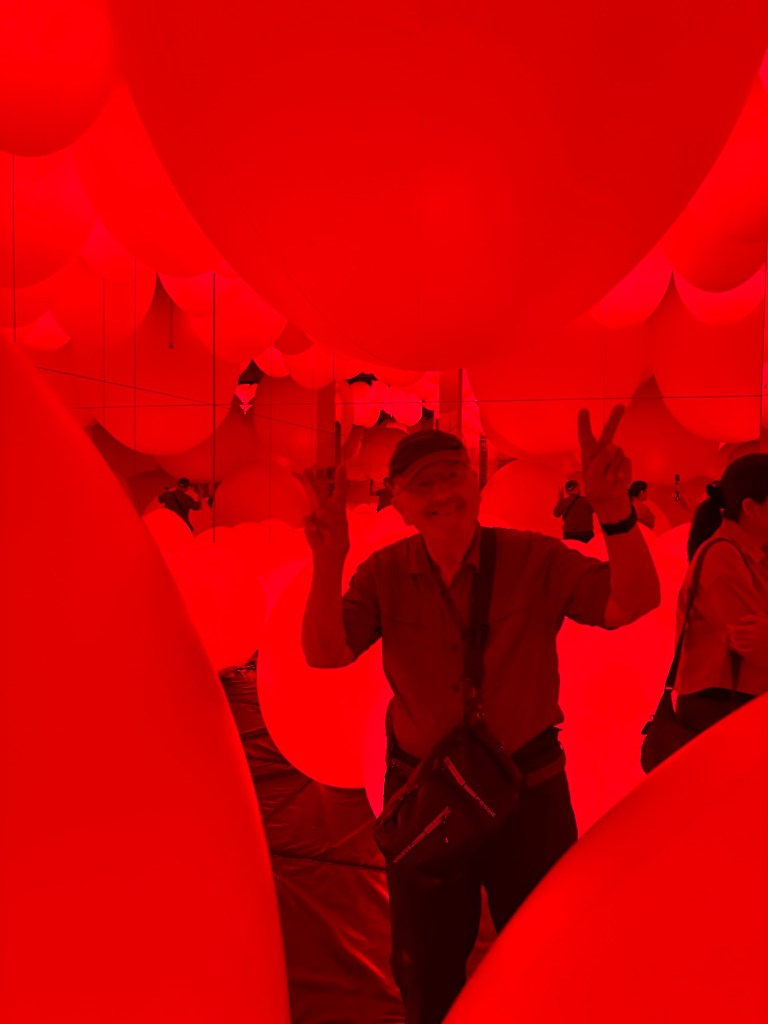
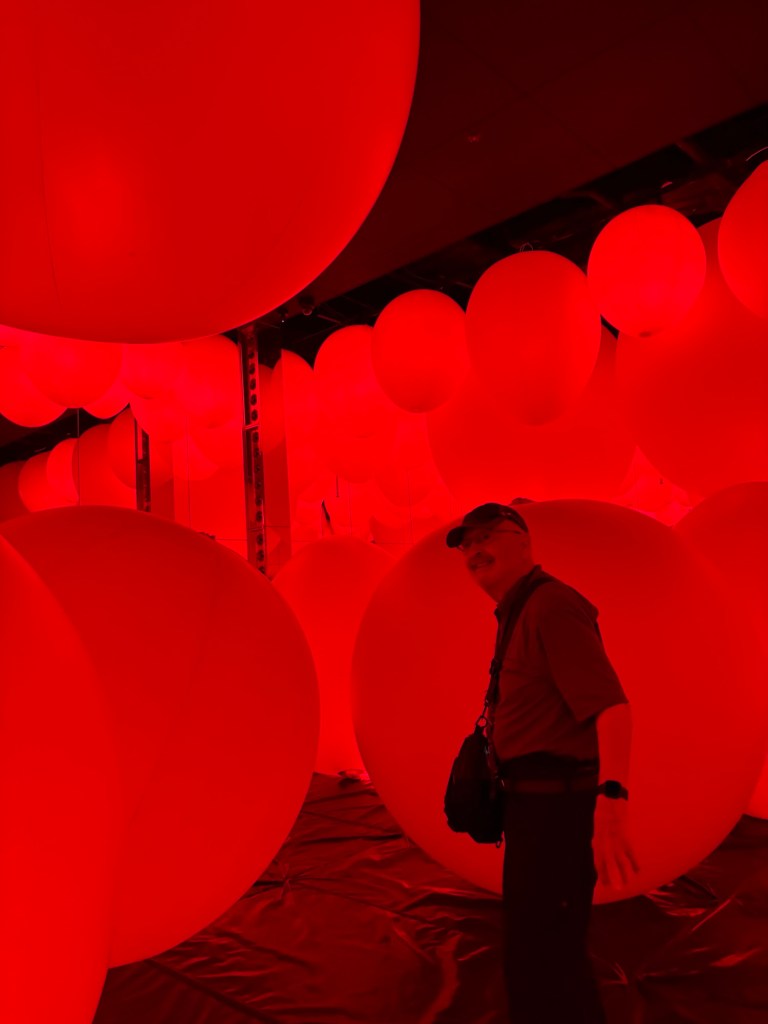
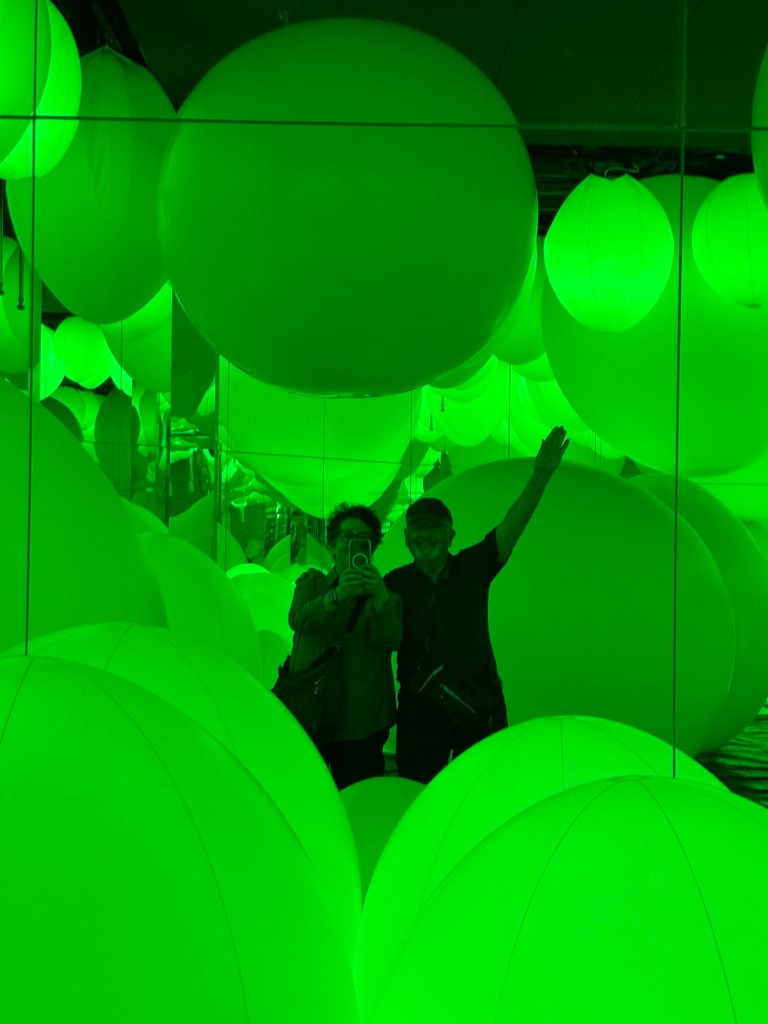
It was full of big spheres that floated about in the breeze, as well as big egg shapes lightly tethered to the floor. As the spheres floated by we could gently bat them away or forward or up as we walked through the egg shapes. The colours shifted every minute or so, and the mirrored walls and ceiling made it feel like an infinity of spheres.
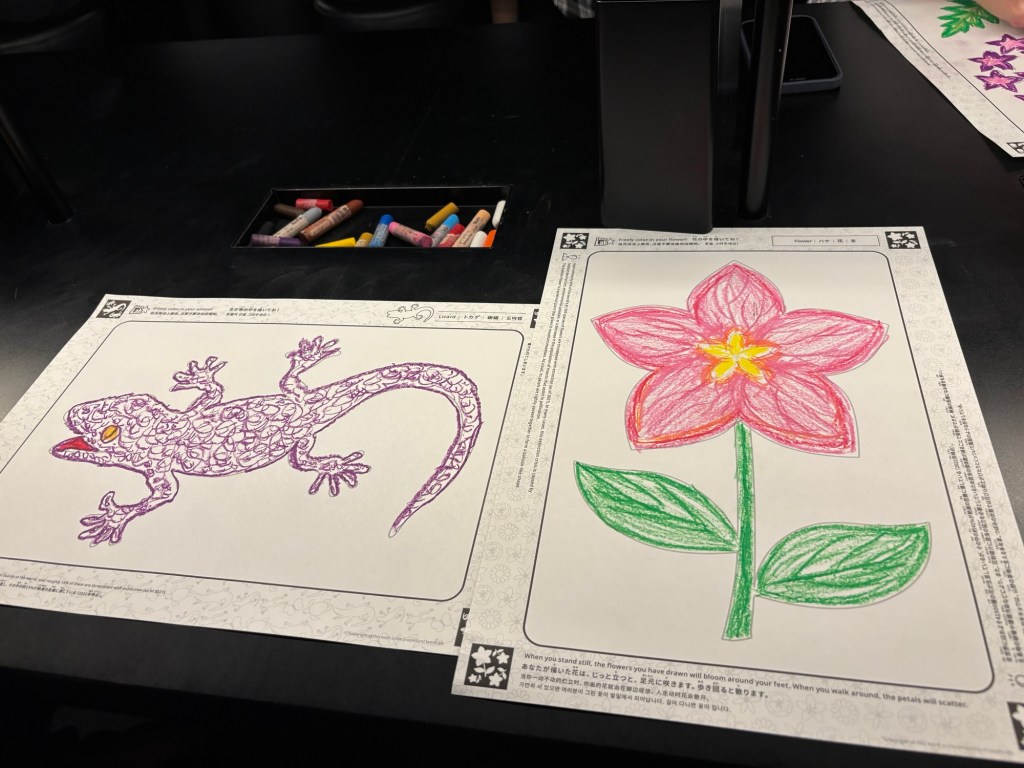
There was also a station we could sit at where we could choose a piece of paper with an outline of an image on it. We would colour it as we chose and when we were done we would hand it to the attendant. She would scan it and when we walked back into the room our image would be on the floor.
Mine was a flower and when I stepped on it it exploded into a shower of petals around my feet. Wilf’s lizard came to life and ran around his feet before running off and joining the other lizards. It took mere seconds between the scan and the animated projection.
When I think about the two teamLabs events we have been to I have the same feeling. It is dazzling and amazing and very cool to be inside of it. And….. I keep longing for a story, for something to react to, some emotional connection. At the end I find myself thinking ‘that was cool, but what was it for?’ Dazzling for dazzling’s sake? In Tokyo there is an immersive digital display about Hokusai, including his Great Wave. We’re going to try and get to that and see if an immersive digital display with a theme feels a bit different.
In our never ending quest to see All The Castles we made two day trips while in Fukuoka.
First up was Karatsu. We took the train south from Fukuoka – actually into the next prefecture. It was a basic commuters train – we got on the subway and eventually the train came above ground and wandered down the coast to Karatsu.
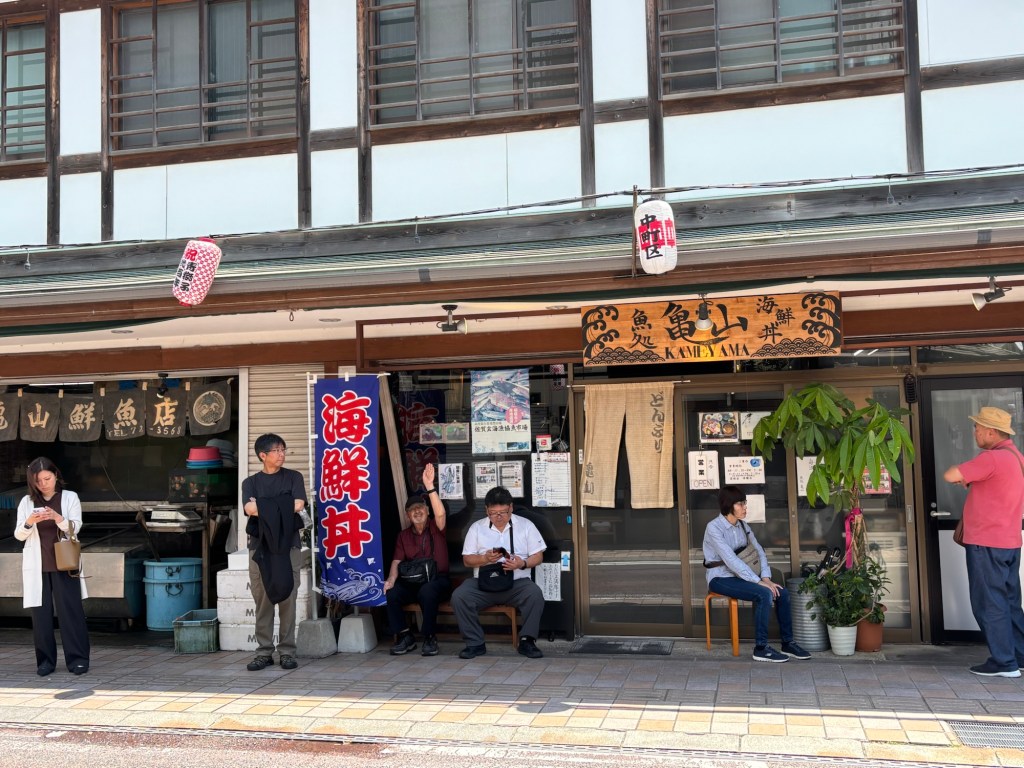
Wilf had scoped out a restaurant in the old town near the train station, so that was the first order of business. It opened at 11:30 and we arrived at 11:45 – put our name on the list for the 12:30 sitting.
Wilf holding our spot in line.
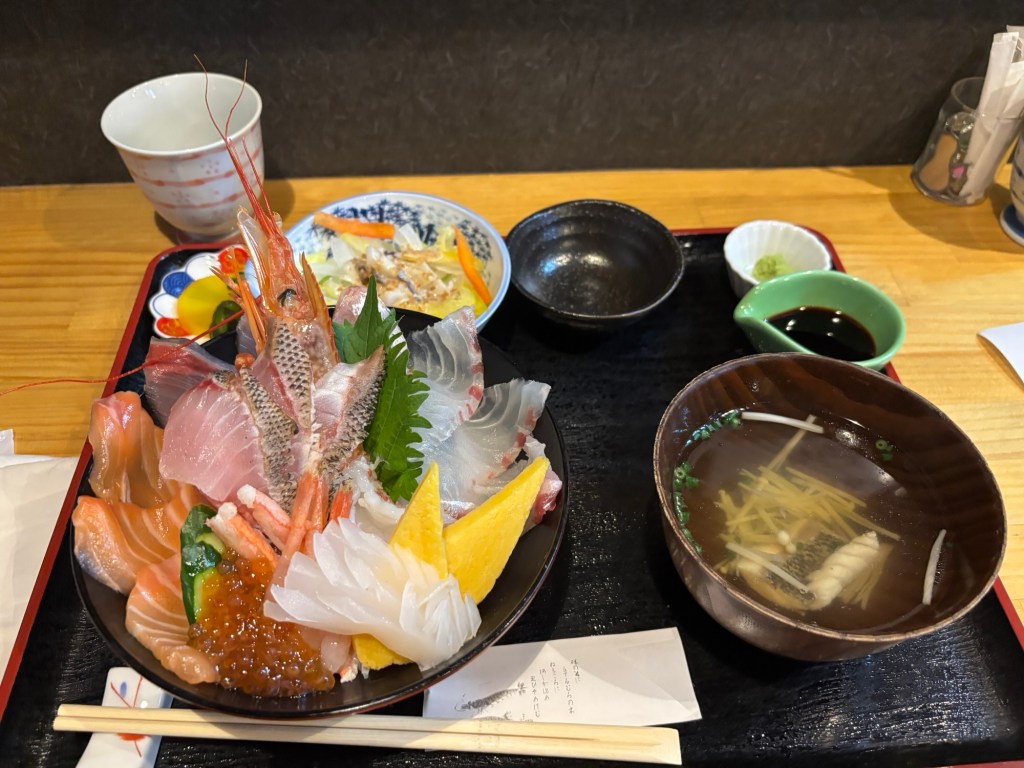
The restaurant is tiny, run by a husband and wife team. Your choice is a seafood rice bowl set menu – the only difference is in the fanciness of the seafood. We went for the super deluxe because – why not? It was amazing!!!!
The set meal pretty much always includes the main course, a bowl of miso soup, pickles, often a salad of some sort. And so this did. The bowl of seafood was amazing – so many good things. As I was eating my way along I was thinking about how things have changed. When we first came to Japan in 2009 my seafood tastes were pretty limited. Faced with a bowl like this I would have been hesitant. Now – dive right in. I didn’t know what everything was, but it was all delicious.
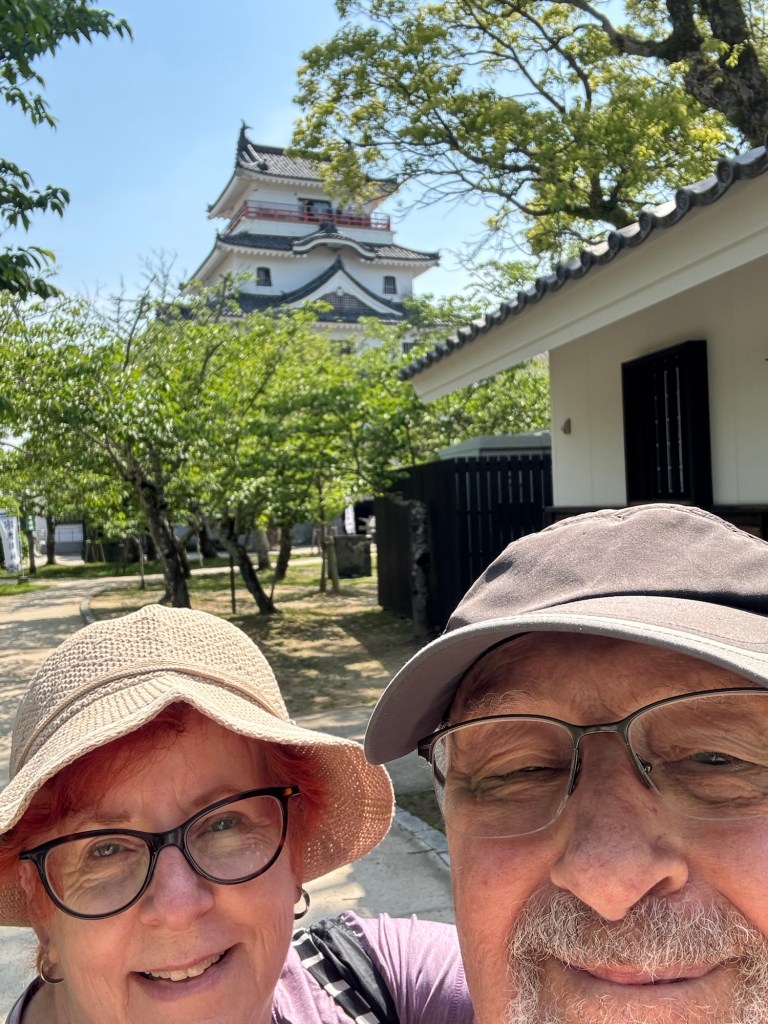
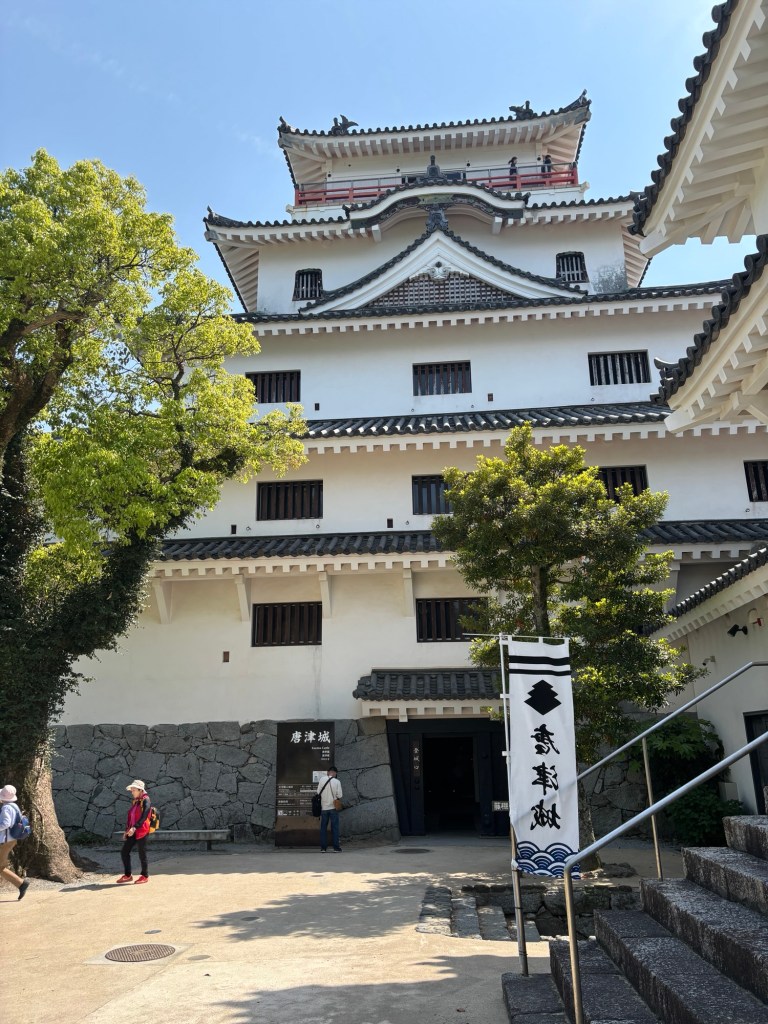
From the restaurant we took a cab to the castle in the harbour. It was very hot and we were happy to find there was an elevator to take us up to the entry to the castle. Often castles are on high points – which makes sense, but this one was originally on the water’s edge. It was destroyed at one point and has since been rebuilt. Over time the harbour has been extended, so the site is now a bit inland. But originally the castle foundation rose out of the sea, providing defence on that side. A series of moats and trenches protected the other sides.
The exhibits inside were interesting, showing the history of the area. Not surprisingly, they were whalers, and there were interesting drawings and paintings of how they went out in small boats to capture whales. I’m reading ‘Moby Dick’ at present, so have whales on the brain!
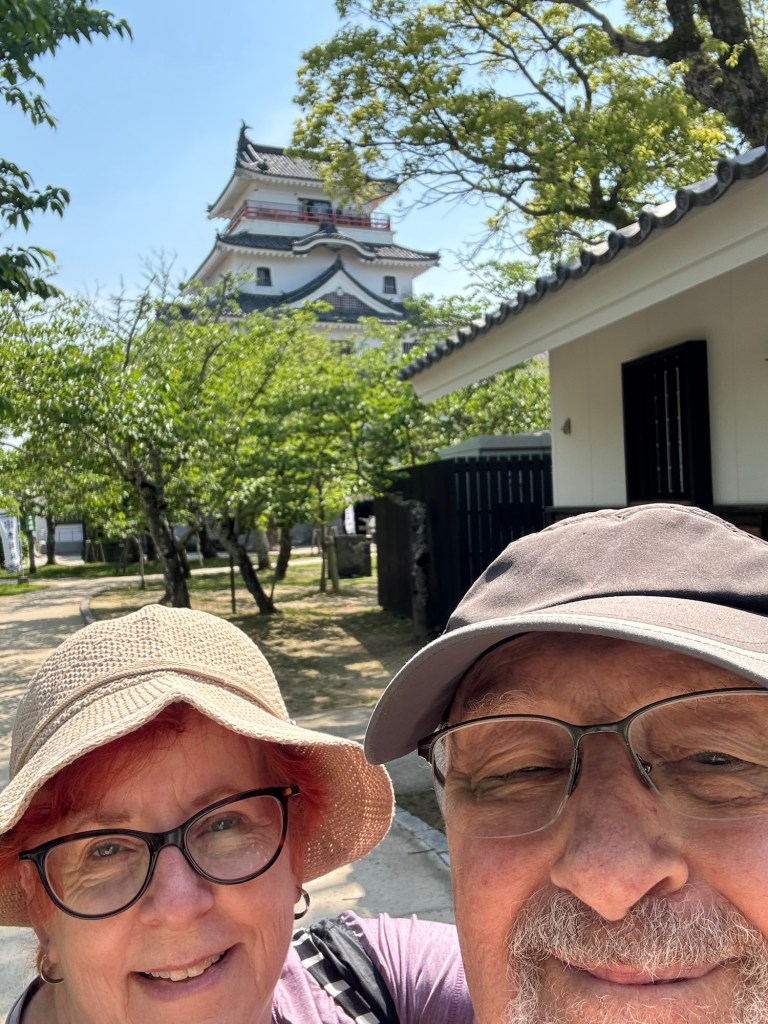
Karatsu Castle selfieThe castle is surrounded by cherry trees – must be pretty in the spring!
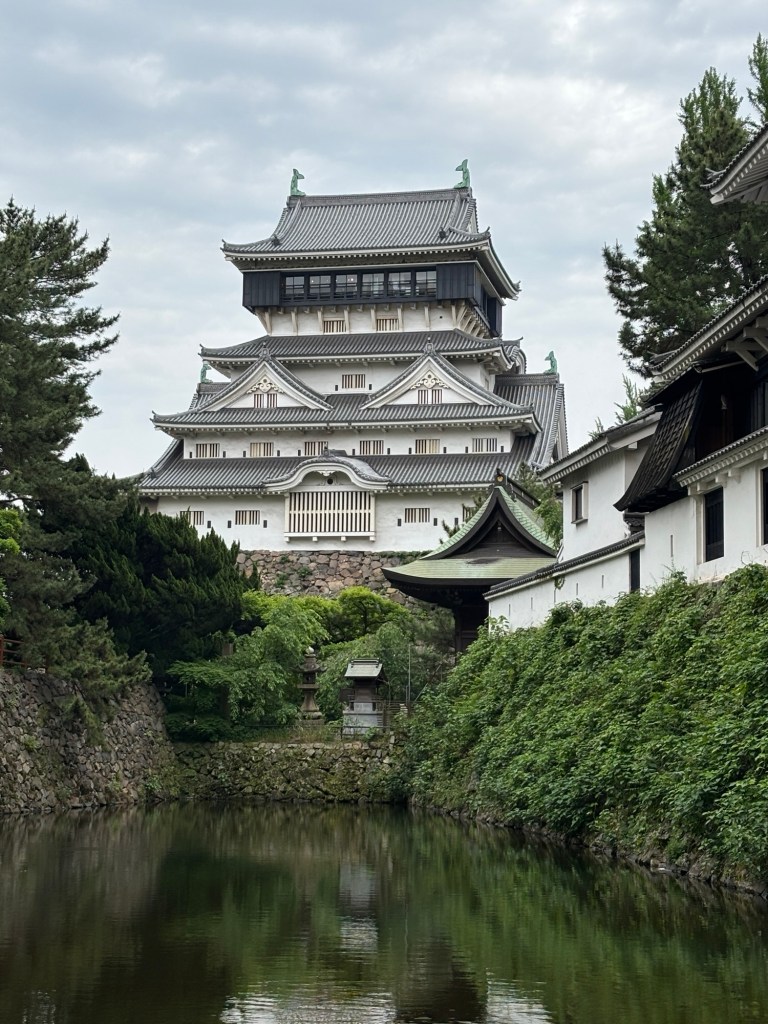
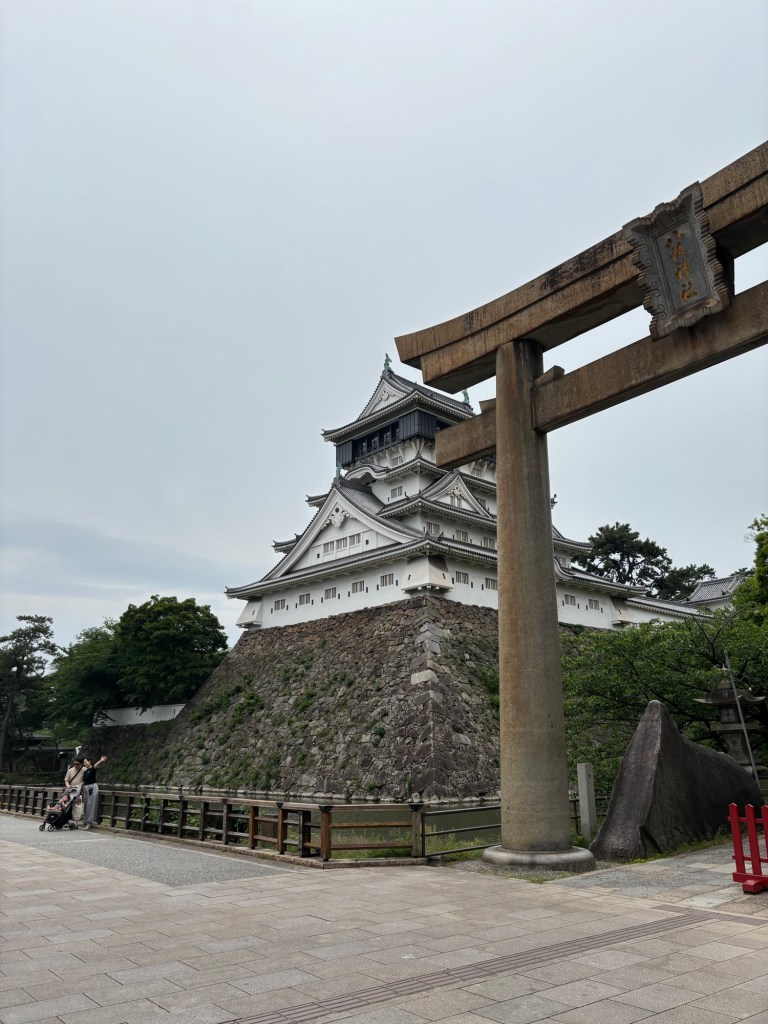
Castle number two was in the city of Kitakyushu, which is north of Fukuoka. One stop on the Shinkansen. Zoom zoom – about 15 minutes, mostly through tunnels. Kokura Castle is another castle that has been rebuilt. Kitakyushu is a large city at the tip of Kyushu Island. The modern city is an amalgamation of smaller cities, including Kokura. It was a prosperous place, ruled over by generations of the same family and a major stopping point on the way to the capital. Back in the day the Shogun required the samurai lords to spend alternate years in Edo (now Tokyo). Kokura was positioned at the top of the island and traffic would cross the Kanmon straits to Honshu on the way to Edo.
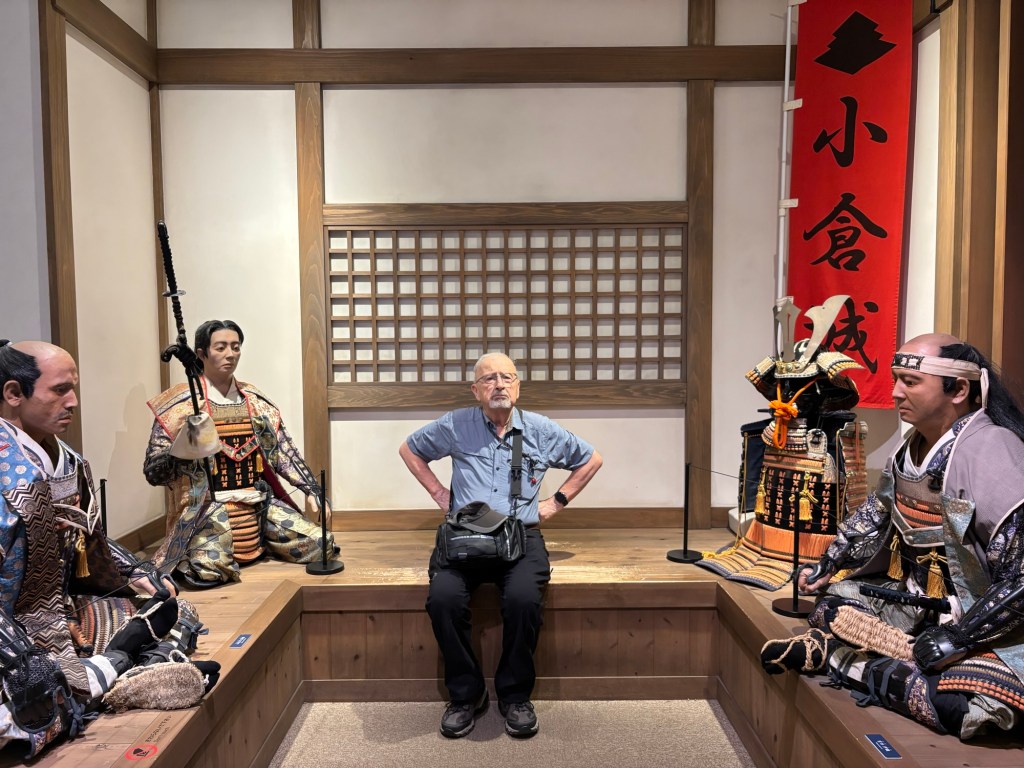
In the late 19th century the castle was pulled down, and the current replica was created in the 1960’s. We have visited several castles that are intact from the samurai times, and they are interesting. But there is something to be said for the reconstructions….. No ladders between floors, for one thing! The exhibits were really interesting and interactive.
Wilf, meeting with his buds.Yee-haw?
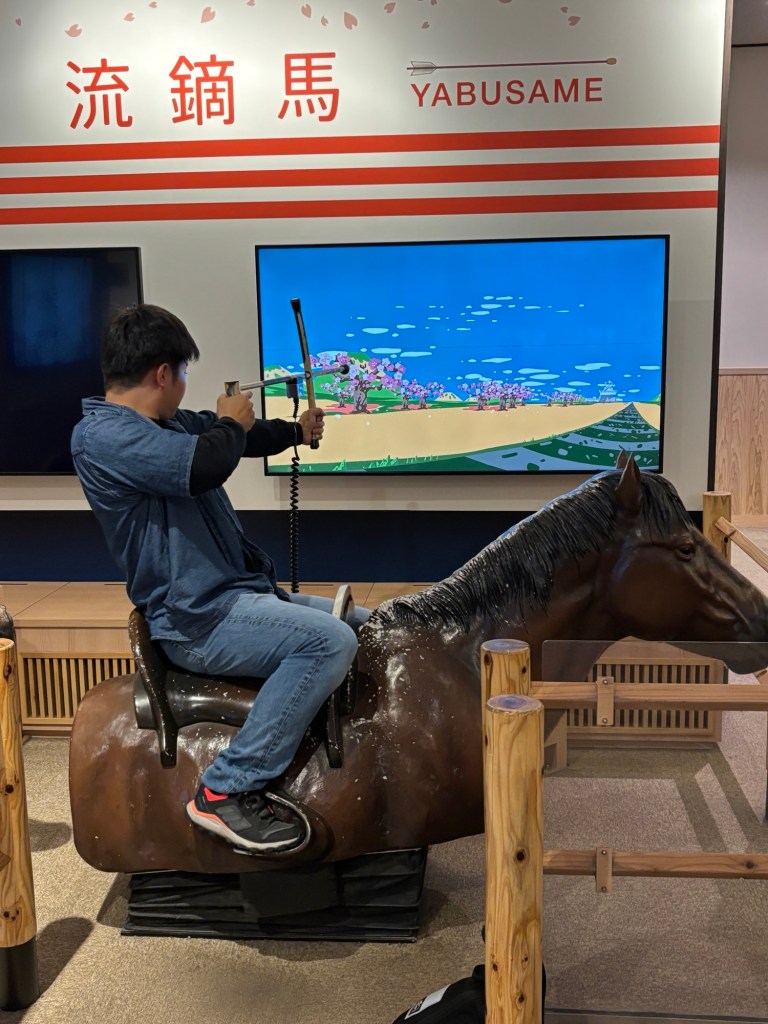
Yabusame is horse mounted archery. I tried sitting on the horse but decided my dignity probably would not survive if I rode the pony and tried to fire ‘arrows’. Kind of like a slow motion bull riding with less twisting. This fellow did well – he ‘fired’ the arrows and hit the targets….
It’s a pretty castle and, again, must be lovely when the cherry trees are in bloom.
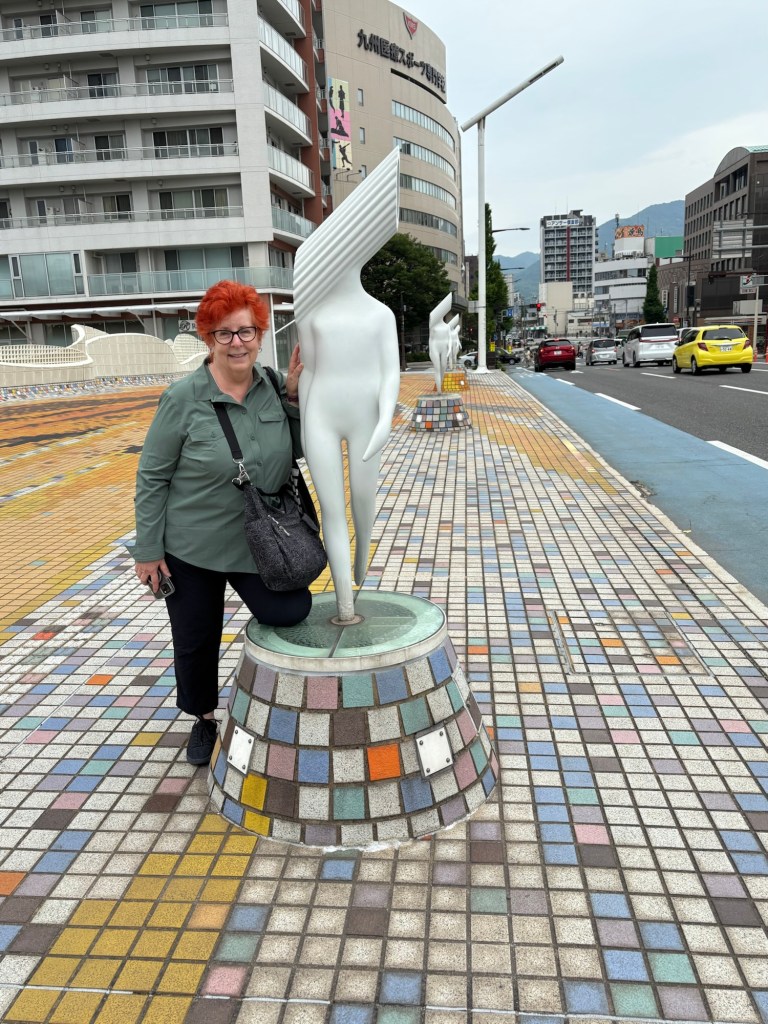
On the way to the castle we crossed a bridge over the river that was decorated with….
A long row of statues with penne heads? The mosaic underfoot is a sunflower motif, ,the official flower of the city.
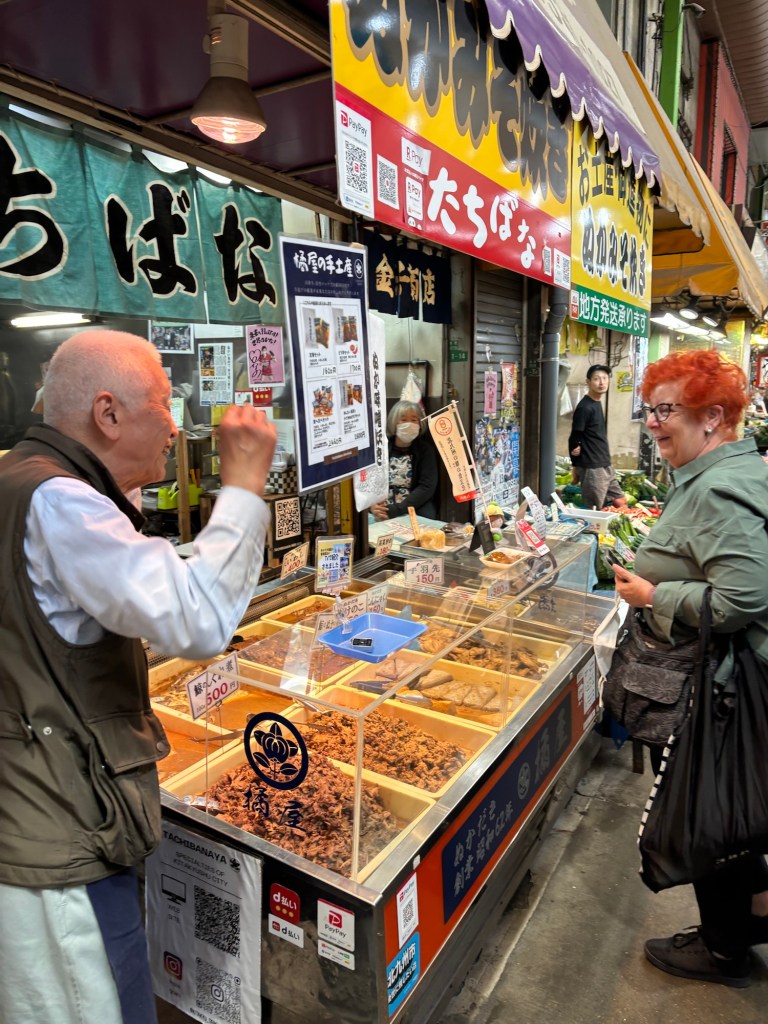
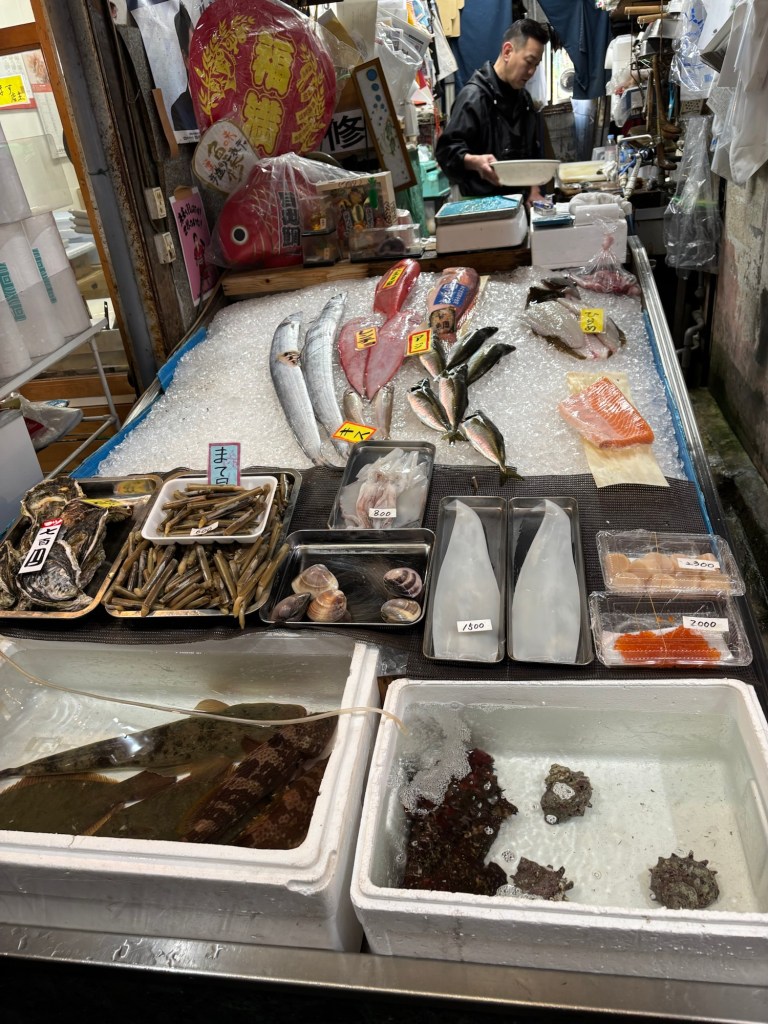
And there was a tiny little fish market – the Tannga Market.
This gentleman was comparing my hair to the colour of the fish. I think….
Two day trips, two interesting and historic towns.
Greetings, dear ones. Yes, Wilf and I are in Japan. And yes, we’ve been uncommonly silent. Usually when we get to Japan we hit the ground running and do all the things. This time around – we’re tired! Jet lag has been a thing. But, we’ve been out and about between the eating and the sleeping and the napping.
We flew from Vancouver to Tokyo – as usual Japan Airlines was wonderful. When we were here in 2012 we went to the city of Fukuoka. Our goal was to go to a sumo wrestling tournament, which we did. And it was great. It was, however, November and the weather was wet and chilly. We agreed that we had not seen the city that well and decided a do-over was in order.
Most international flights (especially from North America) arrive at Narita airport, north of Tokyo. Domestic flights in Japan usually fly from Haneda airport, south of Tokyo. Usually we take a train into the city, but the instructions for the transfer from Narita to Haneda seemed a bit confusing, so we took the Expressway bus. It was fabulous. Straight there in less than an hour, passed by Disney and other things to see along the way. We were dropped at Terminal 2, which turned out to be a small oops, as our hotel was at Terminal 3. No problem, the airport shuttle had us over to the other terminal right quick and it was a shortish walk to our hotel in the adjacent building.
This was our first experience at a hotel right at the airport and it was great. The Villa Fontaine Premier was very new and very luxe. In addition to restaurants in the hotel there was a shopping complex below with every kind of food. And on the top floor – a spa!
The spa was lovely with multiple baths at different temperatures. There was even an outdoor bath. I gave that a try, but…. Let’s say Haneda is one of the windiest places I’ve been. I got out the door and across the decking and into the bath. Sitting there amidst the whitecaps I thought ‘why am I doing this? This is not fun.’ As I was getting out, the door flew open and a tiny elderly Japanese woman popped out. I believe I heard the Japanese version of ‘Oh, hell no’ and the two of us wrest the door back open and retreated to the calm indoors.
In the morning we returned to terminal 2 and flew to Fukuoka, which is on the island of Kyushu, directly south of Honshu, the main Japanese island. The airport is two stops on the subway from the main train station for the city. And our hotel was across the street from the train station.
I have mentioned before about the wonders, and terrors, of Japanese train stations. How you can take the wrong exit and literally be hundreds of meters from where you want to be (I’m looking at you, Shinjuku station). Or, you can inadvertently take the west exit rather than the east exit and have a devil of a time finding your way to where you want to be. The station is built around the regular train and Shinkansen tracks, and has all these department stores accreted to it around the edges. Poor old Google maps has a hard time giving directions in the maze that is the area.
Once we got to the east side of the station there was our hotel big as day – in fact if we had taken the correct exit from the subway we would have wound up in the basement level of our hotel.
The Miyako Hotel is another beautiful hotel. We were on the 10th floor with view west over the train station. On the top floor as an indoor bath as well as an outdoor swimming pool and lounge area. We enjoyed the baths before bed time and sat in the lounge area in the afternoons.
Being near the train station there were lots of places to eat – lots of breakfast places ranging from the homey to the uber hip.
So – we left home on a Thursday and it was Sunday by the time we arrived at Fukuoka. All our connections worked and that was a relief.
Next up I’ll tell you what we did in Fukuoka… (here’s a sneak preview..)
Tomorrow we’re homeward bound. It’s been a great month and we have been to so many places, seen so many things and ate so much good food!
Thank you all for riding along with us. I’ve enjoyed hearing from you and if there are any questions for me – I’ll do my best! Ask away.
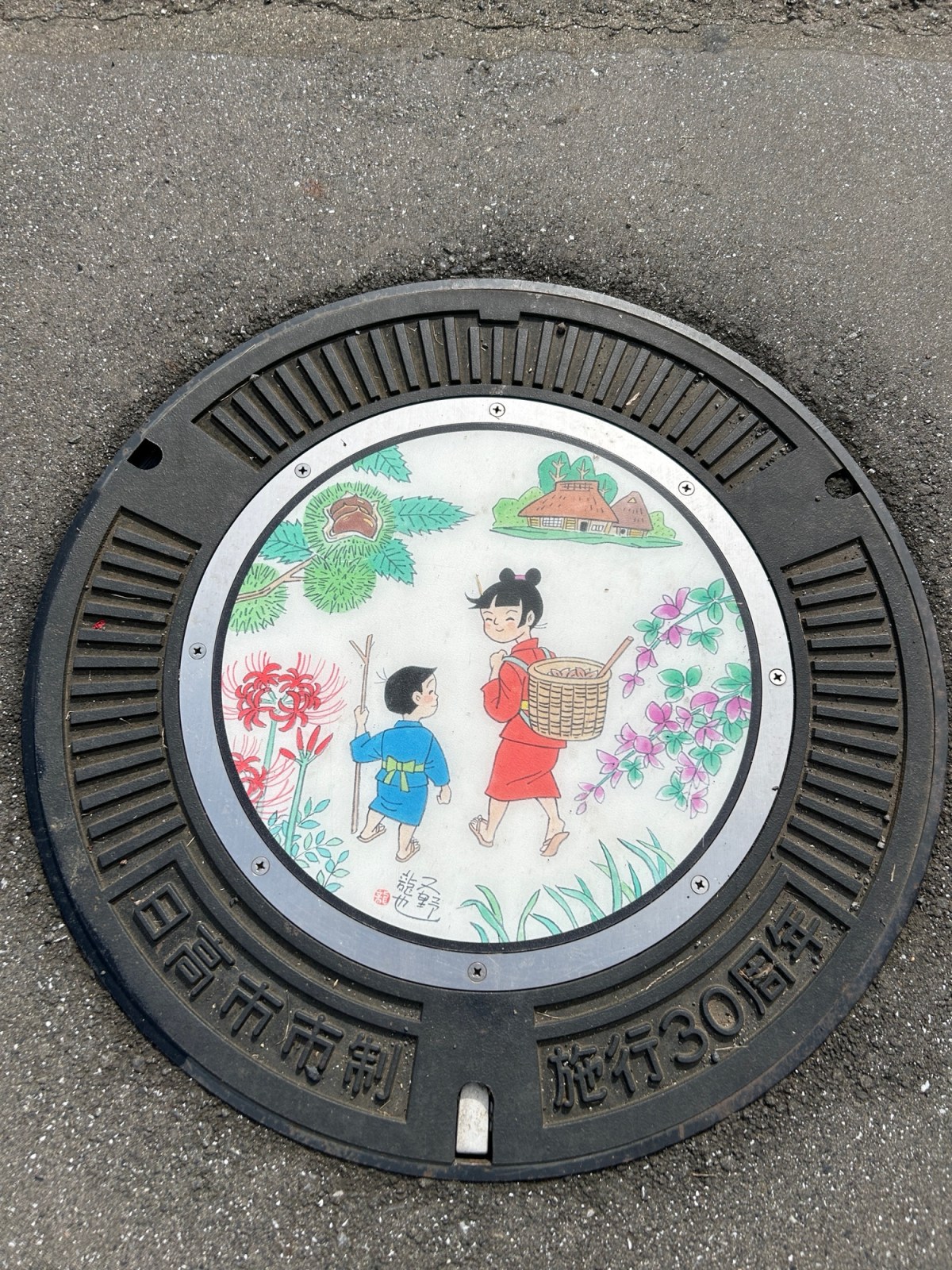
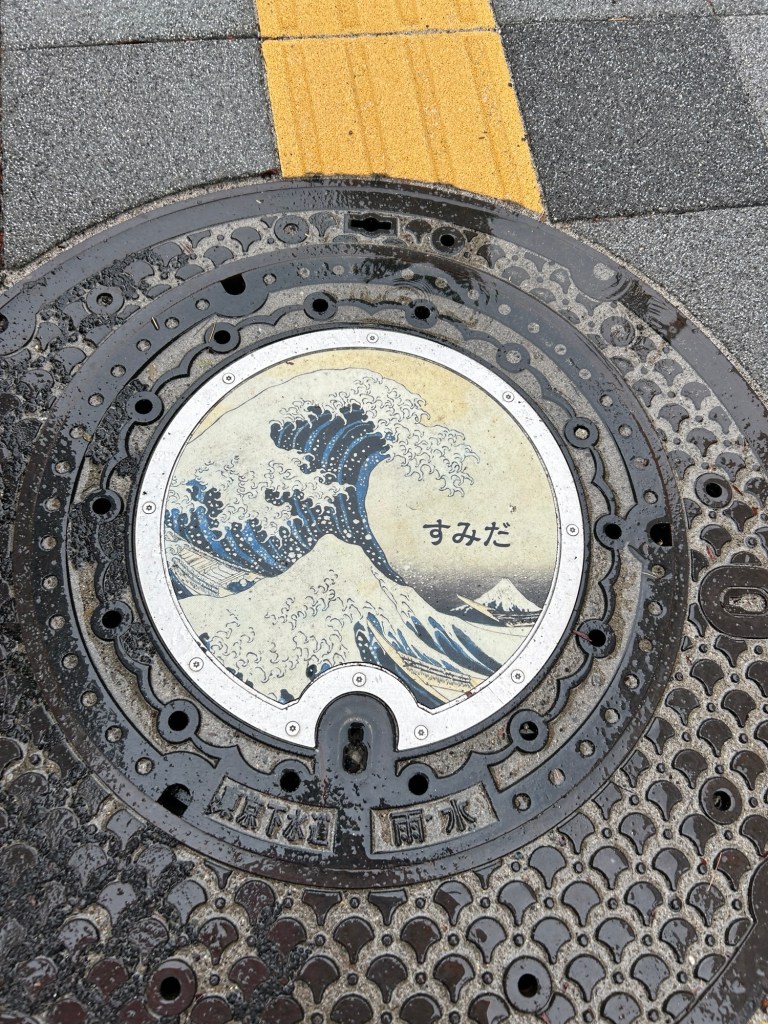
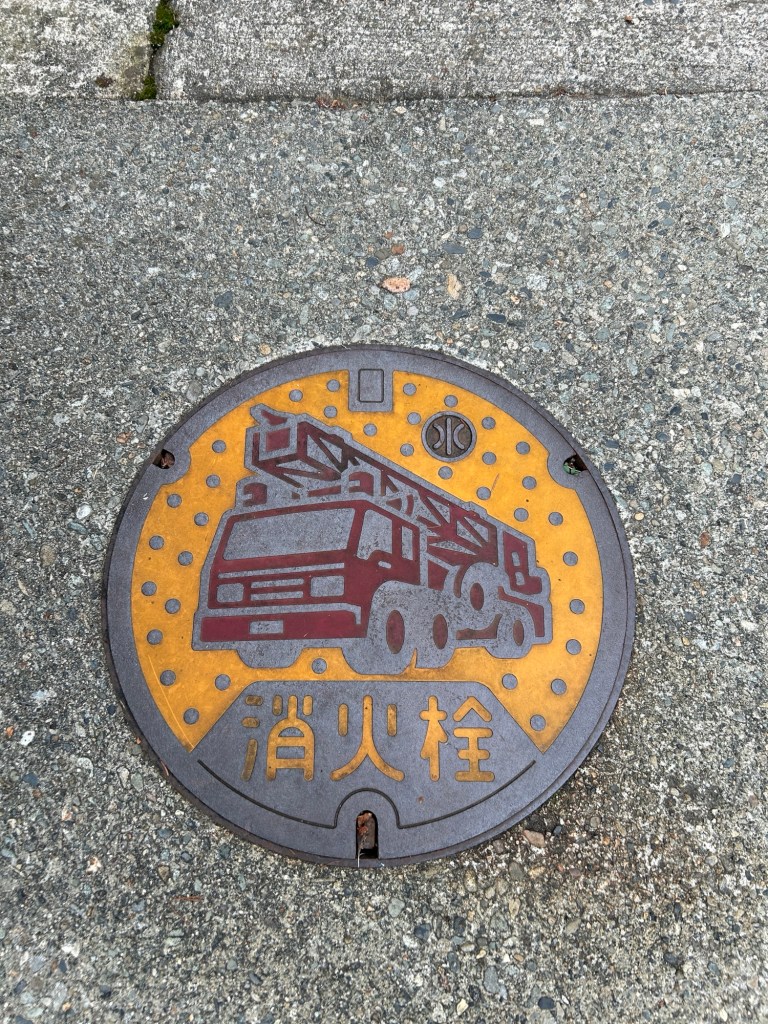
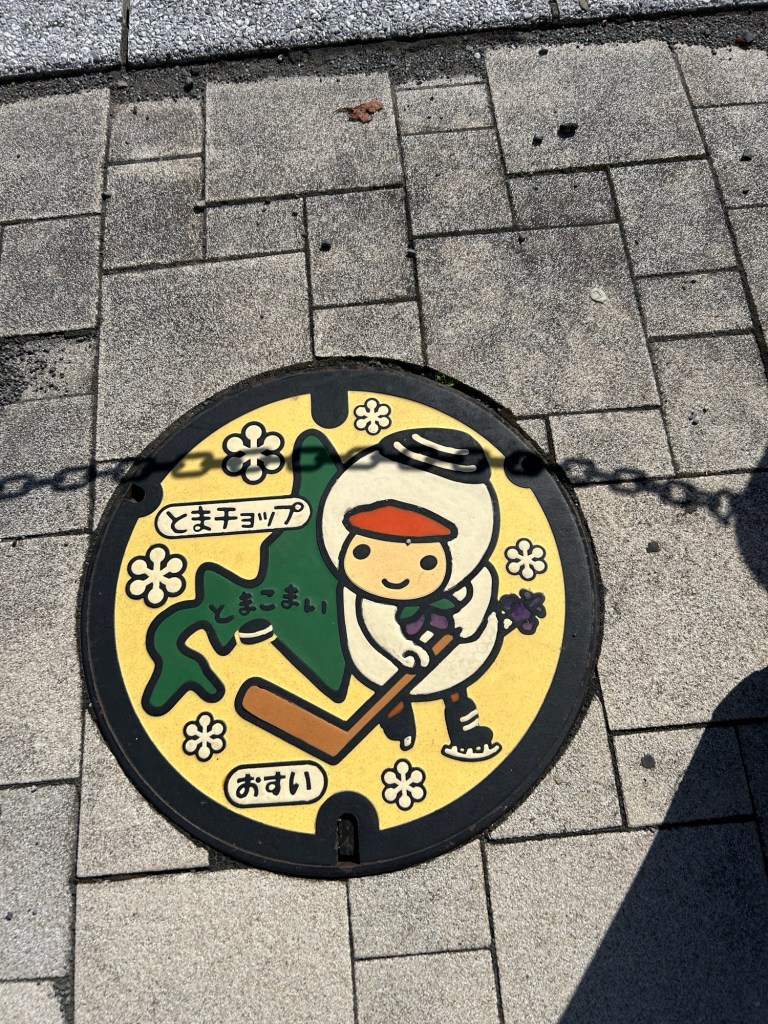
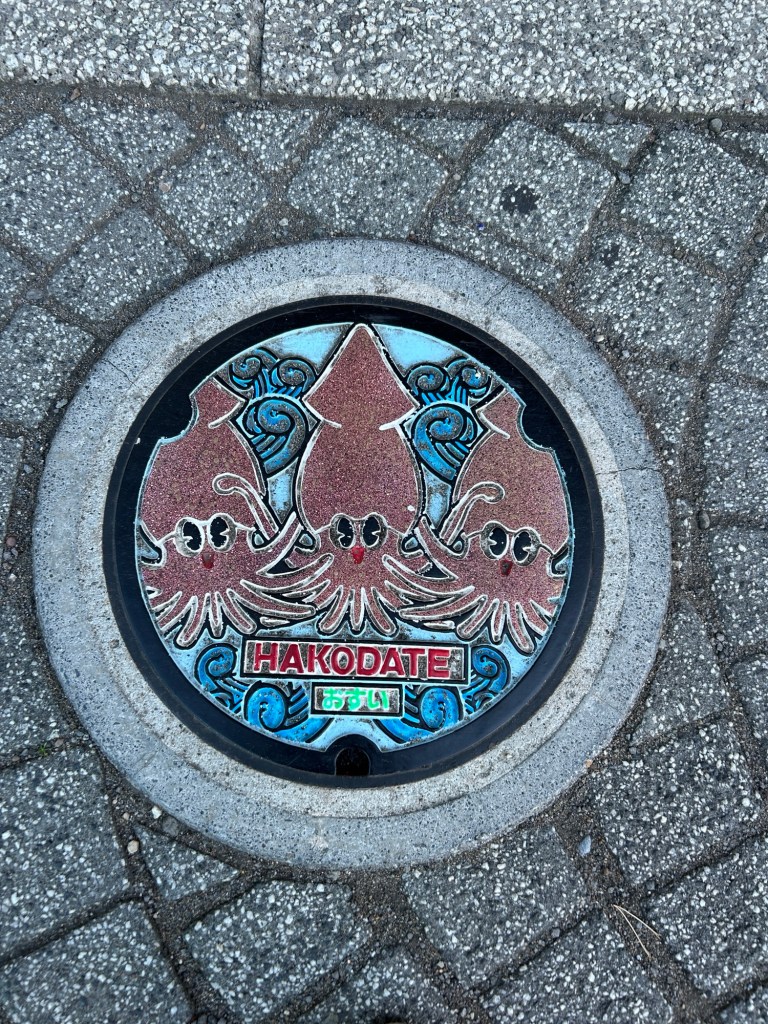
Japanese cities make decorative manhole covers that have the symbols of their cities on them. Some are simple cast iron, some are painted and are quite lovely. It’s become quite a thing and people hunt them down quite obsessively. I’m not quite that dedicated, but here are a few that I found along the way.
Hokusai museum, SumidaYuzawa – cover for an underground fire hydrant Tomakomai, Hokkaido, where it gets cold enough to play hockey?Hakodate, Hokkaido
Well, actually it doesn’t so much these days. We’ve had some really great sushi and sashimi on our trip – for breakfast, lunch and dinner. Some nights, when we’ve had a big lunch we will choose sushi for dinner as we are in total control of quantity. That’s if we don’t want convenience store sandwiches!
Back in the day conveyor belt sushi places were just that – the sushi chefs in the middle, making the food, putting it on the belt, in a little boat, a little train, whatever the thing was for that restaurant. We would wait and see what appeared, or ask for something especially. The dishes were colour coded for the price of the sushi and at the end the dishes were counted up and that was that.
When we started coming to Japan that was how things worked, but as technology has changed so to has the conveyor belt sushi restaurant. The first change was the there would be two tracks for delivery. On the lower track would be food selections on plates with plastic lids on them which we could take if we wanted them. The upper track was for specific deliveries. With a tablet at each table we could order anything we wanted and soon it would come zooming along and be shunted to a little siding in front of our position, when the tablet would announce that our order had arrived. The sushi chefs were not longer out front. The tablet kept track of what we had ordered, the dishes have a chip in them to ensure delivery and at the end of the evening there was a slot at the end of the table where they all went onto a third, hidden conveyor belt.
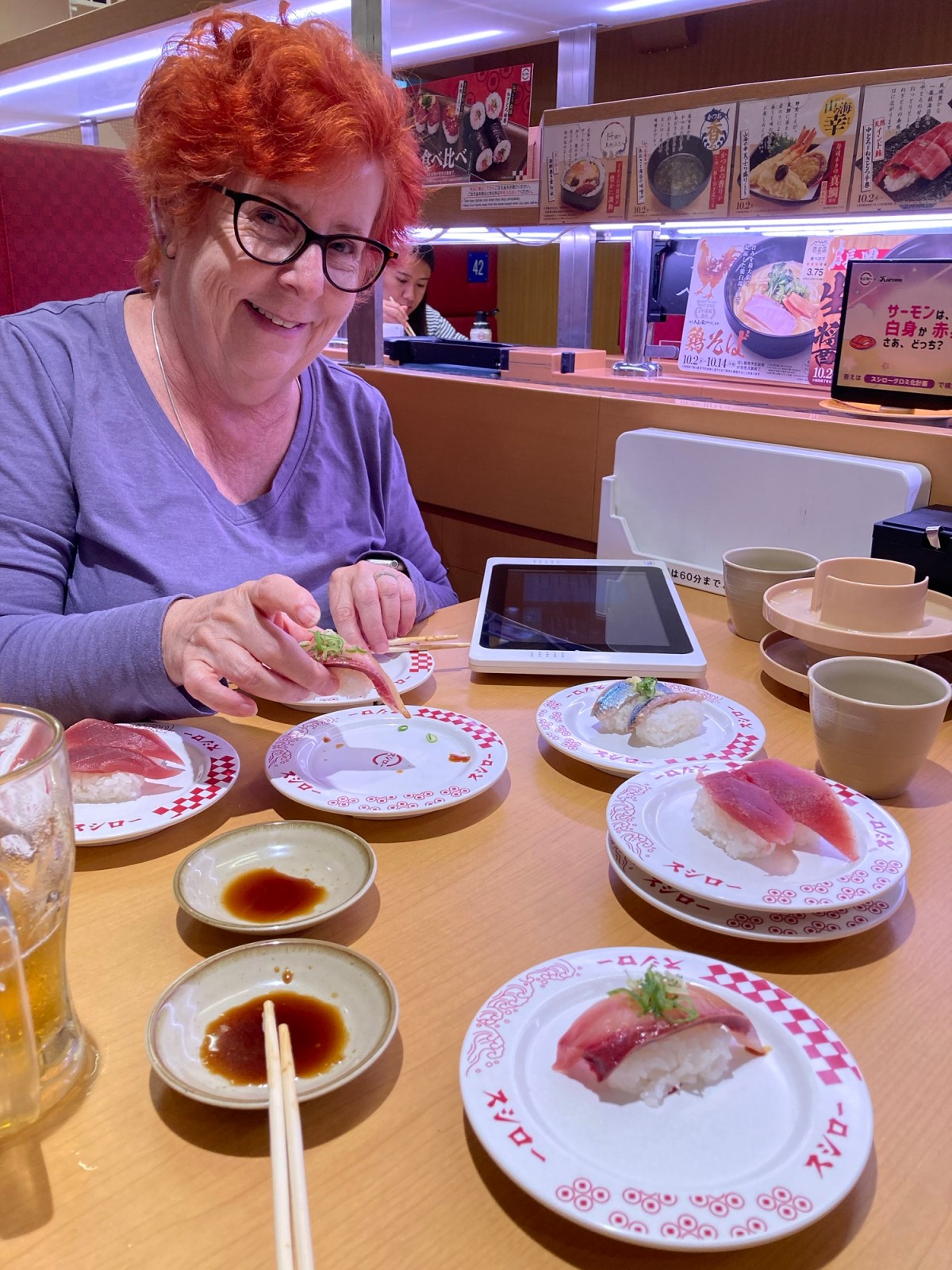
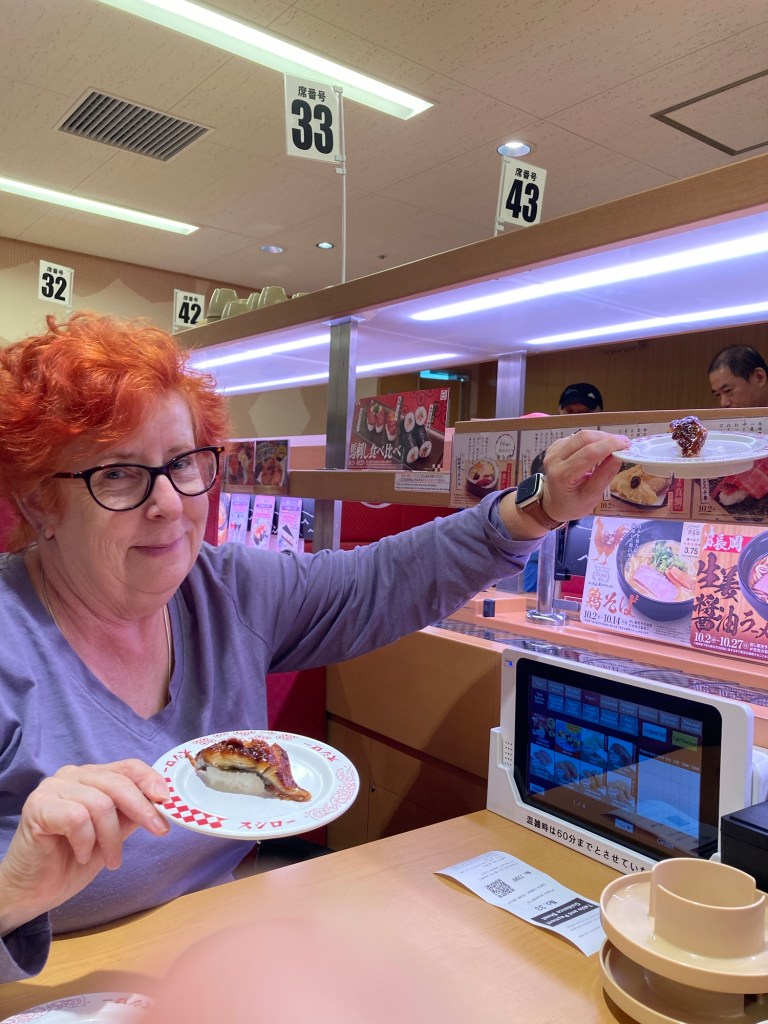
On this trip we tried a new to us chain called Sushiro. They are a big operation and it is slick. When you arrive you check in via a machine, telling them if you want a table or counter space. When your number is called you scan your ticket and it produces another ticket with your table number, which is also keyed to your tablet. The lower level conveyor belt no longer has sushi on plates – just ads for the special of the day. There was a case where some idiot internet goon was messing with the food on the belt and the stores said okay then, we won’t do that anymore. One bad apple…..
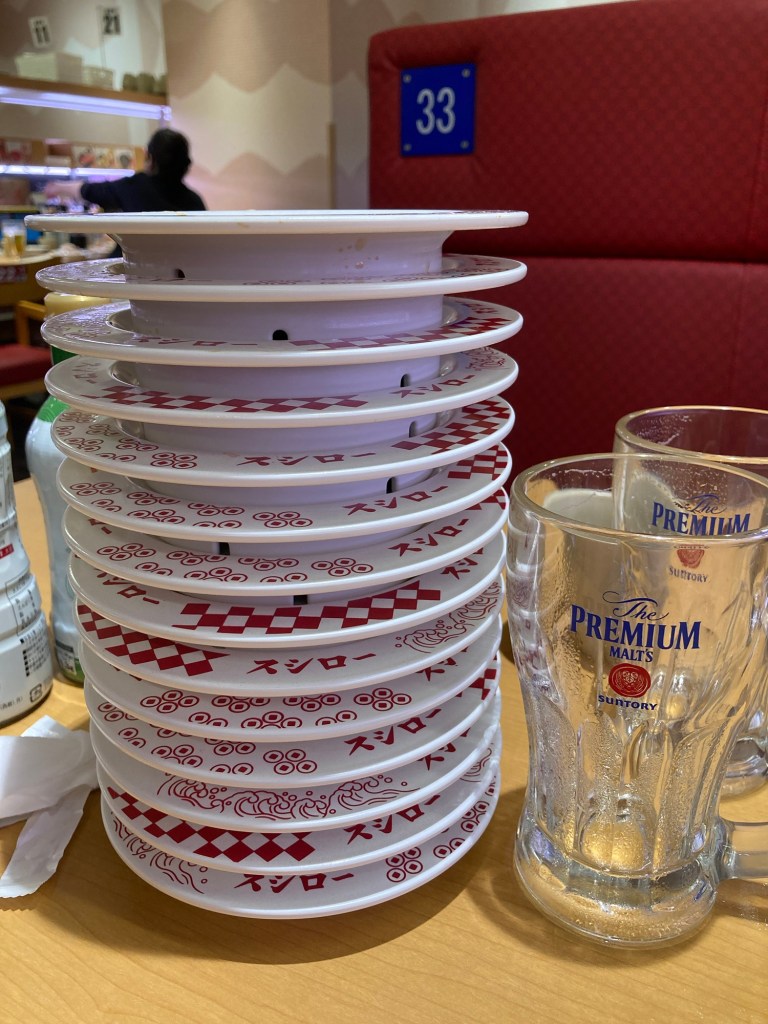
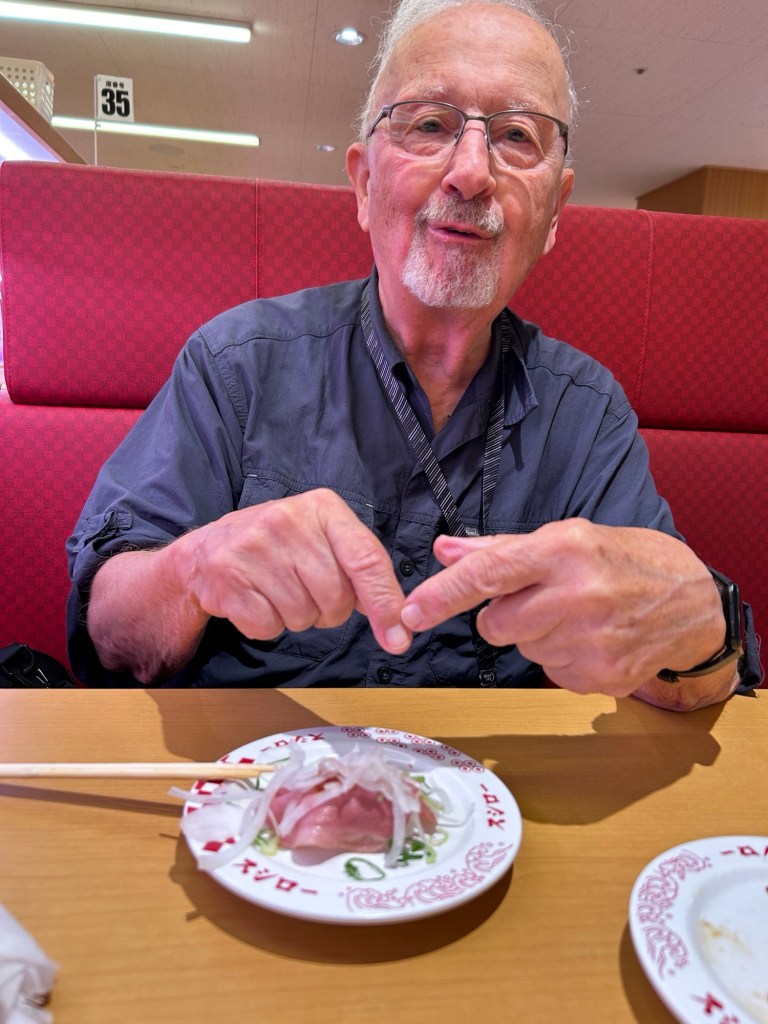
Beer and 14 dishes between us – total less than $20.00 apiece for all we could mange to eat.
Grilled eel – yum yum! The beer mugs arrive on a special tray so they don’t splash or tip – you can see two of them stacked in the lower right of the picture.
We always feel like we’ve eaten So Much Sushi, then we look over at the counter and people have 20 dishes stacked up, as well as a soup bowl just for themselves. I think we’re half milers, but then we haven’t had as much practice as the locals.
Wagyu beef sushi, with yuzu jelly and onions. So good.
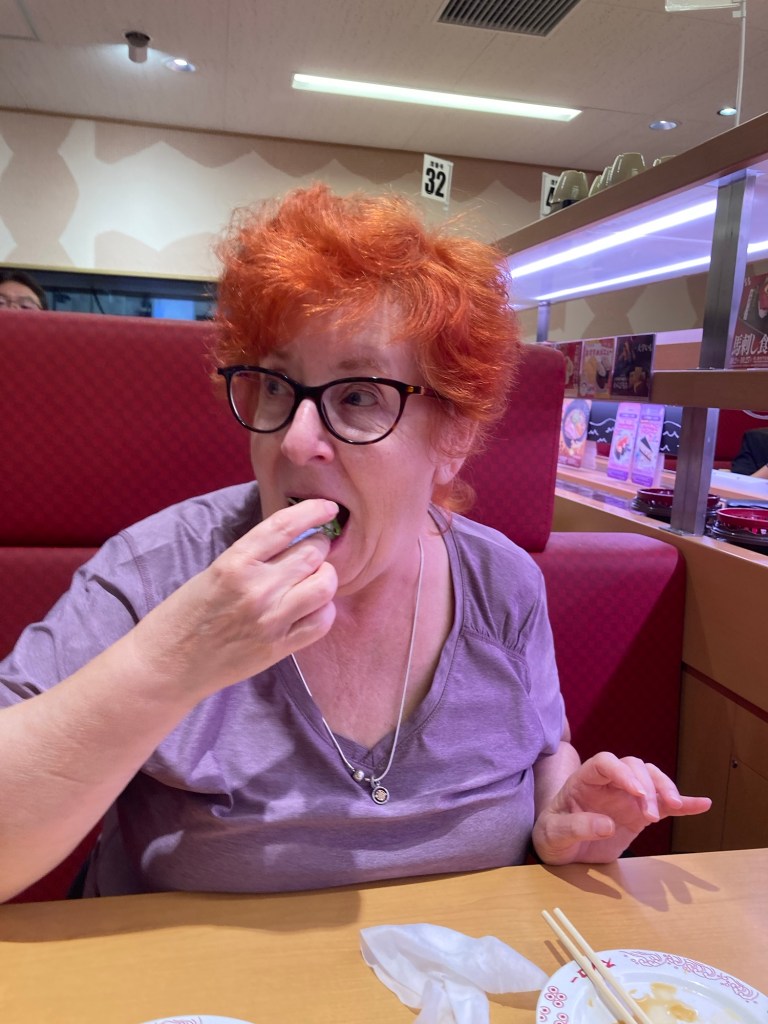
Caught in the act!
And when we are done we tell the tablet that we’re ready to go – it totals our meal and shows it to us. From there we go to the checkout terminal in the front, scan our ticket and pay the machine. There are about 15 ways to pay. When we first started coming to Japan it was cash cash cash. Over the pandemic there was a move to have contactless pay and the options have expanded. We still find some places that are cash only, and others that are credit card only, but most have many choices – Apple Pay, a service called PayPay, Rakuten, our train cards. Lots of options now, and a lot less handling of cash by the staff.
Happy Thanksgiving! And its a holiday in Japan, too. It’s Sports Day. As is often the case with national holidays some things are open, some are not and sometimes there are special events. Wilf had us all lined up to go to a festival in the district of Jiyugoaka. We’ve been to this area before – had a nice lunch on a tree lined street, explored the area around the train station,, indulged in some great people watching. The area has a bit of a European look to it and is not full of high rise buildings. It looks like an area where prosperous senior management might live, where the ladies who lunch come to eat and browse the shops.
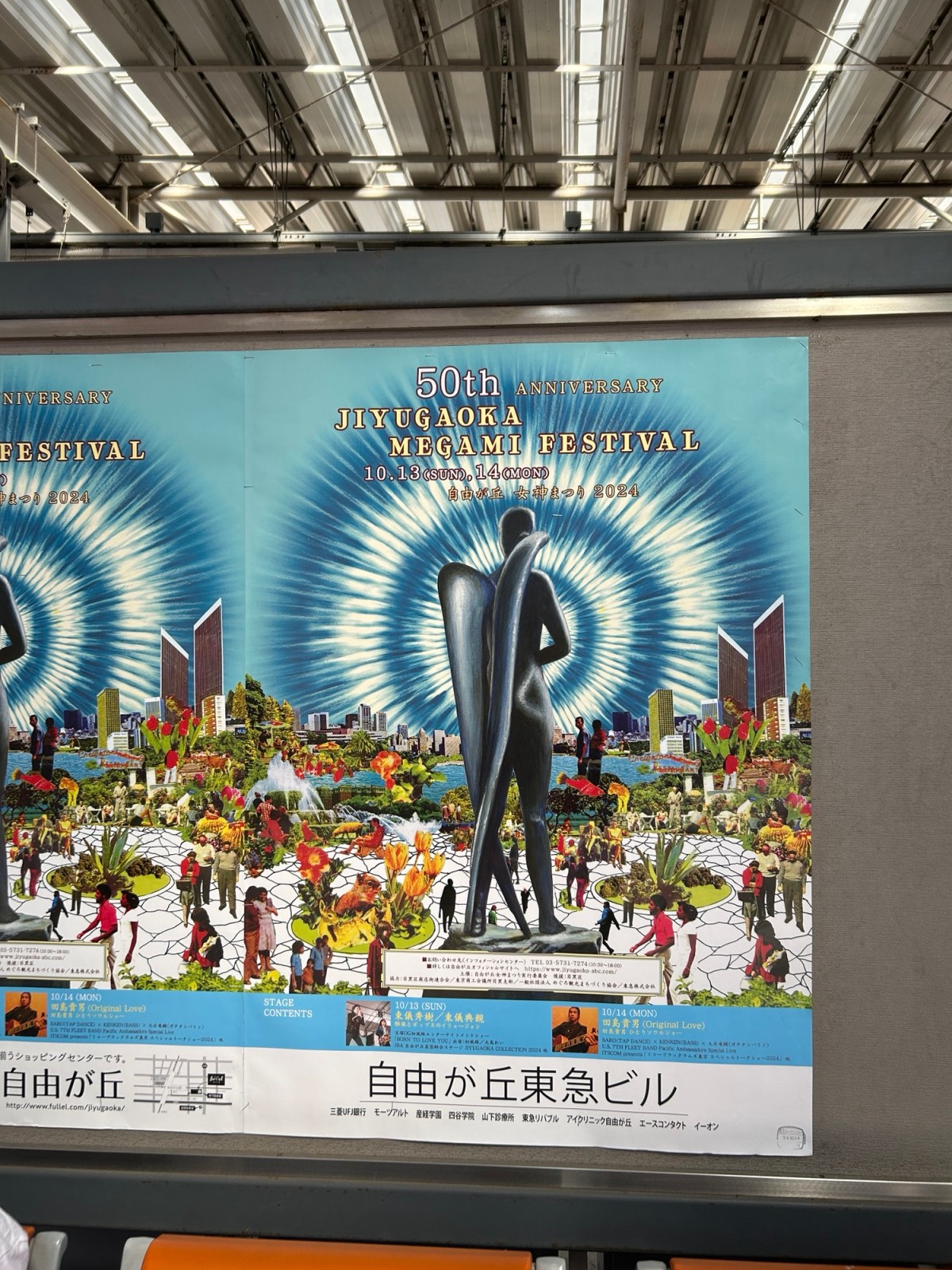
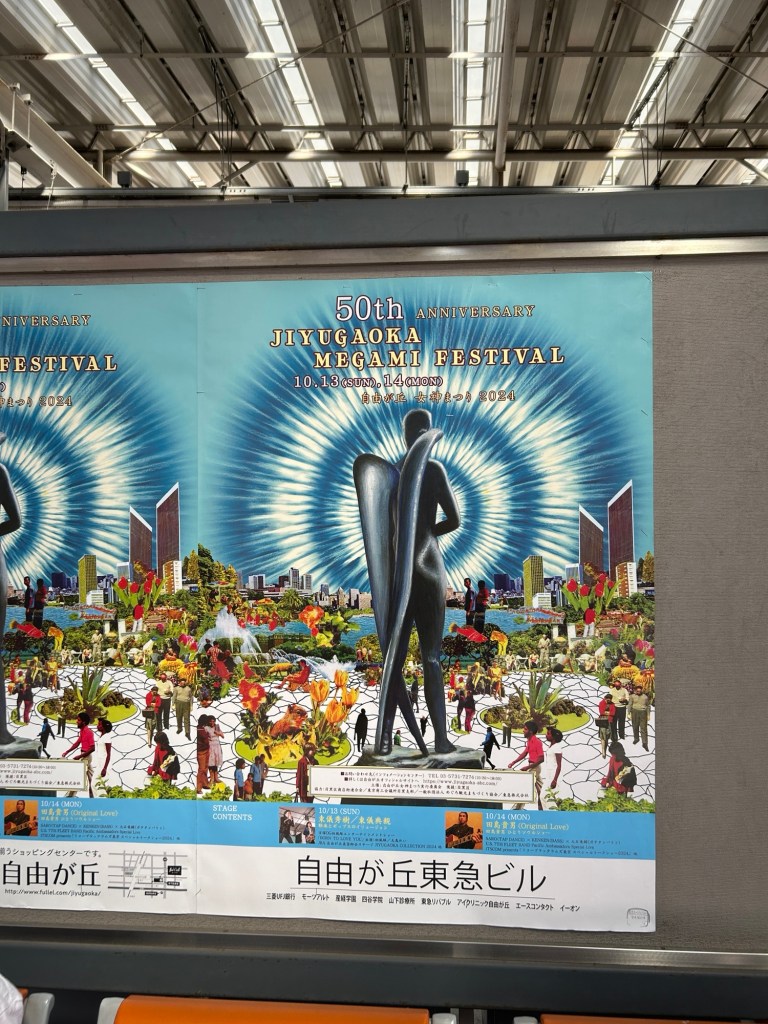
Of course our visit required another multi-transfer 45 minute ride across the city, but I was happy to see this poster at the transfer point for the last leg of the journey.
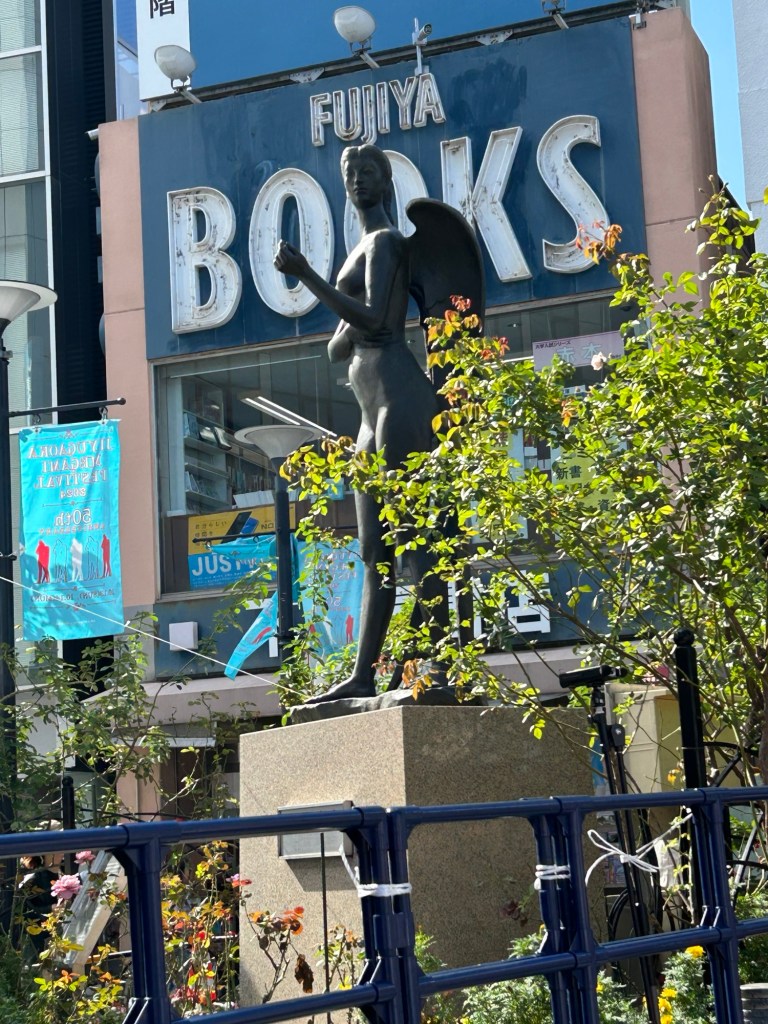
It is encouraging to find evidence of the event in advance! This is the Jiyugoaka Megami Festival, the 50th edition. Megami means goddess, and refers to the winged statue that stands in the square in front of the train station. I’m not sure what she is the goddess of – here’s a photo of her from the front side since the poster is a posterior view….
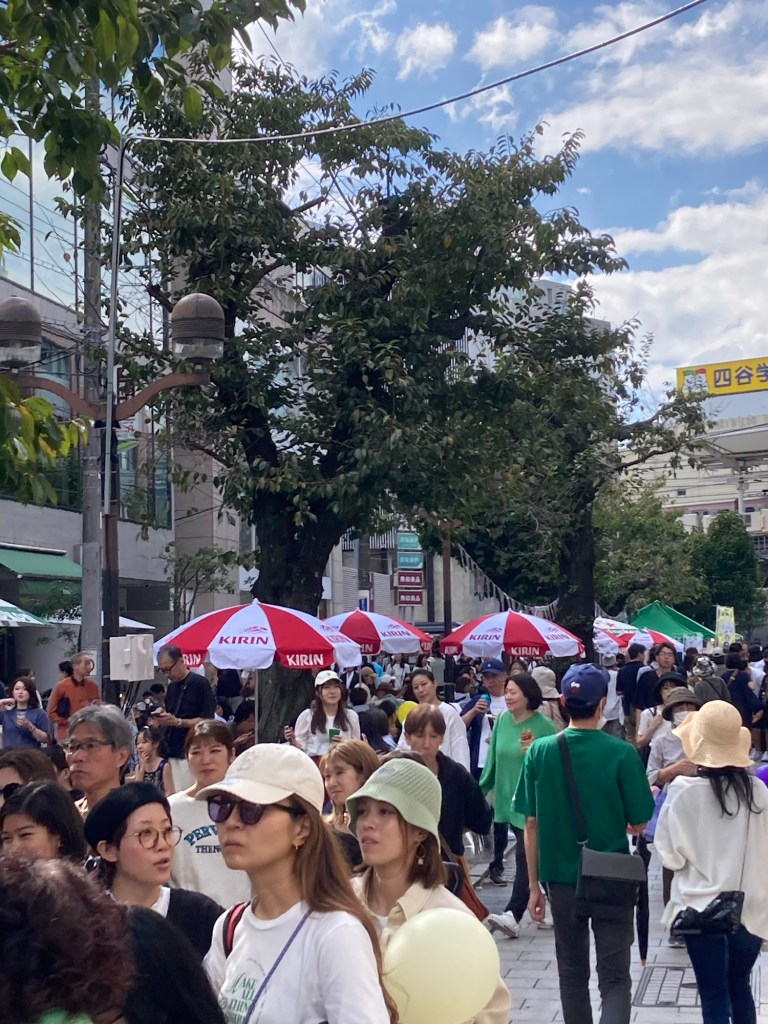
It’s a hilly neighbourhood – when we came out of the train station the train platform was above us – we went out, turned left, went down a slight incline and met the train line as a level crossing. Once over the tracks another block down the hill brought us to a street that used to be a creek bed. It has been filled – or culverted – to make a charming street with seating up the middle. The are flower shops and restaurants and all the usual clothing shops along the street. And the center of the street had been filled with tables, chairs and umbrellas. Further along – food tents! We got ourselves established and then took turns provisioning. First up = I went for beer and sparkling wine while Wilf chatted with people who were sharing our table. The Japanese are very reticent and they will share a table, knee to knee, with no conversation. But not when we’re there – either we start talking to them or their curiosity is too much and they talk to us. By the time I returned with drinks Wilf was chatting up several people. He went off for food and it was my turn to talk. Wilf found grilled chicken, rather than fried, and it hit the spot. After we had had our snack we wandered up the street.
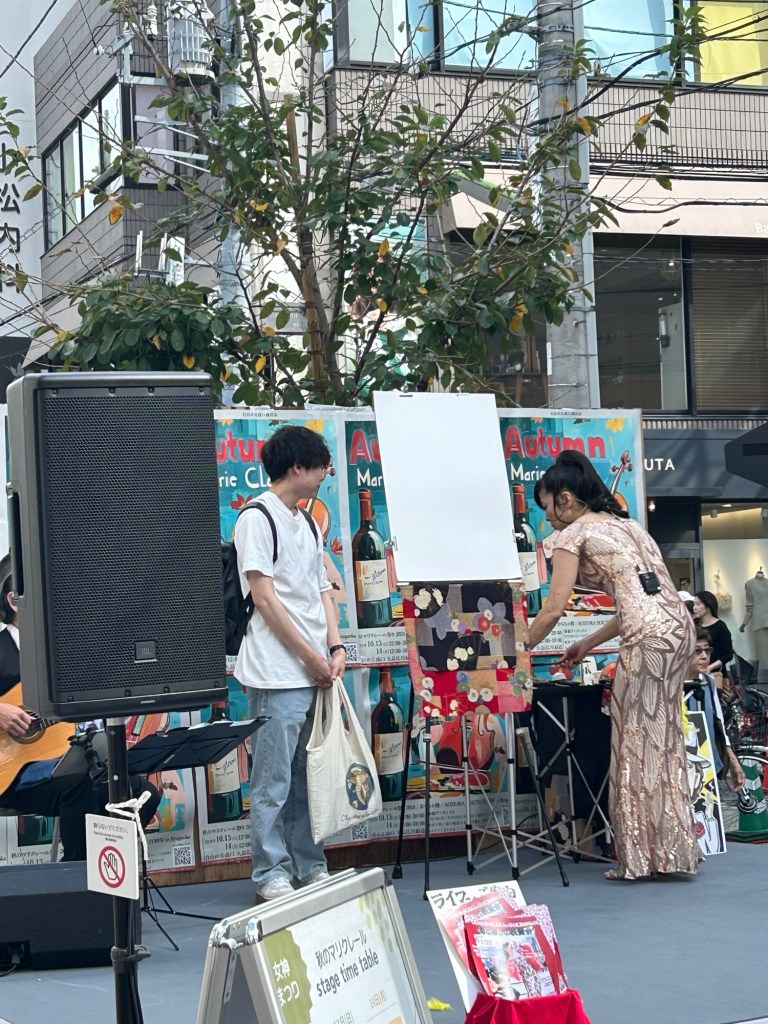
There was a stage and a gal was singing – in English – jazzy songs. The next thing we knew she was out in the audience, selecting her victim.
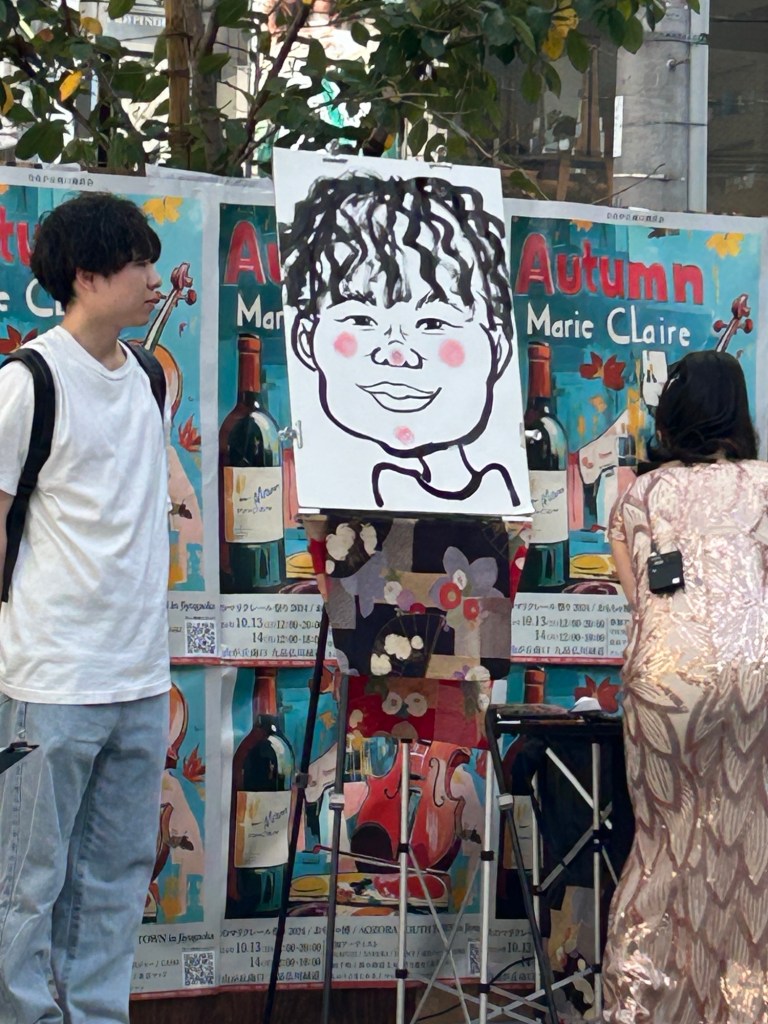
She is singing and chatting while she draws a caricature of this young man, accompanied by a fellow noodling away on a guitar in a jazzy style.
I think he was just waiting for it to be over! But she kept hauling people up there, singing and chatting and drawing….
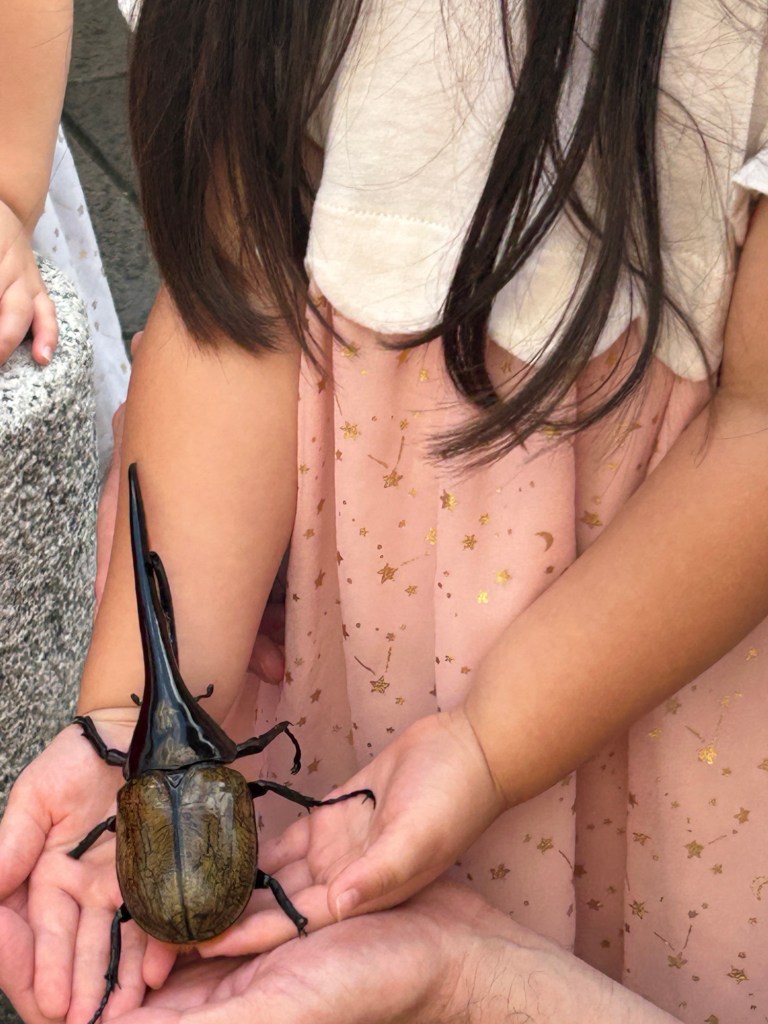
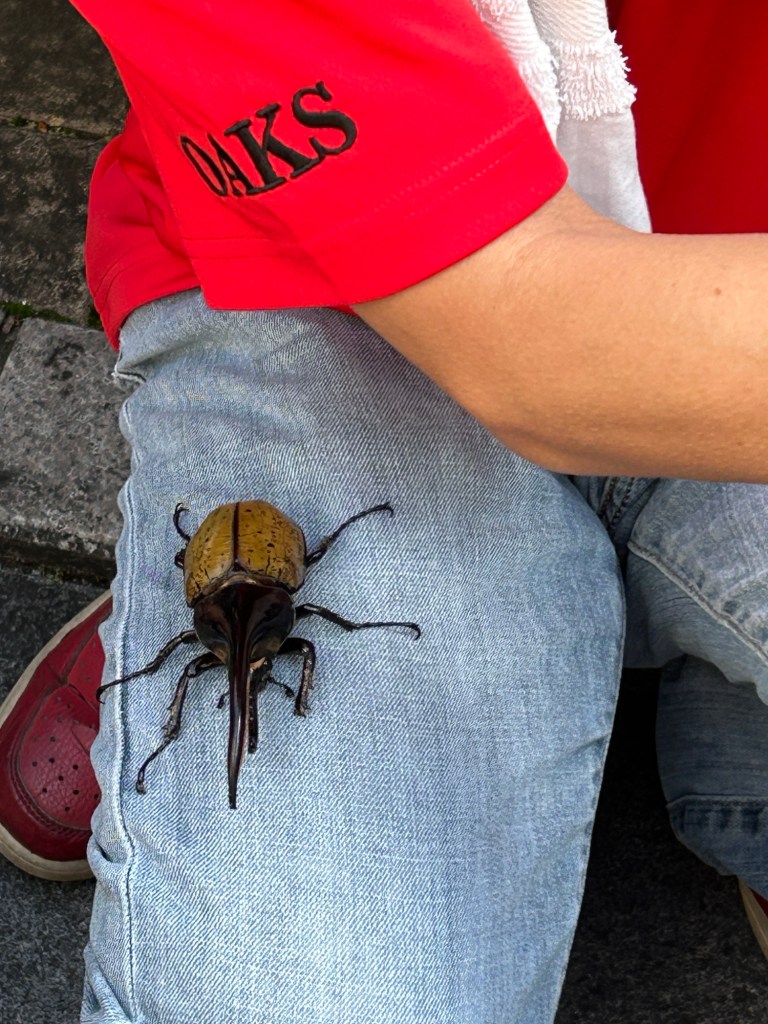
Just past her was a bug zoo, where the kids were handling the biggest beetles I’ve ever seen…
I’ve seen them in museums, but never on the hoof, as it were.
It was time to go back up the hill, over the tracks and to the stage in front of the train station for the first major performance of the afternoon.
It was hot – a lovely sunny day. We found a spot for Wilf to sit right at the front and I was standing in the shade when a Japanese lady came up to me, spoke quite insistently and then, when I clearly didn’t understand grabbed my arm and escorted me to a seat front and centre. Which was kind of her.
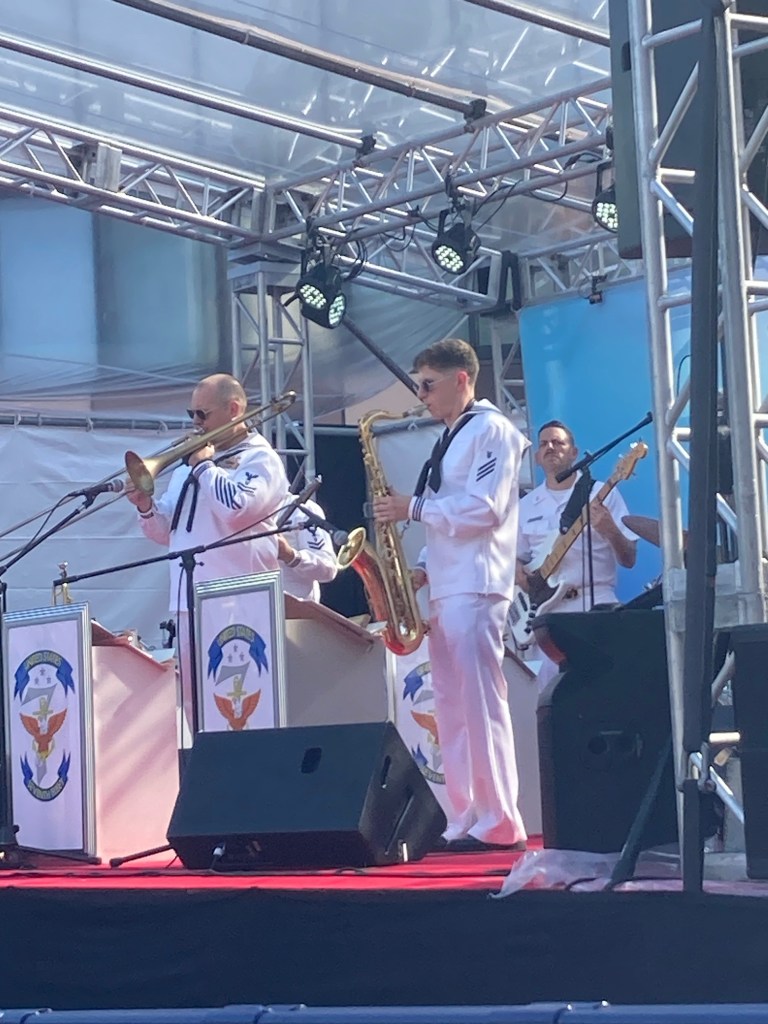
And who was performing?
The United States 7th Fleet jazz band!
So – sunny afternoon beside the train station, some jazz – what’s not to like?
Eventually it was time to move on in search of ice cream. That was when we found the other half of the festival!
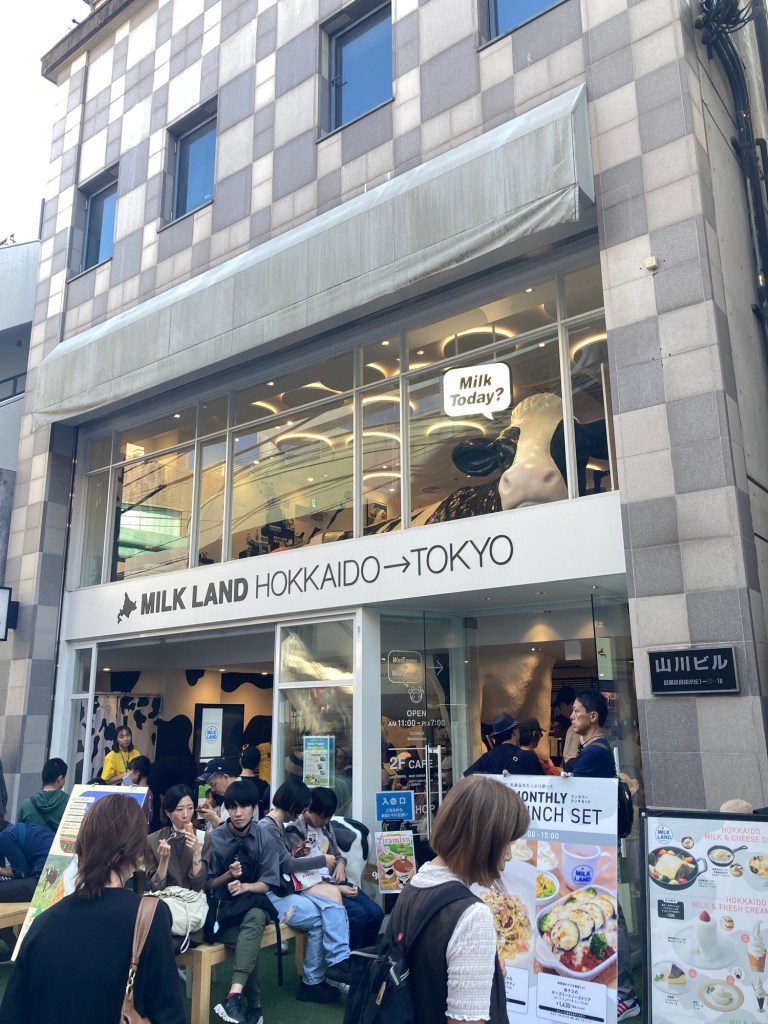
I asked one of the volunteers if they knew where ice cream was to be had and after some discussion they suggested ‘Milkland’. And I remember that place from our last visit. All things milk, all from Hokkaido.
Needless to say it was crazy town there, but Wilf snagged a seat while I got the goods. They lean hard into the whole cow things here.
See the cow in the second story window asking ‘Milk today?’ Said cow continues to the downstairs…
Where it dominates the room!
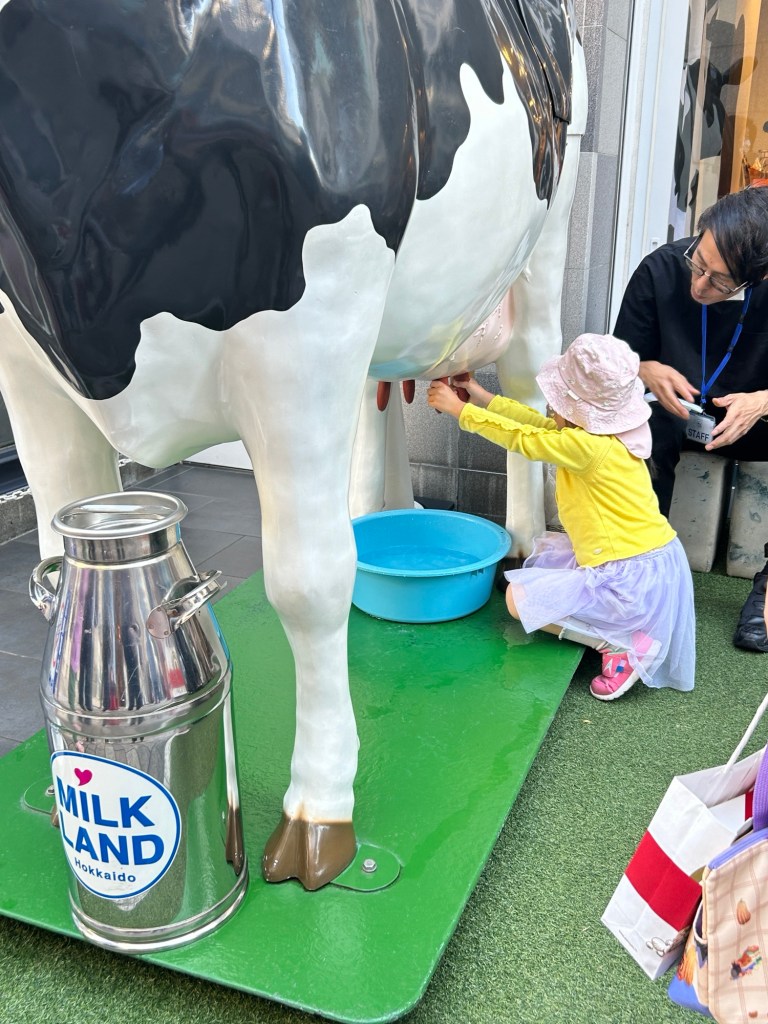
Outside there is a cow that kids can milk…
Every so often the supervising staff member opened a port in the side of the cow to ensure there is still water for the kids to ‘milk’. I’m guessing for a lot of city kids this is as close to a cow as they’ll ever get.
We had soft service ice cream – milk flavour, of course – and an iced latte topped with fresh whipped cream. There was a cooler with probably 15 different brands of Hokkaido milk to buy and you could have flights of cheese or milk to sample a variety of products.
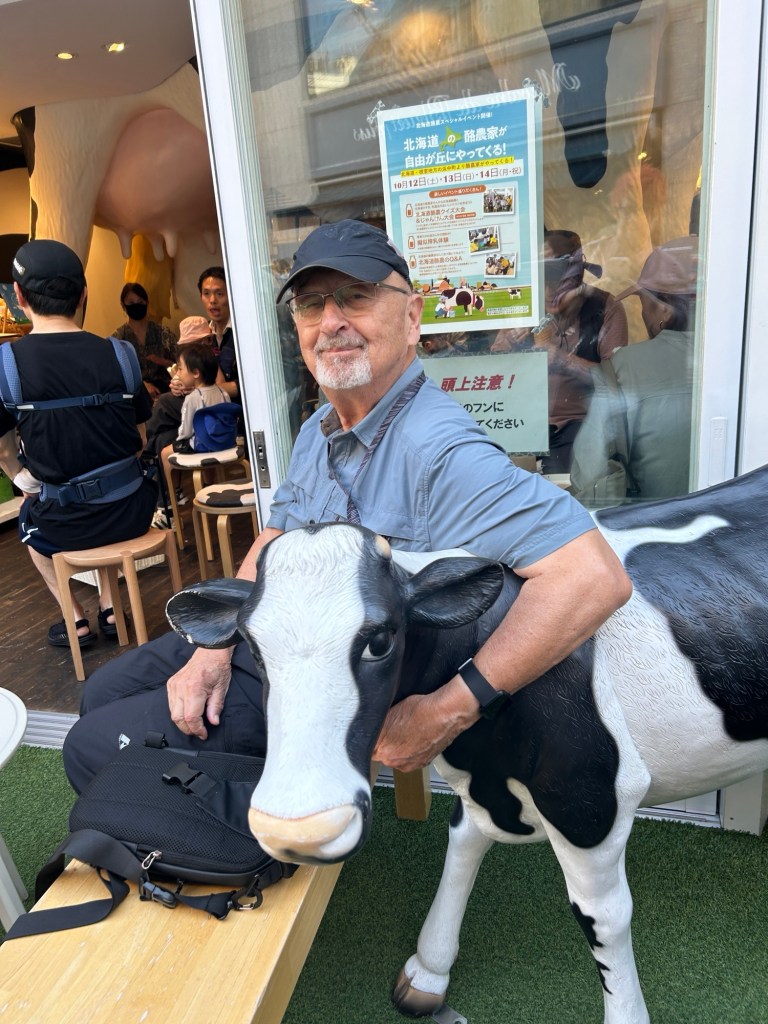
And as usual, Wilf was making friends,.,,,
The cow looks rather sceptical about this new relationship!
And then back across town – via another route with only one transfer at Shibuya station. Which is number two on the list of busiest Japanese train stations. I learned the hard way many years ago that the ‘ya’ in Shibuya meant valley and the Ginza subway line actually comes in above ground at this station. Which is confusing for a subway. There have been times when I thought we’d never get out of that train station. But they’ve been busy renovating the whole area and we made the connection from the train line out of the station and into the subway station without incident. A first for us!
This was a fun day at a very community based event – everyone enjoying themselves in the sunshine.
After a busy week with a lot of train trips and walking we planned an easy day for our second Saturday in Tokyo.
Let me tell you, folks, there is no such thing as an easy day in Tokyo. Everything is a long way away from everything else and that is just how it is. Remember – Tokyo is huge as well as being densely populated. Like, really huge!
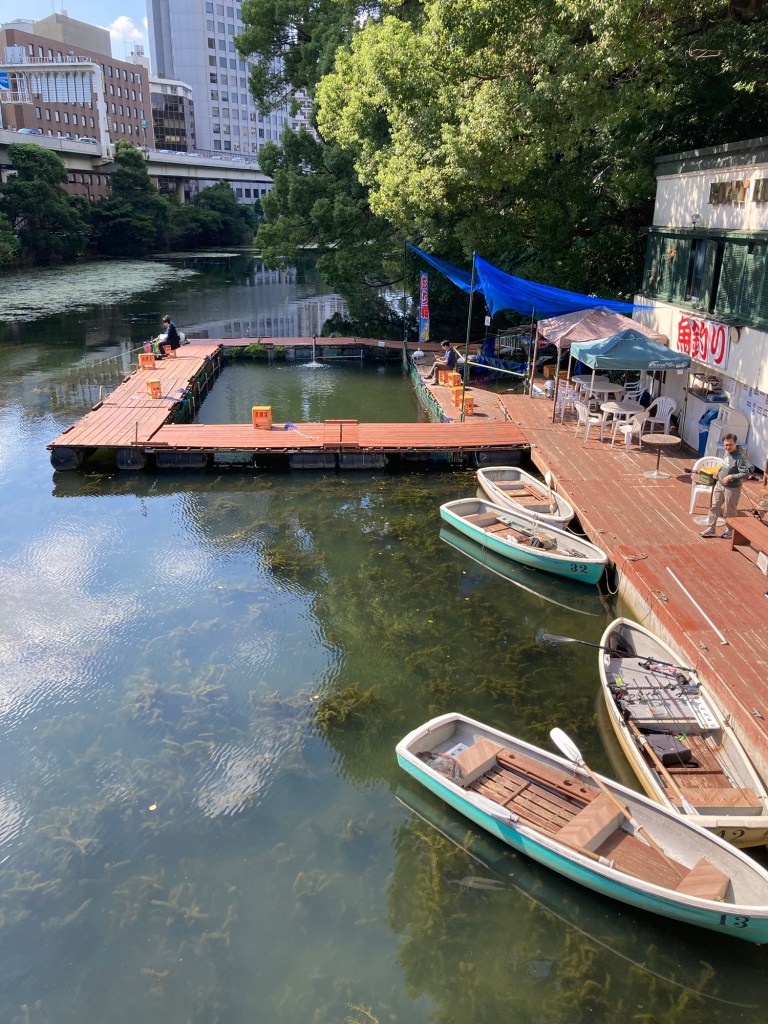
Wilf had heard that there were places in Tokyo where you could go fishing – sometimes on a river, or a lake. Or in Saturday’s case, one of the moats of the Edo Castle. This sent us to the district of Akasaka (not to be confused with Asakusa, where we are staying….). And we did find the fishing club on the edge of the moat.
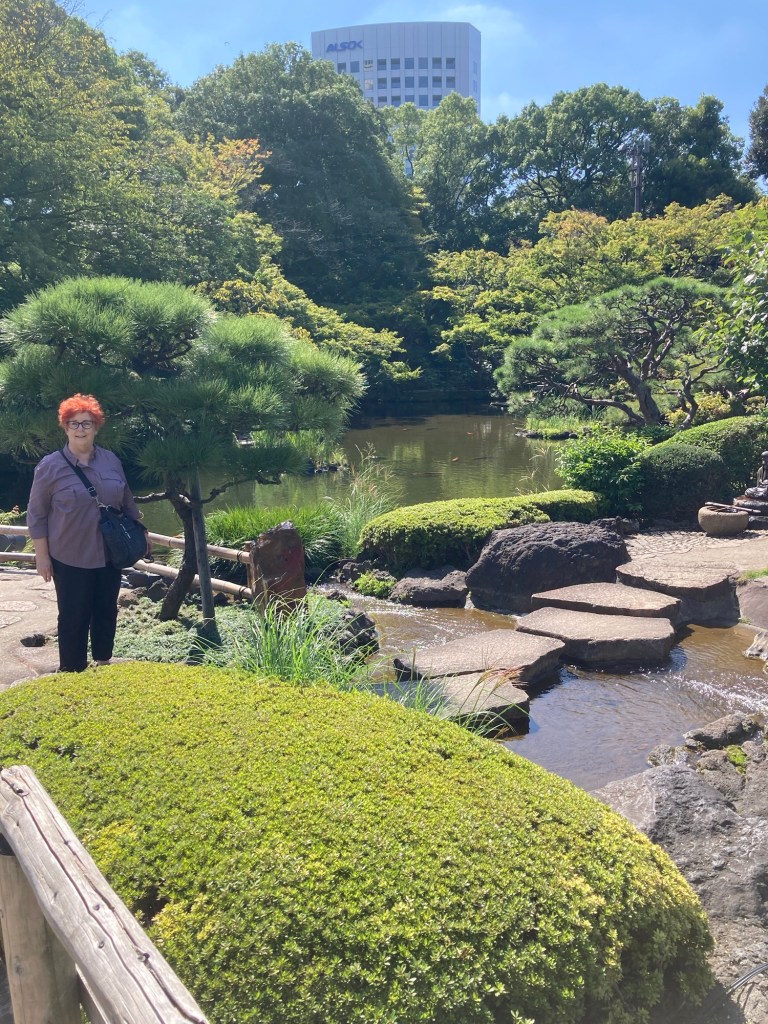
It was very hot, and while the boats up under the trees looked pretty and coolish, neither one of us was volunteering to row a boat up the moat. But – right next door we knew that we could visit the Japanese garden at The New Otani Hotel. So we did. The hotel is almost like a small city. It has two towers, one built in the 1960’s, the other the 1980’s. There are more than 40 stores on site and I don’t know how many restaurants. Rolls Royce has a dealership on the ground floor, which tells you something about the clientele.
The garden is lovely and would be nice to see at night all lit up. There are several stand alone restaurants nestled amongst the trees.
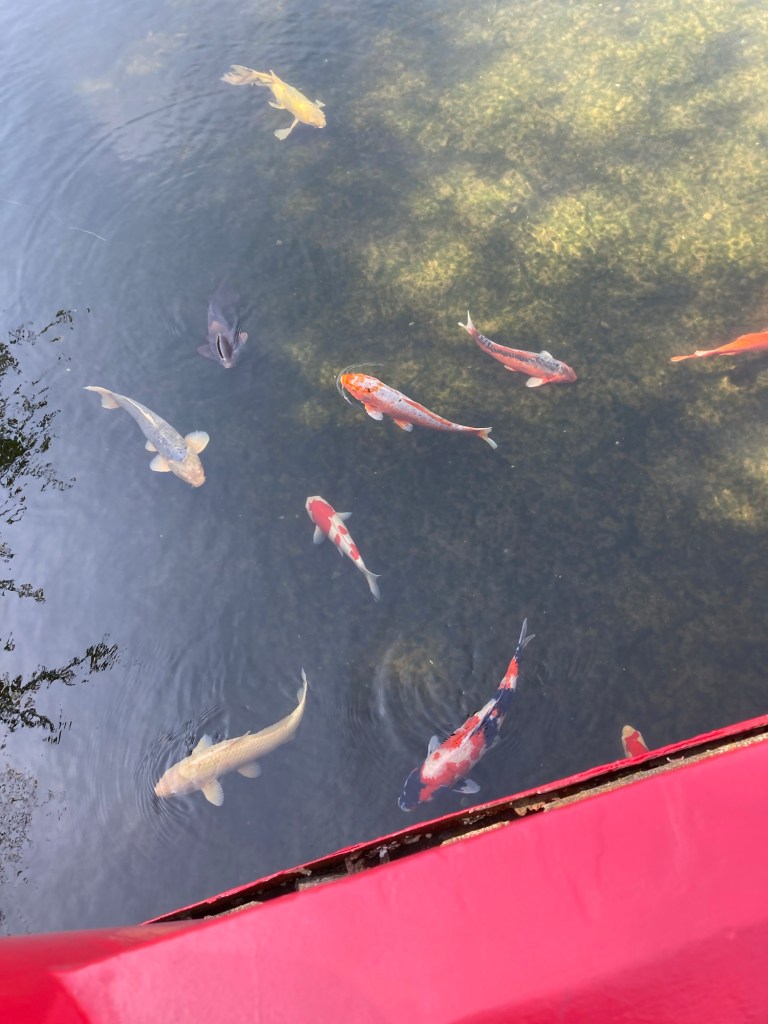
And of course there are koi..
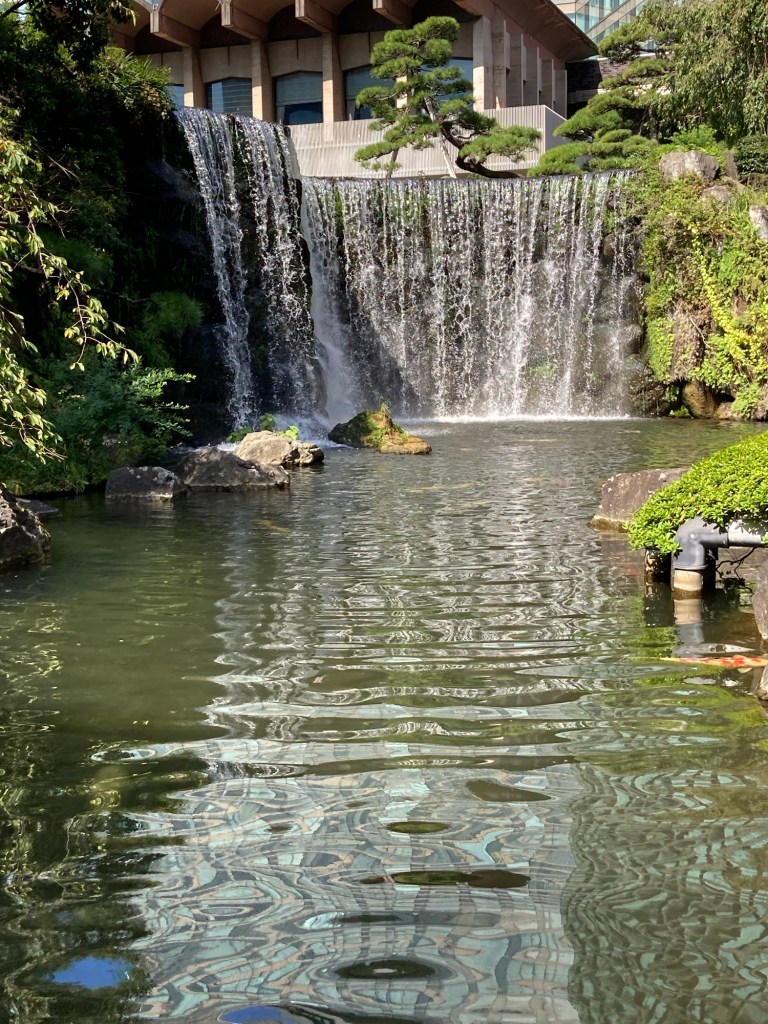
And a very pretty waterfall,
After a bit of time enjoying the garden we walked up the street for lunch at a brewpub, then headed off to see a shrine.
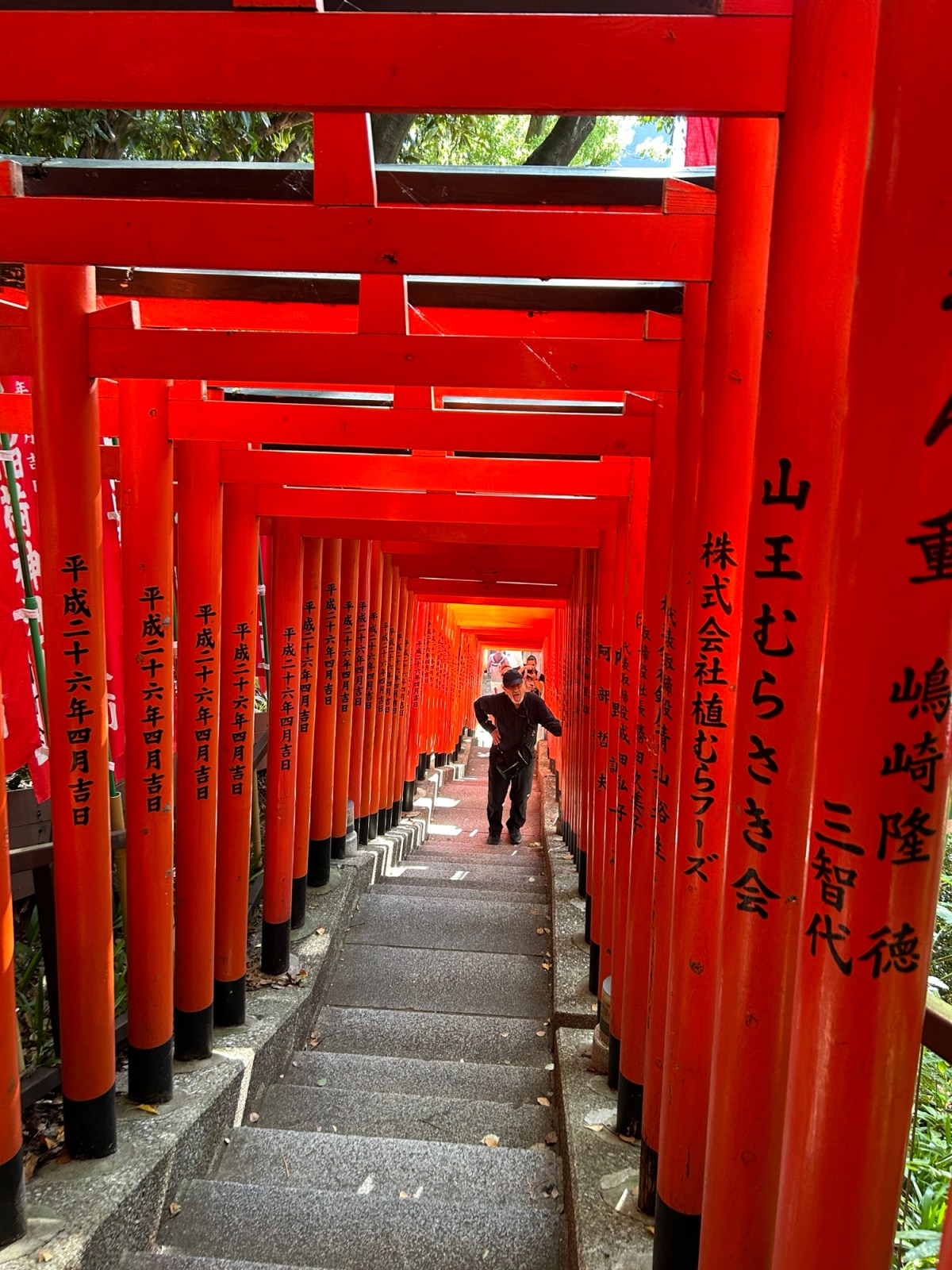
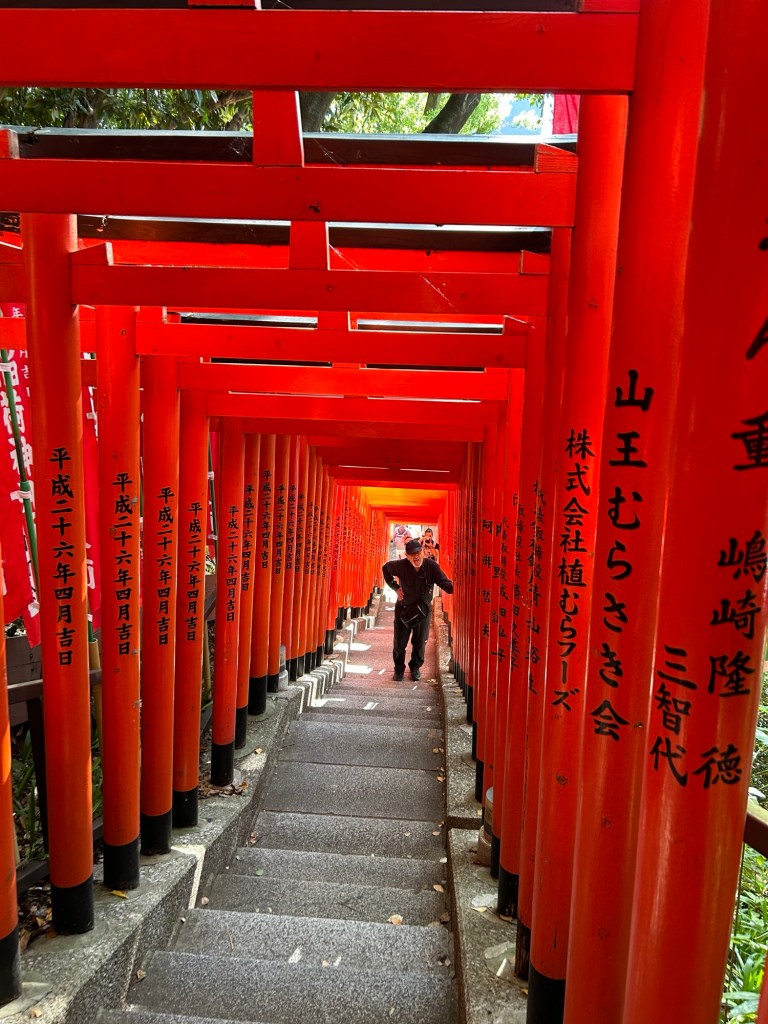
Somewhere in the mists of time there was a rule made that shrines and temples had to involve as many stairs as possible, and the Hie Shrine was no exception. Well, it feels like that is the rule…..
Are we having fun yet?
When we arrived at the street below the shrine everyone was going to the left to go up through the tori gates. I was a little – shall we say – annoyed to discover later that if we had gone to the right there were escalators to take people up top. But – good things come to those who climb stairs, right? And it is a lovely temple.
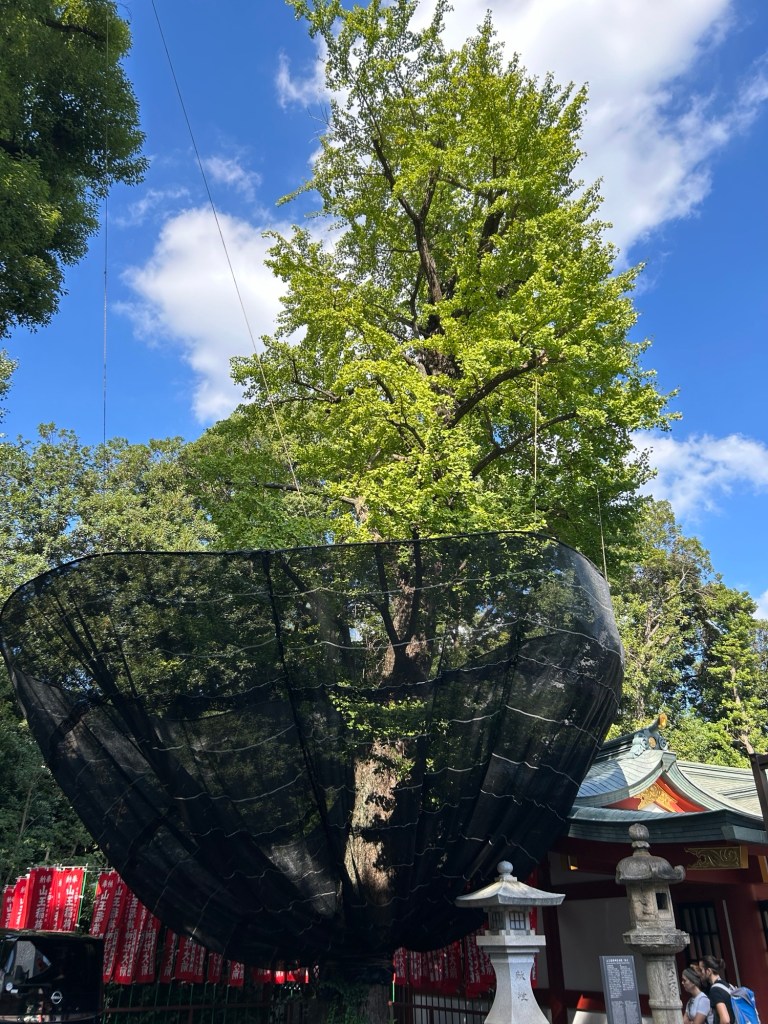
This was something we hadn’t seen before. In effect it is a tree diaper on a ginkgo tree. The female trees produce fruit in the fall and it messy and the fruits go off quickly when they hit the ground. Not a pleasant smell at all. So these big nets are up to keep it all under control!
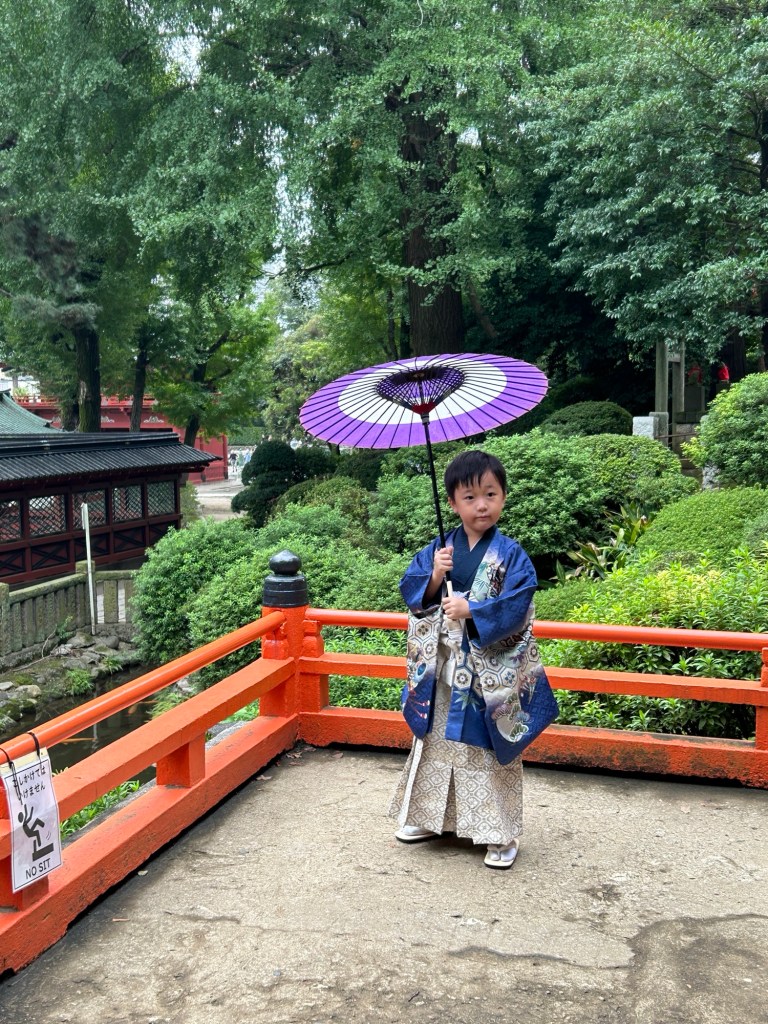
In November there is a ceremony held at Shinto shrines to bless children who are 3, 5 or 7 year old. Three and seven year old girls and 5 year old boys. They are dressed in traditional attire, there is a ceremony and many pictures are taken of the children and their families. This shrine is a particularly popular one for the ceremony and there were lots of families about .
Brother and sisterWe met this young man the week previous at another shrine.
In order to get photographs taken, and have the ceremony at the shrine, every weekend before the ‘official’ date of November is busy with kids having their pictures taken.
A long time ago Wilf heard/read about an excursion from Tokyo that sounded like a fun way to spend the day. It never seemed to fit into our itinerary – until today! And even that was touch and go as the weather has been iffy. But today was a lovely day.
The southwest entrance to Tokyo Bay is a peninsula – the Miura peninsula. There is a private rail line that runs almost to the end of the peninsula – to the town of Misakiguchi. A little further along is the port of Misaki, which is home to a tuna fishing fleet. The towns and the rail line have put together a package that makes a great day trip from Tokyo.
Wilf had assembled instructions on how it all worked, but we were a little uncertain as we set out this morning.
First thing was to get from where we are staying on the eastern side of Tokyo to Shinagawa Station in the southwest. This included a pretty wild ride on the JR Yamanote line during the morning rush, but we did it. The Keikyu line starts at Shinagawa, but it is not part of the JR system, so first we had to find our way out of the station, We had to ignore the ticket gate that said you could transfer from JR to Keikyu, but only if you already had a Keikyu ticket, which we did not. We went out of the station, turned left and found the Keikyu ticket office. Where they did not sell the tickets we needed, but the lady there had a series of big laminated cards that showed how to use the ticket machine in English mode to get the tickets. Back outside and we figured out which of the four ticket machines would actually sell the ticket we wanted – it was the one on the far left. And sure enough we were able to buy two sets of the Misaki Maguro tickets. Now we each had three tickets in hand. Ticket A is for train and bus fare. Ticket B is for lunch. Ticket C is for sightseeing or souvenirs. Through the ticket gate with Ticket A (which returned by the turnstile for the rest of the journey) and to our surprise we found the train – a limited express to Misakiguchi. The limited express part was important because we were getting on at station 1 and getting off at station 72 and stopping at Every Station would have been a bit much. The station was zoo because one of the Keikyu lines goes to Haneda airport and there were lots of people wrangling suitcases through the station.
The train was quite crowded until about Yokohama and thinned out after that. We did have to get off the train and wait for another to continue the journey at one point, but by that time it was pretty obvious that everyone was going to the same place so we all hung out together and hopped on the next train. It took about 90 minutes and we were in Misakiguchi town. Our information told us that bus #2 would meet the train and take us to the port, so we joined the crowd and hopped on the bus for a ride to the port.
Misaki town is a fishing town. A tuna town. In particular, maguro tuna, the really good stuff. One of the many things that I don’t understand about Japanese is why some words are written in kanji and some are written in hirigana, which represents the sound of the word. Sometimes it works to my advantage. Maguro is written phonetically, not in kanji, so as we walked around I could read the signs まぐろ。Lots to choose from! And we were on a roll – we had to use a machine to put ourselves on the wait list for the restaurant, which we did, and then when they called our number – I actually understood her! I was pretty pleased with myself.
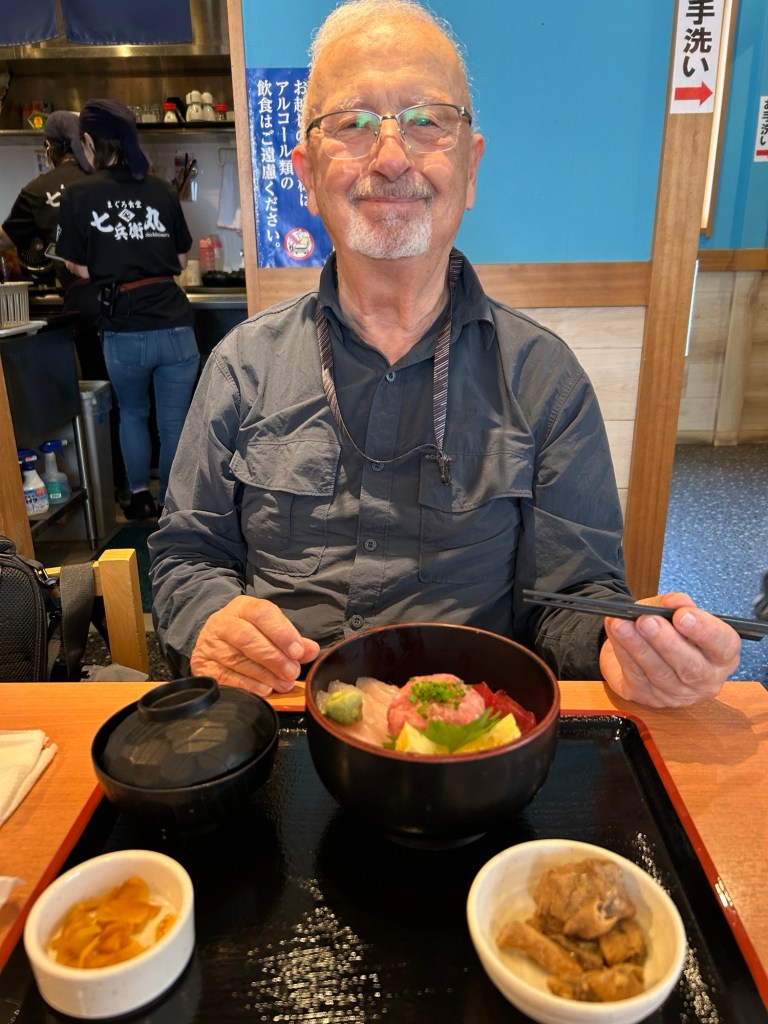
We had a choice of several dishes and we both ordered the same thing – the tuna special! The large bowl had three slices of maguro tuna – it is the red tuna. Three slices of albacore tuna – the pale slices. A scoop of chopped tuna and green onion (from the cheek of the tuna). These were all sashimi – raw. There was also a bowl of miso soup, a dish of pickles and a dish of marinated cooked tuna. In the sashimi bowl (which had rice under the fish) there were also two pieces of rolled omelette. It was a substantial meal! And it was delicious! Included unlimited cold barley tea, too. And at the end we handed over Ticket B and went on our merry way.
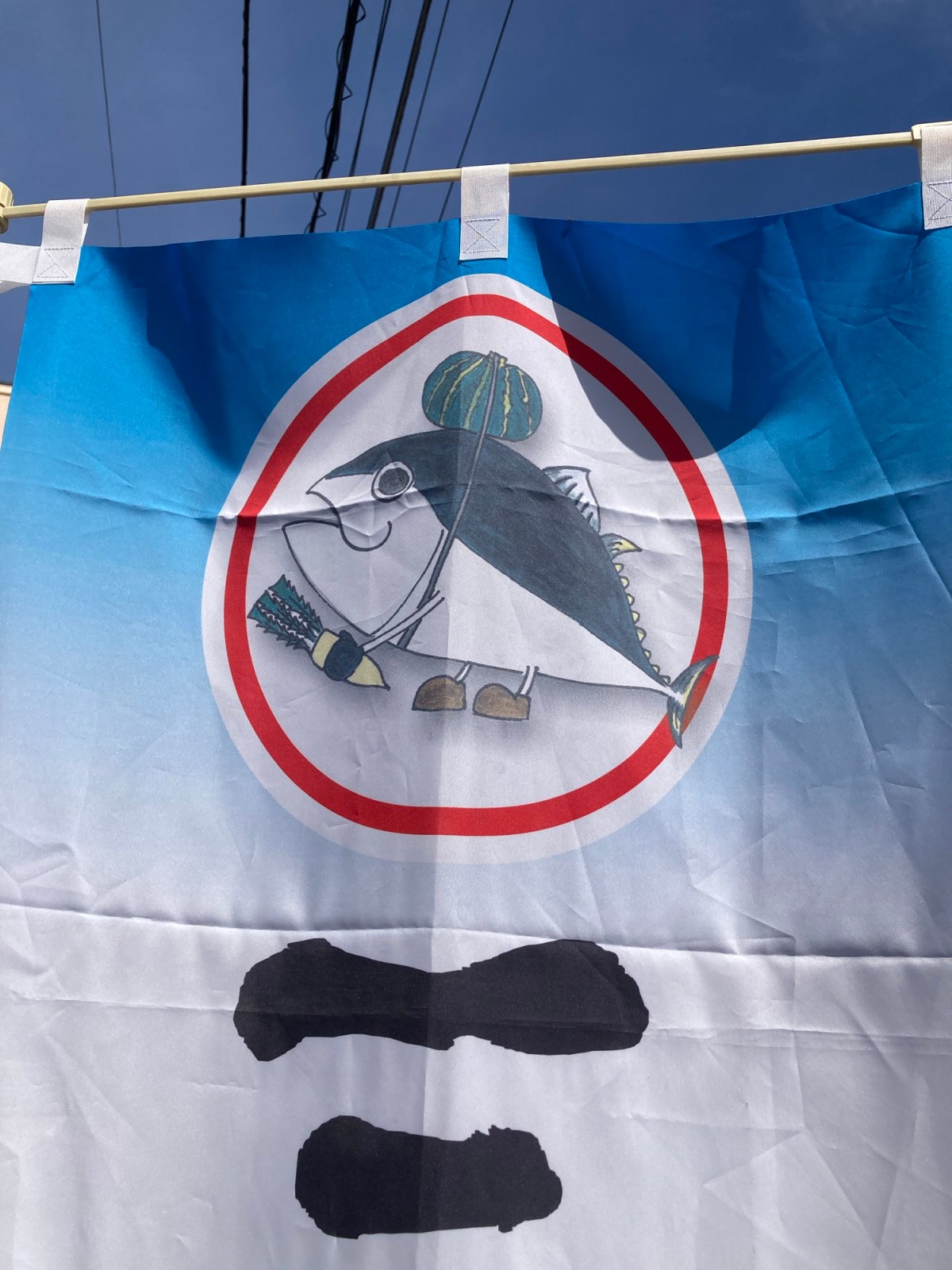
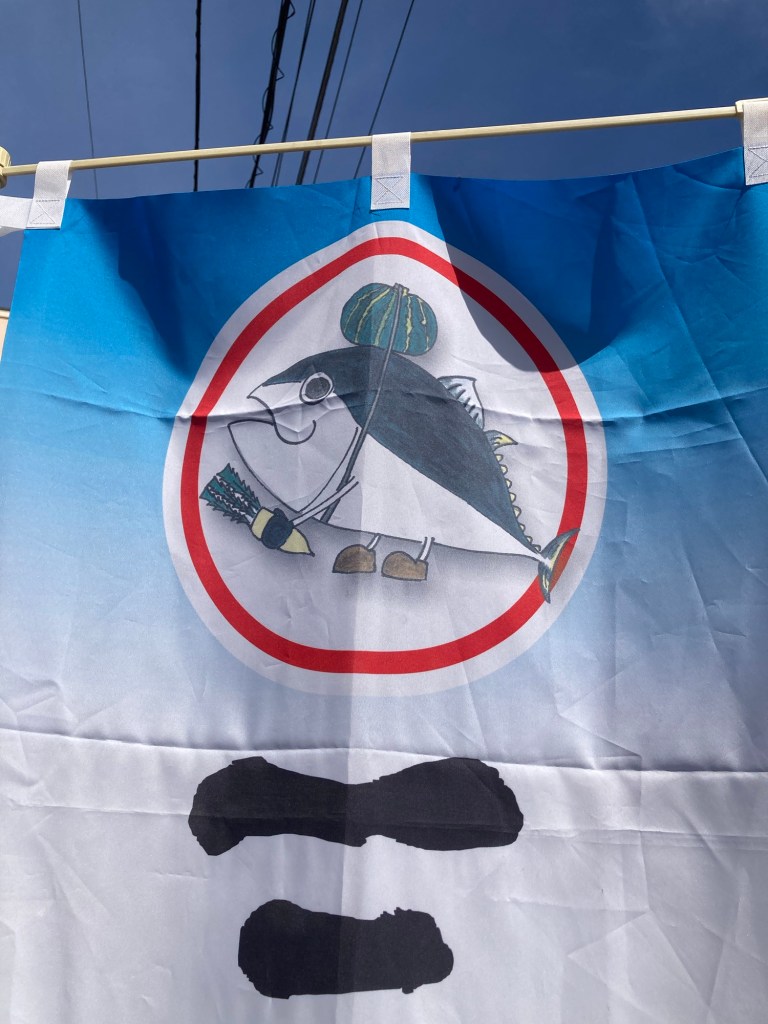
I’m not sure why the banner outside of the restaurant had a tuna wearing a pumpkin and holding a radish, but you do you, tuna!
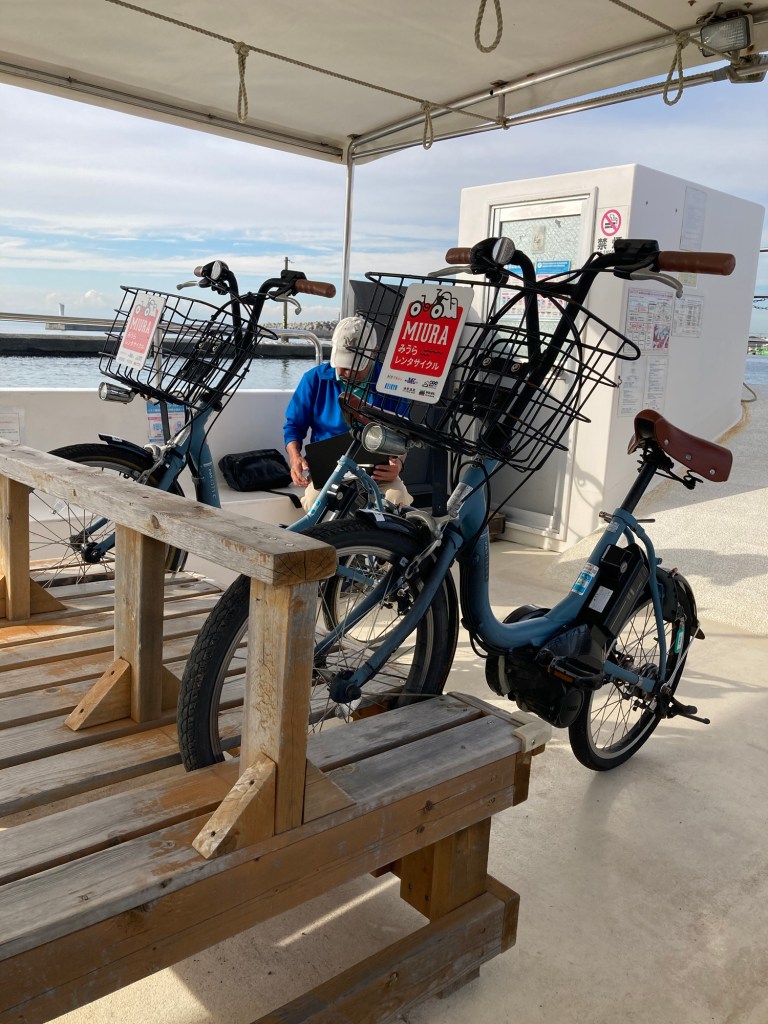
After lunch we decided to rent e-bikes and go across the bridge to Jagoshima Island to admire the views and the geology. Somehow we thought the bridge would be a small affair.
We were a little taken aback when we realized that was the bridge. How would we get up there? Turns out the port people knew we’d ask that and there were markings on the road to direct us. We were still uncertain but we found our way through the port and up to the bridge. There was a wide protected sidewalk so we decided that we could manage that. I was a little taken aback as I was whizzing along and a guy on a bike zoomed past me on the road way, but we crossed the bridge and found our way to a rest stop. We were reviewing our maps and drinking lemonade when a couple in wedding garb appeared, bouquets of flower in hand along with a couple of photographers. Okay – guess a sunny Friday afternoon is a good time for pictures. We said congratulations – おめでとう!as they went by, A few minutes later another pair with photographers – and their little dog in a tiny little tuxedo- passed us. Okay then – congrats to you too! As we rode out of the parking lot another car pulled up with a a woman in a wedding dress.
But we were off, riding along the path, pulling off at look outs. And at the second one….
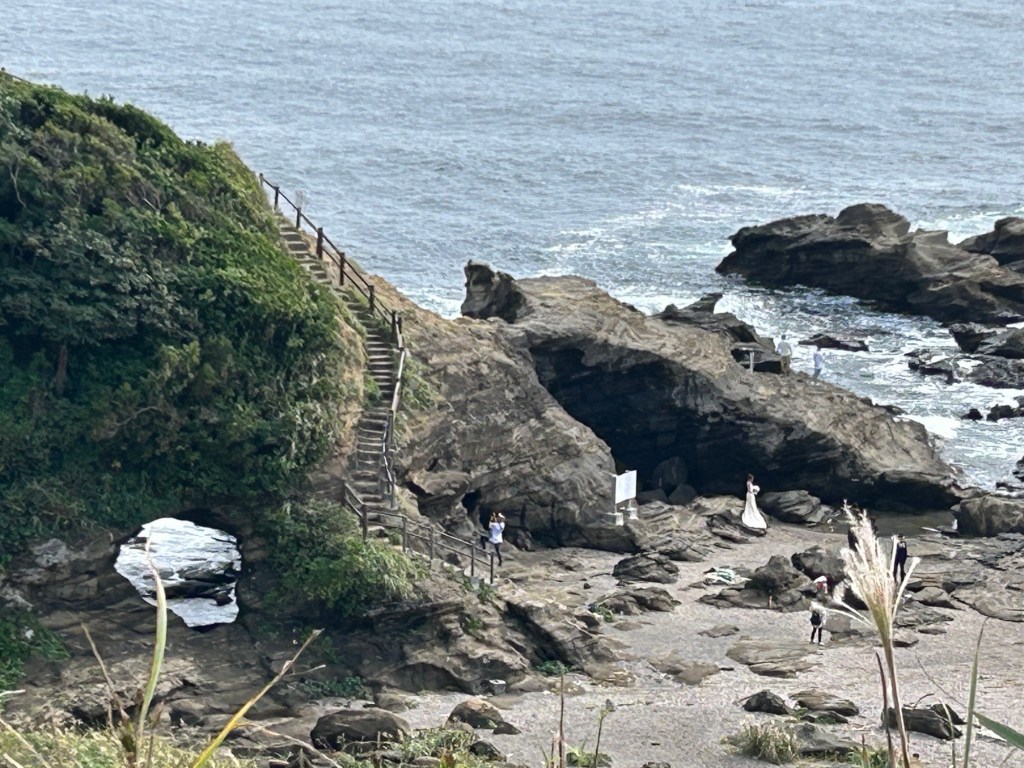
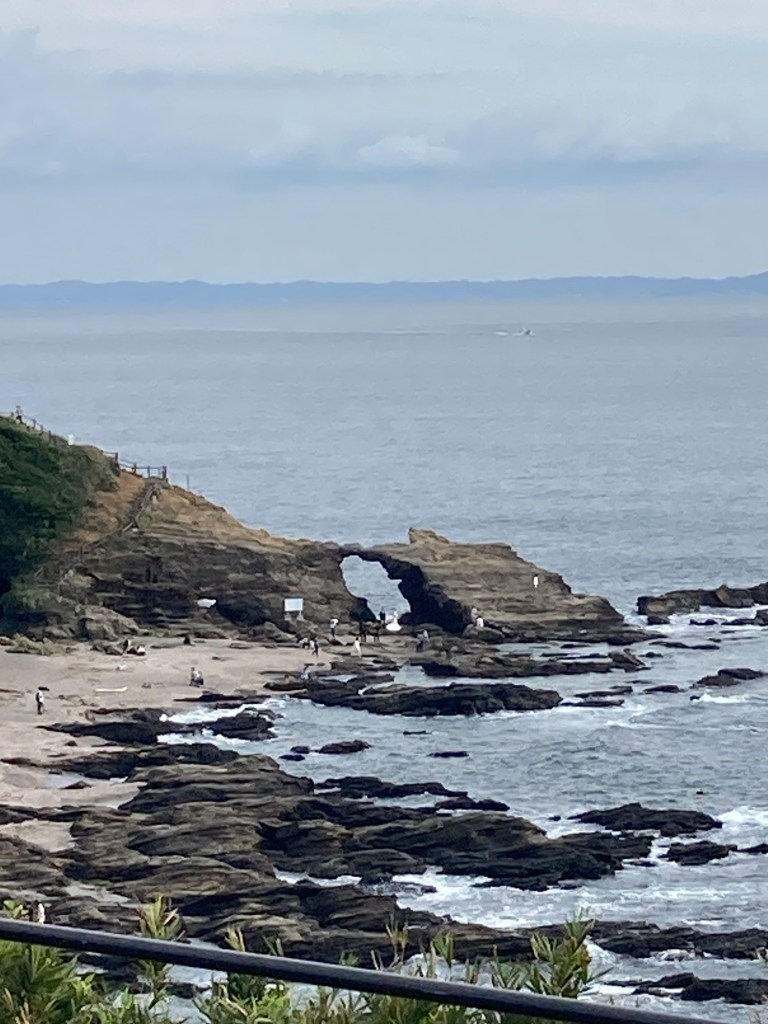
Do you see the bride down on the beach – she has her back to us with the train of her dress displayed.
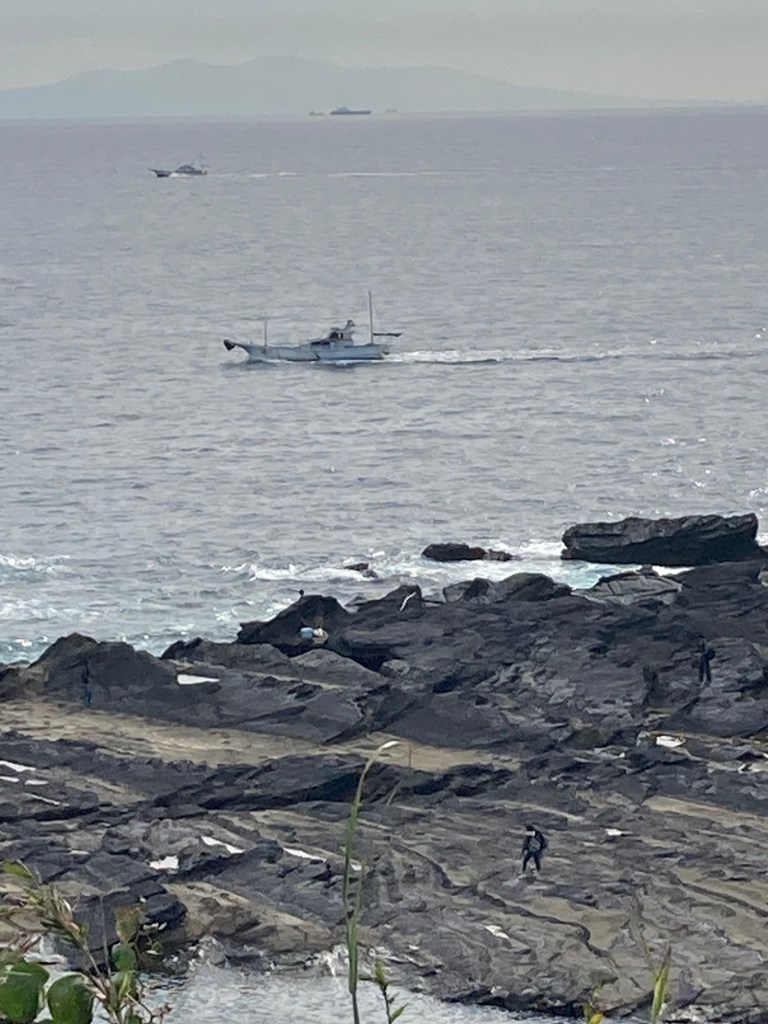
This was the shot they were aiming for with the bridal couple framed in the arch of stone. And there were lots of people on the rocks, hanging out and fishing. I was hoping that someone was in charge of watching the tide so they wouldn’t have to swim back.
Up above on the cliffs there were lots of trees that are wind swept in permanent curved shapes and the path has been cut through the trees making very scenic arch ways. We’re zipping along the path, come around a corner and yikes – another bridal party! By the time we were finished we passed six groups. Avoiding mowing down brides was only part of the problem. At one point we ran into a dead end. No more bike path. We were puzzling this out and saw a slightly muddy goat trail to one side, and through the trees some cars so we thought – okay, this will get us back to civilization. So now we’re off riding through the forest! Until we hit a flight of shallow steps. Well, dang it. Those e-bikes are heavy, but we got down to the bottom, turned onto the path, met another bride and groom and popped out into a parking lot.
Usually when I tell stories like I’m sure people are thinking to themselves ‘remind me never to go anywhere with those two ‘
We knew that there was a small ferry that would would go back to the port where we started and by this time we were thinking that we really didn’t want to have to go back up to that bridge and them back down again. And – sure enough – the ferry would come soon and we could either leave the bikes with the dock master there, or take them on the ferry and wind up back where we started. So that is what we did!
We’re not the first people to put the bikes on the ferry!
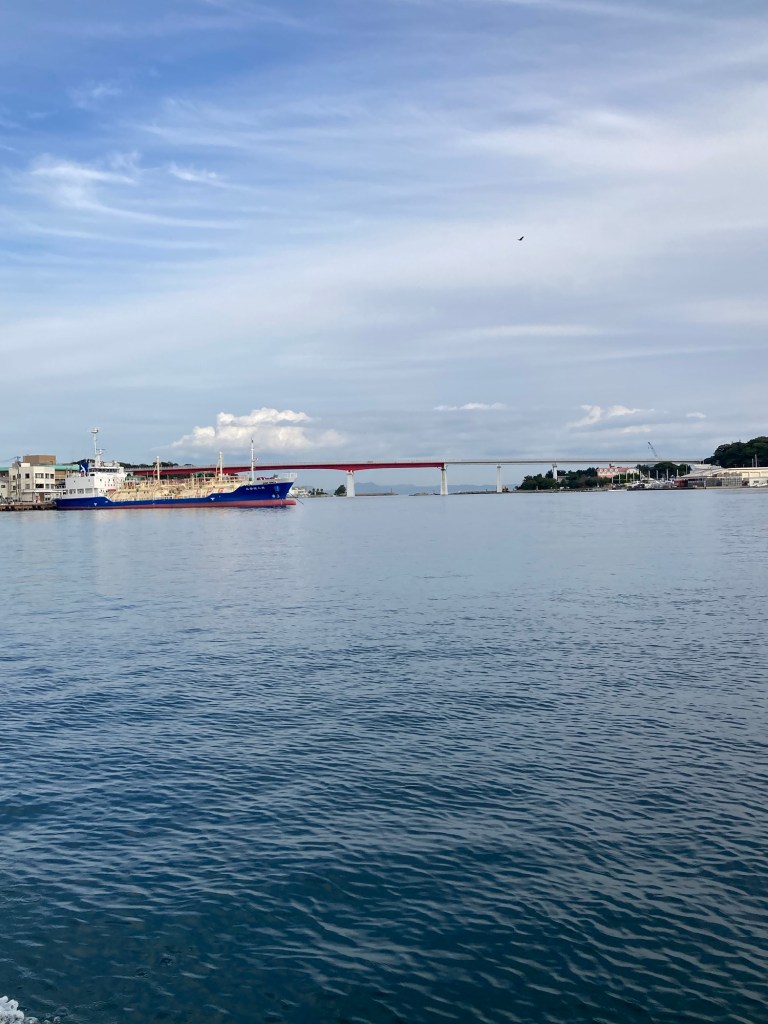
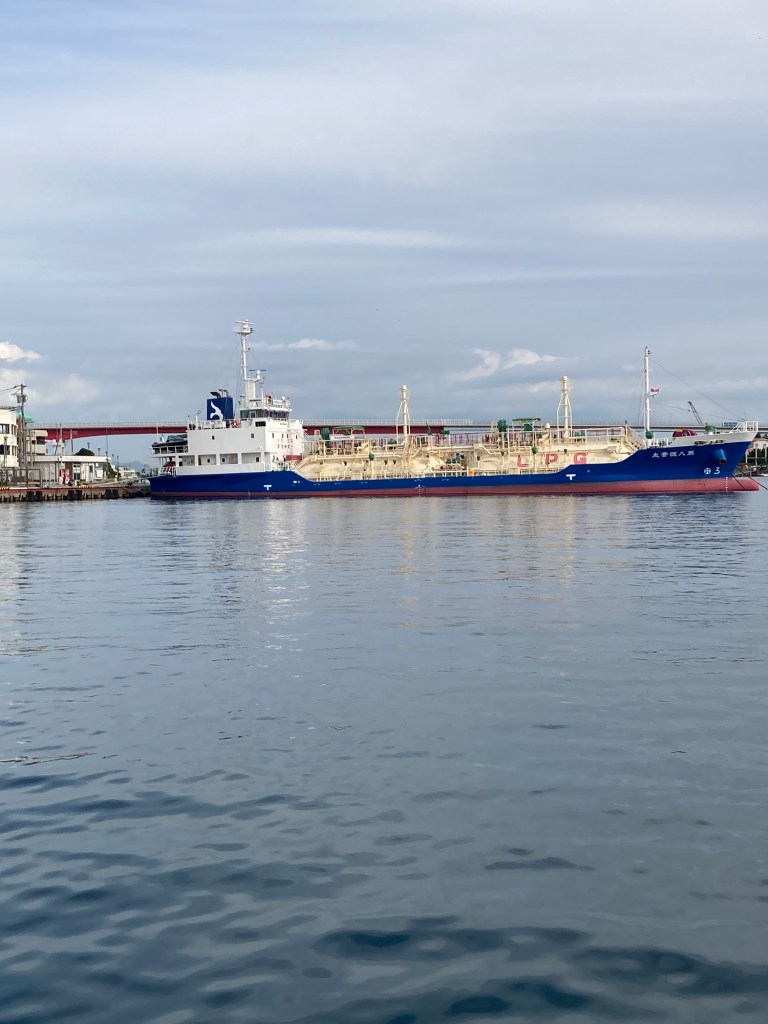
Short ride past the LPG carrier.
And if you are wondering what we did with Ticket C – there was a little shop where we could get gelato and a coffee with our ticket, so that is what we did.
The documentation that Wilf had put together about the trip and what to do and where to go was really excellent. We’re kind of far off the beaten track here and English is pretty sketchy, but we managed. But one really critical piece of information could be added to the whole thing – you can take your bike on the ferry and go across to Jagoshima Island that way – and then come back! No big bridge required!!!
We had just finished our gelato when the bus arrived and back to Misakiguchi station we went. 90 minutes later we were in Shinagawa station. And look who put in an appearance on our way back….
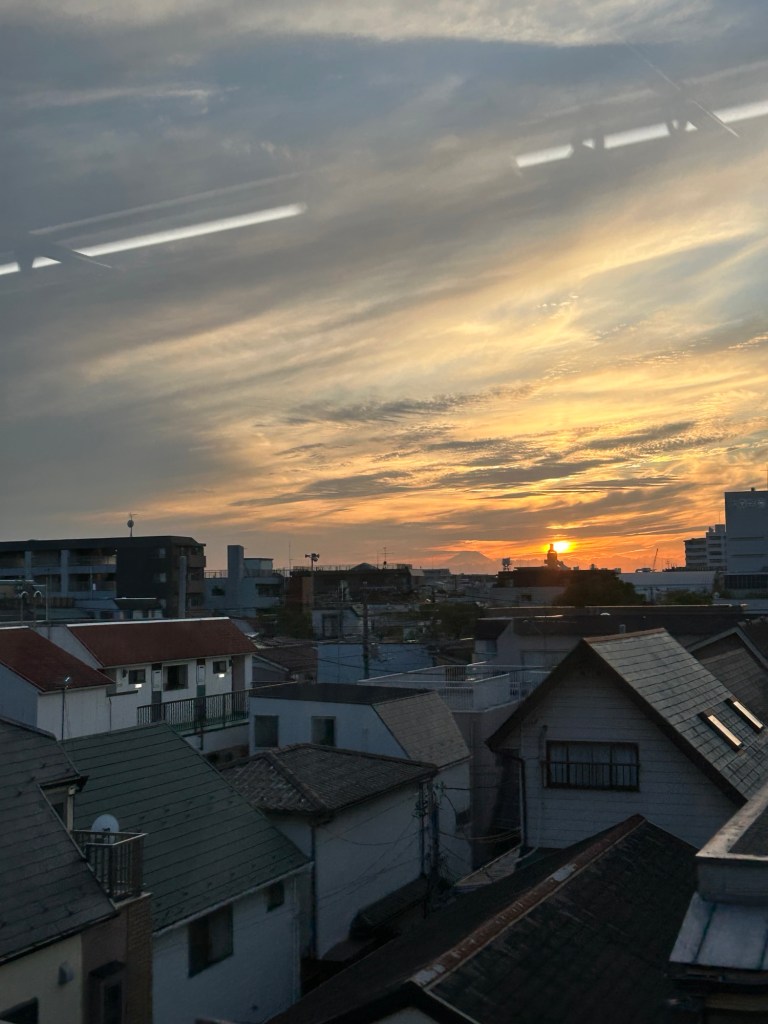
Can you see Mt Fuji peaking out just to the left of the setting sun?
And we arrived back at Shinagawa station just past 5:00 on a Friday night, which was not unlike entering the 7th circle of hell, but we got back to our hotel and are quite pleased with ourselves and our little adventure.
We’re big fans of KDramas on Netflix, and we’ve been exploring Korean food so we were keen to visit the Korea town district of Tokyo. We made an attempt when we were here in 2023. Picked the wrong day – it was a Sunday and honestly every young person in the city seemed to be on the street. The JR train station is small and dumps everyone right out onto the street (Shin-Okuba station). We got about a block down the street and gave up and decided to do something else that day.
Yesterday was not a particularly nice day – it was raining pretty seriously – but we decided that maybe a Tuesday morning in October would be a better time to visit. Armed with our new umbrellas we set off.
Wilf had his mind set on a restaurant called Delica Ondoru and since it was pretty popular I tackled their website, got myself registered and got us in line in advance. Step one done. Now we just had to find the restaurant. We had reviewed the map very carefully and with guidance from Mr Google we got out of the station, down the street and then turned onto what looked like an alley. When Mr Google announced that we were there there were several businesses in front of us – and then I realized ‘I can read the sign! I know which one it is!’ Even in a non-standard type face I could read it. Anyhoo. We presented ourselves at the door, showed the staff member our queue number on my phone and were sent upstairs for immediate seating. At first we just sat there looking at each other in astonishment – we found it and we got in!
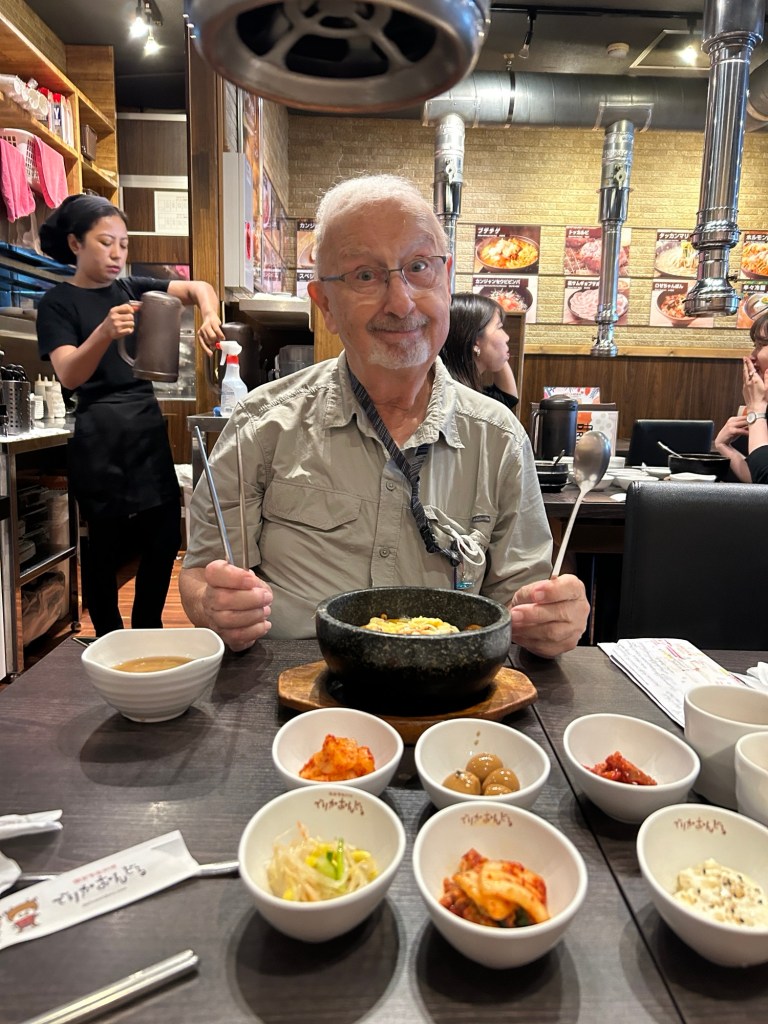
They had a wide selection of Korean dishes but we were there to try the bowls. In this case the bowls are super heated stone that arrive with all the goodies sizzling away – sort of like fajitas but a bowl. Wilf had squid with cheese and I had beef. Being Korean food an array of six side dishes also arrived. And a bowl of soup.
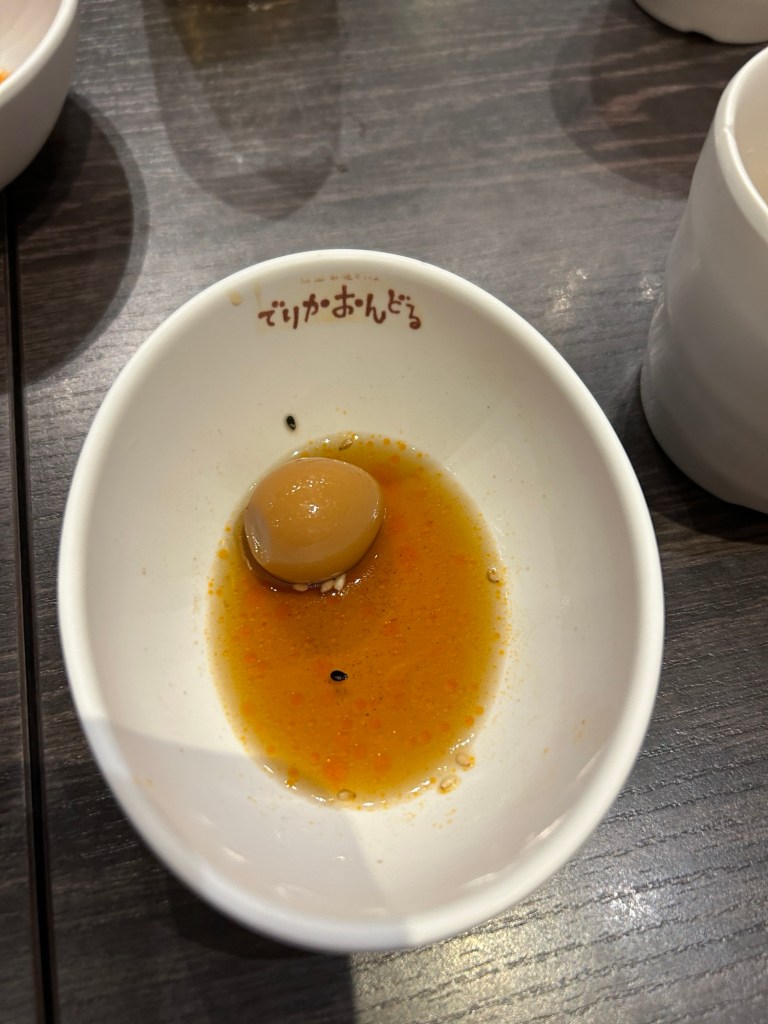
The round metal thing above Wilf’s head is an exhaust fan. Should you choose to barbecue meat they pull it down right close to the grill and whoosh go all the fumes. We don’t know a huge amount about Korean food, but we have noticed that they like to put cheese on or in a lot of things where it might not be expected. Like with squid…. The little dishes had sprouted beans in a vinaigrette, kimchi radish, kimchi cabbage, something red and crunchy and sliced lotus root in mayonnaise. Over by Wilf there is a dish in the middle with what sort of looks like olives. I had it in my head that they were olives but they clearly were not. They were good but we could not figure out what they were.
We were so busy going down a ‘some form of vegetable’ rabbit hole that we were completely buffaloed. I finally asked the waiter and he said ‘tamago’ – egg. He dove into his phone to try and come up with the name and so did I – quail eggs. Turns out he wasn’t Japanese he was from Tibet, so he didn’t know the word for quail either. For your reference quail’s egg are: uzara no tamago. In this case, cooked hard and marinated. Yum yum! It was all very good and we had no trouble eating it – even the kimchi wasn’t too fiery for us. I don’t know if that means they’ve toned it down for the Japanese palate or we’re just getting used to it.
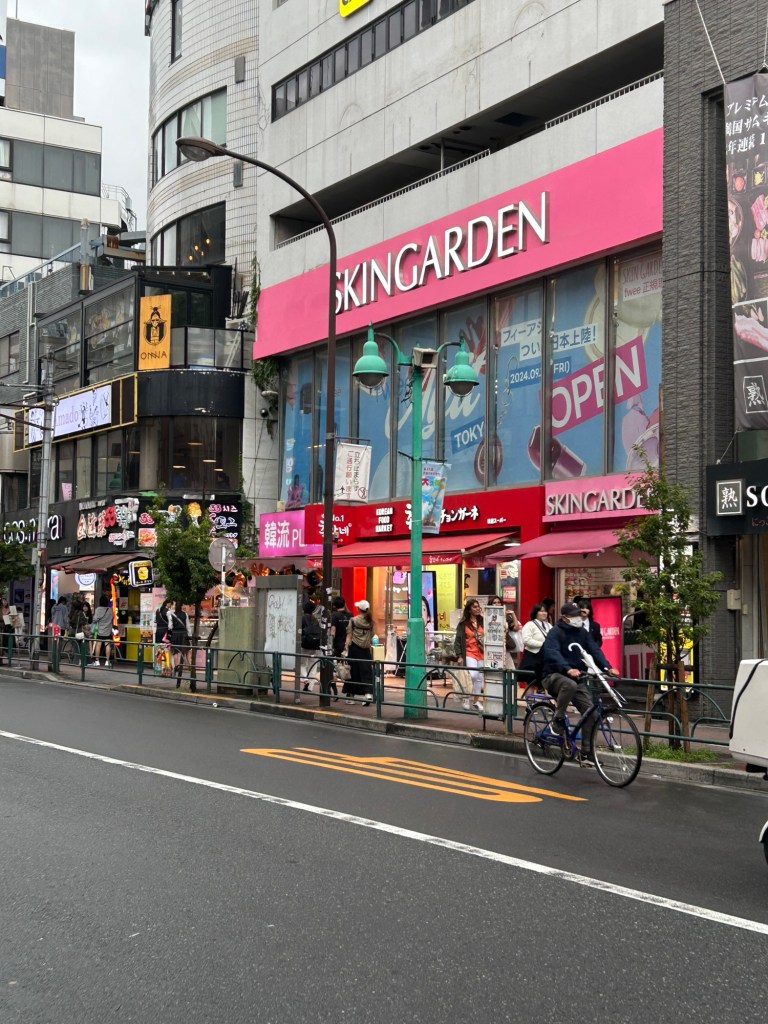
Besides the streets in this neighbourhood being full of Korean restaurants and kiosks there are two others exports that rule.
Skin care:
There were stores – big and small, one after another crammed full of cosmetics and skin care products.
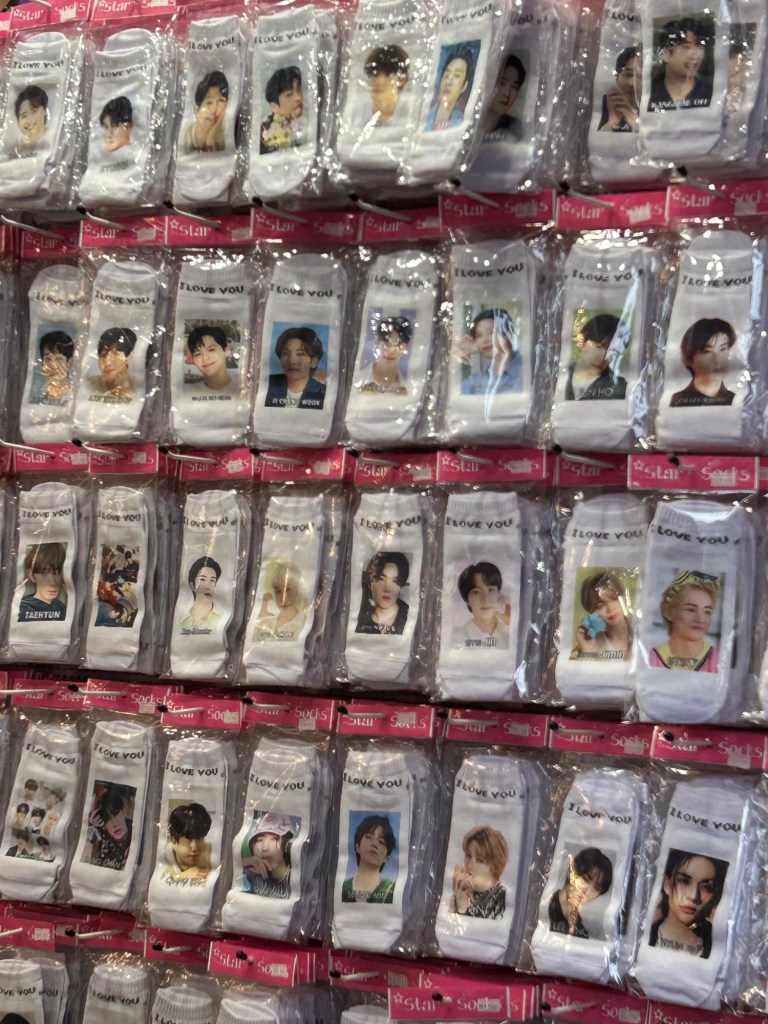
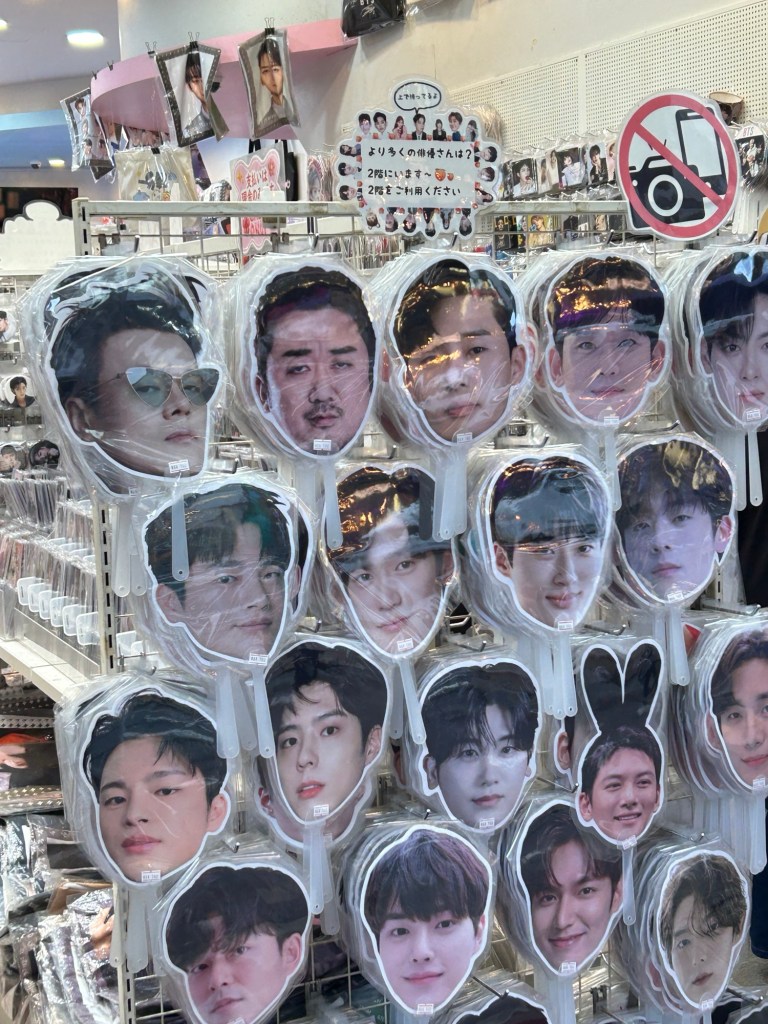
And, of course, K-pop…
These are socks with the faces of Korean actors and idols on them.And these are fans with actors and idols.
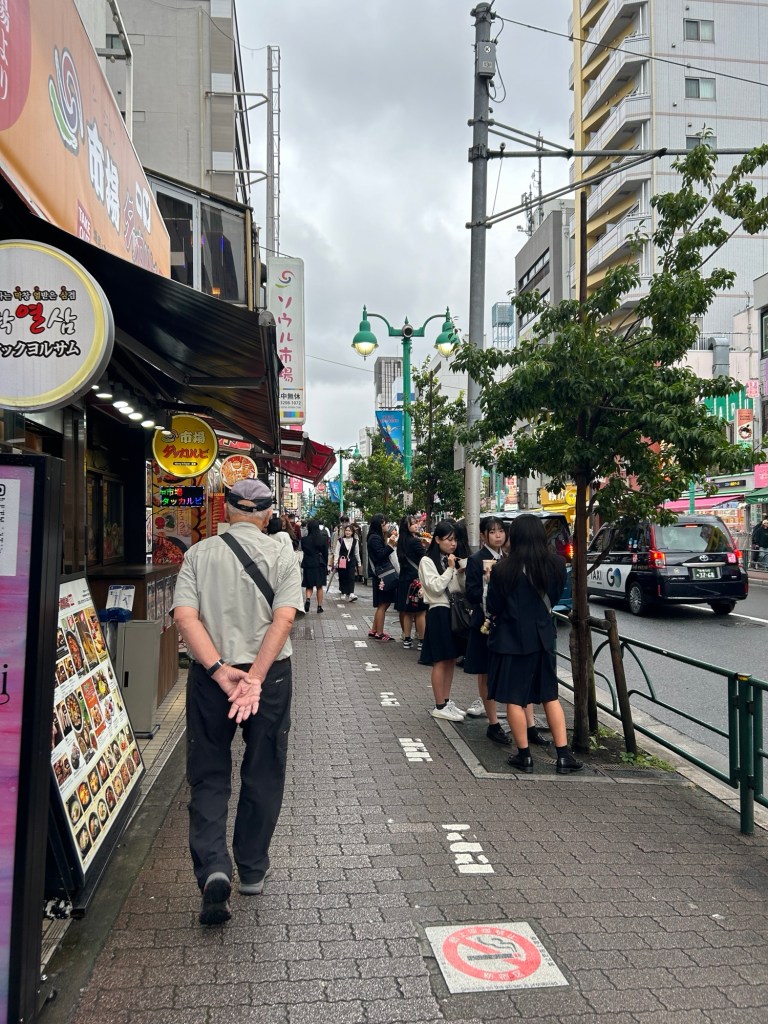
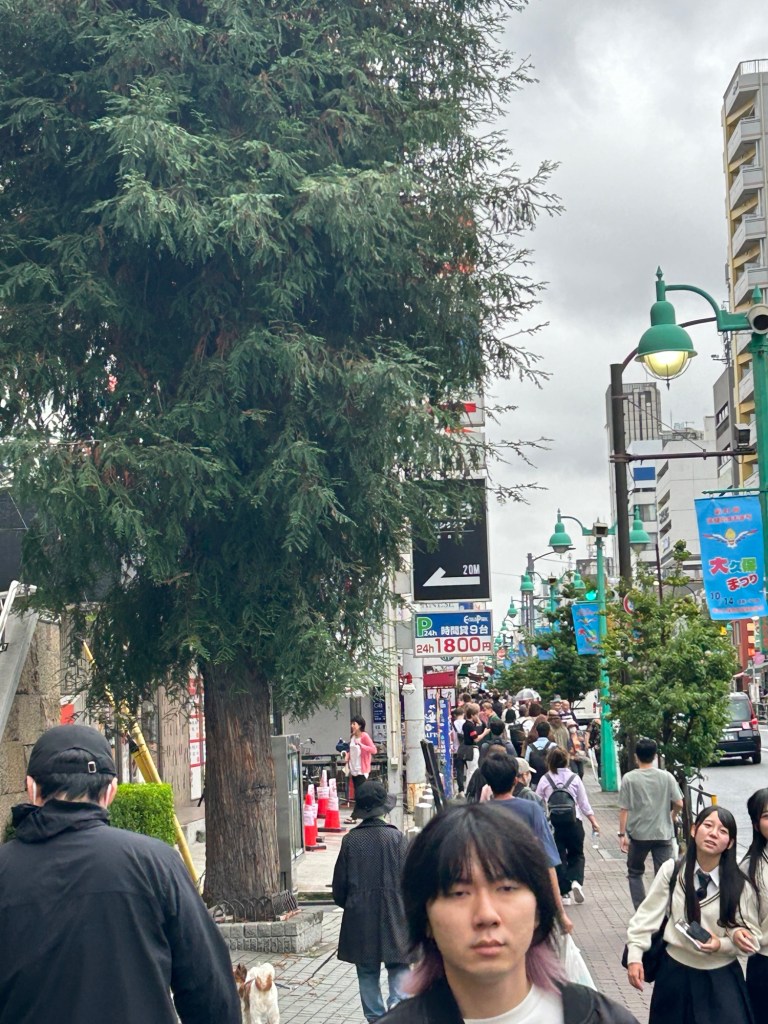
By this time it was about 3:00 pm, the rain had stopped and the school kids were arriving…
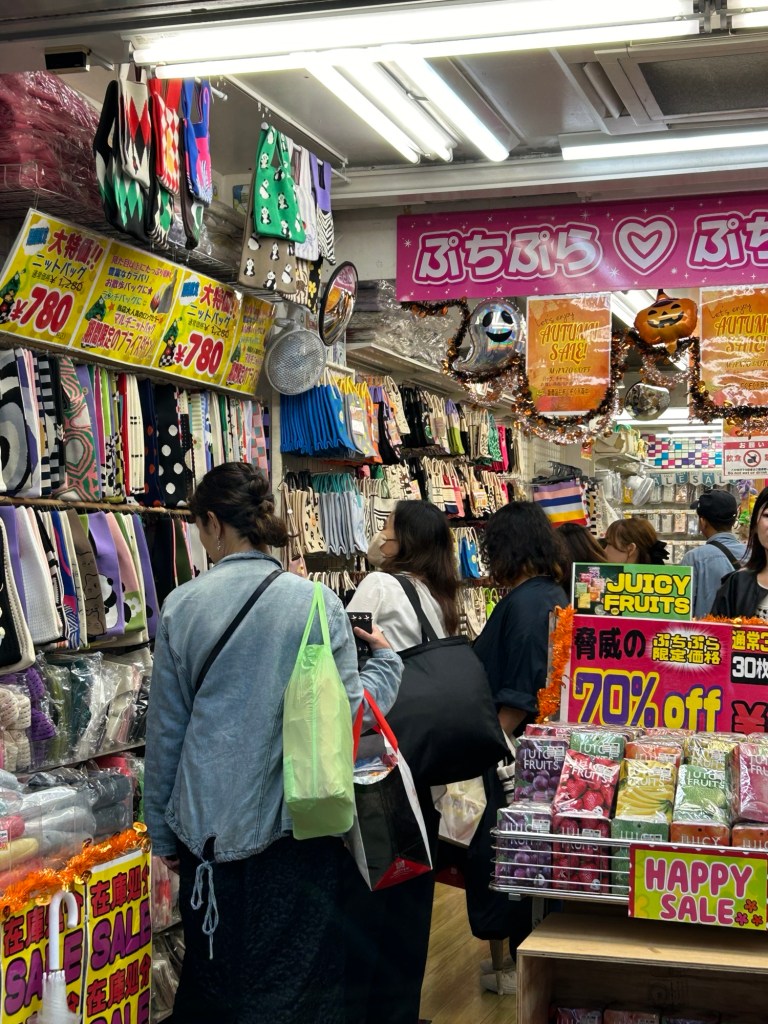
School girls loading up on ‘fried things on sticks’This store selling hand made purses was very popular.
The street was getting crowded. Nothing like the first time we came, though. I’m glad we came back, had a good meal and got to see a bit of the district.



 Where I'm At