The end of the Samurai.

Have you seen the new version of ‘Shogun’? It is really fantastic, and covers a pivotal time in Japanese history. We are in the city of Aizu-wakamatsu, who brand themselves as the Samurai City. Events here in the 19th century closed the bracket on the chapter opened in ‘Shogun’

After a long period of civil war, in the year 1602 the Tokugawa shogunate began, and lasted until 1868. While there was an Emperor, he was a figurehead, relegated to life in Kyoto. The Shogun ruled with an iron fist from Edo (which is now Tokyo). It seemed like this would be the way forever. Until the American s arrived in 1853, demanding that the Shogun open the country to trade. This was the beginning of the end of the Shogun’s feudal reign. The Emperor was restored to power as ruler, an event known as the Meiji Restoration. There was resistance, and rebellions broke out sporadically through the country. It all came to a head in 1868 in the city of Aizuwakamatsu. The shogun’s supporters were vanquished and banished and the Meiji restoration was secure.

Every September 23 the city of Aizu celebrates the events with a festival and we decided we needed to see it. The city is in Fukushima prefecture in a big inland valley. There are small ski resorts in the surrounding hills. We’re not quite into the Japanese alps, but they get quite a lot of snow up here.

Turns out they get a lot of rain up here, too. Like holy cow a lot of rain!

The original castle was destroyed after the insurrection, but it was reconstructed by 1965.
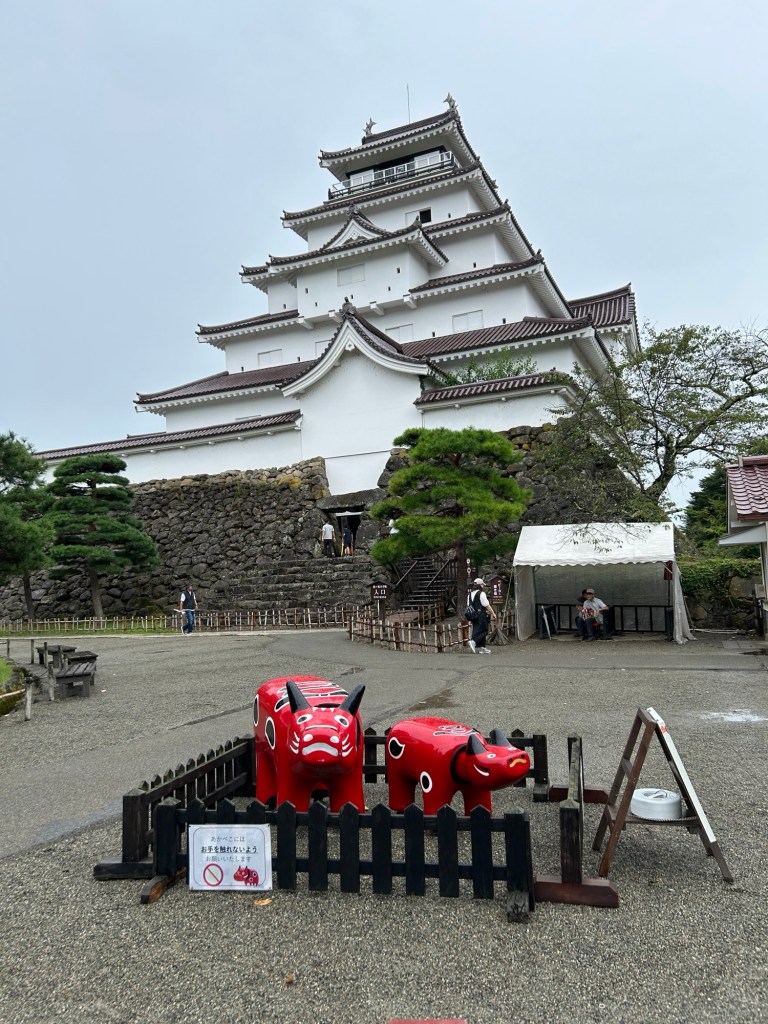
Yes, there is a story about the red cows. They are called Akabeko, and have a story…
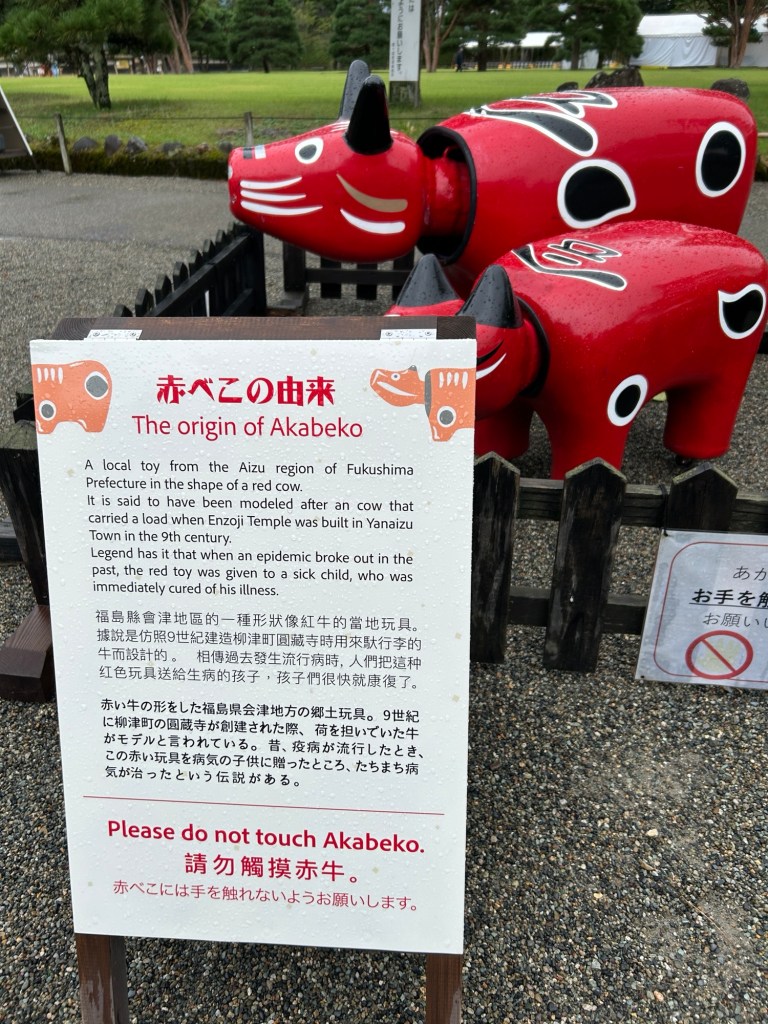
They are Everywhere here!
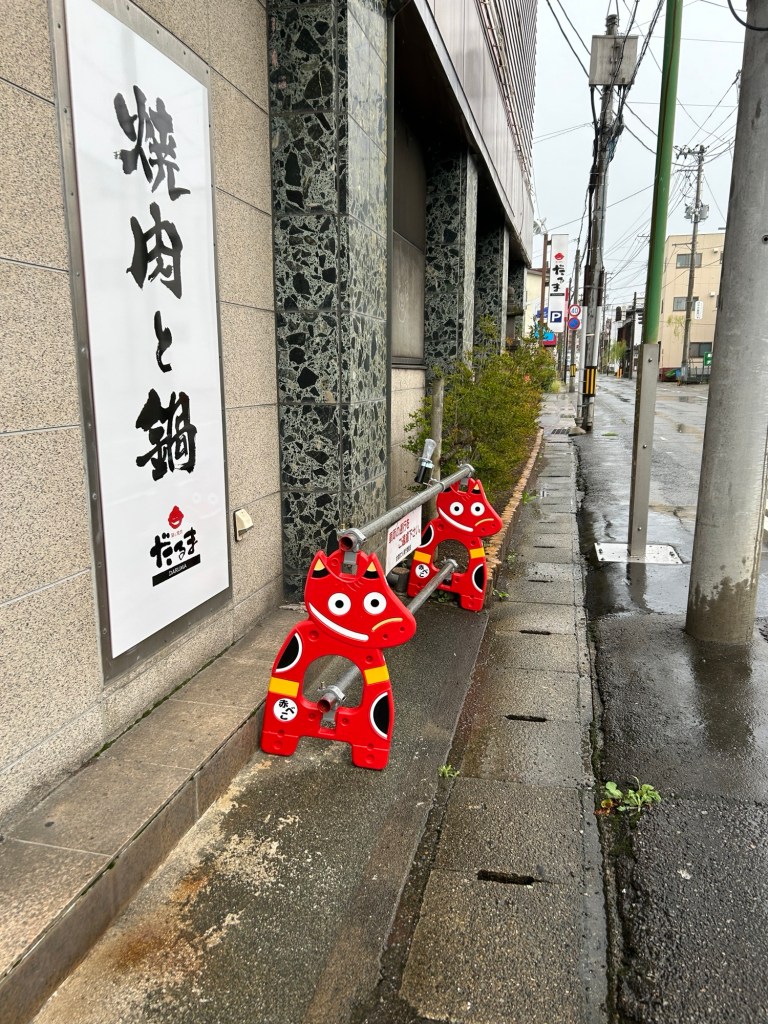
Haven’t seen a Hello Kitty, a Pikachu or a Kumamon since we’ve been here, but little red cows are everywhere.

Anyhoo. The castle is very nice and the inside is an interesting museum of the area. After the war the losing side was banished to the northern end of the island, but it looks like many of the capable people were reabsorbed into Japanese society becoming teachers and police officers.

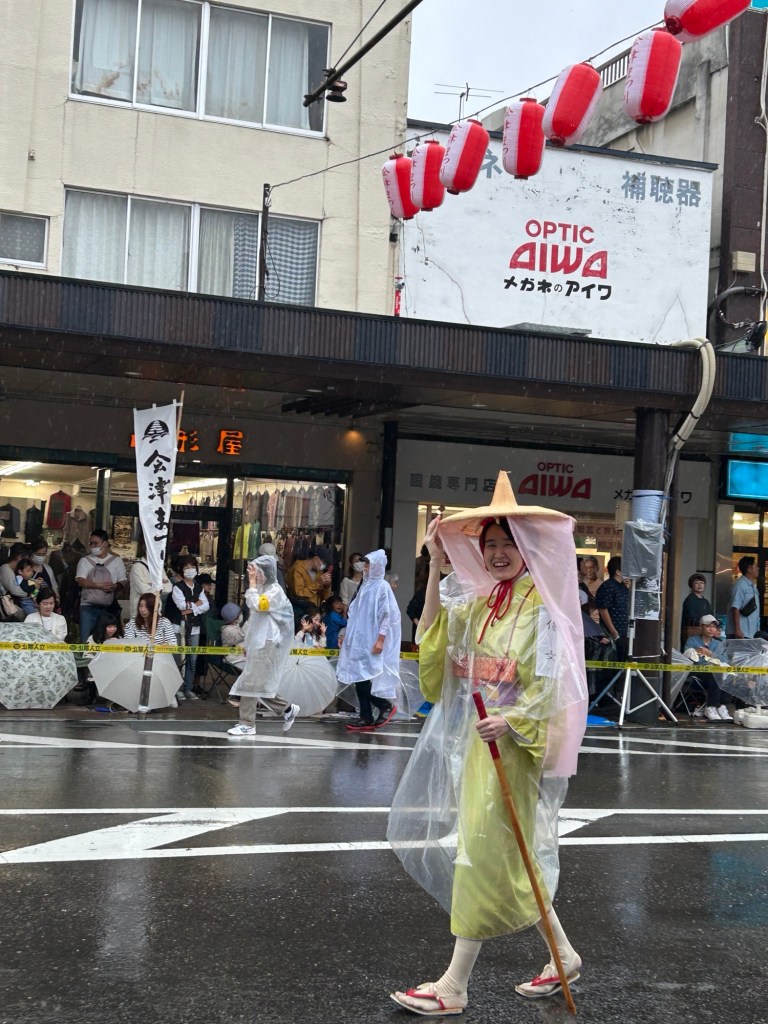
The high point of the Aizu Festival is a parade that involves 500 participants in costume. With horses…. We were uncertain because on Saturday it rained and rained and rained. A good 30mm worth. Sunday we got up and went to the info centre at the train station and they were very confident that the parade would happen. No matter that it was pouring. We sloshed down the street, heading for the shopping district. A few food stalls appeared, and then we heard cannons being fired. And sure enough when we got further down the street we found everyone.
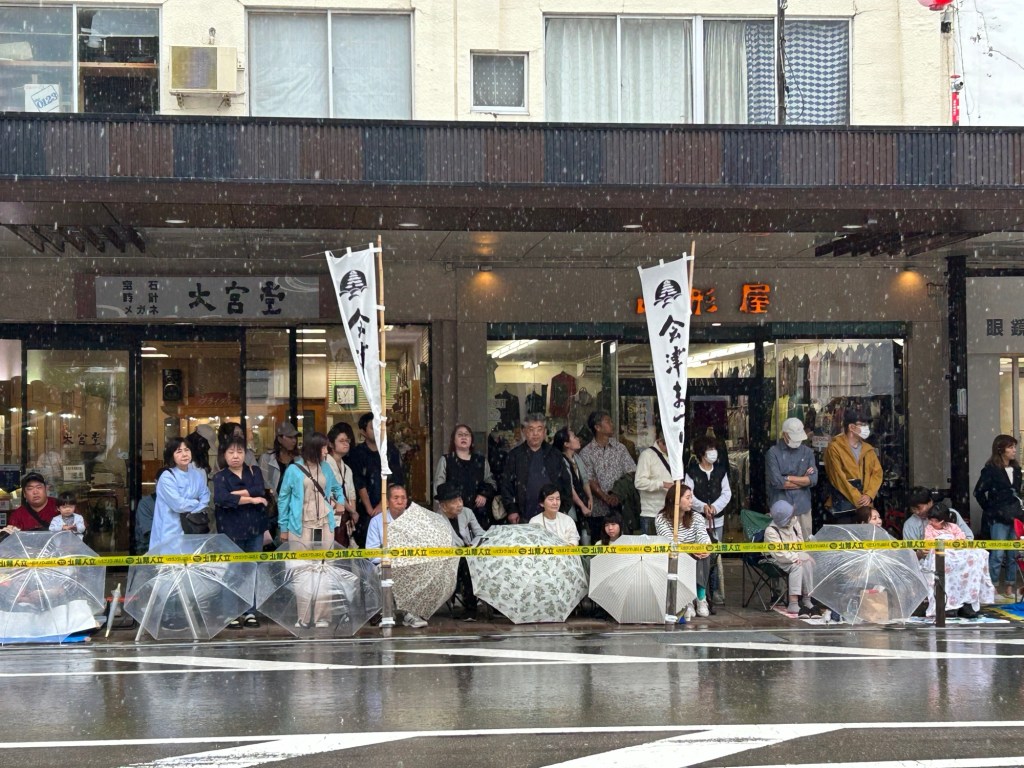
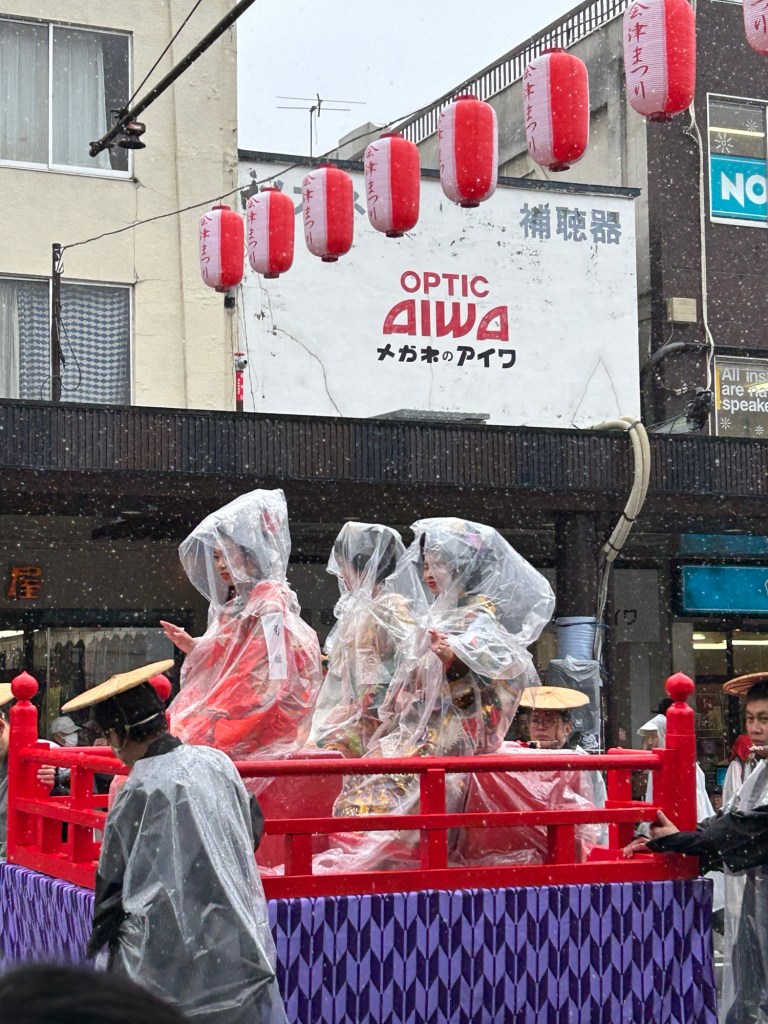
This part of this street is arcaded so we could get out of the torrential rain. The parade participants – not so much….
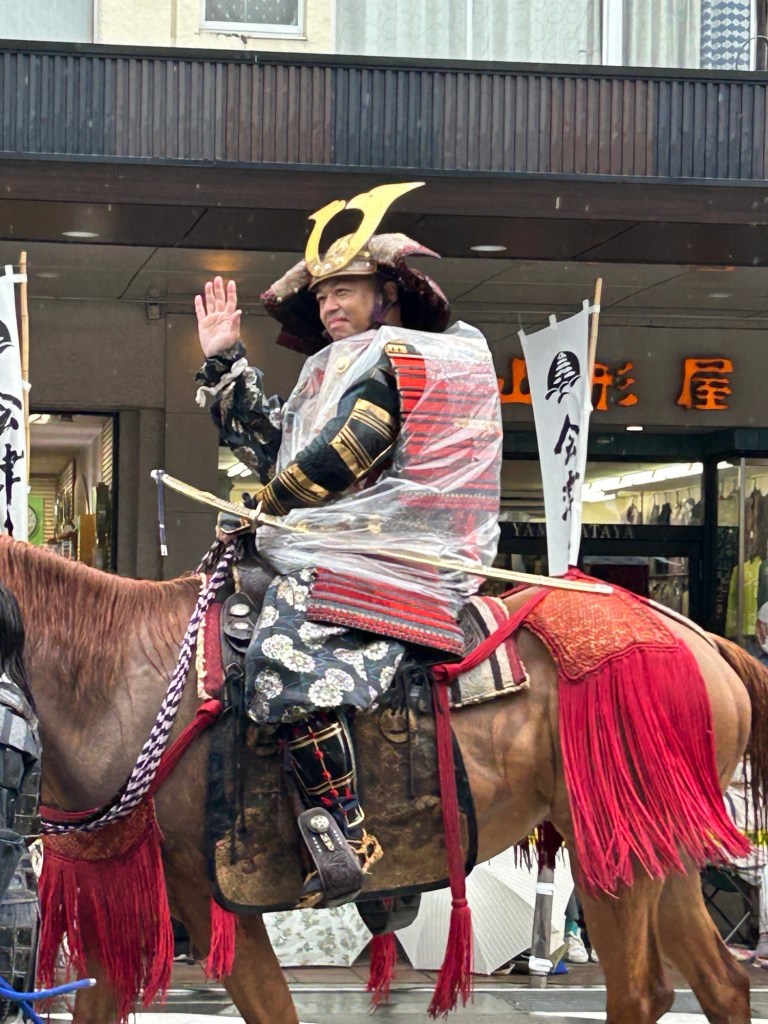
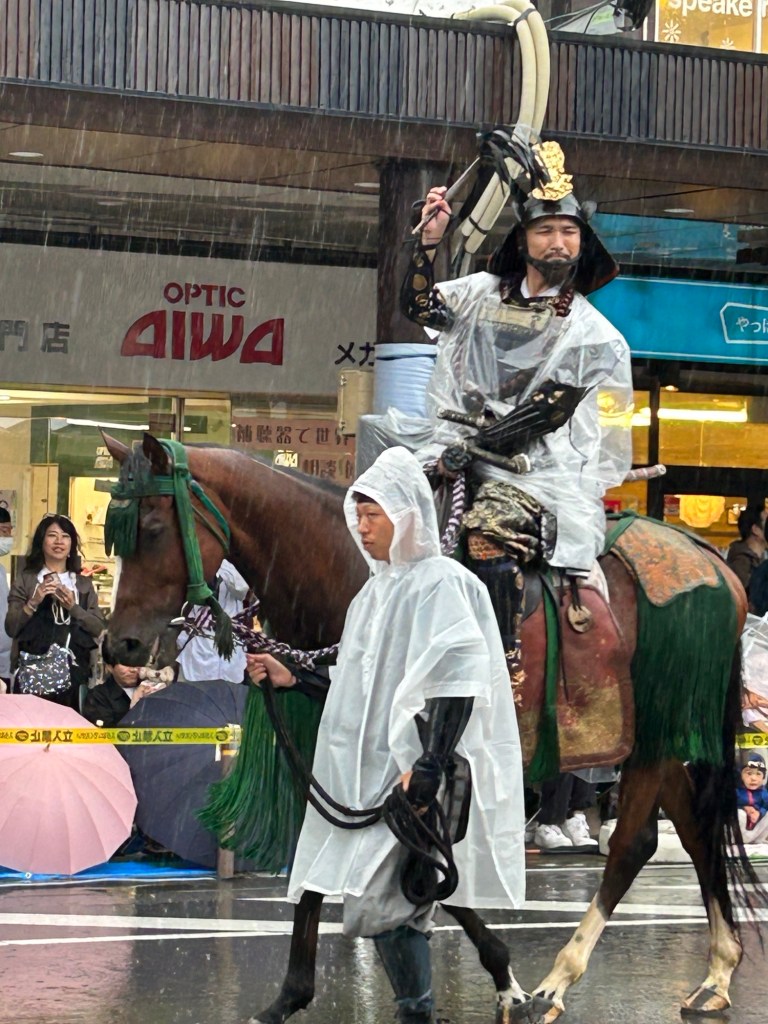
There was a big range of clothing and weapons as the participants represented the rulers of the city over a 400 year span. There were also drummers, sword dancers and a variety of performers. It was quite a spectacle and we were glad to have been able to see it. Too bad bout the rain, though. It was quite a production for a city of about 120,000 residents.
Well. That never happens….

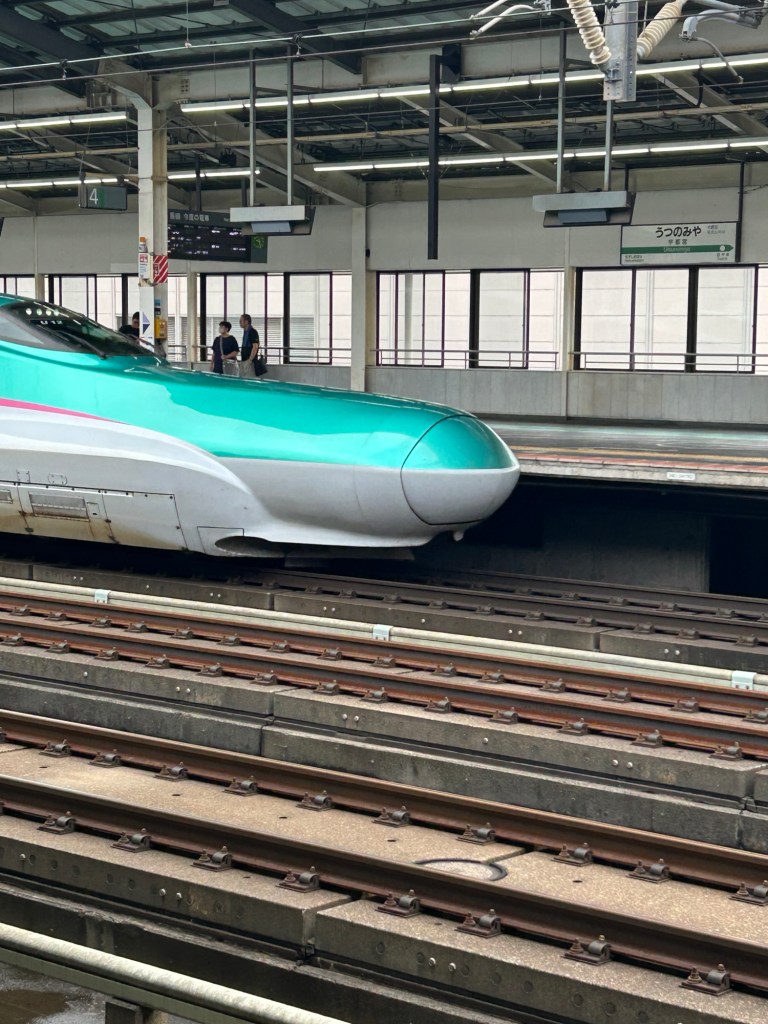
There are some certainties in life. The sun rises in the east and sets in the west. Taxes. And that the trains in Japan will be on time. We know not to be a minute late because the train will come and go right on schedule. If there is a delay of a minute – gasp – the announcements become a long string of apologies.

We set off this morning, heading for the city of Utsunomiya, about 90 minutes on the Shinkansen from Tokyo. Short walk from the hotel to the subway,, short subway ride to the big train station at Ueno, found the track, picked up something to eat.

While we were waiting for our train to arrive other trains would pass through the station. And there was even a pair of trains joined together. That sleek sexy nose of the Shinkansen actually pivots open and the train can be joined to another. How about that.

Anyhoo, our train arrived, we found our seats and settled in. Turns out it is too early in the season for the vending machines to dispense hot coffee in cans, and carrying a cup of coffee along with suitcases, knapsacks et al seemed like a bad idea, so we were enjoying a morning bottle of cold latte, which is better than it sounds. Eventually we realized that the doors were still open and we weren’t going anywhere. Time passes, still nothing. And then the announcements begin. We are the only non business people in the car. Everyone else is a salary man, pounding away on their computers, or sleeping. The announcements are a storm of Japanese out of which I can grab a few place names, but clearly something is wrong. Our 8:30 departure is long past – 9:00 goes by. Around about 9:30 an announcement in English – something has happened further up the line and the entire Tohoku Shinkansen line is suspended. Don’t know why but sounds like equipment failure.

We eat our bento box and wait. 10:00 passes and our fellow passengers begin to leave. We don’t know another way to get where we are going, so decide to stay. I eventually realized that I can use my translation app to capture the announcements and at 10:50 the announcements says get off the train, cross the platform and get on the next train that arrives, go one stop and transfer to another train. So – we do that. Get off the train, at least. Fortunately a lady on the platform took pity on us and helped us out. But of course when the train arrived it was already full of people, so we all had to stand. Off the train at Omiya, whip through the station and onto another train (thank you for our guardian angel who was going the same way and swept us along to the correct train). Of course that train was already full of people so we stood until we got to our stop.

Sheesh! What a mess! Turns out two trains ,which had been coupled together became decoupled while flying along at 315km/hr. When the emergency brakes kicked in the trains were 300 meters apart on the track. No derailment, no one injured. But a five hour suspension of the service. The train station at Utsunomiya was a zoo. We managed to get someone to amend our ticket so that we could get a refund for our fare (any delay over two hours and they’ll refund you) but they were still in the thick of things dealing with moving people around, so we’ll sort that out out later. We were among the 45,000 people affected by the stoppage.

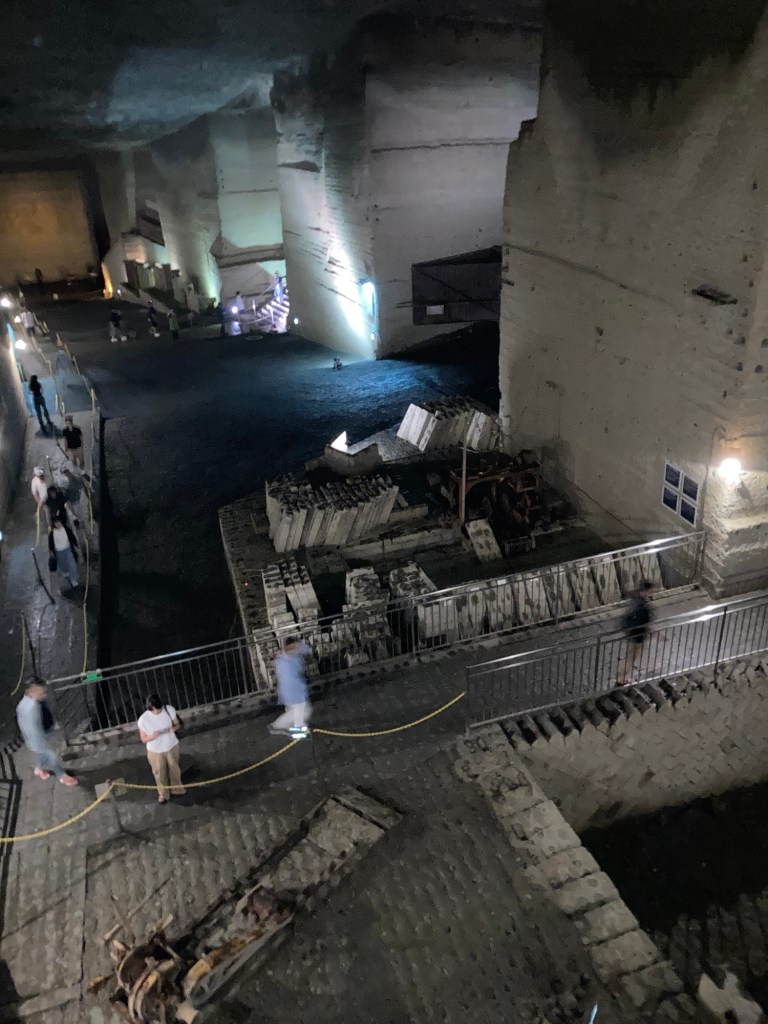
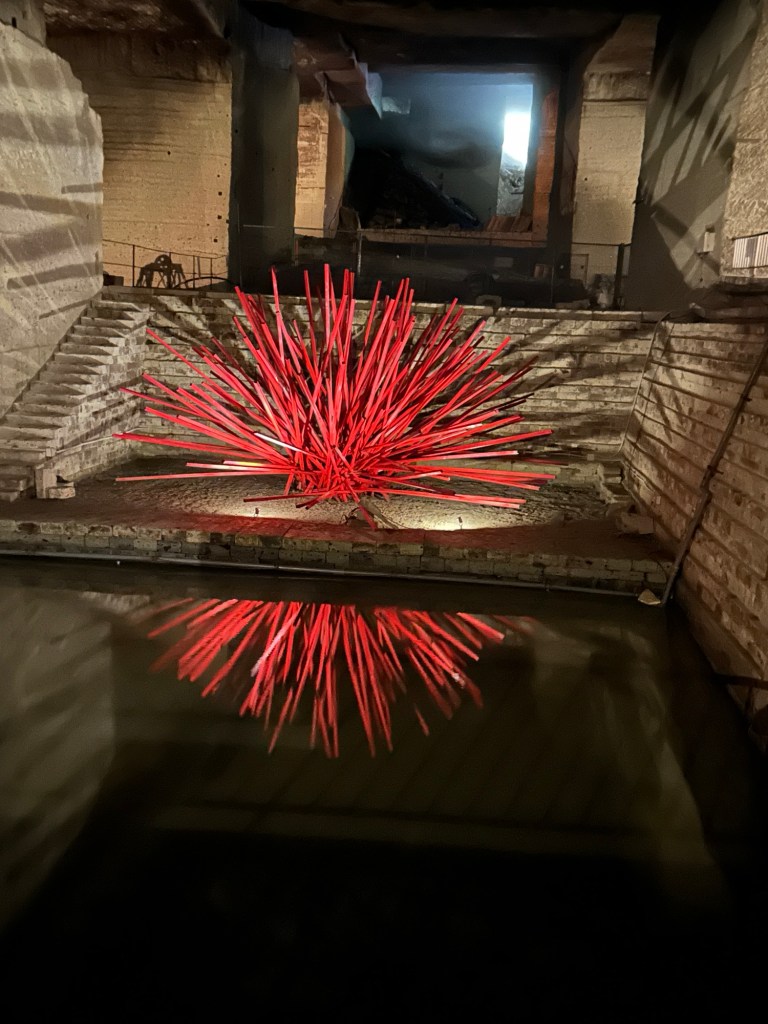
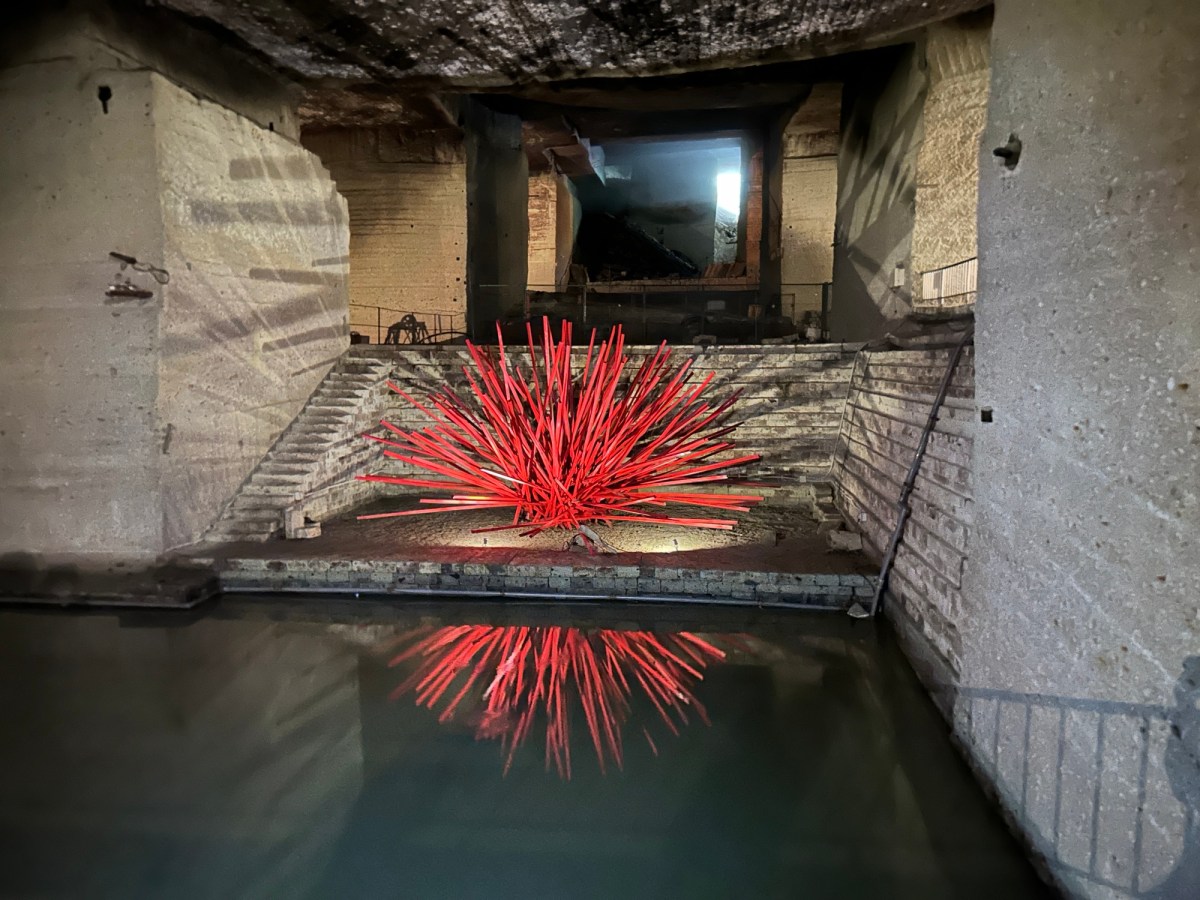
So why Utsunomiya? Knowing its us you won’t be surprised if there is a geology angle, right? We stored our luggage and caught a local bus, which took us to the Oya Museum. The rock formations in this area are made of volcanic ash laid down under water 20 million years ago and then raised into hills in central Japan. So, we went to see some:

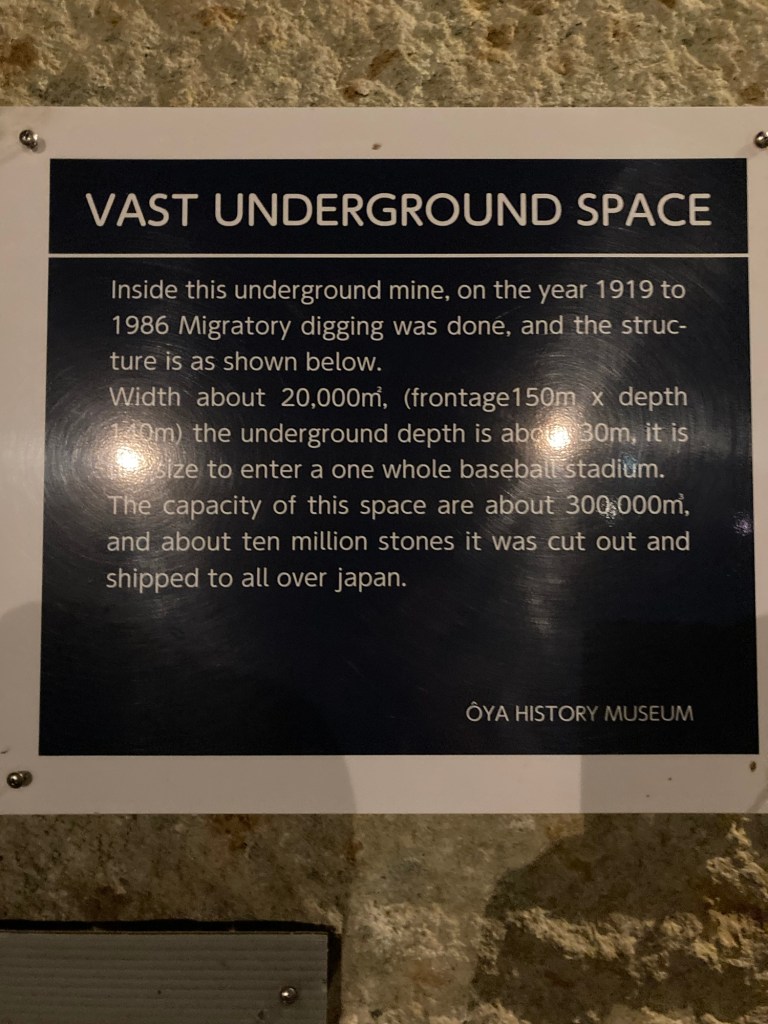
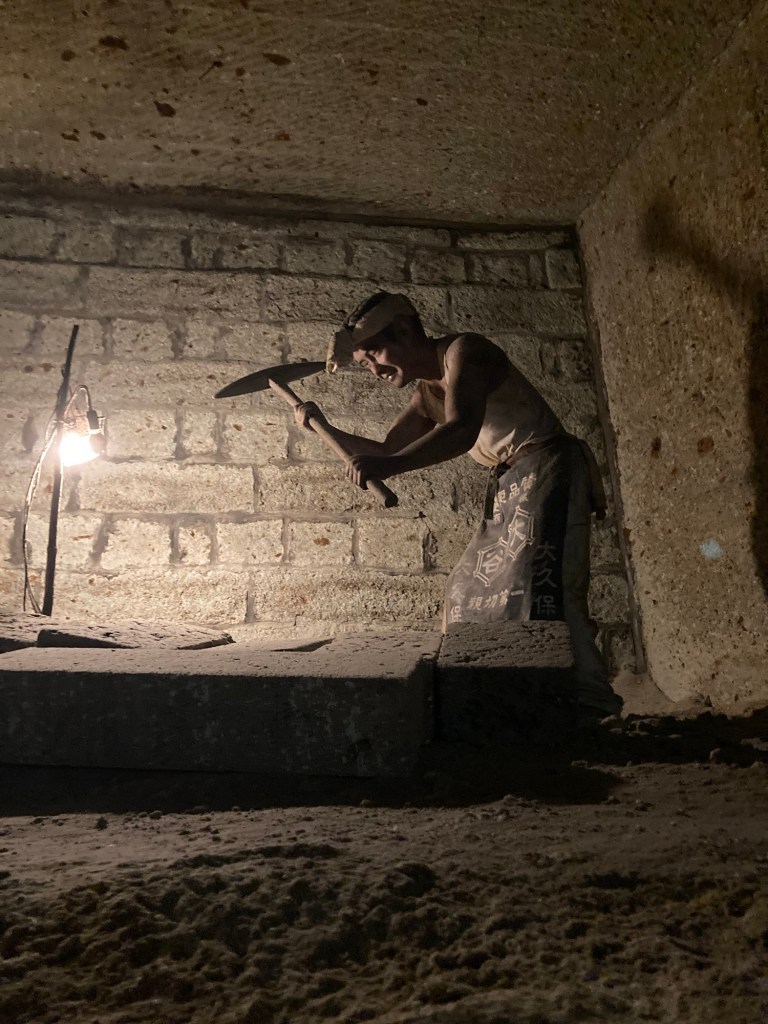
Excuse the reflections, but that summed it up. We went down down down into the ground where the rock had been mined out, first by hand and then by machine.

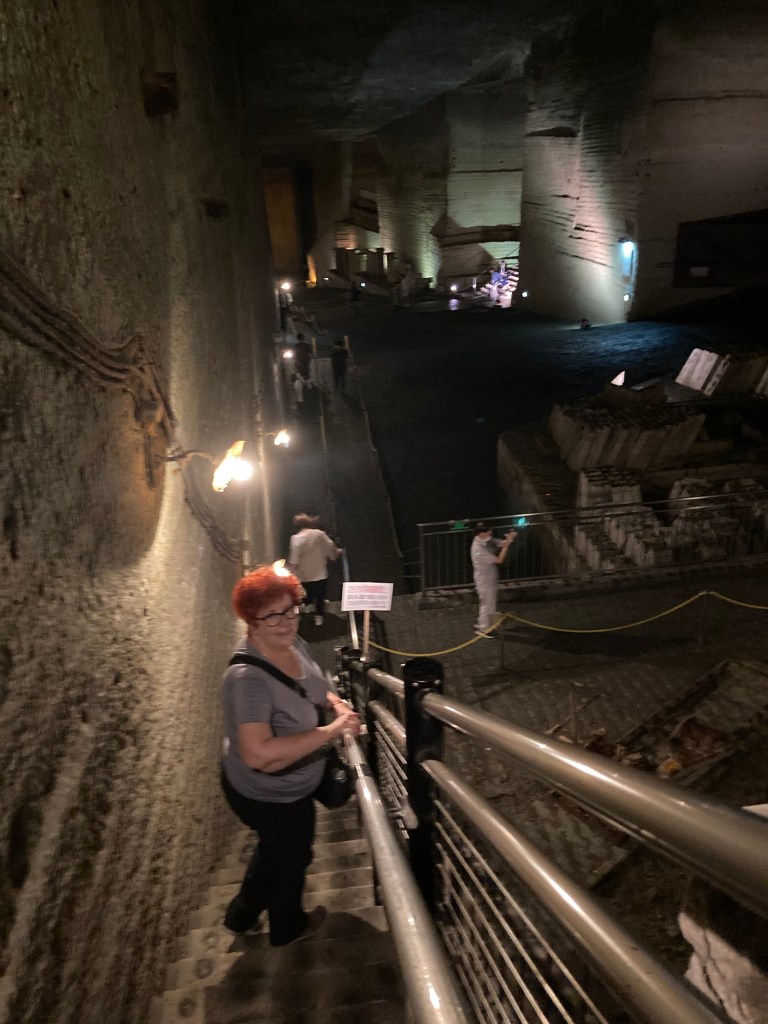
Wilf was astounded at how it was mined. Unlike hard rock mining, there were no elaborate support structures – it was more like a salt mine. It was lovely and cool down there, and we wandered about theses enormous cavernous spaces.

There were rooms and stairs and walkways , pools of water and shafts that lead to the surface . During the Second World War airplanes were built down there.

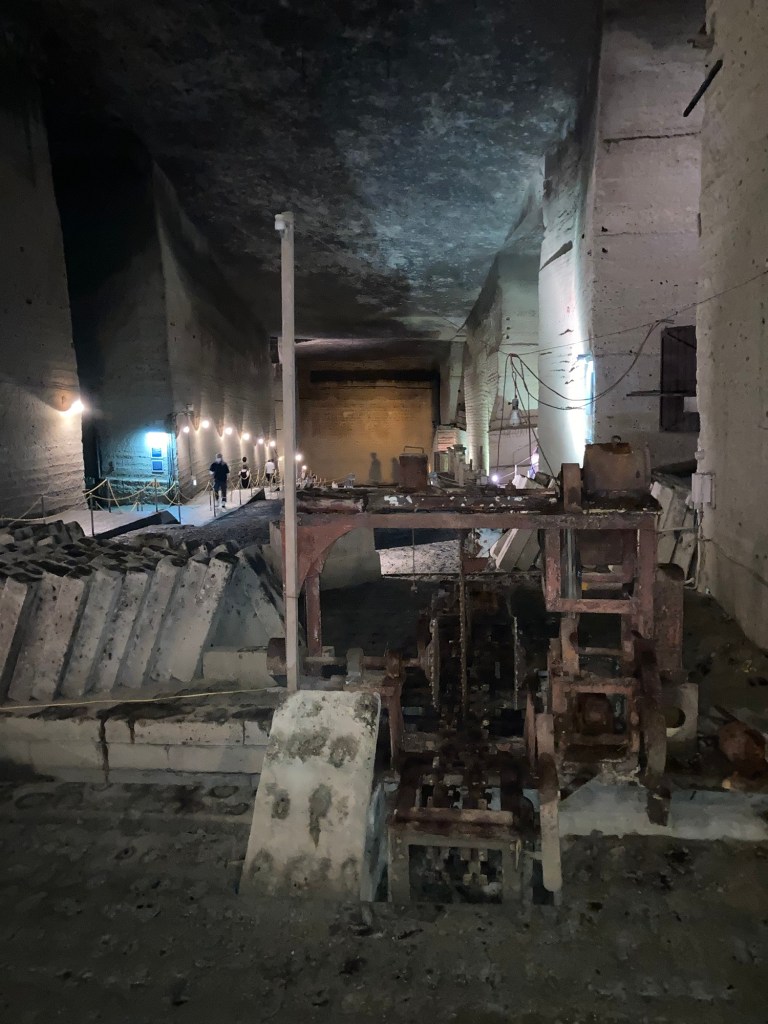
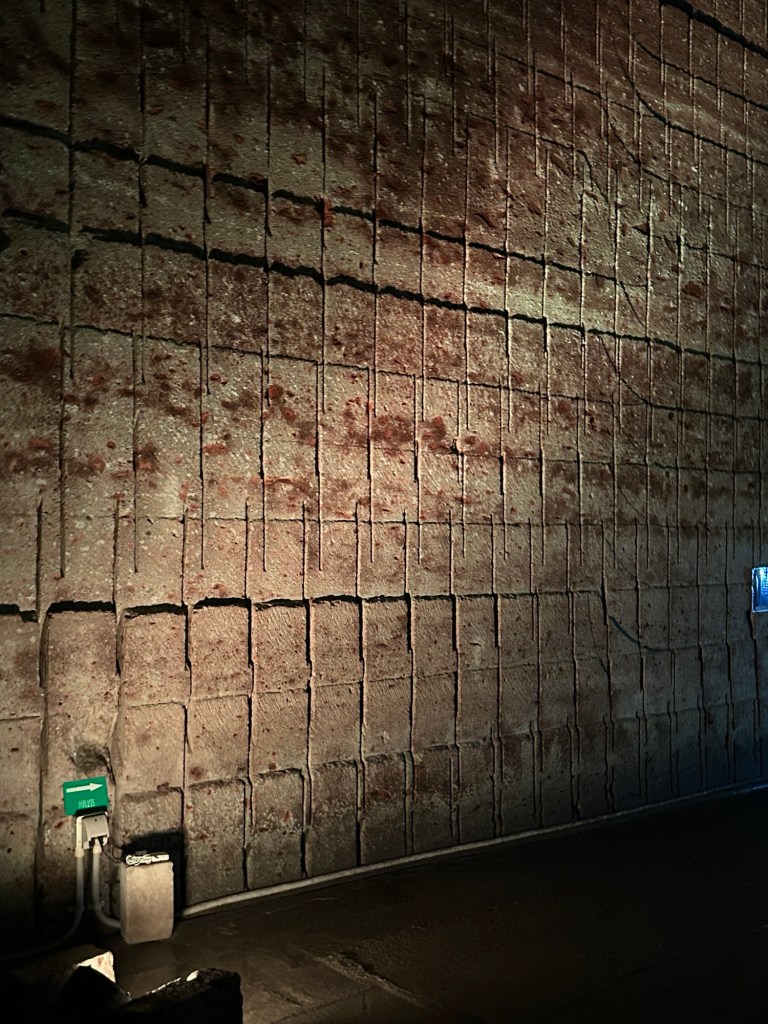
The walls bear the marks of both hand work and machine work.

The hard way….
Still not easy, but faster!

All this activity left some interesting marks on the wall.

Power saws at work

The quality of the stone varied – the above pictures show sections with more iron, which oxidizes to brown. Other areas were an even cream colour. The texture is quite porous and we saw no examples where they put a polish on it. In the early 1920’s Frank Lloyd Wright was commissioned to design the a new version of the Imperial Hotel in Tokyo and the stone from Oya was used for the building. Subsequently it was not considered competent for building and is mostly used for cladding and decorative elements.
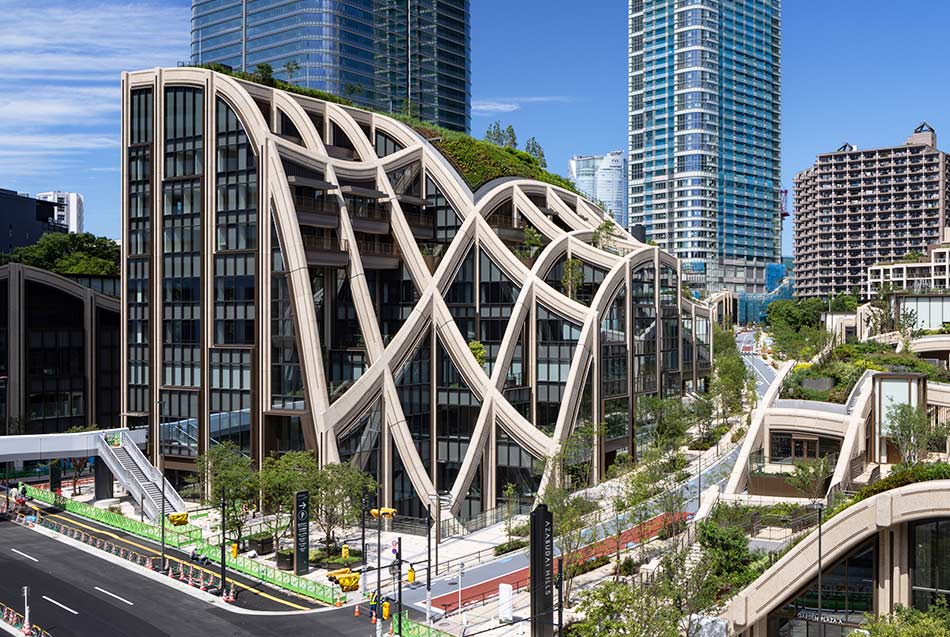
So what to do with an abandoned mine, besides hosting tourists? The site lives on as an event space. You can get married down there. There were pictures of various promotional events – product launches for car and luxury goods companies. Concerts. Sets for movies and music videos. Art installations.

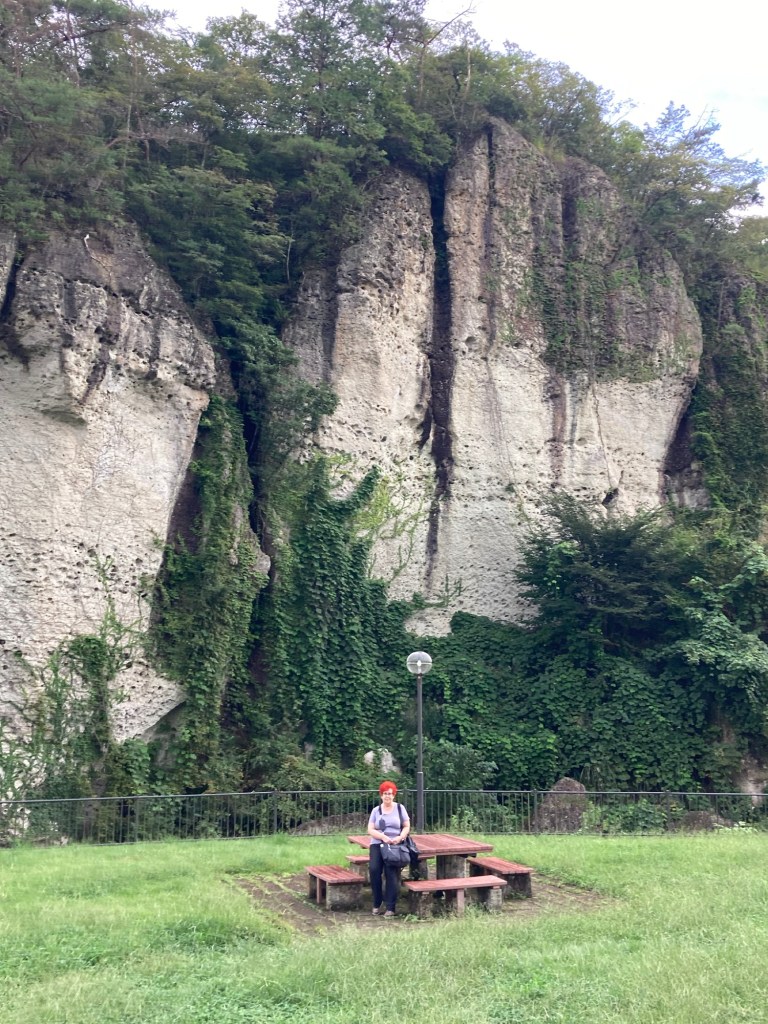
And then, if all this wasn’t enough we went next door. On the other side of the hill, as it were. The hills look like this:

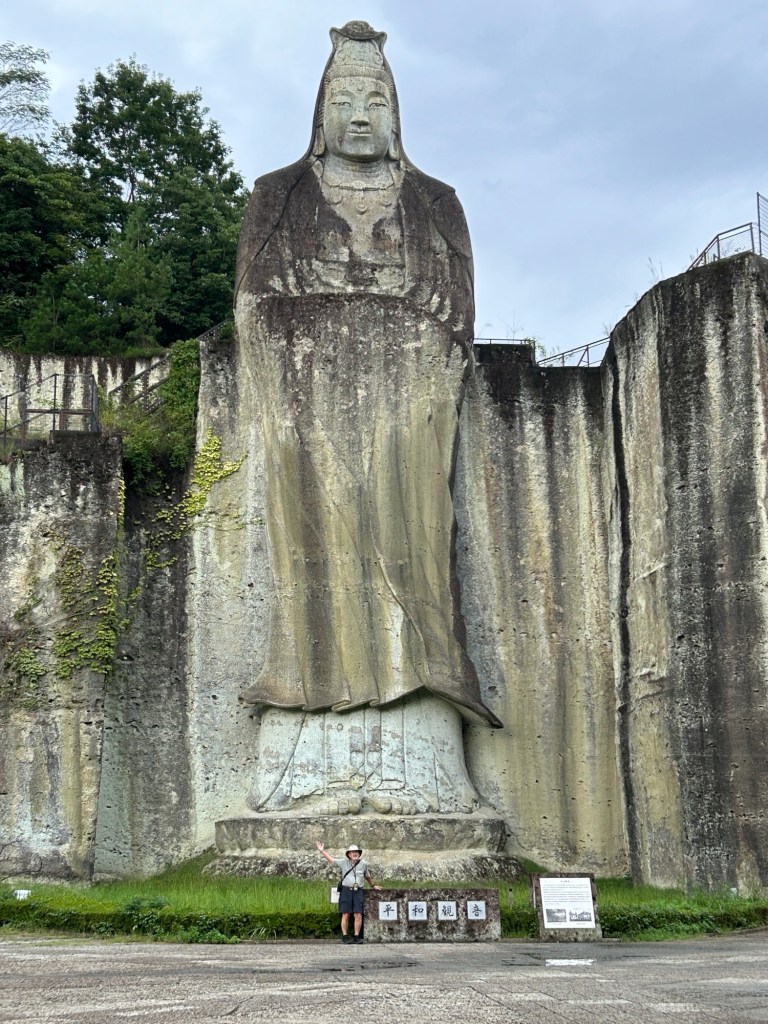
Except when the locals decide to carve a representation of the Buddhist goddess Kannon into the living rock. Then it looks like this:

Wilf at the bottom for scale. After the war she was carved into the hill as a memorial to the war dead and dedicated to peace.

So – big day for us and we were plenty tired. Our hotel had a Spa in the Sky on the 14th floor so we could soak our bones. And as important – there was a laundry facility. With dryers! Clean clothes – yay!

After Utsunomiya we’re off to another place with a long name, but that’s a story for another day.

Still with the moon

As I mentioned yesterday we have arrived in Japan at the time of Tsukimi, the mid autumn festival that celebrates the harvest and the change in seasons. (Feeling a little salty about the whole ‘change of seasons’ thing as it was 34C here today. Not what we would consider autumn weather…..)

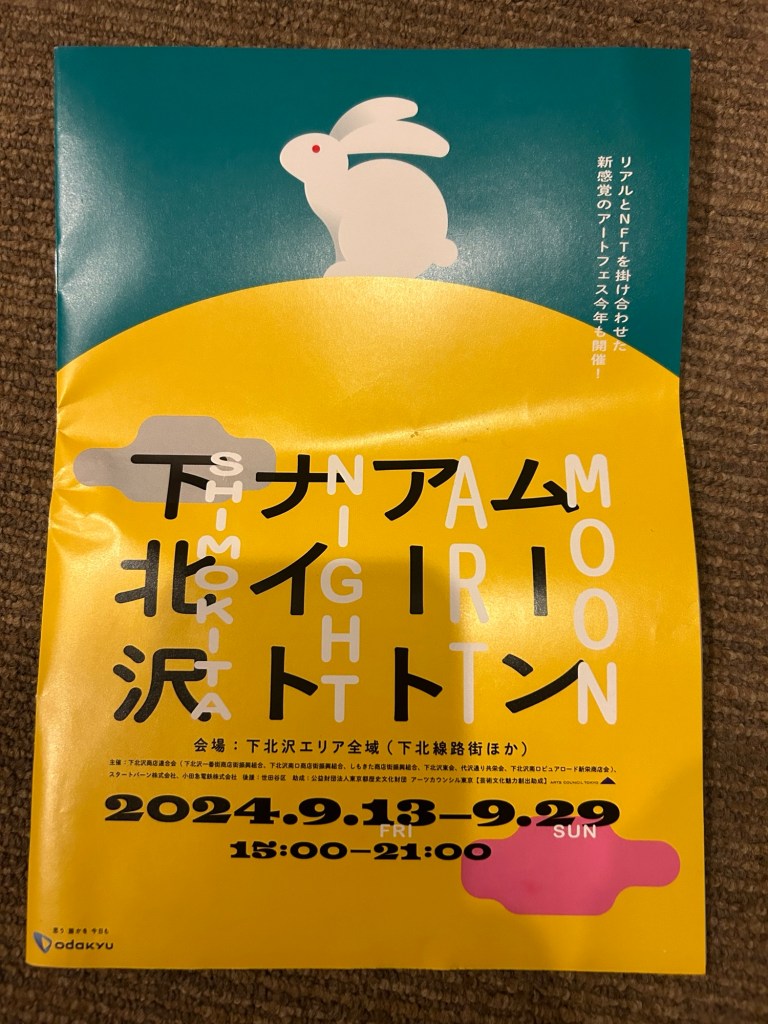
In the district of Shimokitazawa there is a moon festival with several art installations. We had it on our list as a thing to do but figured we’d get to it when return to Tokyo at the end of our trip. Sounded like a plan until today, when we discovered that the event was over on September 29th. Okay then – guess it’s tonight or not at all.

Let me just point out that today was intended to be an easy day. A day to sleep when needed to deal with the jet lag, to ease into things. We walked out the door just after 8:00 to be hit with a blast of 30C humidity and sun. We were reduced to skulking along the street, clinging to the shadows, hiding in doorways while we waited for lights to change.

We went to Ueno station to sort out some train tickets and thought we’d go for a walk through the shopping area under the tracks. Didn’t get too far before we had to bail into the first place that had outdoor seats for sticks of fruit and mango bubble tea at a Korean spot.We eventually staggered back to our hotel and had a Power Nap that had us feeling pretty perky. Enough so that we decided to make the hour long trip across the city to see what Shimokitazawa had to offer.

Before I tell you about it let me tell you that on our ‘quiet’ day, as I am writing to you, my watch tells me that today I walked 15,151 steps, which is 9.36km.

Fortunately the event was well organized and the signage was very good.

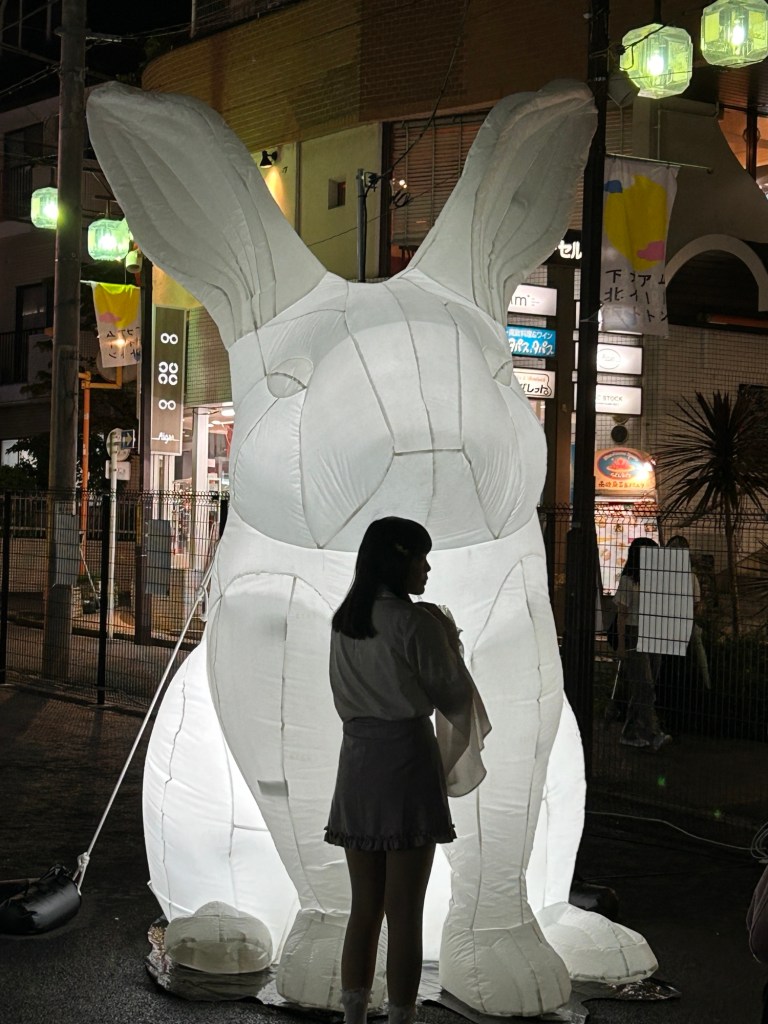
Rabbits and the moon…

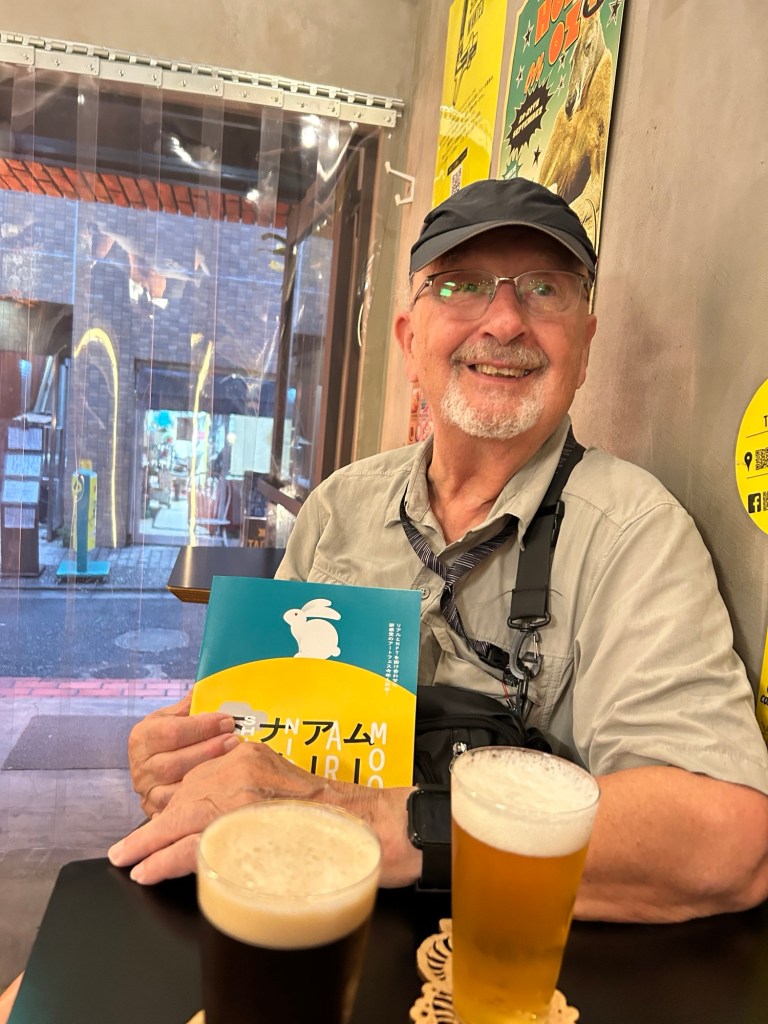
There were three public installations to see, in addition to many collaborations with local businesses. We arrived late afternoon in a light drizzle and decided that we should wait for it to fall dark, so we did what we often do, and asked Mr Google ‘craft beer near me’, which led us to the Tap and Growler, a tiny pub with 10 seats and an abundance of beers.

Quite the hairdo provided by the humidity!

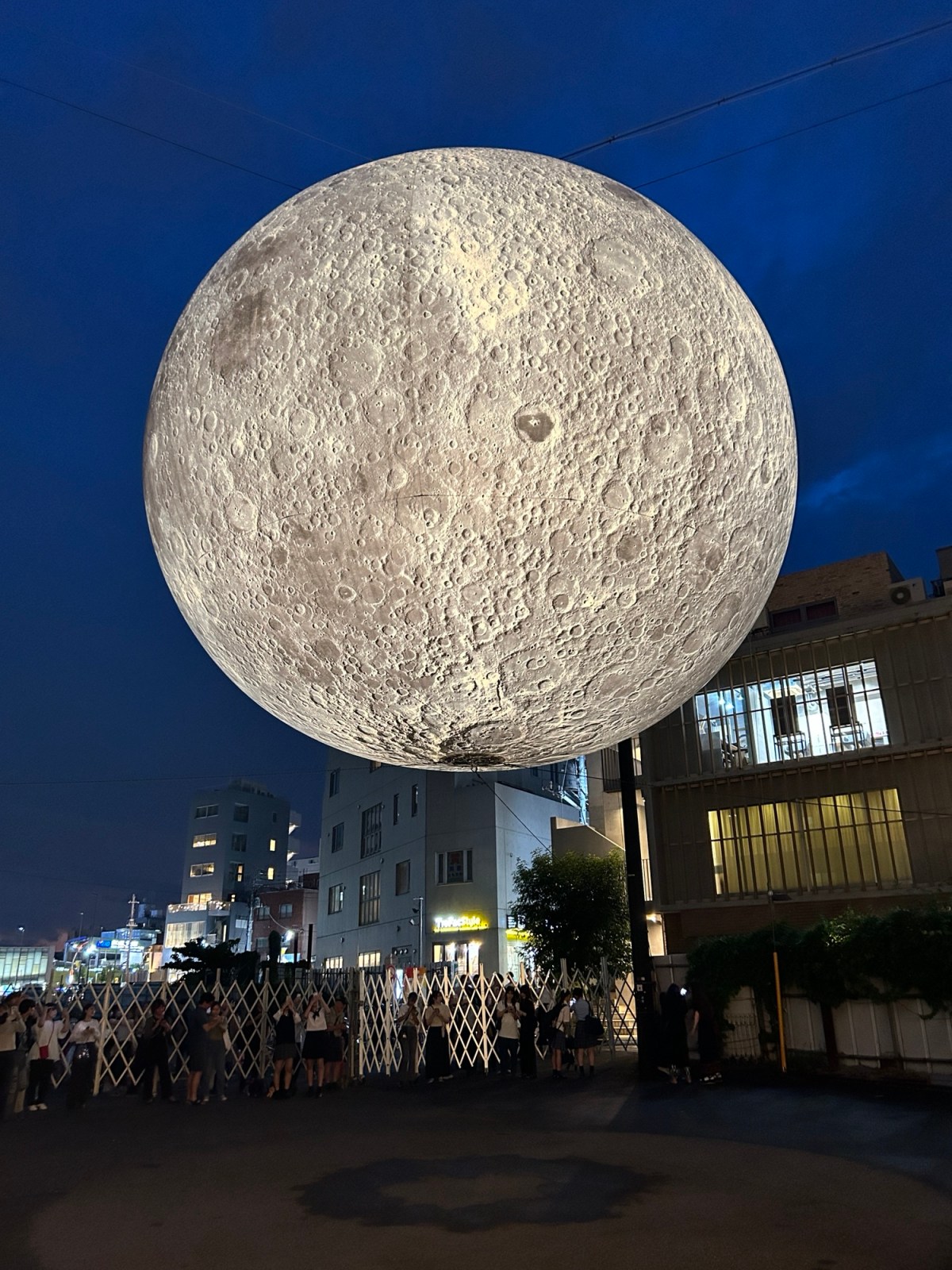
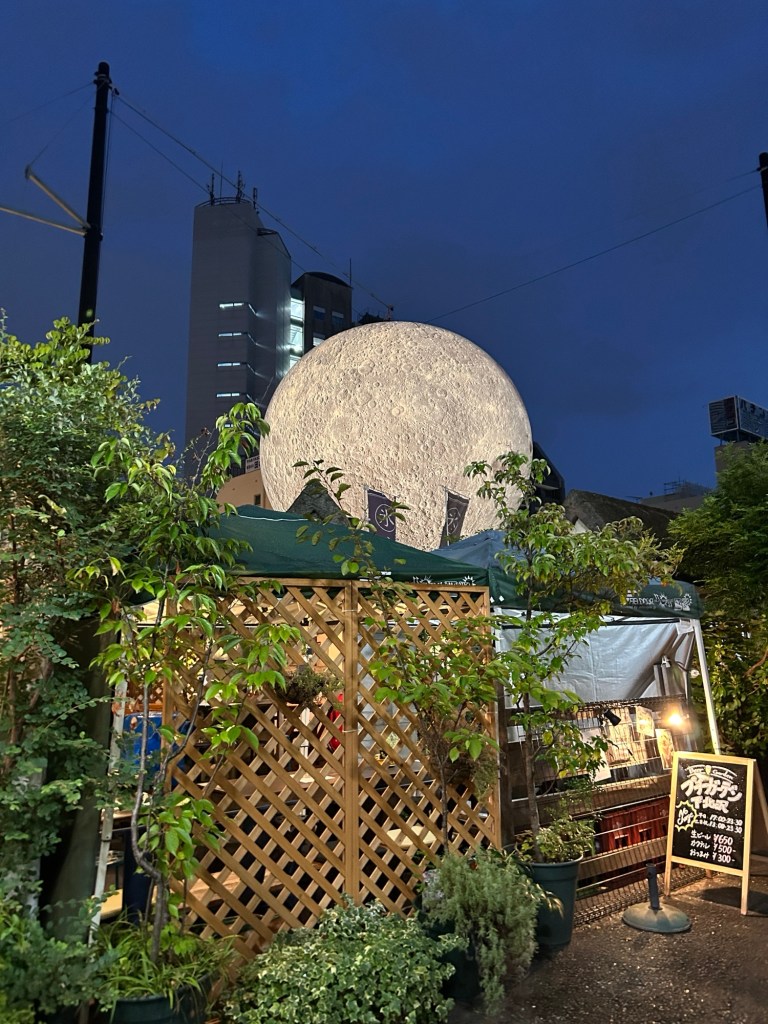
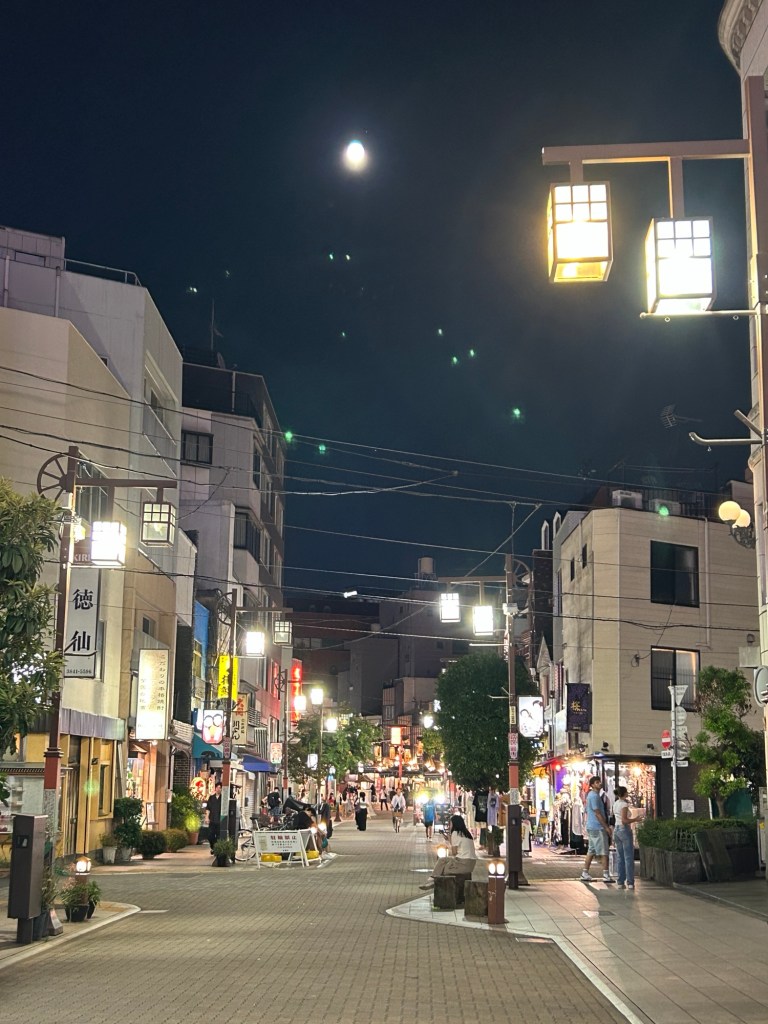
Down the street we went, and around the corner we went and found – the moon!

Hovering over an empty lot, turning gently in the wind. Peeking behind other buildings:

A delightful surprise!

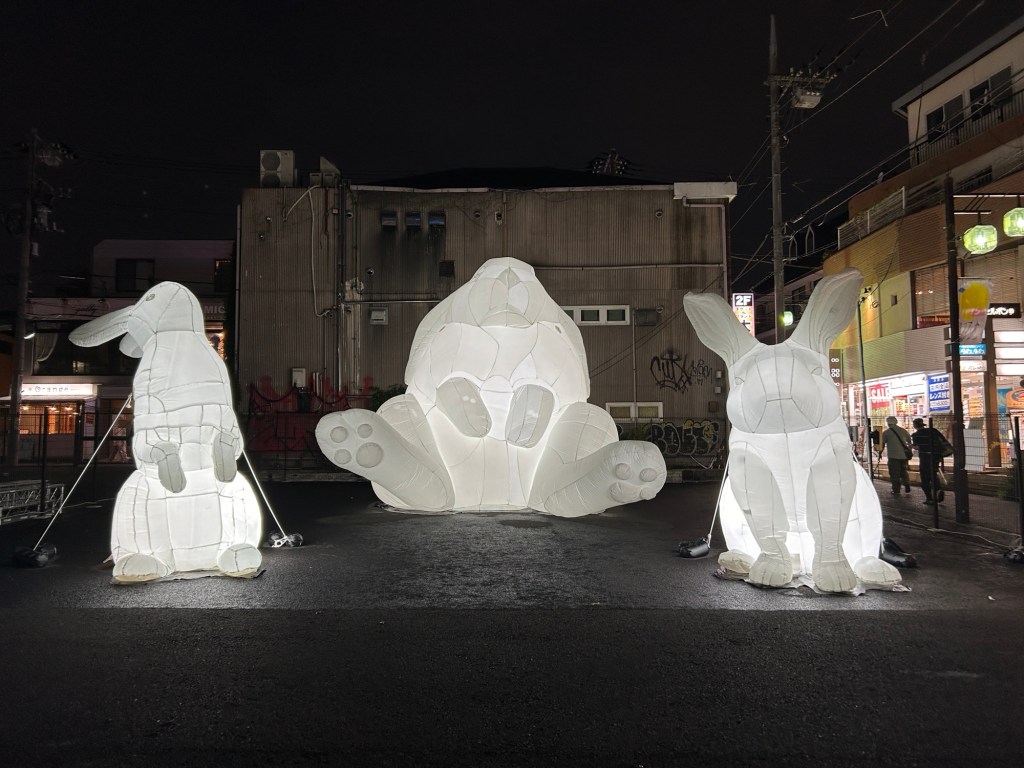
Up another series of streets we found

A gathering of rabbits, shining in the night!

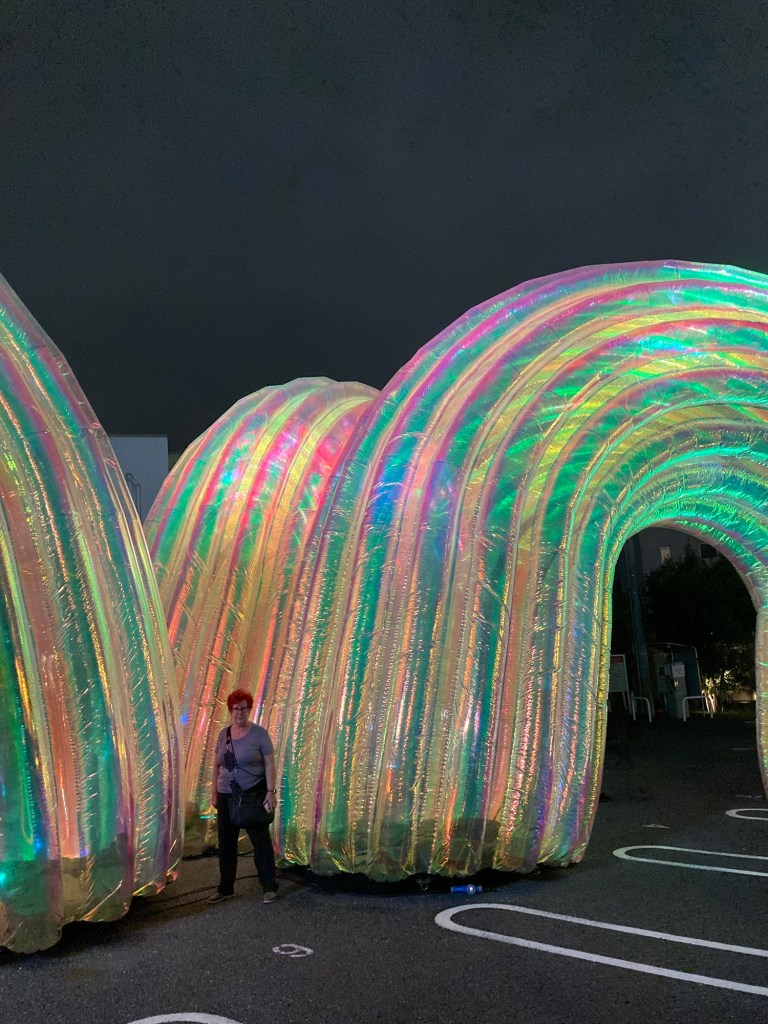
The third installation we a bit of a walk to the other side of the station, and it, too was about light.

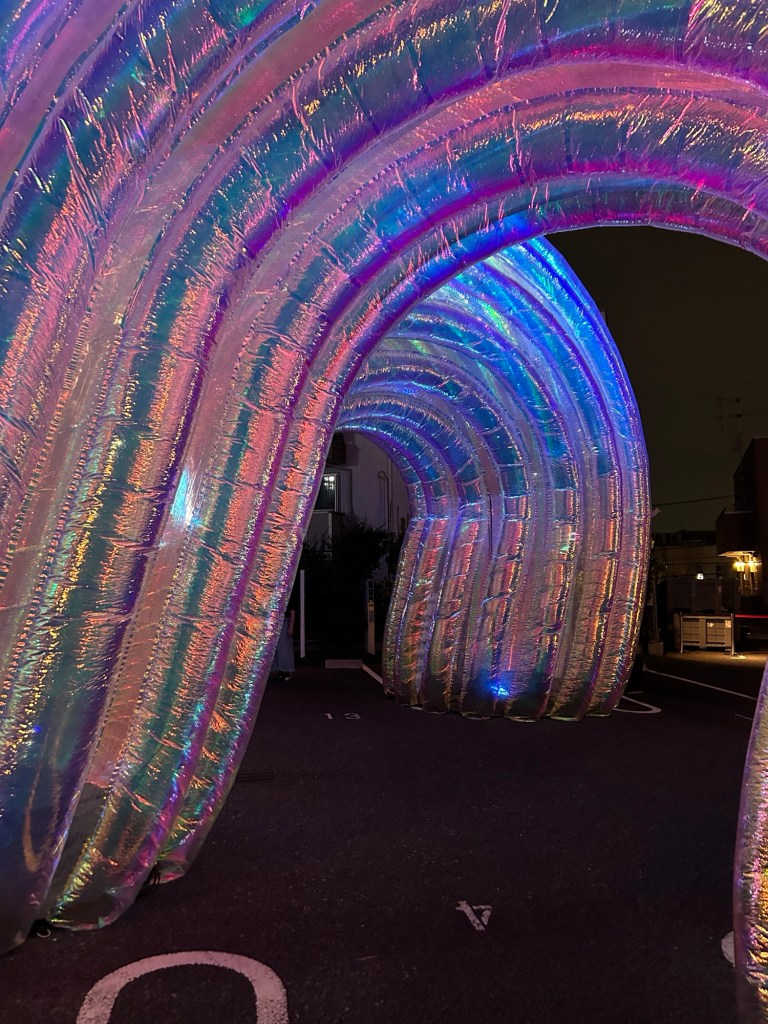
In other life this space is a parking lot. But for awhile these giant inflatable arches are perched instead of cars. The lights change colour and shimmer in the dark. They’re kind of neat up close but part of the fun is seeing them from a distance – an incongruous shimmer of colour that gradually resolves into a series of arches to explore.

Tomorrow we hit the road for further adventures – maybe we’ll find some cooler temps?

When the moon hits your eye….

And here we are, once again, in Tokyo. 30C at 7:00pm!

This is the time of the moon viewing festival, also known as the mid-Autumn festival. In the west we refer to the man in the moon, but in Japan they see a rabbit. We will be exploring moon cakes and other seasonal treats while we are here (rumour has it McDonalds has a special tsukimi menu!)

But tonight as we arrived, there was the moon shining down on our street!

Tsukimi in Asakusa

Short but sweet and on our way

Our time in Tokyo went quickly and soon it was time to think about packing our bags. We had days where it was 15C, and then the night before we left it began to snow. And it kept snowing. It was a festival of slush in the morning as we made our way to the subway. Probably better that it was slush rather than snow – it would have made for a bumpy time pushing, pulling and dragging the suitcases. One of the many subway lines a short distance from our hotel goes in one direction to Narita airport, and in the other to Haneda, which was our destination.

Before I switch to Singapore adventures I thought I’d finish up with some pictures of the things we ate in Tokyo.

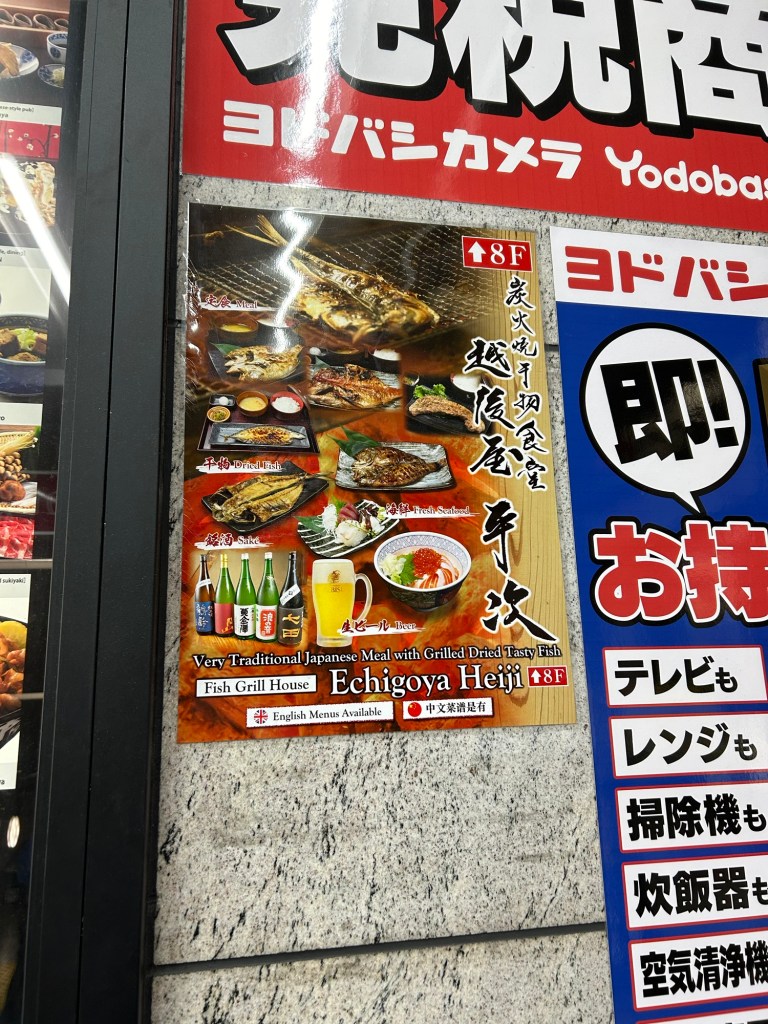
In Akihabara (electronics town) we saw a sign for a restaurant in Yodobashi, one of the big electronics stores.

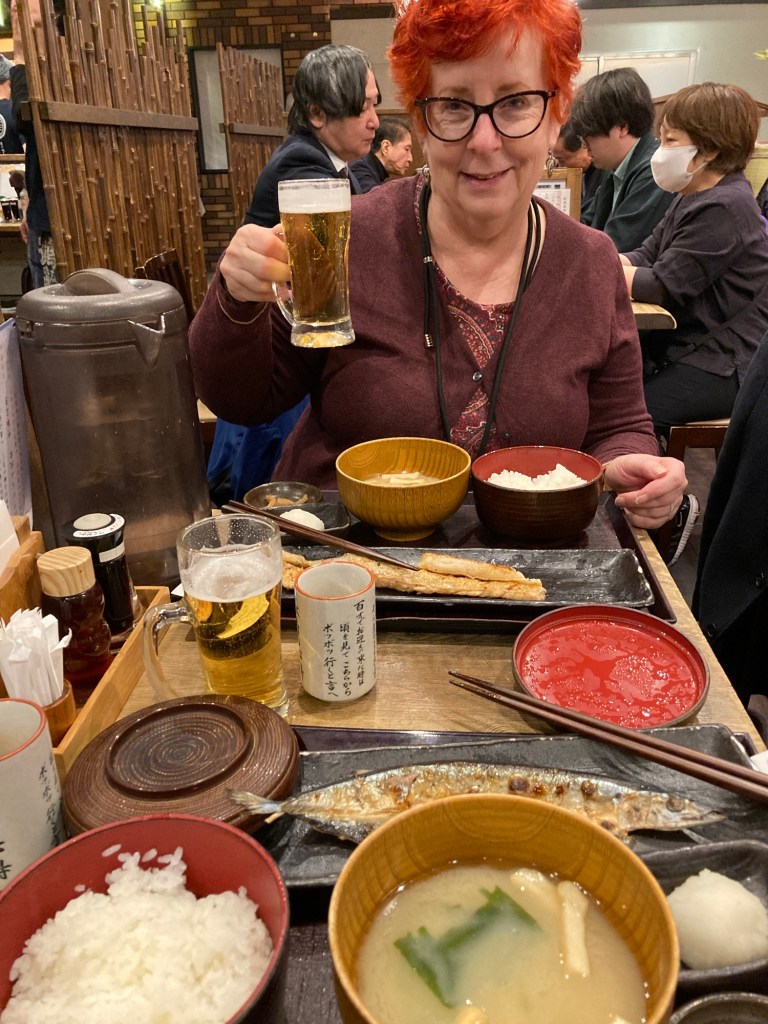
And sure enough, up on the 8th floor was a collection of restaurants. Grilled fish! Lunchtime set.
Grilled saury for Wilf, salmon for me.

Some time back the fish market at Tsukiji was moved to a new location at Toyosu. Its part of a big development and while we were there a new area opened up. It is a building that looks like an older historical building that is full of shops and restaurants, with a fancy new spa/hotel at one end. We thought we’d go check it out. That turned out to not be a great idea. It was a zoo of epic proportions. It was jammed with people and media and we swam like salmon up the main ‘street’ and back. Decided to go to the fish market proper and have lunch.

We went to a restaurant called Yamahara and it was terrific. The special was a seafood bowl. When it arrived it was like a basin with a translucent cover. When everything was just so the server whipped off the cover and trails of smoke rose from the bowl. Smelt good…. but didn’t make the fish taste smokey.

This was chirashi sushi, where the fish and seafood is cut up into pieces and served over rice. It was delicious and fresh. It was also quite a workout with the chopsticks, picking up all those little bits and pieces.

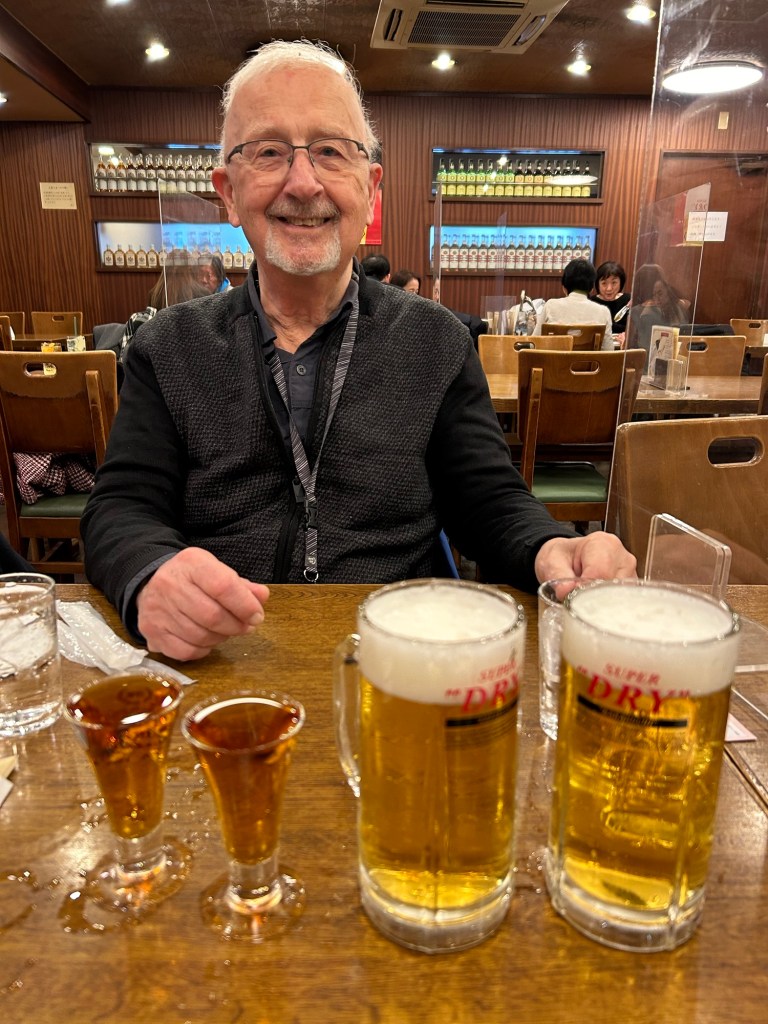
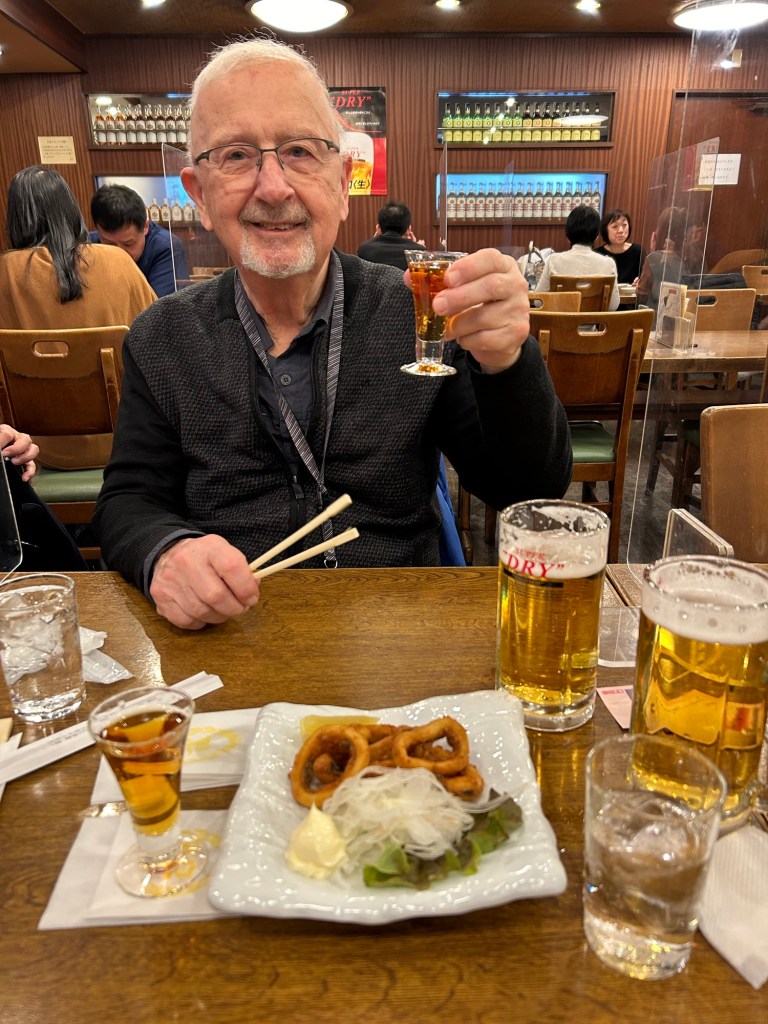
The day we went to Azabudai and Roppongi we went on a bit of a tear. Feeling cheerful after our lunchtime beer we hunted down a bar near our hotel. Bar Kamiya as been in that location since 1880. It is an old school beer hall – noisy, cheerful, old fashioned. They have a signature brandy based drink, so we had to try that.

With beer chasers, of course. (as you can see they do a big pour. The Denki-bran was to the brim and then some….)

And fried octopus.

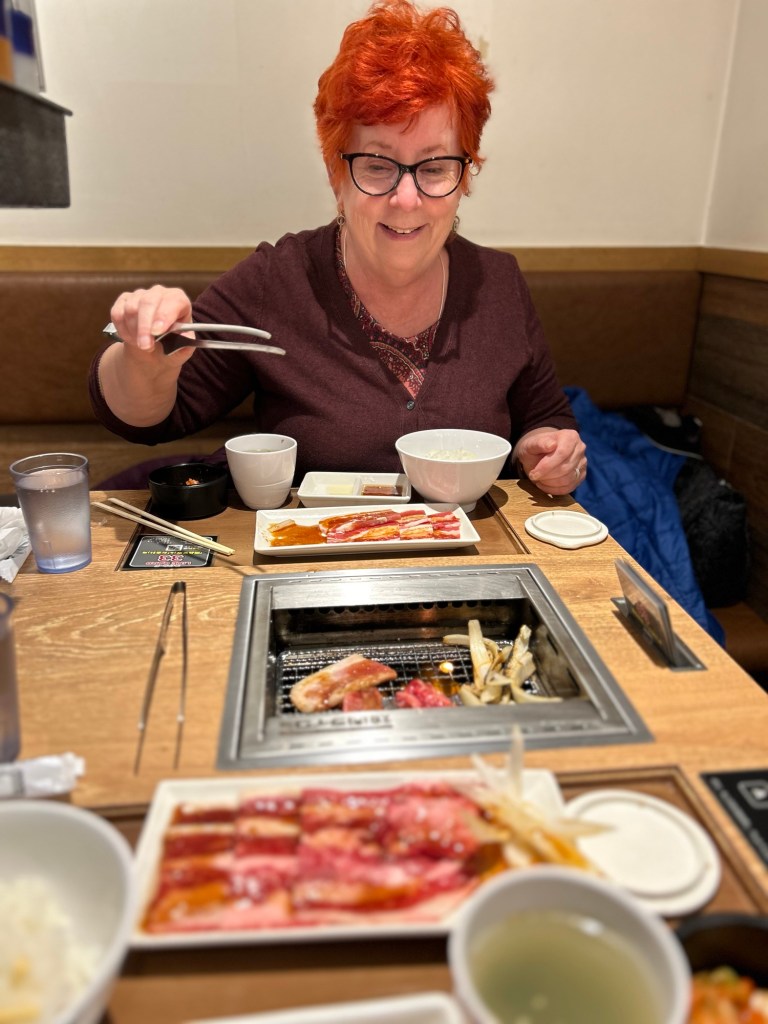
After that a quick snack at the Korean BBQ place seemed in order.

We slept well that night!

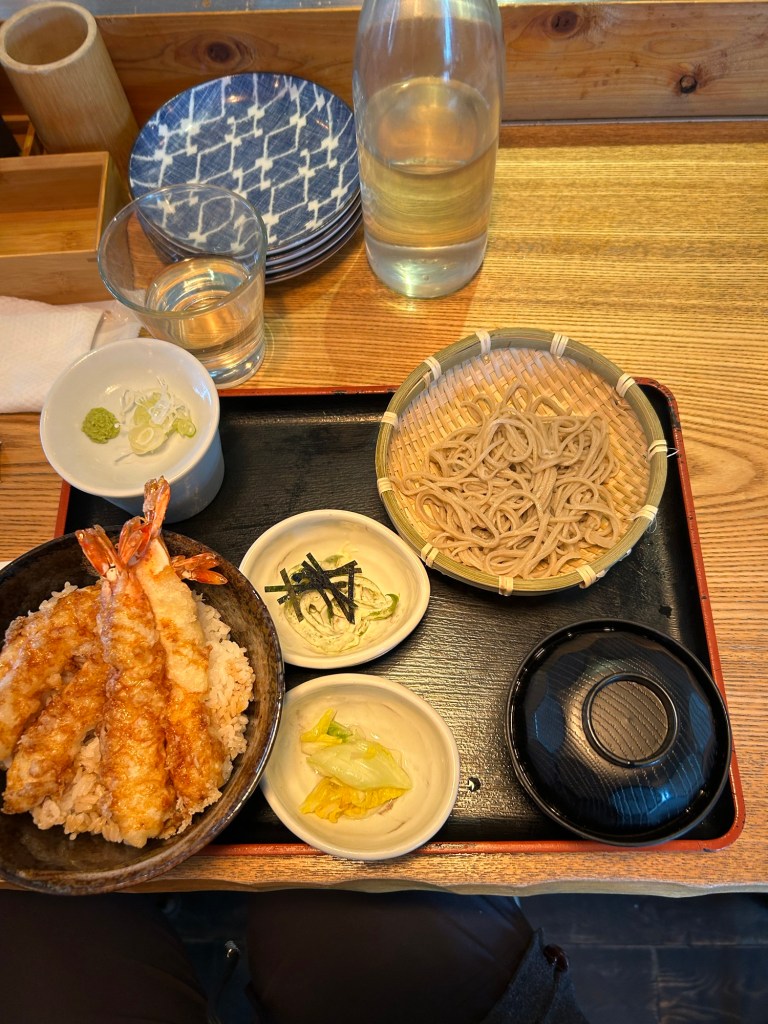
Another place near us was a restaurant called Gonpachi. Nothing too look at from the street, but upstairs was a lovely room looking over the Sumida river. The lunch set was delicious – grilled fish for Wilf, tempura for me.

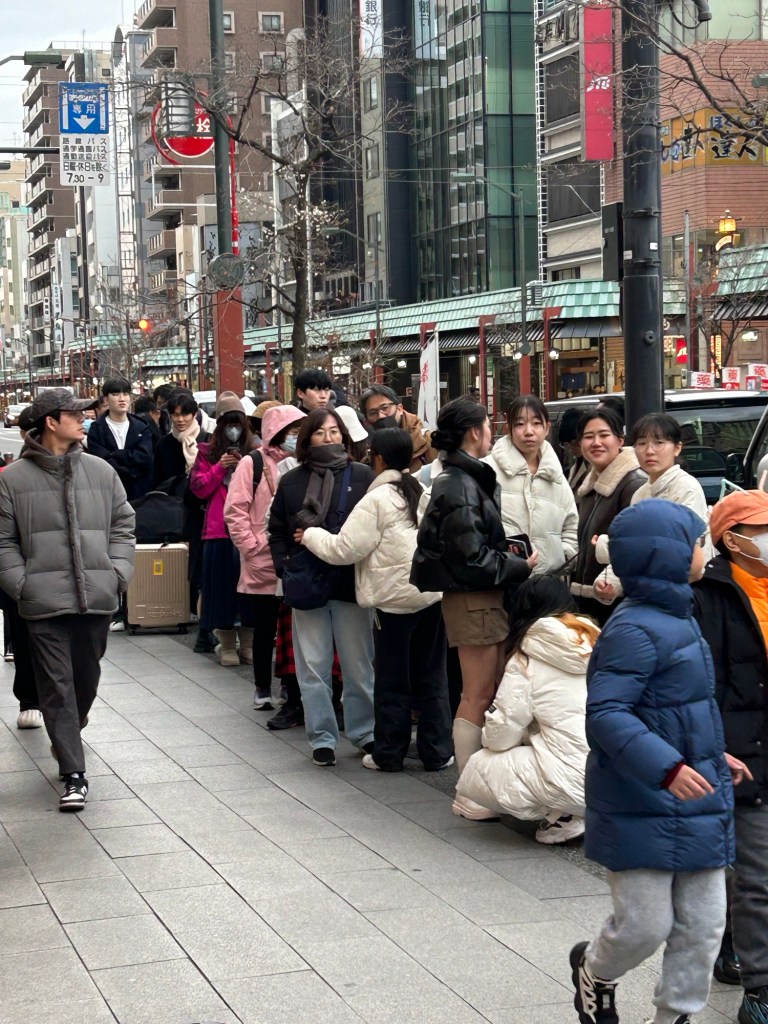
One thing that always mystifies us while in Japan is how one restaurant will be The Place to Go and people will line up for huge amounts of time to go in. Almost right beside our hotel was such a place. Usually katsu is a fried pork cutlet, but this place does beef cutlets. Starting everyday at 11:00 there would be line up, lasting until about 10:00 at night. Even the night it snowed they were standing out there under umbrellas, shivering. Here is a typical line going down the sidewalk. I don’t think I’d enjoy my meal knowing that there was a tidal wave of people waiting to get in. Always. All the time. People waiting….
So – farewell Tokyo and the winter. On to Singapore and the heat!

Is Japanese fruit really expensive?

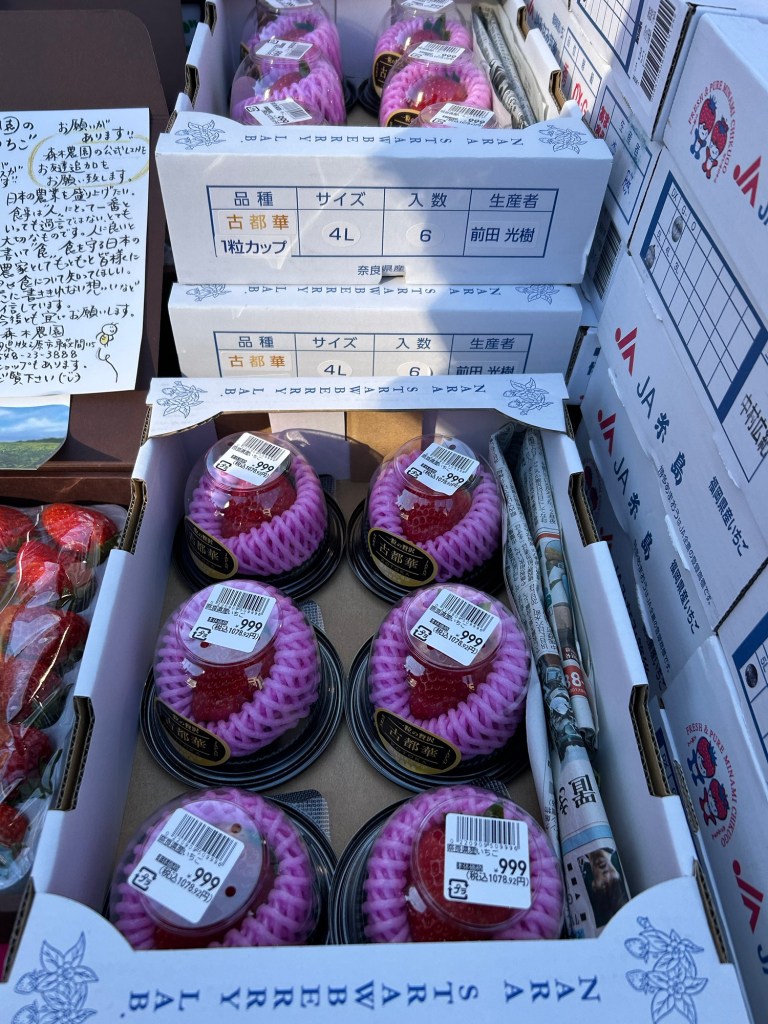
Sometimes it is. It is full on strawberry season here. Unlike Canada, where strawberry season is May and June in Japan it is a winter fruit. Christmas often involves a strawberry shortcake (insert joke of your choice about the merits of strawberry shortcake vs our traditional Christmas cake!!!)

Our hotel has a small supermarket right next store. The strawberries keep arriving.

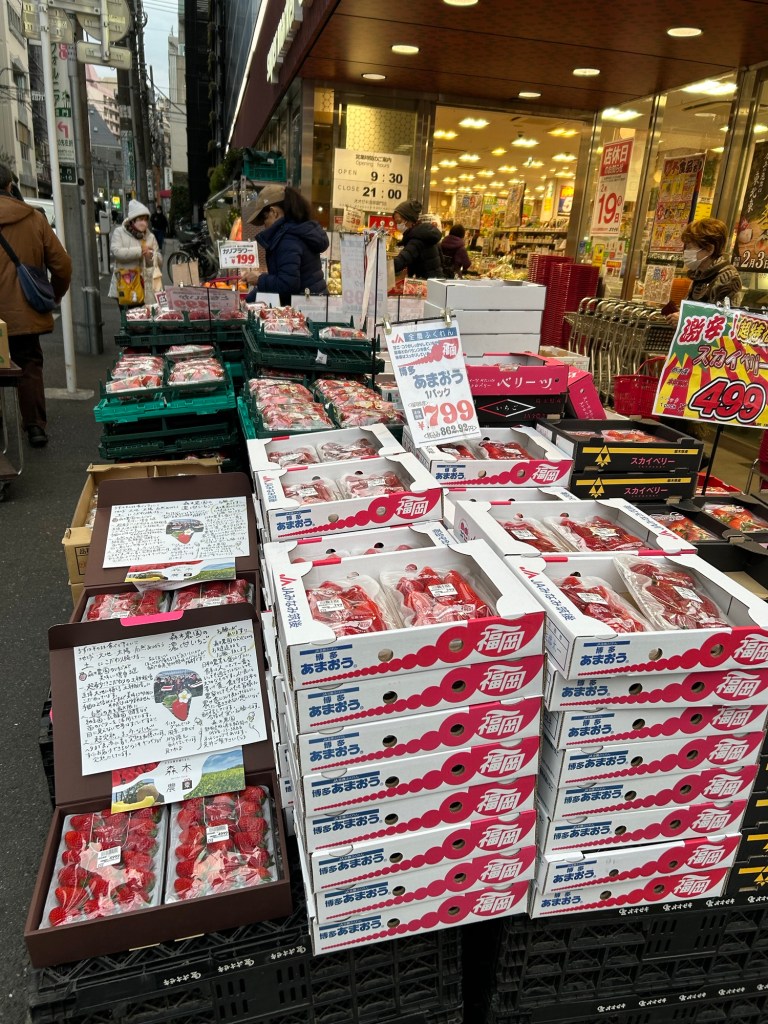
Baskets of berries for about $8

Obviously these are grown in greenhouses. And just like our local Thrifty’s this store likes to show the provenance of the berries.

However…

The good stuff. $10 per strawberry

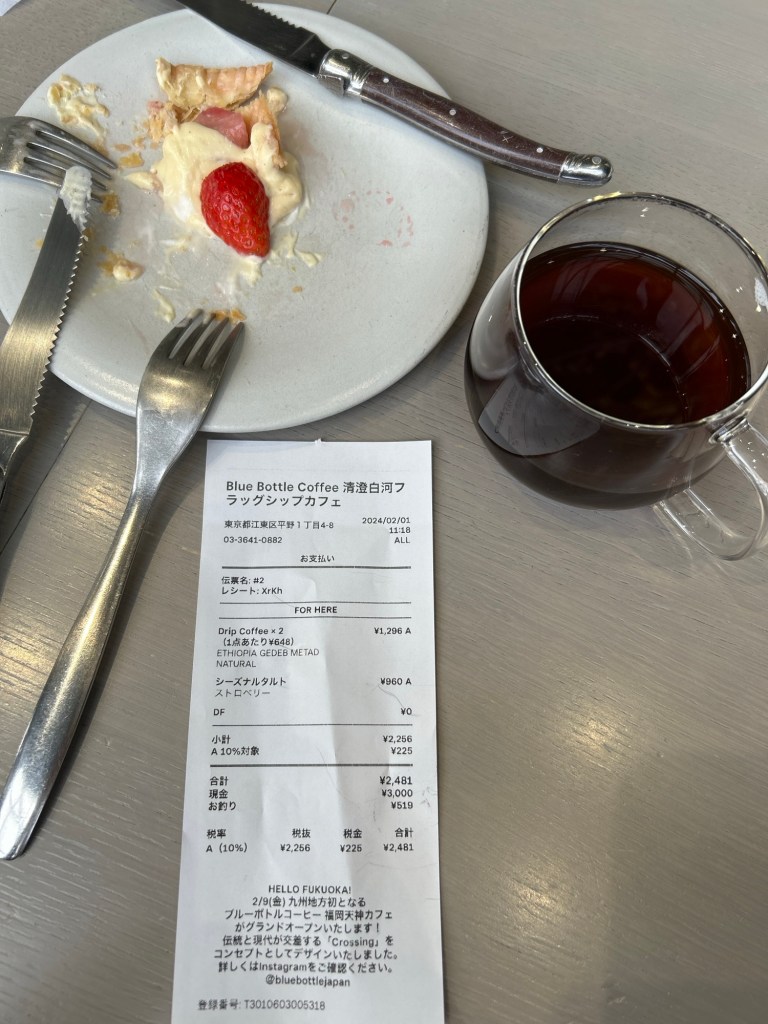
We debated whether we should buy one to see what the excitement was about. Instead we bought a ten dollar strawberry tart at a coffee shop and it was spectacular.

Not all fruit is presentation fruit like these. We’ve been buying tangerines at the same market – a bag of mid size fruit $5 for 6 or 7 fruits. Yesterday we bought three huge tangerines for $2. So good!

A question of scale

Way back when, in 2009, when we first visited Japan we visited an area called Roppongi. It was in the midst of a big redevelopment and new buildings were going up in a large planned community. Everything was very new and barely completed. We could see that there would eventually be shopping areas full of luxury stores. But it all felt quite unfinished. We were back in 2018 to visit the Mori art museum at the top of one of the towers. Things were filled in by then, but it still had a sense of echoing vastness. The scale felt wrong.

On this trip we headed off to see Azabudai Hills, the newest development by the same development company – Mori. It officially opened last November, but whole areas are still active construction sites and once gain the whole luxury shopping area mostly consists of what look like large shops with the windows covered in signs saying ‘Coming March 2024 – Bulgari. Or Chanel. Or Dior’.

When you come along the street from the subway station you are faced with this building:

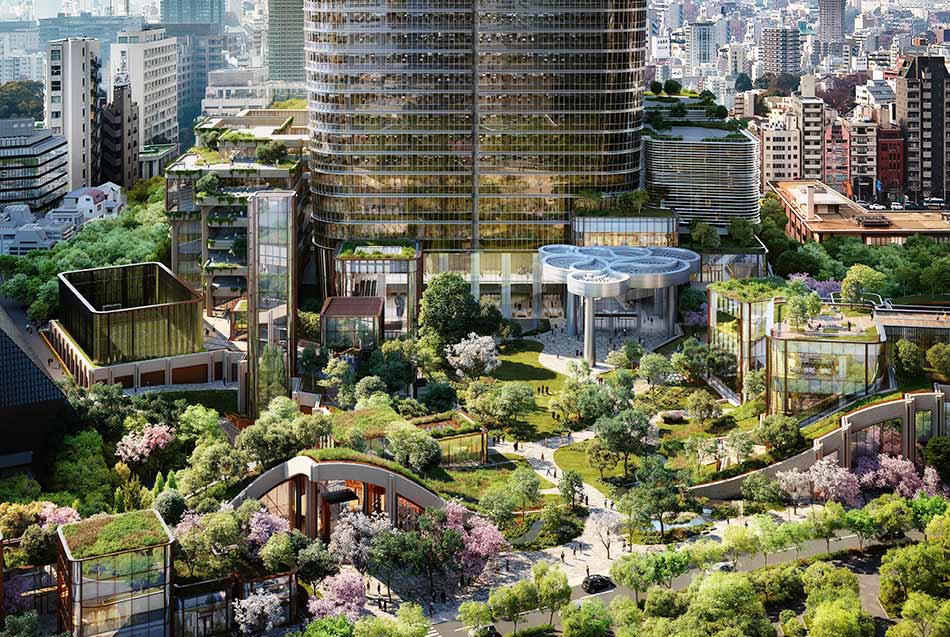
Stock photo, artists conception.

Now, this is to be a whole new vision of a work/live community. As we walked up the road that goes up to the right we thought the whole design seemed strangely dated for something that was brand new. The curved portions of the buildings are not white, they are a tan coloured concrete. We could make no sense of what the forms were supposed to be and the materials and shapes chosen looked like they had been beamed in from 1984.

Another stock photo, artist’s conception.

It does not look like this at all – the trees have been planted but will be sticks for many years. Nothing is green as it is winter. But again with all these curved forms that do what? Go where? And then the central building, which is the highest in Tokyo at present and contains both commercial and residential areas, which looks so… ordinary….

We wanted to go to the 33rd floor where there was an observation area. This is not advertised but we figured how to get there. 

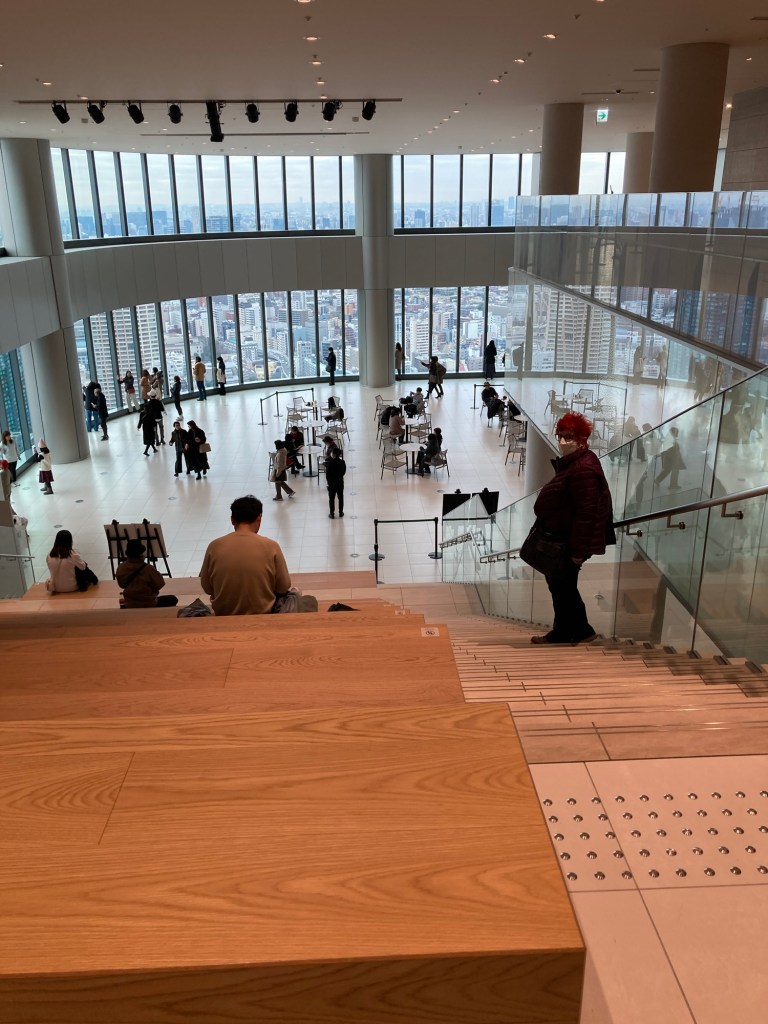
And the view is amazing. Here is what you see when you stand looking down onto the 33rd floor which is the actual observation area:

I am standing on a huge staircase that leads to the lower level. The centre portion of the stairs are wide and are intended to be a seating area. Below me there are a few tables and chairs for people to sit at, but not for too long! The info on the website extolls their plans for new ways of working, of collaborative spaces where creative things will happen as people meet and interact. Sitting on the big staircase. As we were exploring this area on the other side of a small barrier was a group of about thirty people. Business people in business attire, getting a tour. I don’t know that much about Japanese business culture, but it doesn’t seem to me like the kind of companies that can afford the rent in a building like this are going to have their employees hanging out in public spaces, sitting on a fancy staircase to do their work. And the kind of companies that do the kind of collaborative work that would suit spaces like this won’t be affording this neighbourhood. Everything seemed too vast, cool and echoing. They did not feel like human sized spaces to me.

Leaving this new space we walked down the street towards the Roppongi subway station. This is a typical busy street, lots of restaurants, lots of office buildings, lots of people walking around, going places, doing things.

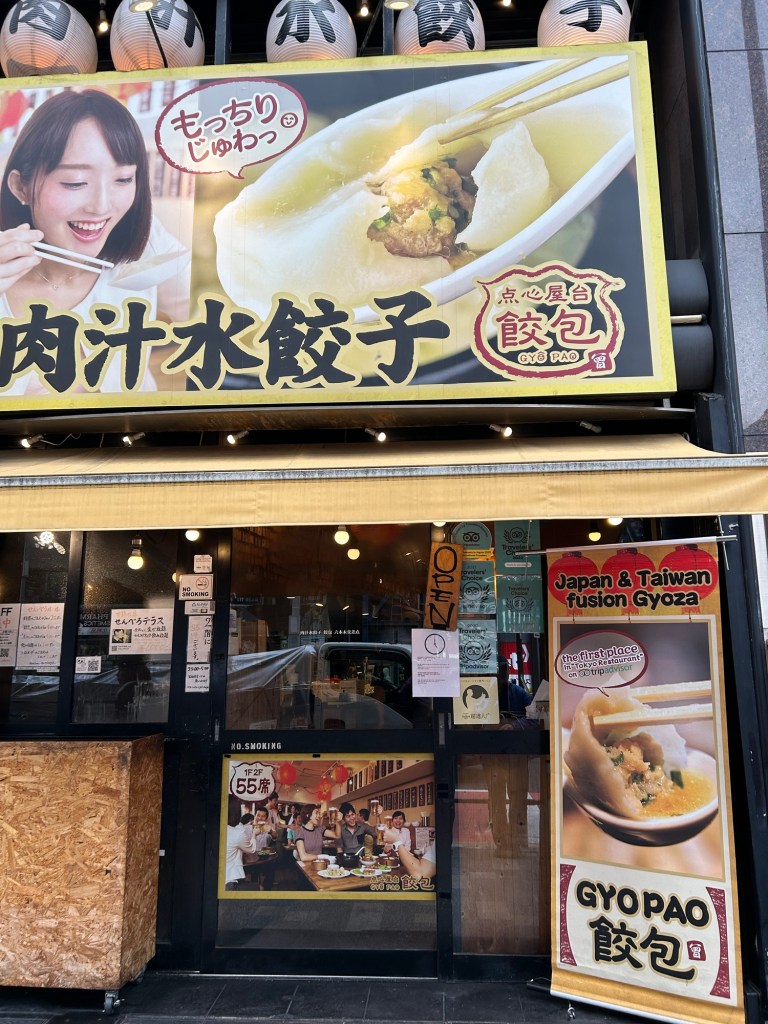
We were headed for lunch and here is where we wound up:

And it was a literal hole in the wall!

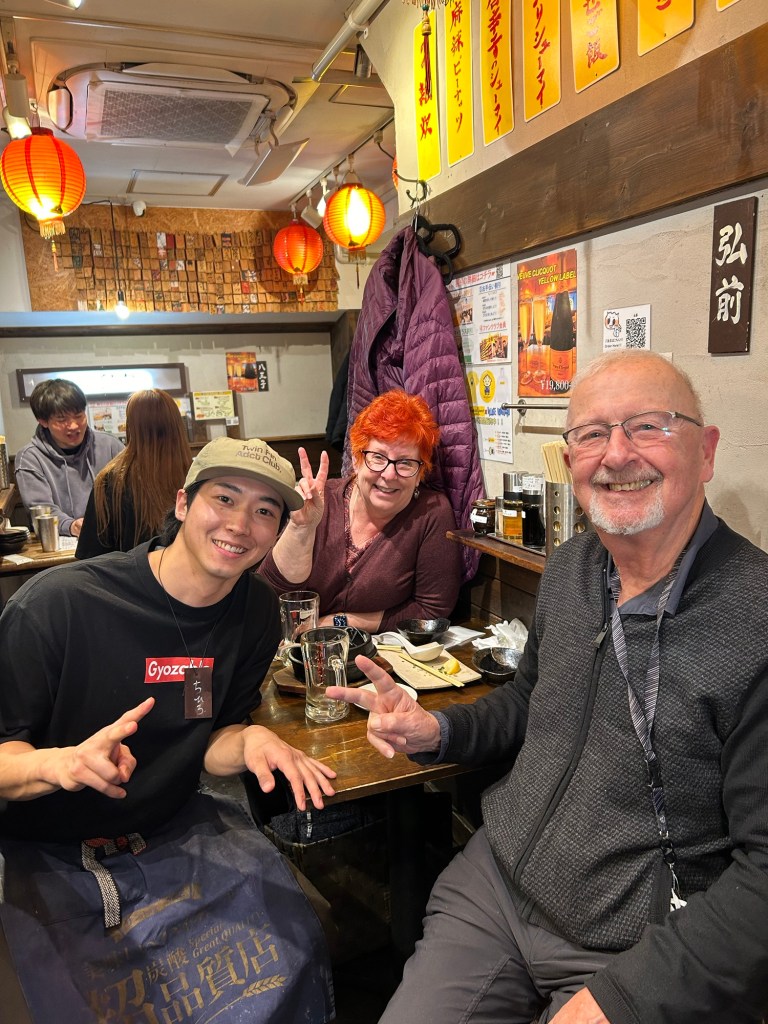
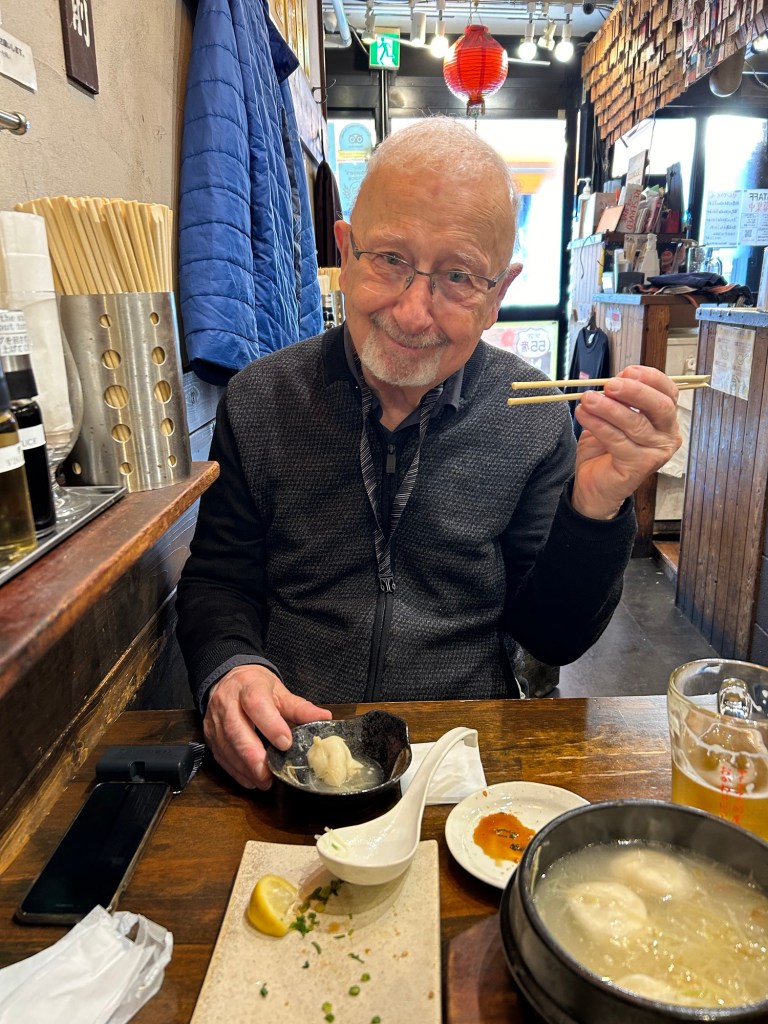
Our charming server Chihiro spoke excellent English and made recommendations to us – chicken soup with dumplings. Four giant dumplings in soup in a cast iron bowl that was heated to the temperature of the sun! We had to have special instructions so that we didn’t hurt ourselves eating it. And a plate of bite sized deep fried gyozas. And beer! This felt like human scale – a room where you could see what was happening, see a place that had been pounding out the dumplings for years, enjoy the history.

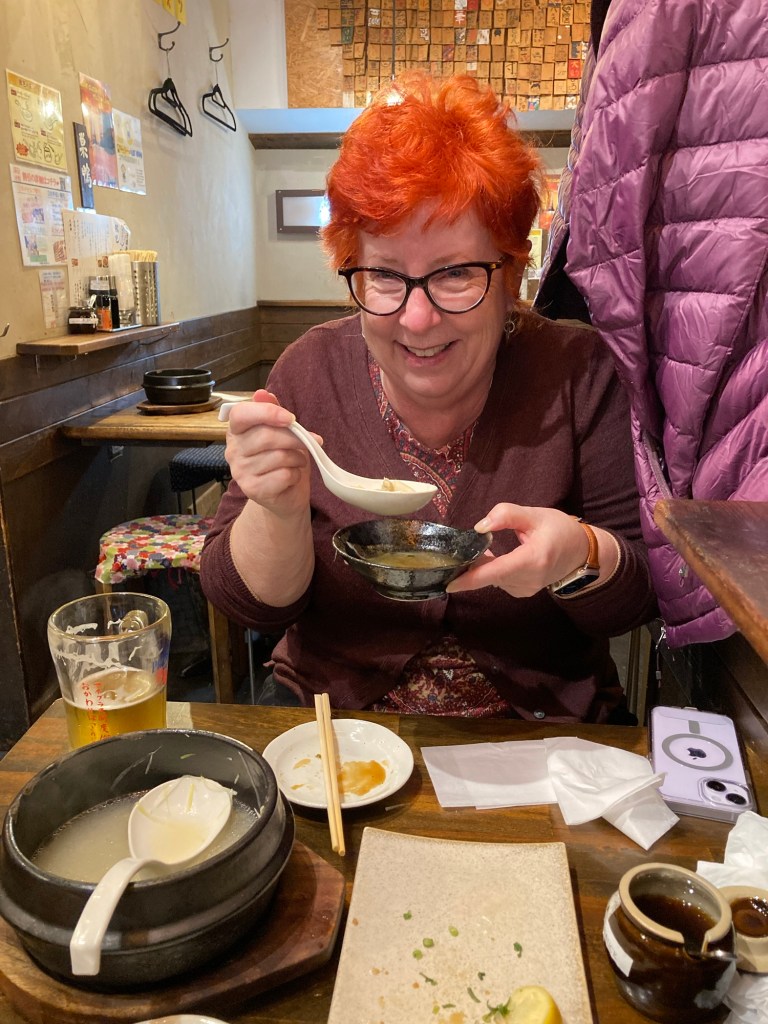
And clearly we enjoyed ourselves!!!

One dumpling down, three to go!
Dumplings done, now to finish the soup!

I found myself thinking of visits to Dubai, and to Putrajaya in Malaysia. Both places built on a grand scale, built to impress. And both feel soulless. And the reason is the scale is wrong. Tokyo seethes with life – the streets are busy, people are living their lives in full view. And maybe these new, planned communities will eventually have the ‘new’ sanded off of them and they will be places that fulfill the dreams of the developers, where people live and work and play. But right now – it doesn’t feel that way…

A change in the seasons

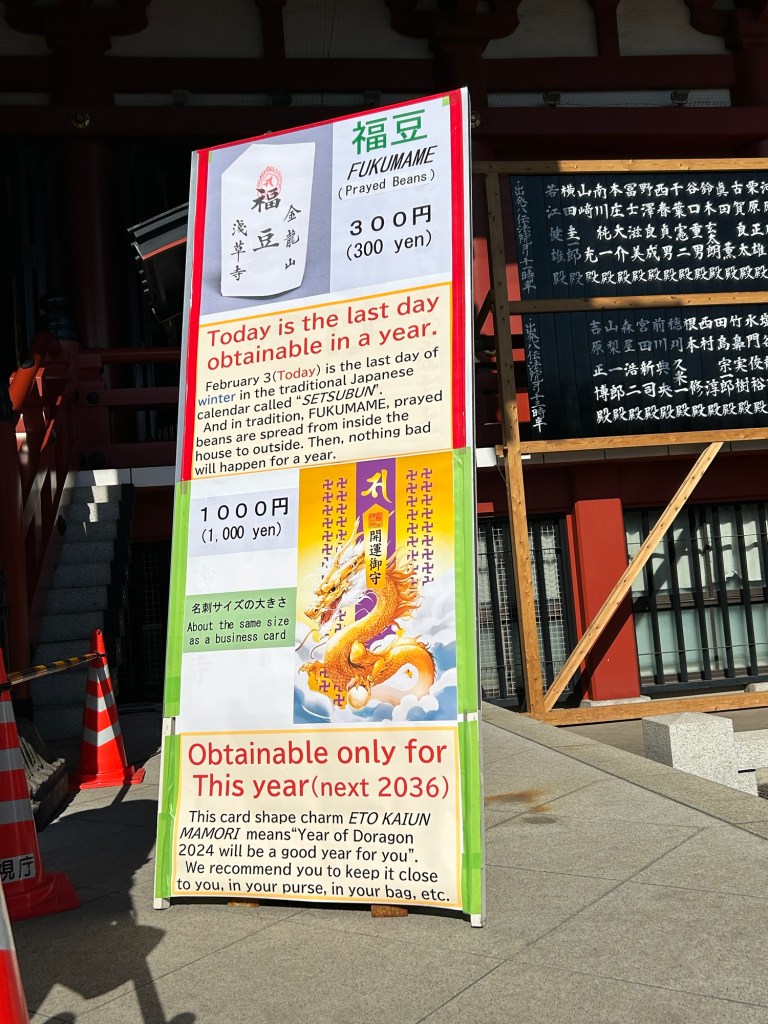
The lunar new year approaches, and in Japan we have officially moved from winter to spring (never mind the snow flakes we saw this morning). To celebrate the change in seasons there is the celebration of Setsubun, which is held on the last day of winter, according to an ancient calendar. This year Setsubun was on February 3.

To welcome in a new year/new season there are ceremonies to drive out demons and usher in good fortune. At home the oldest adult male wears a demon mask and the other members of the household throw dried beans at him and call out 鬼は外! 福は内!, Oni wa soto! Fuku wa uchi! Demons out! Good luck in!

There is also a particular type of sushi eaten on this day. And apparently for super good luck you should eat beans – one for each year of your life, plus one.

Senso-ji temple in Asakusa hosts a Setsubun celebration. They do make a point of saying that since the Goddess of Compassion, Kannon, is resident there are no demons to be chased out. In her presence they call out “Long Life! Welcome good fortune!”

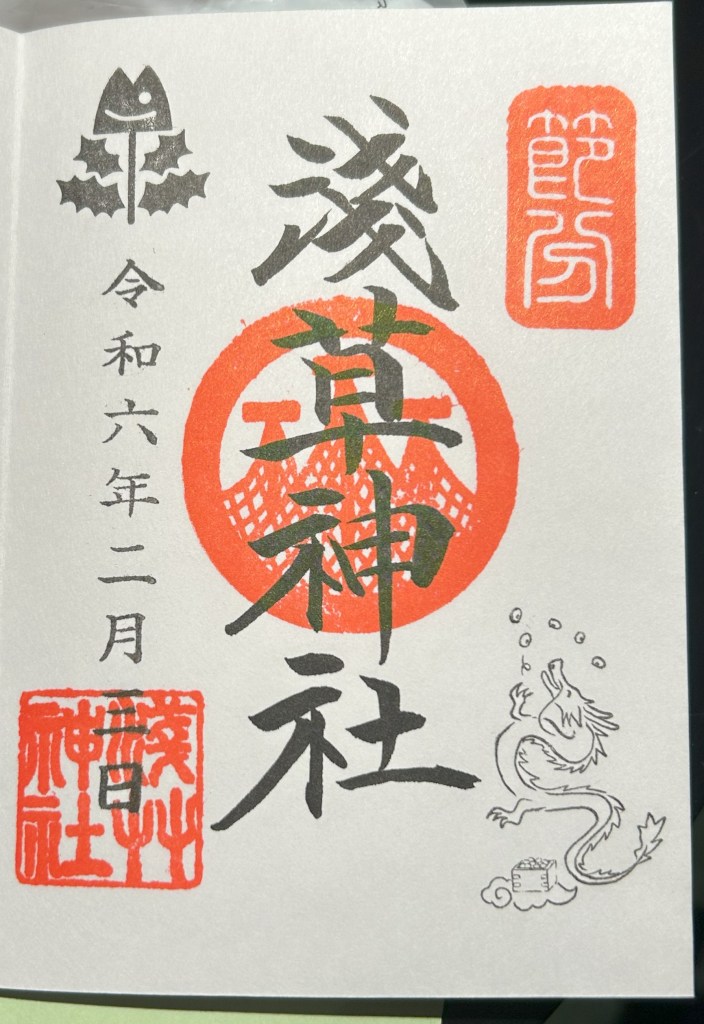
We, of course, had to investigate. I wanted to visit the Shinto shrine next to the temple to collect another stamp for my book of shrine and temple stamps. I figured that there would be a special stamp for the day – and I was right! I will have to make a separate post all about these stamps, but here is my new one:

The red circle in the centre is the symbol of the shrine and it represents the three spirits embodied in there. And in the lower right is a dragon/demon being pelted with beans.

As we left the shrine grounds we came out right where the bean throwing ceremony would happen. Everyone was being very patient and quiet, standing below the temporary balcony. It was a lovely sunny day, which helped. There were a surprising number of police officers around, but everyone seemed cheerful and relaxed.

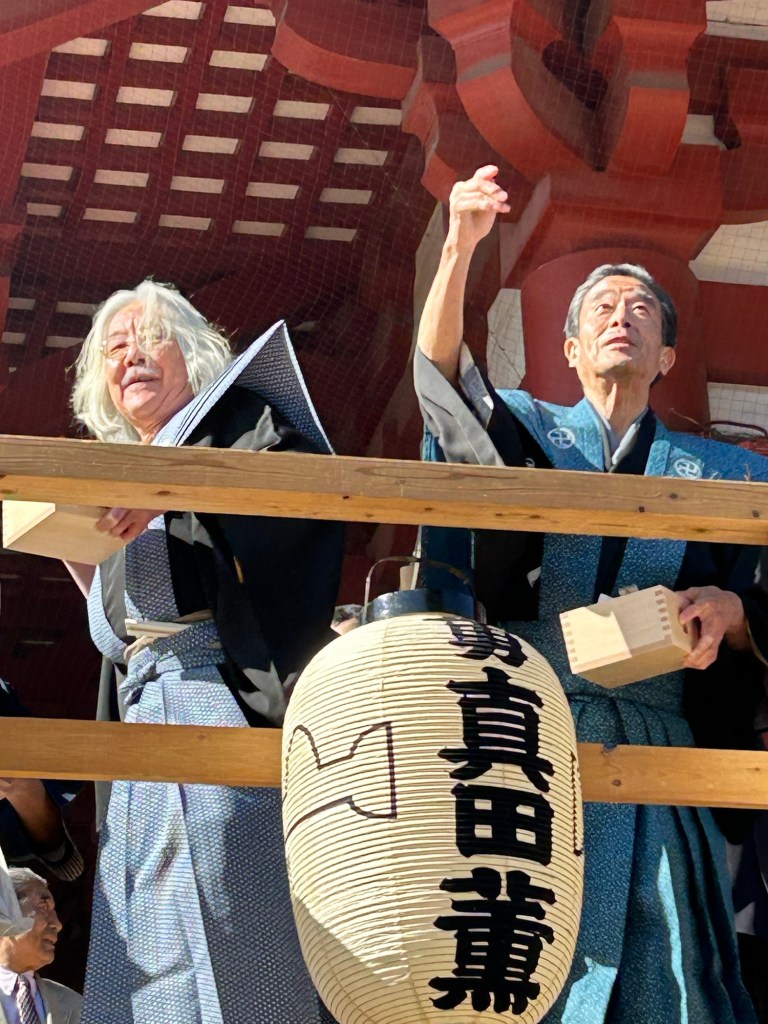
Eventually there was a procession up the street of men carrying lanterns. Turns out these were the junior members – they fastened the lanterns to the balcony edge and each were given a plastic shopping bag bulging with …. something. A few minutes later another group of men arrived in samurai style robes – the senior guys. They each held a small wooden box. Junior guys filled the boxes with little white envelopes and after a mercifully short bit of speechifying the senior guys began throwing the envelopes out to the crowd.

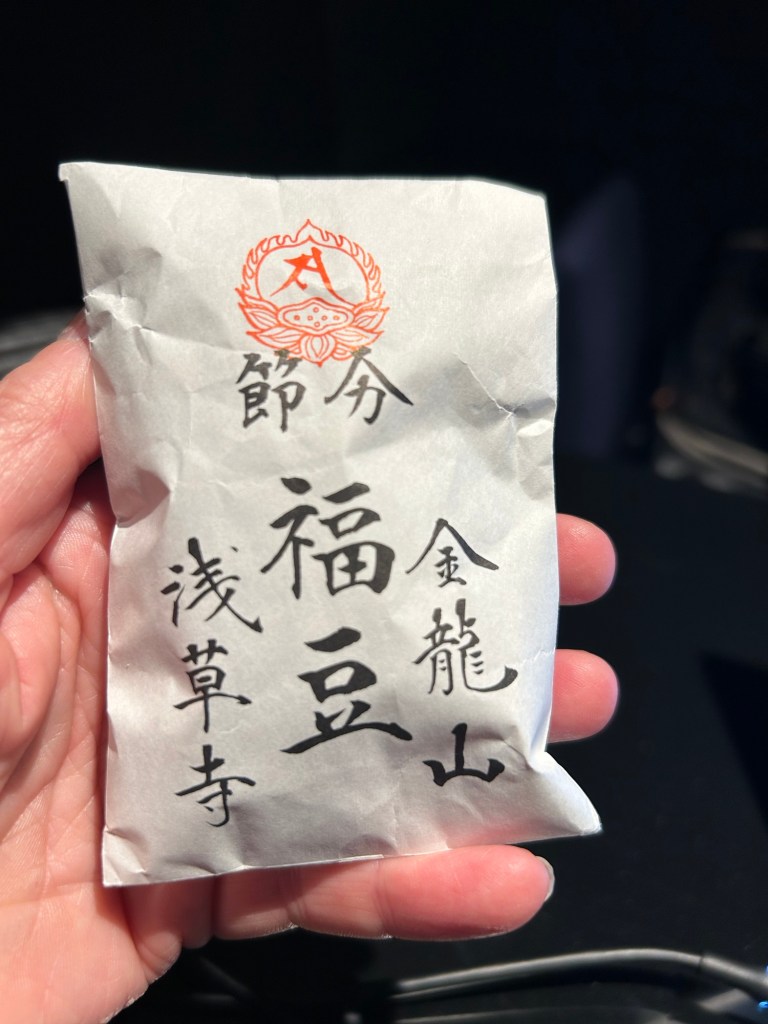
They turned out to be small bags of roasted soybeans. Most of them were acting like they were throwing to the outfield during the Japan series, but some took pity on those of us closer to the front. I’m not sure if we are supposed to eat these or just keep them for good luck. And if you didn’t catch a bag of beans, well just walk around the front of the temple and you can buy yourself a bag that have been prayed over to ensure a year of luck.

It turns out things were pretty nicely done at Senso-ji. I’ve seen pictures of other temples where the beans were thrown by the handful and people were holding up bags and squares of cloth to catch them. That seems like it could have led to chaotic scramble. Nice and neat, no pushing and shoving where we were.

When we were here in May one of the biggest festivals of the year was happening. This was a much more low key event, but the grounds were filled with food stalls, people were out with their families enjoying the day and the sunshine and once again we got to enjoy another event of deep meaning to the people who live here.

A poetic walk

I think most people are aware of haiku, a form of Japanese poetry. We are taught that it is a poem of seventeen syllables, arranged in three line of five, seven, five syllables and that it evokes images of the natural world. As with many things what seems simple is actually more complicated and one could spend a life time – and many do- mastering the art form. And that’s just in English! Now do it in Japanese!

My Japanese teacher has requested that we write haiku in Japanese.

先生、まだ詩を書いていないことをお詫びします. (This is not a poem it is an apology for not doing my homework....)

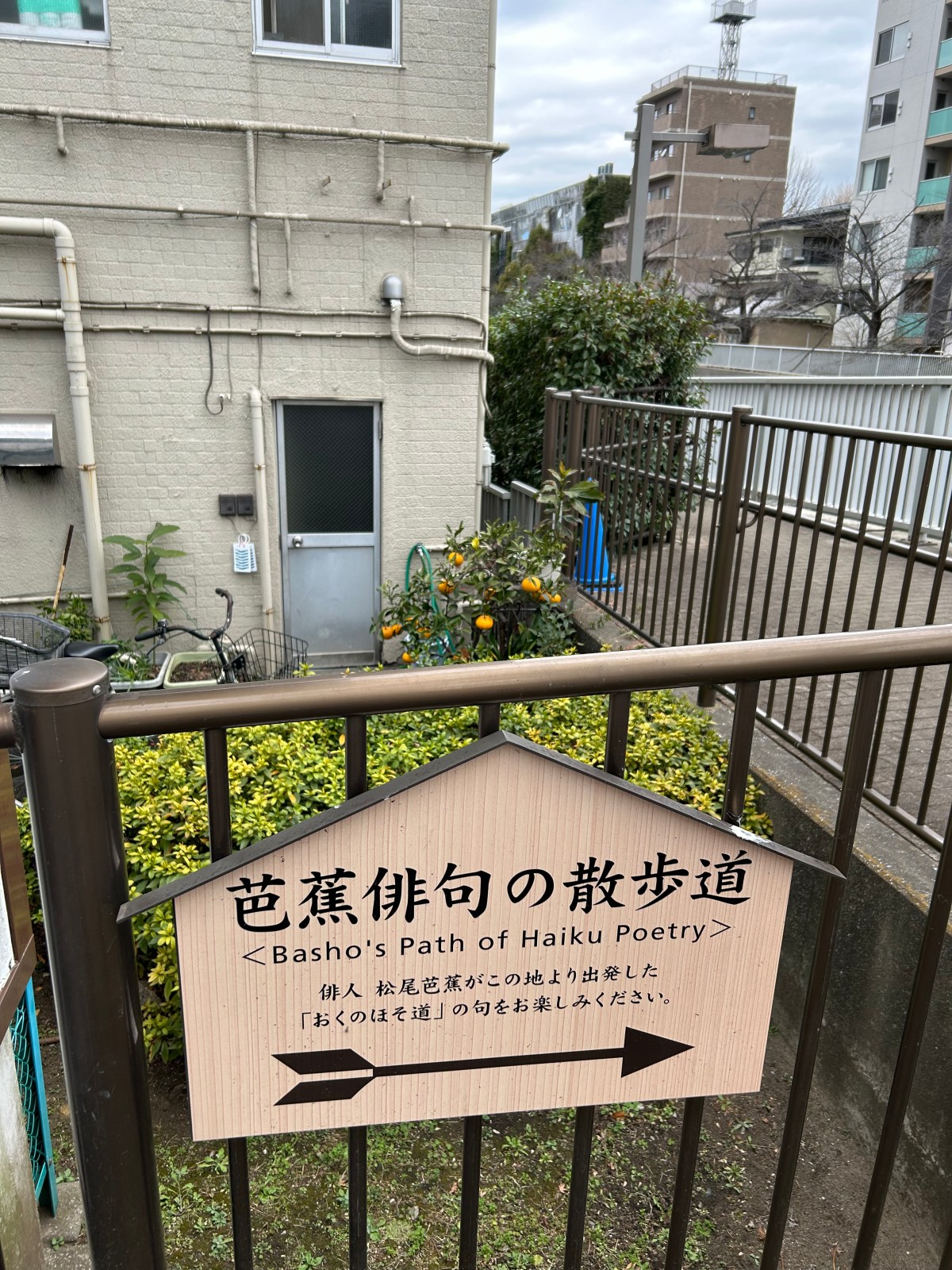
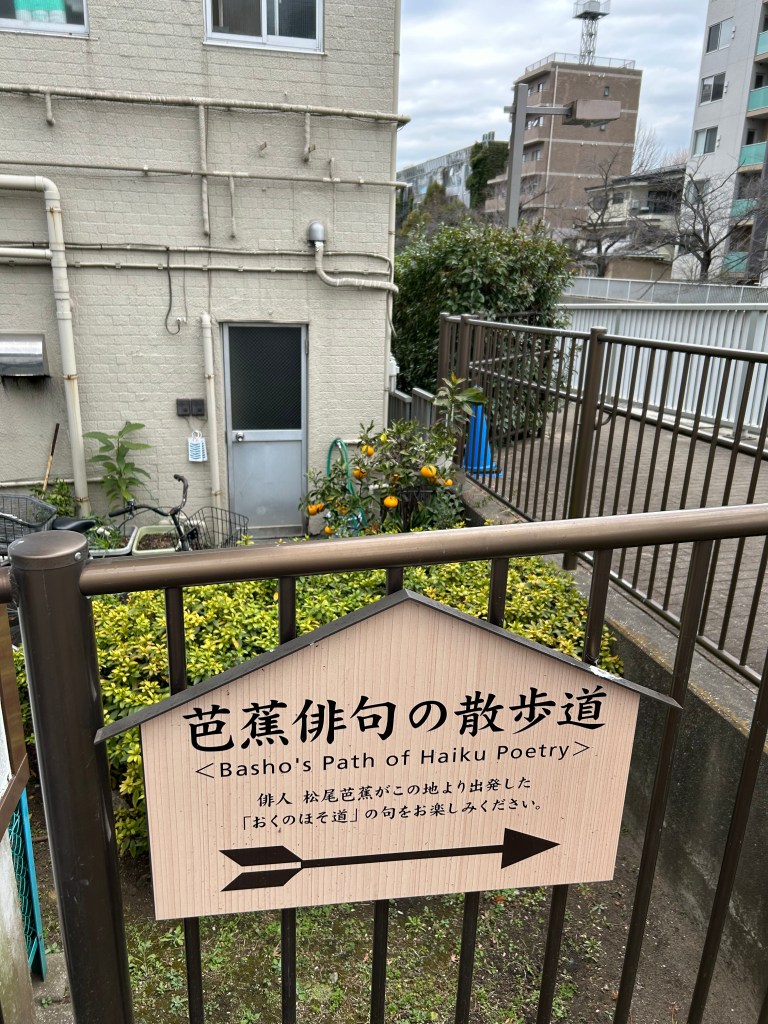
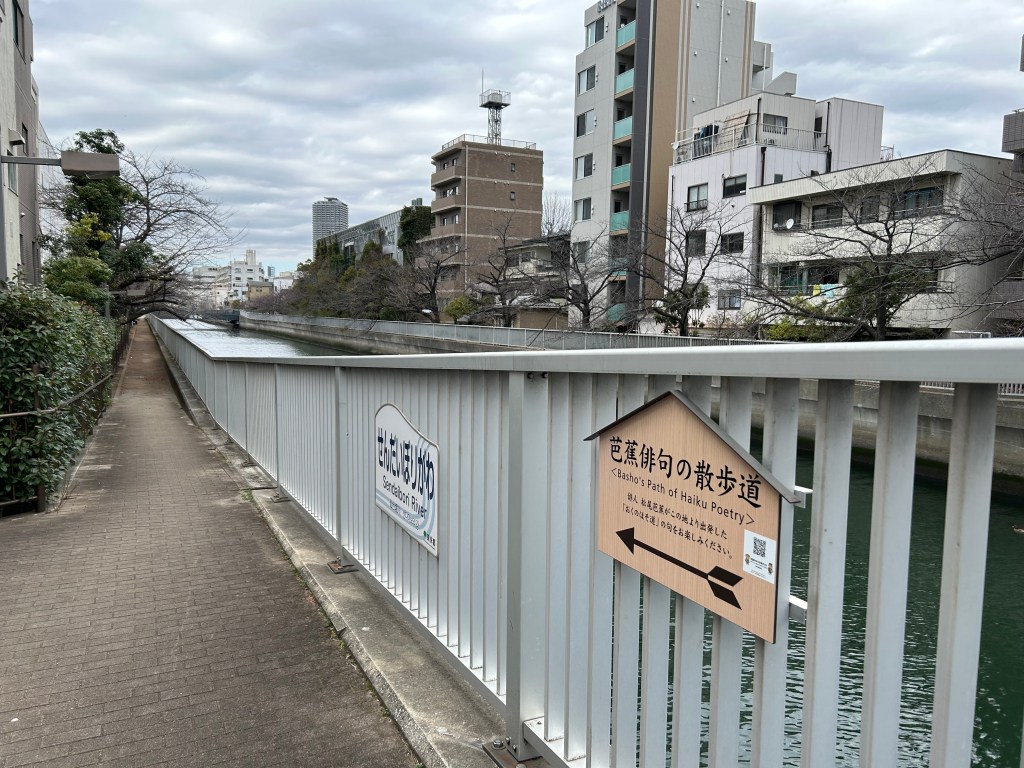
One of the masters of the form is the poet Basho, who lived in the mid 1600’s. He wrote, taught and walked to many parts of Japan. But he also lived on and off in what was then Edo, now Tokyo. And not, as it turns out, too far from where we are. There is a walking tour that follows sites related to the poet.

His followers built him a little hut on the banks of a canal and there is a reproduction near there at the beginning of the walk.

A quick chat with the master – perhaps he has some inspiration for me?

The canal is very quiet, just a few ducks paddling along. Mostly the buildings backing on the canal are small residential buildings, most relatively recent builds. It looks like this area is becoming more popular, but there are lots of buildings that look they were built in the 1930’s – kind of art deco/moderne in style.

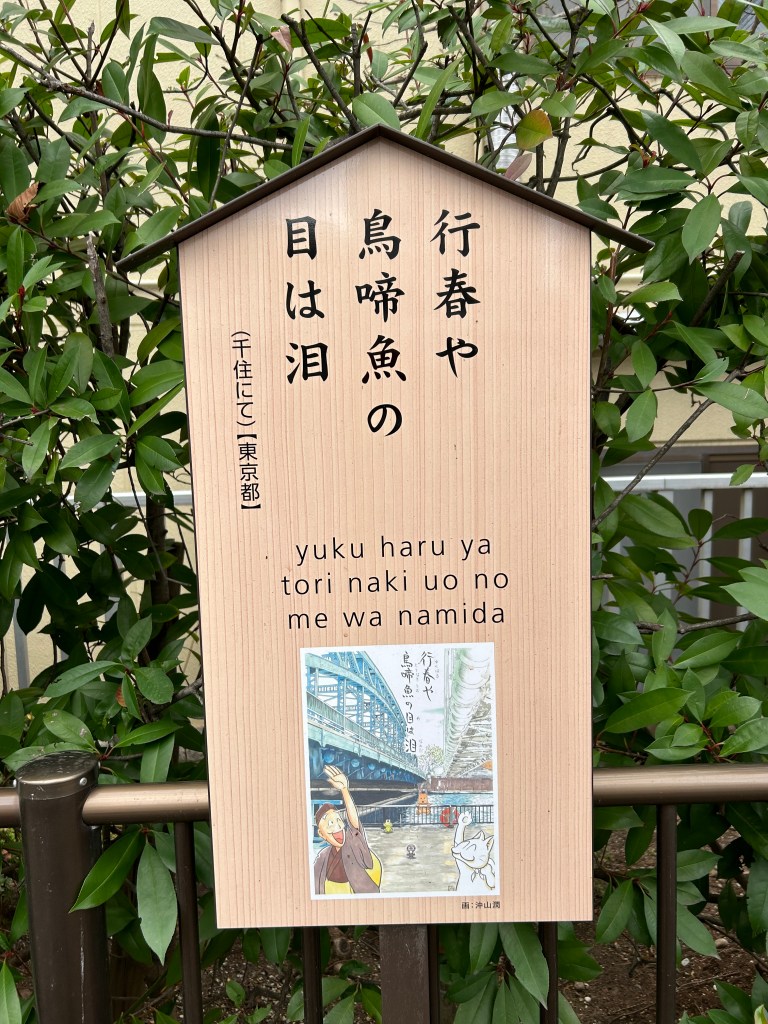
Along the pathway are plaques with Basho’s poems. There are 16 of them – I’ll show you one that is about spring, since that is the season we are in (yes, really by the old calendar….)

spring is leaving ..

birds sing and the eyes of fish

are full of tears

Not my translation… apparently it evokes the sadness of a final parting on a spring day. Which is not what the pictures shows, but let’s move on.

The whole walk goes for quite a way and we realized that the end point would leave us with a loooong walk back to the metro, so we cut our rambles short and wandered through a park before returning our starting metro station.

I’m glad to have found the walk and hope that Basho-sama will lend me some inspiration so I can do my homework!

Coffee with the hipsters

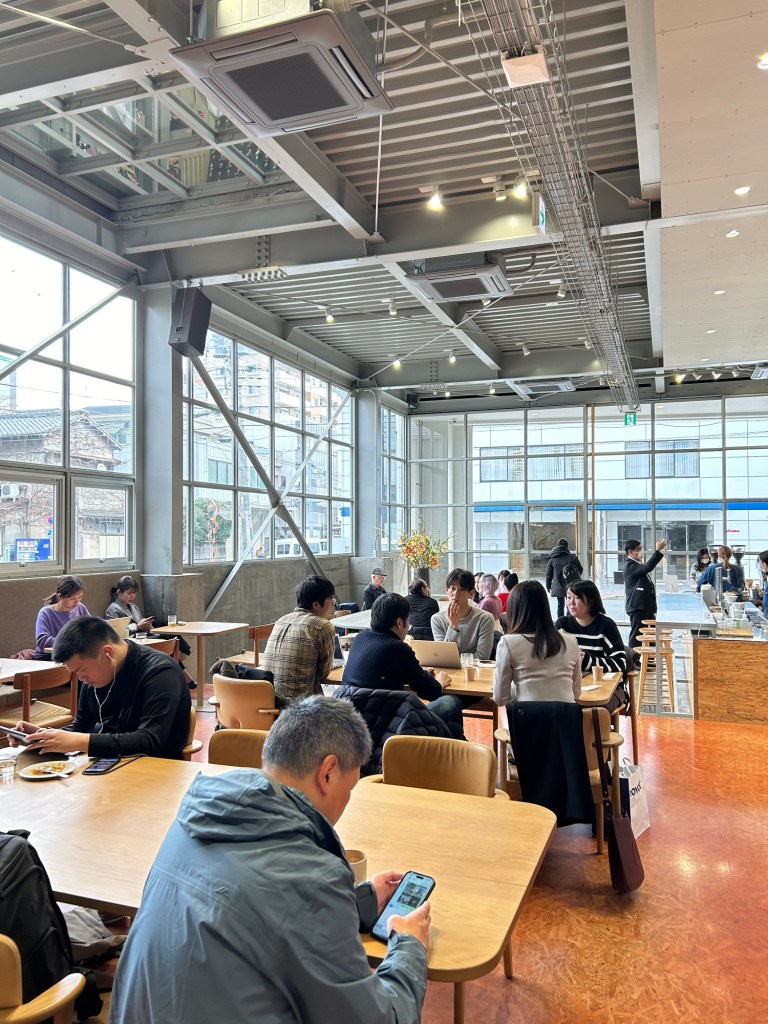
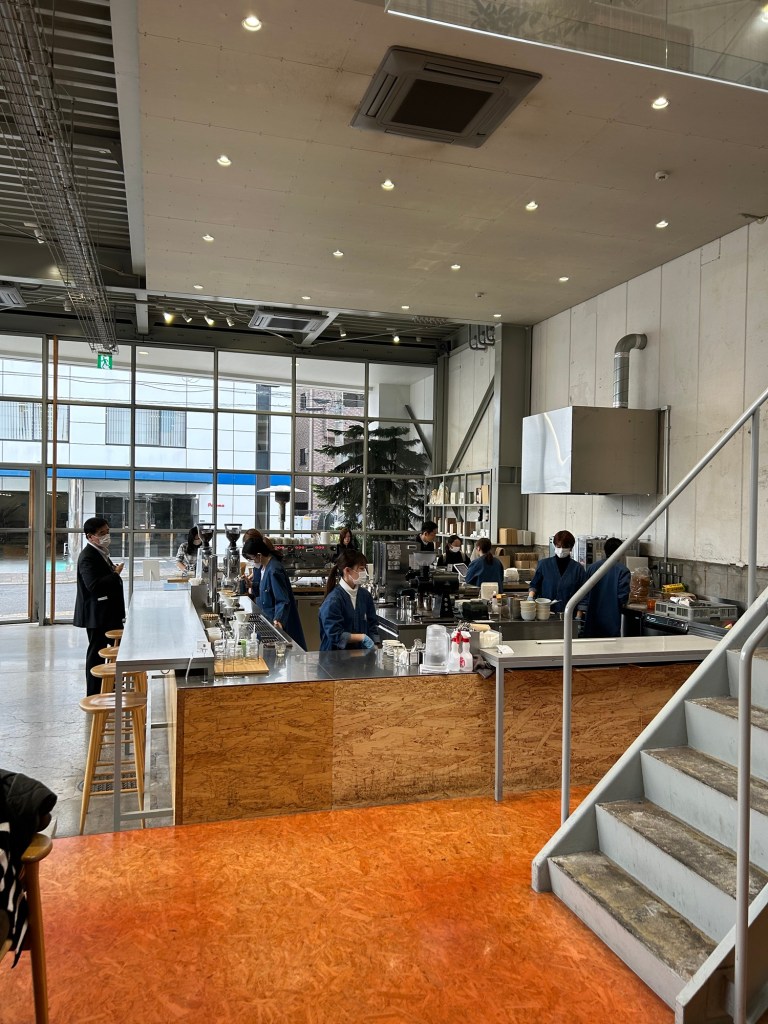
We are off this morning to find a walk by the river that honours the haiku poet Basho. On the way we stopped for a coffee at Blue Bottle coffee, a local coffee roastery and shop. It checks all the boxes for hipness – industrial space. Uber-cool young people. Dave Brubeck on the playlist.

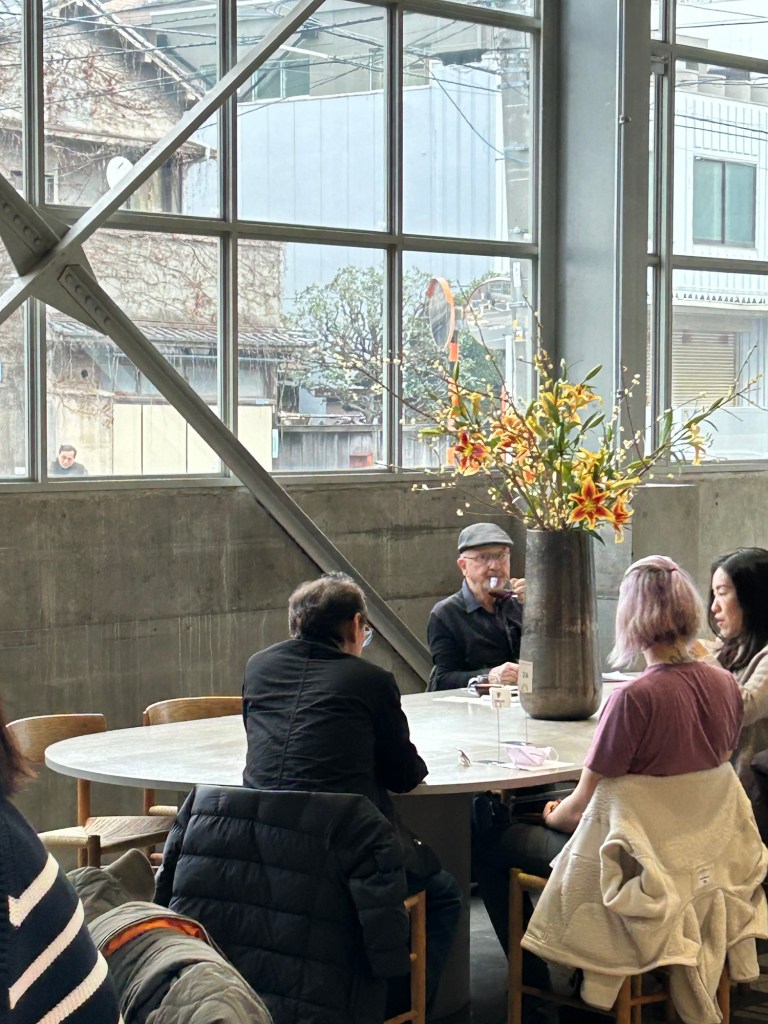
Shared tables.

Serious young people in serious lab coats seriously brewing coffee.

And one dude of a certain age enjoying a very good cup of coffee. I’d show you the delicious strawberry tart but we demolished it too quickly.

Is $25.00 for two coffees and a tart a lot? I don’t even know any more.

Refreshed, we are heading for the poetry walk.