Our last day in Aizuwakamatsu had us pay a visit to Iimoriyama, a hill that overlooks the city.
Our little excursion up the mountain took place after two days of rain, with an accumulation of over 80mm. The day dawned sunny and bright and we were enjoying the city in the sunshine. And then came a little blast of rain just as we arrived at Iimoriyama. We wound up in a deluge up there.
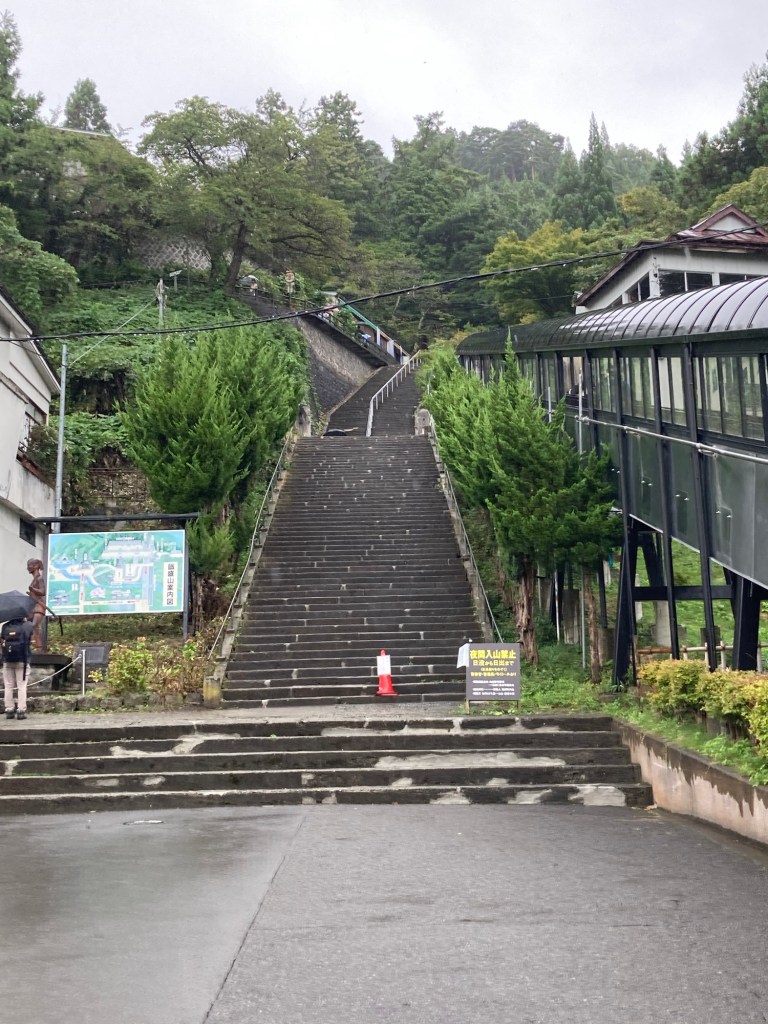
The Sazaedo Temple is a wooden structure built in 1796. As is so often the case one approaches it via an enormous staircase. Just as our hearts sank we looked to the right and there was a covered conveyor belt that would whisk us to the top!

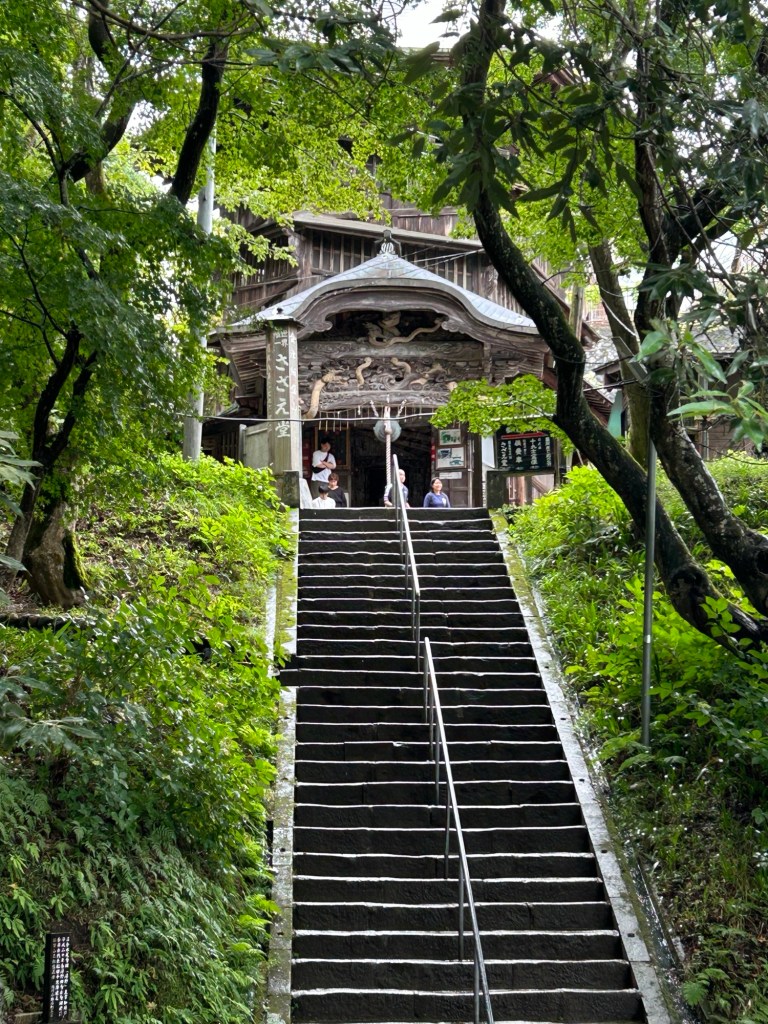
The building itself is quite unique. It is hexagonal in shape, and the interior staircase winds up in a double staircase. We walked up one spiral staircase and at the top crossed over a small bridge and then went back down another spiral staircase.

The other site on the mountain is tied to the battle that raged in 1868. In the pouring rain I didn’t wind up taking pictures, which I now regret as I’ve been thinking about the site a lot. But the story goes…
As the defenders of the shogunate prepared for their showdown with the imperial forces various battle groups were formed. In Aizu young samurai class men formed a group called the Byakkotai. They were 16 or 17 years old. A small group of them got separated from their unit on Iimoriyama, and when they looked out in the morning they could see flames in the town and assumed that the castle was burning, that the city had fallen. The unit of twenty boys committed suicide – 1 young man survived.
Unfortunately, they were wrong – the castle had not fallen. The town below the castle was on fire, but the defenders in the castle held out for a month before eventually succumbing. Many of the samurai and their families did commit suicide rather than surrender.
The Imperial government punished the town and the people of Aizu. The clan members were banished to the north. The castle was destroyed. The town’s name was changed from Aizu to Wakamatsu. More recently it was renamed Aizuwakamatsu. The remains of the Byakkotai lay unburied for a long time. Eventually they were buried up on the mountain.
As time passed they young men were lauded as true Samurais, following the code of the warriors. Movies and television programs have been made about them and the local museum has a big display about them.
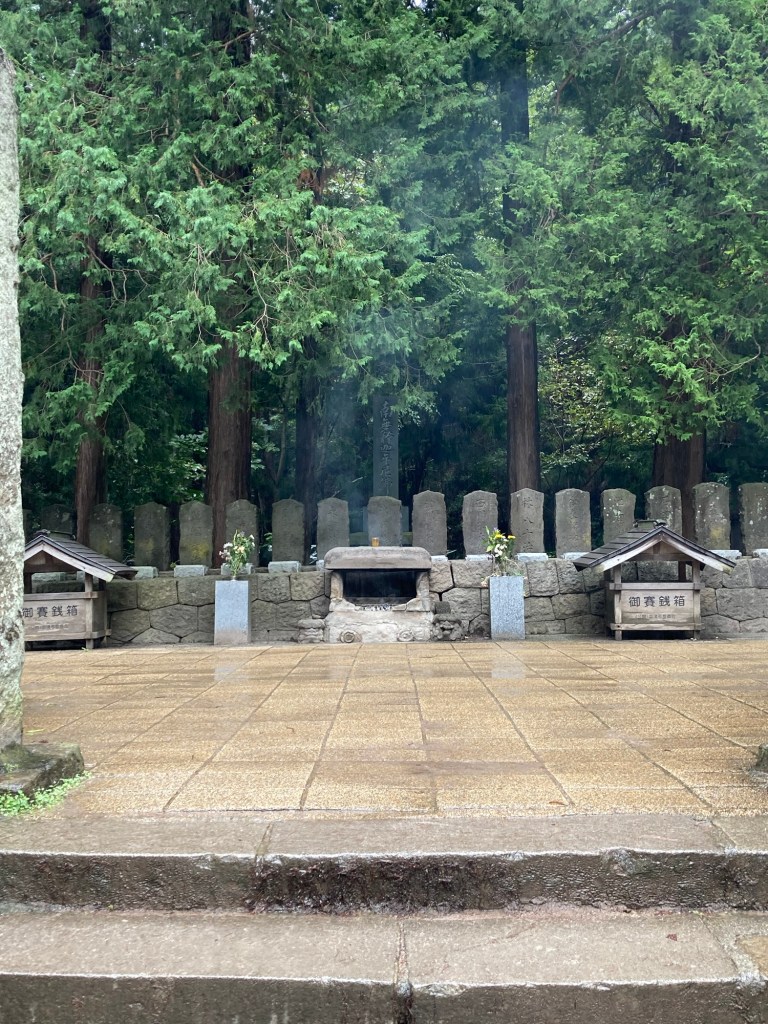
As we stood up there in the pouring rain, looking at the gravesite, where the graves are still tended and the incense still burns I got to thinking about the fact that Aizuwakamatsu, the samurai city, has built its brand, so to speak, on the glorification of the losing side of the battle.
Given the fascination that the samurais and samurai culture has in the modern world I suppose that should not be a surprise.
Walking along I came to a large pillar with a huge iron eagle on the top and as I was thinking that it looked like a very militaristic eagle I read the sign beside it. This is the Roman monument, donated by the people of Rome ‘in the year of the Lord, 1928., year of the fascist era, 6’’
Wait – what? A monument donated by Italian Fascists on a hill way in the back of beyond of Japan? Turns out a Japanese diplomat in Italy met Mussolini, and told Il Duce about the Byakkotai. He admired their fighting spirit and sent along the monument, inscribed in Italian with various bronze symbols, of which only the eagle remains.
I was astounded that the eagle – and the column – remain. Is this a part of history that people want to remember and claim? As I thought about it further I got to thinking about the American south – not a dissimilar path. The glorification of the dead on the losing side, the persistence of the symbols of that time.
History is complicated and never very far away from the present.

 Where I'm At